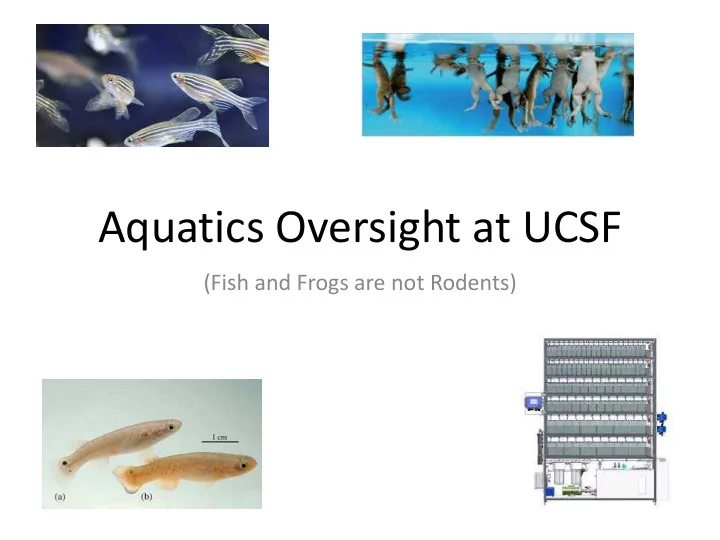
Aquatics Oversight at UCSF (Fish and Frogs are not Rodents) UCSF: - - PowerPoint PPT Presentation
Aquatics Oversight at UCSF (Fish and Frogs are not Rodents) UCSF: Current Aquatics Lab Care Zebrafish Xenopus tropicalis Mangrove Killifish LARC Care Xenopus laevis Axolotl Research Use of Aquatics at UCSF Xenopus laevis: Harvest of
UCSF: Current Aquatics
Lab Care
Zebrafish Xenopus tropicalis Mangrove Killifish
LARC Care
Xenopus laevis Axolotl
Research Use of Aquatics at UCSF
Xenopus laevis:
Harvest of oocytes as assay for ion channel expression experiments
Xenopus tropicalis:
Transgenic analysis to determine function of neurodevelopmental disorder-associated genes
Zebrafish:
Transgenic analysis of many disease processes – neuro, cardiopulmonary, toxicologic
Axolotl:
Characterization of neurotransmitter receptors and ion channels, electrosensory behavior observation
Regulations Covering Aquatics
- The Guide for the Care
and Use of Laboratory Animals
– AAALAC’s primary reference standard for accredited institutions in the U.S. – Current edition: expanded information
- n aquatic animal care
- NIH – OLAW
– Defines vertebrates “at hatching” – Includes larval amphibians and fish
- CA Fish and Wildlife
– Transgenic fish and frogs considered detrimental species and must be included on a permit
UCSF: Aquatics Policies and SOPs
- Policies:
– Zebrafish Inclusion in IACUC Protocols
- Based on OLAW definition
- f live vertebrate animals
“at hatching” => must be counted at 72hpf
– Zebrafish (Aquatics) Care Standards
- Based on the Guide
- Lab SOPs must include all
aspects
Schiwy et al 2014
UCSF: Aquatics Policies and SOPs
Aquatics
Zebrafish zygote collection and crossing Xenopus oocyte harvest (cat D) Fin clipping (cat D)
Rodents
Production of Genetically Modified Mice Tissue Collection for Genotyping
Lab Care of Aquatics
What are we aiming for?
- Demonstrate LARC and lab care of aquatics
consistent with centralized care of other animals on campus
– Husbandry and recordkeeping – Health care – SOPs – Emergency response – Housekeeping – Occupational Health and Safety
Husbandry and recordkeeping
- Housing/Husbandry:
– Check tank densities – Check sump tanks – Food in date – Live food managed
- Recordkeeping
– Feeding/Daily assessment – Water quality monitoring – Room temp/humidity – Mortality – Census: average daily
Health Care
- LARC Veterinary Staff
– Veterinarians and rodent/aquatics nurses – approx monthly visits to lab facilities – RVTs round aquatics under LARC care – If increased illness or mortality: contact veterinary staff, on call veterinarian
- Sentinel testing
– Per lab SOP or LARC veterinary advice – Health surveillance data for receiving institutions
- Surgery records
SOPs
- Should reflect what actually happens
- Updated version available in facility
- All users familiar with them, can answer
questions about them
- Most current uploaded to RIO as protocol
attachment
Emergency response
- Animals checked daily, water environment allows
for some leeway before parameters change to a dangerous level
- However:
– Know ER contacts - should be posted (and accurate) – Water parameter alerts are to reach main users - email or text – Users know how to communicate with Facilities - most aquatics rooms monitored through them
Housekeeping
- Clean shelves and floors
- Address corrosion
- Tank visibility, condition, clean tops, sanitization
schedule
- Check expiration dates, labels
- Food Storage
Occupational Health and Safety
- Are you enrolled in the Occupational Health
Program?
– Answer should be yes – Animal users on the protocol complete a MHS
- MS-222: stock solutions made in chemical
hood; chemical waste disposal of solutions
- Zoonoses: ehs.ucsf.edu/zebra-fish-zoonoses
Summary
- Aquatics animals are cool
- Aquatic animals are included in the UCSF
Animal Care and Use Program
- When you are in Aquatic animal facilities