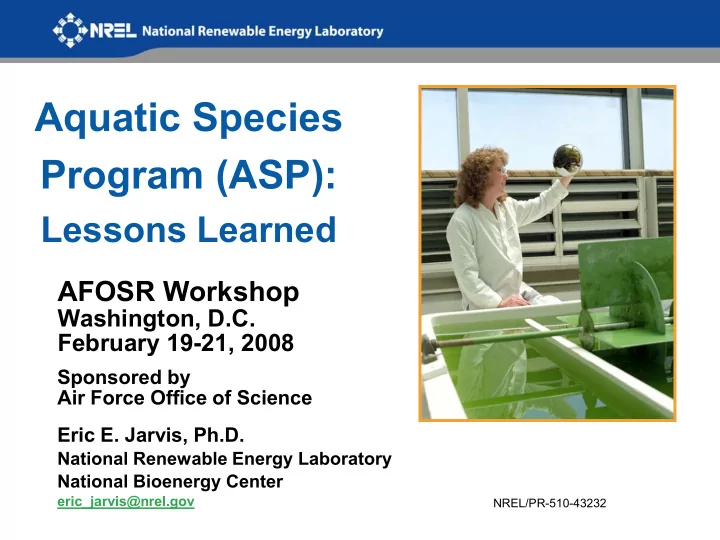
Aquatic Species Program (ASP): Lessons Learned AFOSR Workshop - - PowerPoint PPT Presentation

aquatic species program asp
SMART_READER_LITE
LIVE PREVIEW

Aquatic Species Program (ASP): Lessons Learned AFOSR Workshop - - PowerPoint PPT Presentation

Aquatic Species Program (ASP): Lessons Learned AFOSR Workshop Washington, D.C. February 19-21, 2008 Sponsored by Air Force Office of Science Eric E. Jarvis, Ph.D. National Renewable Energy Laboratory National Bioenergy Center


slide-1
SLIDE 1

Aquatic Species Program (ASP):

Lessons Learned

AFOSR Workshop

Washington, D.C. February 19-21, 2008

Sponsored by Air Force Office of Science Eric E. Jarvis, Ph.D.

National Renewable Energy Laboratory National Bioenergy Center

eric_jarvis@nrel.gov

NREL/PR-510-43232

slide-2
SLIDE 2

The ASP Didn’t Invent the Concept of Fuels from Algae…

  • Algae for methane (via anaerobic digestion)
  • Meier (1955); UC Berkeley 1957-59 (Oswald and

Golueke)

  • Wastewater use, recycling of CO2 and nutrients
  • Revival during Energy Crisis of 1970’s
  • Uziel et al. (1975); Benemann et al. (1976-80)
  • Still focused on methane and hydrogen
  • Energy Research and Development Administration

(ERDA)

  • Later DOE (SERI founded in 1977)
slide-3
SLIDE 3

…But the ASP Took the Concept to the Next Level

  • Supported work at SERI/NREL and through

dozens of subcontracts to universities and private companies

  • Focus turned to lipid oils, diesel replacements,

microalgae rather than other “aquatic species”

  • Algal hydrogen research moved to different program
  • Explored all aspects of the technology
slide-4
SLIDE 4

The ASP Funding Rollercoaster

  • ASP began

in 1978

  • Ended in

1996 to focus lean budgets

  • n bioethanol
  • Overall

investment ~$25M

slide-5
SLIDE 5

The ASP Chronology

slide-6
SLIDE 6

Program Justification

  • Lignocellulosic ethanol can’t for substitute for

energy-dense diesel (and aviation) fuels

  • FAME (biodiesel) was evolving as an option
  • Renewable oil sources insufficient to meet diesel

fuel demand

  • Algae offers alternative
  • Energy security concerns dominated at first,

later global climate change became important factor (flue gas CO2 capture)

slide-7
SLIDE 7

ASP Topic Areas

  • 1. Microalgae collection and screening
  • 2. Physiology, biochemistry, and genetic

engineering

  • 3. Process engineering
  • 4. Outdoor mass culture
  • 5. Analysis
slide-8
SLIDE 8

Microalgae Collection and Screening

  • >3000 strains of

microalgae collected over 7 years

  • Western,

northwestern, southeastern US and Hawaii

  • Most from

shallow, inland saline habitats

slide-9
SLIDE 9

Microalgae Collection and Screening…

  • Screened for tolerance

to salinity, pH, temperature

  • Screened for neutral

lipid production (Nile Red)

  • Media optimization
  • SERI Type I and II, etc.
  • Laboratory surrogates
slide-10
SLIDE 10

Microalgae Collection and Screening…

  • Collection narrowed to 300 most promising

strains (partly by attrition)

  • Primarily greens (Chlorophyceae) and diatoms

(Bacillariophyceae)

Amphora, Chaetoceros, Chlorella, Cyclotella, Monoraphidium, Nannochloris, Nannochloropsis, Navicula, Nitzschia, Phaeodactylum, Tetraselmis, Thalassiosira

  • Some made axenic
  • In 1996, remaining cultures transferred to the

Center for Marine Microbial Ecology and Diversity (CMMED) at U. Hawaii

  • About half the strains still available
slide-11
SLIDE 11

Microalgae Collection and Screening: Lessons Learned

  • Many microalgae can

accumulate neutral lipids

  • Diatoms and greens

most promising

  • No perfect strain for all

climates, water types

  • Serial transfer less than

ideal

slide-12
SLIDE 12

Physiology, Biochemistry, and Genetic Engineering

  • Studies on induction of

lipid accumulation response

–N or Si depletion

  • What are the

biochemical and genetic underpinnings

  • f photosynthate

partitioning?

–The “lipid trigger”

slide-13
SLIDE 13

Physiology, Biochemistry, and Genetic Engineering…

  • Cyclotella cryptica primary model organism for biochemistry
  • Identification of key enzymes in fatty acid and carbohydrate

(chrysolaminarin) pathways

–Acetyl CoA carboxylase (ACCase) activity increases upon Si depletion (Roessler 1988), enzyme characterized –UDP glucose pyrophosphorylase (UGPase) and chrysolaminarin synthase activities also charac- terized (Roessler 1987, 1988)

slide-14
SLIDE 14

Physiology, Biochemistry, and Genetic Engineering…

Genetic “toolbox” developed

  • Transient and stable marker systems
  • Effective methods of DNA introduction
  • Achieved genetic transformation of

diatoms C. cryptica and Navicula saprophila (Dunahay et al., 1995)

– Antibiotic resistance marker under control of ACCase gene promoter & terminator – Cell wall penetration via “biolistics” – Random chromosomal integration

slide-15
SLIDE 15

Physiology, Biochemistry, and Genetic Engineering…

Key genes isolated from C. cryptica

  • ACCase gene cloned (Roessler and Ohlrogge, 1993)

– First from photosynthetic organism

  • UGPase gene cloned (Jarvis and Roessler, 1999)

– Chimera with phosphoglucomutase (previous step in pathway)

Attempts at gene modulation

  • Successful ACCase overexpression (2-3x)
  • Successful UGPase overexpression, but not turn-

down

  • No effects seen on lipid accumulation in these early

experiments

slide-16
SLIDE 16

Physiology, Biochemistry, and Genetic Engineering: Lessons Learned

  • Choosing right starting species is critical
  • Lipid induction upon nutrient stress doesn’t

help productivity

  • Key enzymes change activity upon induction,

but no obvious “lipid trigger”

  • We have only begun to scratch the surface

–Need to understand pathways, regulation, devise genetic strategies

slide-17
SLIDE 17

Process Engineering

  • Explored methodologies for dewatering

algal suspensions and solvent extraction of

  • il
  • Tested transesterification of lipids to fuel

(no other methods, scale-up, fuel characterization, or engine testing of algal fuels)

  • Laboratory-scale experimentation, but not

major focus of project

slide-18
SLIDE 18

Process Engineering: Lessons Learned

  • The scale, energy input, and cost challenges make

dewatering and extraction significant hurdles

  • Flocculation/bioflocculation may be most promising

route for dewatering

  • Solvent extraction of oil through the cell wall is

feasible

  • Transesterification is straightforward, but many

challenges in making a quality fuel

  • There’s much more work to be done!
slide-19
SLIDE 19

Outdoor Mass Culture

Hawaii experiments (1980-87)

  • Patented “Algae Raceway Production

System” (ARPS)

  • 60 cm deep, 48 m2raceway with cover

California experiments (1981-86)

  • “High Rate Pond” (HRP) system (developed at UC Berkeley)
  • Four 200 m2, three 100 m2 open raceways, paddlewheel mixed
  • 15-30 cm deep
  • Many species tested, Amphora and Cyclotella did well

Israeli experiments (1984-86)

  • Multiple investigators, configurations, species, harvesting

methods

slide-20
SLIDE 20

Outdoor Mass Culture…

Roswell, NM facility (late 1980’s)

  • Subcontract to Microbial

Products, Inc. (Weissman et al.,

1989)

  • Based on the HRP design
  • Two 1,000 m2 raceway ponds,

15-25 cm deep

  • Cyclotella, Monoraphidium,

Amphora, Tetraselmis, etc.

slide-21
SLIDE 21

Outdoor Mass Culture: Lessons Learned

  • Important successes

–Typical productivities 15-25 g/m2/day biomass over productive months –Roswell gave occasional productivities approaching 50 g/m2/day (but closer to 10 g/m2/day overall) –NOTE: But not 50% lipid! –Long-term, stable cultivation achieved –CO2 utilization >90% with proper sump and pH control –Mixing energy low in paddlewheel systems

slide-22
SLIDE 22

Outdoor Mass Culture: Lessons Learned…

  • Issues identified

–Temperature affects productivity, culture collapse, invasion, grazers, nighttime respiration, O2 inhibition –Invasion by native microalgae species –Lab conditions ≠ outdoor culture conditions –Productivity ≠ persistence –O2 levels problematic –Hydraulics critical –Water loss (evaporation and percolation) –Low lipid contents

slide-23
SLIDE 23

Analysis

Resource assessments

  • Land suitability

– Insolation – Slope – Land use – etc.

  • Water (saline aquifers)
  • CO2 sources
  • Focus on US desert

southwest

slide-24
SLIDE 24

Analysis…

Life Cycle Analysis (LCA)

  • Small amount of LCA

done

  • Focus on co-combustion
  • f algae
  • Needs to be revisited
slide-25
SLIDE 25

Analysis…

Technoeconomics

  • Several different analyses over the course of the

program (Benemann and others)

  • Many assumptions and unknowns, differing conclusions
  • Most optimistic of analyses not competitive with 1996

petroleum costs

–Most recent analysis (Kadam 1995) estimated cost of unextracted lipid from $186/bbl (“current” case) to $59/bbl (optimistic “improved” case) with no CO2 credit –Petroleum at <$20/bbl in 1996 and “DOE expects petroleum costs to remain relatively flat over the next 20 years.”

slide-26
SLIDE 26

Analysis: Lessons Learned

  • Ample land, water, CO2 resources available in

Southwest for “several Quads” (30+ billion gallons?) of fuel per year

  • Economics are challenging

–Biological productivity largest influence on fuel cost –Capital costs huge factor –Unlined, open ponds only option –Land costs minor –CO2 cost and transport distance significant –Need to get value from residual biomass –Water, nutrient recycle

  • Significant R&D still required to reduce costs!
slide-27
SLIDE 27

What’s Changed Since 1996?

  • Oil prices didn’t stay flat
  • Increasing concern about CO2
  • New photobioreactor designs,

advances in material science

  • Explosion in biotechnology
  • Advances in metabolic

engineering

  • Genomics, proteomics,

metabolomics, bioinformatics, etc.

DOE Joint Genome Institute

slide-28
SLIDE 28

Accessing the Legacy of the ASP

  • Close-out report (Sheehan, et al. 1998)
  • http://govdocs.aquake.org/cgi/re

print/2004/915/9150010.pdf

  • Electronic documents
  • Ongoing effort at NREL to scan
  • ld ASP reports and make

publicly available

  • >100 electronic documents now

posted on the NREL Publications website

– http://www.nrel.gov/publications/ – Search “microalgae”

slide-29
SLIDE 29

Conclusions

  • The ASP has provided a solid foundation

for fuels-from-algae research

  • Sheehan et al. presaged the current

revival in this field:

… this report should be seen not as an ending, but as a beginning. When the time is right, we fully expect to see renewed interest in algae as a source of fuels and other chemicals. The highlights presented here should serve as a foundation for these future efforts.