SLIDE 1 International Journal of English Learning and Teaching Skills; Vol. 1, No. 4; ISSN : 2639-7412 (Print) ISSN : 2638-5546 (Online)
290
APPLICATION OF POWERPOINT PRESENTATION IN ENGLISH LANGUAGE LEARNING AND PEDAGOGY: ITS EFFICACIES AND PRACTICAL IMPLICATIONS IN CLASSROOM INSTRUCTION
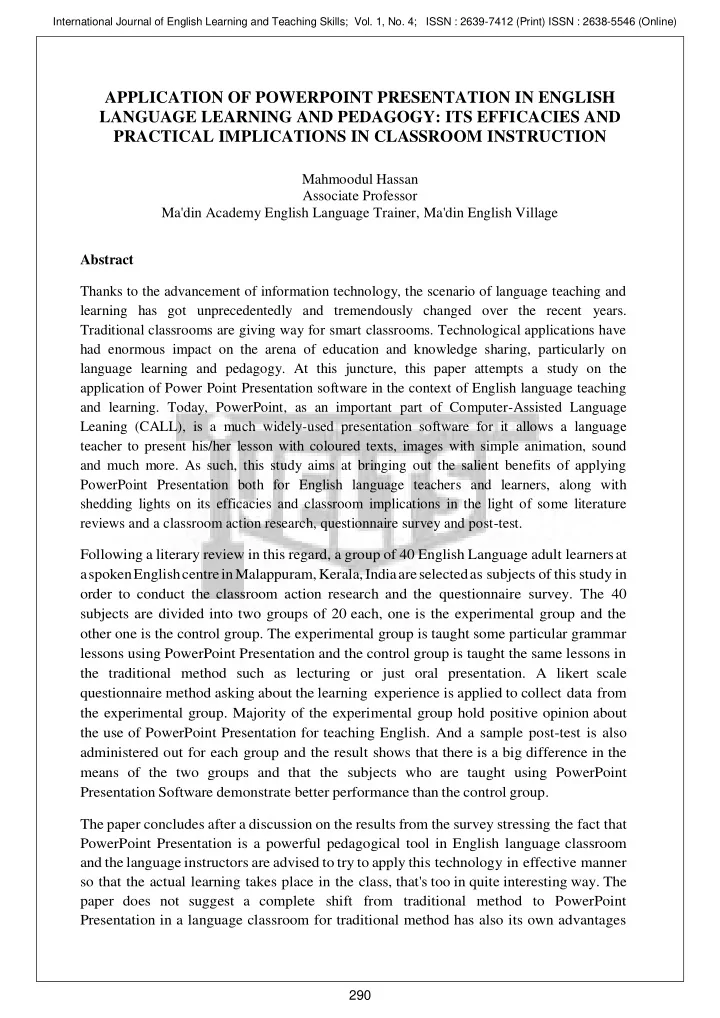
Mahmoodul Hassan Associate Professor Ma'din Academy English Language Trainer, Ma'din English Village Abstract Thanks to the advancement of information technology, the scenario of language teaching and learning has got unprecedentedly and tremendously changed over the recent years. Traditional classrooms are giving way for smart classrooms. Technological applications have had enormous impact on the arena of education and knowledge sharing, particularly on language learning and pedagogy. At this juncture, this paper attempts a study on the application of Power Point Presentation software in the context of English language teaching and learning. Today, PowerPoint, as an important part of Computer-Assisted Language Leaning (CALL), is a much widely-used presentation software for it allows a language teacher to present his/her lesson with coloured texts, images with simple animation, sound and much more. As such, this study aims at bringing out the salient benefits of applying PowerPoint Presentation both for English language teachers and learners, along with shedding lights on its efficacies and classroom implications in the light of some literature reviews and a classroom action research, questionnaire survey and post-test. Following a literary review in this regard, a group of 40 English Language adult learners at a spoken English centre in Malappuram, Kerala, India are selected as subjects of this study in
- rder to conduct the classroom action research and the questionnaire survey. The 40
subjects are divided into two groups of 20 each, one is the experimental group and the
- ther one is the control group. The experimental group is taught some particular grammar
lessons using PowerPoint Presentation and the control group is taught the same lessons in the traditional method such as lecturing or just oral presentation. A likert scale questionnaire method asking about the learning experience is applied to collect data from the experimental group. Majority of the experimental group hold positive opinion about the use of PowerPoint Presentation for teaching English. And a sample post-test is also administered out for each group and the result shows that there is a big difference in the means of the two groups and that the subjects who are taught using PowerPoint Presentation Software demonstrate better performance than the control group. The paper concludes after a discussion on the results from the survey stressing the fact that PowerPoint Presentation is a powerful pedagogical tool in English language classroom and the language instructors are advised to try to apply this technology in effective manner so that the actual learning takes place in the class, that's too in quite interesting way. The paper does not suggest a complete shift from traditional method to PowerPoint Presentation in a language classroom for traditional method has also its own advantages
SLIDE 2
International Journal of English Learning and Teaching Skills; Vol. 1, No. 4; ISSN : 2639-7412 (Print) ISSN : 2638-5546 (Online)
291
and benefits as first Indian Prime Minister Jawahar Lal Nehru rightly said: "Change is essential but Continuity is also necessary" (Synthesis is Our Tradition, 1959) Keywords: Technology, PowerPoint, Pedagogical, Classroom, Innovative, Efficacy Introduction “Any sufficiently advanced technology is equivalent to magic” – Arthur C. Clarke (Author) Advancement in Information and Communications Technology has brought about drastic changes in the arena of language learning and pedagogy. This advancement has not only smoothed the path to educate more effectively but allowed us to shift the paradigms of traditional pedagogical practices with modern technologies. As a result, private and public educational institutions are vying with one another to digitalize their classrooms so as to enhance teaching and learning as well as to enthuse the stakeholders as whole. And thus, technology plays a significant role in today’s language classrooms as well. Teachers incorporate varied forms of technology to support their teaching and engage learners in the learning process. As for English language teaching and learning, technology is indeed an effective tool that can support and transform language teaching and learning in many ways, ranging from making it easier for teachers to prepare instructional materials to enabling innovative methods both for teachers and learners in order that it builds up and fosters teaching and learning atmosphere in quite fruitful and productive manner. Moreover, the application of technology can inculcate considerable interest in learners by adding variety and innovation to the classroom. “There is a great value in incorporating new technologies not as a bolt on or reward, but as an integral part of the teaching and learning process. This allows the learners to foster the four C’s; Communication, Creativity, Collaboration and Critical Thinking” (Joe Dale, 2014 May,The Guardian). So, this study attempts to show the efficacies of applying PowerPoint Presentation software, as an example technology tool, in the context of English language teaching and learning. Microsoft PowerPoint is a kind of presentation software created by Robert Gaskins and Dennis Austin in 1984 for the American software company Forethought, Inc., initially named Presenter, was released for the Apple Macintosh in 1987 and was acquired by Microsoft in July of the same year (Encyclopaedia Britannica, November 25, 2013). Though PowerPoint was initially developed for business use such as giving reports at meetings and presentations to clients but has got wide acceptance today as a key professional pedagogical device for improving teaching and learning both for teachers and students. Today, PowerPoint, as an important part of Computer-Assisted Language Learning (CALL), is a much widely applied presentation software in English language classrooms as well for it allows a teacher to present his/her lessons with coloured texts, images with simple animations, audio-visual supports and much more. PowerPoint presentation appeal learners’ diverse learning styles, such as visual, auditory, kinesthetic, and creative by employing multimedia methods such as sounds, colour, images, action, design and so on (Abraham Oommen, 2012). Conforming to those already conducted studies and researches in applying this technology for English language teaching,
SLIDE 3 International Journal of English Learning and Teaching Skills; Vol. 1, No. 4; ISSN : 2639-7412 (Print) ISSN : 2638-5546 (Online)
292
this research paper mainly addresses two questions:
- a. How far does the application of PowerPoint Presentation become effective in
English language teaching and learning?
- b. How do learners respond to the use of PowerPoint in English language classroom?
Review of the Literature There has been a number of researches carried out to investigate the effectiveness and benefits of using PowerPoint Presentation technology in pedagogical contexts. Many researchers have discussed both the pros and cons of the application of PowerPoint presentations in language classrooms. Some researchers have explored the teachers’ skill
- f using PowerPoint presentation software for language teaching as well.
Segundo and Salazar (2011) in their research paper hold the view that PowerPoint is a complete presentation program that allows teachers to produce professional-looking presentations in EFL classrooms. Szaboa and Hastings (2000) hold that PowerPoint based classroom instruction helps learners focus attention and reduce distraction and find that learners want PowerPoint presentation to be adopted in English language classroom
- instruction. Brock and Joglekar (2011) in “Empowering PowerPoint: Slides and Teaching
Effectiveness” have examined the linkage between PowerPoint and learners’ levels of classroom engagement and explored the pedagogical efficacy of this presentation
- software. A recent study by Zouar Abdellatif at Cardiff Metropolitan University,
Morocco (2015) has sought the impact of PowerPoint in enhancing learners’ participation in EFL classroom and found that the learners’ level of participation augmented when PowerPoint is applied. A research conducted by Ozaslan and Maden (2013) on the use of PowerPoint presentation in the department of foreign language education at Middle East Technical University concluded in their study that learners learned better if the course material was presented through some visual tools. And they also found that teachers themselves believed that PowerPoint presentations made the lesson more appealing, thereby helping them to draw the students’ attention to the class. The findings of Corbeil’s research (2007) shows that the learners who are exposed to PowerPoint presentations prefer them over the traditional textbook presentations and that they are learning better when their attention is captured through highlighting, colour, different fonts, images, animations and visual effects. Researchers have analyzed various ways in which PowerPoint can be applied in an ESL or EFL classroom. English language teachers can deliver PowerPoint-based presentations for attracting and motivating learners towards the new lesson or topic to be taught, for initial teaching introducing new lesson or topic, for providing practice and drilling in grammar and pronunciation, for reviewing the topics or ideas which have already been taught, for testing the learners’ understanding the lesson through quizzes or games displayed in presentation slides and for integrating all these aspects into one single presentation (Fisher, 2003).
SLIDE 4 International Journal of English Learning and Teaching Skills; Vol. 1, No. 4; ISSN : 2639-7412 (Print) ISSN : 2638-5546 (Online)
293
In a communicative English classroom, the learners need to be well trained in all the five language skills Listening, Speaking, Reading, Writing and Grammaring (LSRW&G) – Grammaring is the ability to use grammatical structures accurately, meaningfully and appropriately, which is considered the fifth skill alongside LSRW as claimed by Larsen- Freeman (2001). A teacher can integrate all these language skills in his or her one single presentation itself by means of PowerPoint presentation. Some Key Benefits of PowerPoint Presentation (PPT) PPT allows teacher to import graphics, audios, videos, and links to simulations
- r web pages, thereby creating an enriching learning atmosphere.
Teachers can have face to face communication with learners in contrary to the traditional blackboard teaching method where the teachers often face the chalkboard with their back to the class while writing on the board (Lanius, 2004). PowerPoint can be used as a multimedia and interactive tool as well. Pictures, animations, music and sound effects can greatly enhance the presentation quality (Miltenoff, 2003). Teachers can integrate PPT to all stages of delivering a lesson or topic – Preparation, Presentation, Practice and Production. Teachers can integrate all the language skills in one single PPT itself. Teachers can modify their PPT lessons and use them over and over again for
Instructors can save time on distributing instructional materials as handouts, writing on blackboard or whiteboard and so on. Purpose of the Study Researchers, Educators and computer technology experts have perceived that the application of PowerPoint presentation can augment the efficiency of English language
- teaching. As such, the purpose of this study is to decide whether this study actually
conforms to this concept or not; and the author being an occasional user of PPT in classroom, the study aims at bringing out the positive effects and benefits of applying this technology in English language classroom. Significance of the Study In spite of a number of researches conducted in pursuit of the effectiveness of PowerPoint presentation in English language classroom, the author here attempts such a study but in a different context, that is, in a Spoken English classroom of a language learning centre which is solely set up for adult learners who stay just 18 days at the centre and get back home after acquiring sufficient improvement in English communication. A study on the
SLIDE 5 International Journal of English Learning and Teaching Skills; Vol. 1, No. 4; ISSN : 2639-7412 (Print) ISSN : 2638-5546 (Online)
294
efficacy of PPT in such a learning atmosphere seems to be less researched. And the author also believes that the present study would considerably contribute to the earlier findings
- f researchers and academicians in this regard and to the practicality of using PowerPoint
in spoken English classes as well. Method of the Study Towards addressing the key questions of the study and accomplishing its objectives, a classroom action research followed by a likert scale questionnaire survey was conducted. Participants and the Procedure: The participants of the study were one team of 40 adult learners between 20-35 years of ages, at Ma’din English Village, a residential learning centre for Spoken English at Malappuram district, Kerala, India. The 40 member team was divided into two separate groups of 20 learners each, one is the experimental group and the other one is the control
- group. The experimental group was taught particular grammar lessons (Present Perfect
Tense, Future Continuous Tense and Prepositions) for three sessions (each session is of 90 minutes) using PowerPoint presentation software; and the control group was taught the same lessons in traditional conventional method through lecturing, handing out the instructional materials, writing on the whiteboard, etc. Following this, a questionnaire of ten statements based on a five-point likert scale ranging from 1 (strongly disagree) to 5 (strongly agree) was administered to the experimental group in order to understand the learners' perceptions about the efficacy of using PPT in a spoken English classroom. A post- teaching test after completing all the three sessions was also conducted for both the experimental group and the control group in order to assess the performances of the learners in each group and to confirm the positive impact of PowerPoint in English Language classroom in comparison with the conventional oral lecturing method, with teacher writing on the whiteboard using a marker pen. Result of the Survey The questionnaire survey based on five-point likert scale was administered to find out the participants' feelings and perceptions about the efficay of PowerPoint Presentation in a Spoken English classroom in terms of interest, concentration, helpfulness, curiosity, enthusiasm, preference and so on. The participants' responses are rated in accordance with the following the scale - Strongly Disagree (SD), Disagree (D), Neutral (N), Agree (A) and Strongly Agree (SA). The survey result clearly depict that most of the learners very positively responded about the efficacy of PowerPoit in English classroom and liked the lessons with PPT than the traditional lecturing method. All the participants felt that PPT is more beneficial for English learning. Majority of the participants found the lessons with PPT very interesting and enthusiastic helping them understanding the language elements better and they agreed that the pictures, sounds, animations made the class more lively. No one prefers lessons without PPT, instead, they prefer and recommend PPT use in English Language classroom
- instruction. The results are gisted out in the Table 1
below. Table - 1 (Total Number of Participants: 20)
SLIDE 6 International Journal of English Learning and Teaching Skills; Vol. 1, No. 4; ISSN : 2639-7412 (Print) ISSN : 2638-5546 (Online)
295
Questions Strongly Disagree (1) Disagree (2) Neutral (3) Agree (4) Strongly Agree (5) Means
PPT was very intersting 3 8 9 4.3
concentrate throughout the class 1 9 10 4.45
understand the language elements better. 2 4 14 4.6
curiosity to learn more 1 6 13 4.55
beneficial for English learning. 3 17 4.85
practice the grammar lessons very enthusiastically. 1 2 7 10 4.3
and animations made the class lively. 1 10 9 4.4
without PowerPoint. 14 5 1 1.35
with PowerPoint. 1 7 12 4.55
PPT in English Language classroom. 1 8 11 4.5 Result of the Post-teaching Test The Post-teaching Test administered on both the experimental and the control groups shows that the learners who were taught with PowerPoint demonstrated better performance than the learners who were taught in traditional oral presentation with the teacher writing on the whiteboard with marker pens. The result is depicted in Table 2 (i) & (ii) below.
SLIDE 7 International Journal of English Learning and Teaching Skills; Vol. 1, No. 4; ISSN : 2639-7412 (Print) ISSN : 2638-5546 (Online)
296
Table - 2 (i): It represents the result of the learners who were taught with PowerPoint presentation. Grades Attained
A B C D
E
Marks Scored Above 90 80 - 89 70 - 79 60 - 69 Below 60 No.of learners 5 9 4 1 1 Table - 2 (ii): It represents the result of the learners who were taught in traditional oral presentation mode with teacher using the whiteboard and marker pen. Grades A
B C D E
Attained Marks
Scored Above 90 80 - 89 70 - 79 60 - 69 Below 60
No.of learners 2 5 8 2 3 From the Post-teaching Test results, it is very conspicuous that the learners who were taught with PowerPoint outperformed the learners who were taught in conventional method of whiteboard and marker pen. Conclusion It is very clear from the study results that the application of PowerPoint in English Language classroom instruction will facilitate the teaching and learning of English in productive manner and that PowerPoint can play as an effective pedagigical technology tool in English language classroom. Both teachers and students alike can reap its benefits. But the language instructors need to prepare their PPT lessons very appropriately keeping in mind that it meets the learner- requirements helping them improve all the important language
- skills. Hence, this study suggests the language instructors to try to apply this technology
in effective manner so that the actual learning takes place in the class, that's too in quite interesting way. The paper does not suggest a complete shift from traditional method to PowerPoint Presentation in a language classroom since traditional method has also its own advantages and benefits as first Indian Prime Minister Jawahar Lal Nehru rightly said: "Change is essential but Continuity is also necessary" (Synthesis is Our Tradition, 1959)
SLIDE 8 International Journal of English Learning and Teaching Skills; Vol. 1, No. 4; ISSN : 2639-7412 (Print) ISSN : 2638-5546 (Online)
297
References: Dale, Joe. (2014). Teaching languages with technology: tools that help students become fluent, The Guardian, May 2014. Britannica, Encyclopaedia (November 25, 2013). Microsoft PowerPoint Software, written by its editors.
- Oommen. Abraham (2012). Teaching English as a global language in smart classrooms with
PowerPoint presentation. Segundo & Salazar (2011). The efficacy of using PowerPoint presentations to improve grammar and vocabulary among students of the Intermediate II level Brock & Joglekar (2011). Empowering PowerPoint: Slides and Teaching Effectiveness. Szaboa, A., & Hastings, N. (2000). Using IT in the undergraduate classroom: Should we replace the blackboard with PowerPoint? Ozaslan, E. N., & Maden, Z. (2013). The use of PowerPoint presentations at in the department of foreign language education at middleeast technical university. Middle Eastern & African Journal of Educational Research, Issue 2 Corbeil, G. (2007). Can PowerPoint Presentations Effectively Replace Textbooks and Blackboards for Teaching Grammar? Do Learners Find Them an Effective Learning Tool? Lanius, C. (2004). Points of View: PowerPoint in the Classroom: PowerPoint, Not Your Grandmother's Presentations, but Is it Evil? Larsen-Freeman, D. (2001). Teaching Language: From Grammar to Grammaring. Nehru, Jawaharlal (1959). Synthesis is Our Tradition. From India Today and Tomorrow, Azad Memorial Lectures, New Delhi (February 1959).