
SLIDE 1
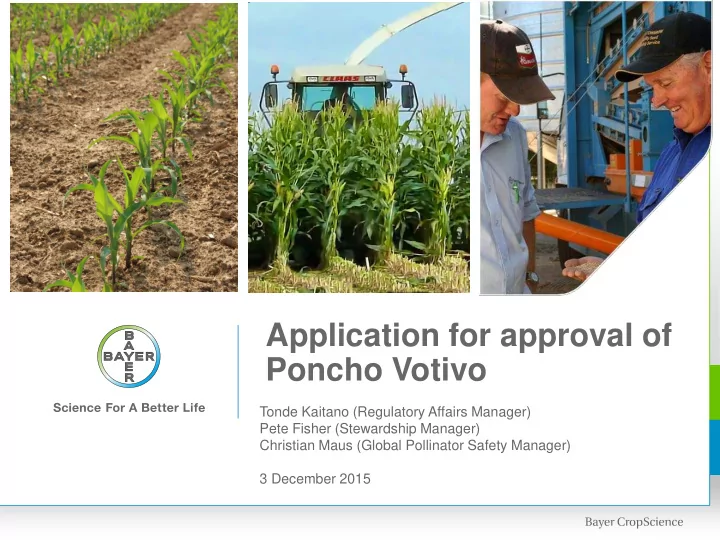
Application for approval of Poncho Votivo
Tonde Kaitano (Regulatory Affairs Manager) Pete Fisher (Stewardship Manager) Christian Maus (Global Pollinator Safety Manager) 3 December 2015
Application for approval of Poncho Votivo Tonde Kaitano (Regulatory - - PowerPoint PPT Presentation
Application for approval of Poncho Votivo Tonde Kaitano (Regulatory Affairs Manager) Pete Fisher (Stewardship Manager) Christian Maus (Global Pollinator Safety Manager) 3 December 2015 Agenda 1. Who we are; 2. How we develop Crop Protection
Tonde Kaitano (Regulatory Affairs Manager) Pete Fisher (Stewardship Manager) Christian Maus (Global Pollinator Safety Manager) 3 December 2015
Source: Oerke et al., Crop Production and Crop Protection, Elsevier, Amsterdam, 1994
Yield without crop protection Actual yield with crop protection Theoretically attainable yield
Nearly half of the current harvest would be lost without crop protection Through innovation and adequate use of crop protection solutions, total yield could be almost doubled Bayer passionate about this
Actual losses
30% 100%
Prevented losses
Today 58%
By pests, weeds and diseases Due to pests, weeds and diseases 28% 42%
Major crops analyzed: rice, wheat, barley, corn, potatoes, soybeans, cotton, coffee
2 3 4 5 6 7 8 1
Synthesis Process development Formulation / Packaging Pilot plant production
Chemistry Biology Toxicology Environment
Laboratory / Greenhouse Profiling & positioning trials Efficacy trials for Registration Acute, sub-chronic, chronic toxicity mutagenicity, carcinogenicity, teratogenicity, reproduction Algae, daphnia, fish, birds, microorganisms, bees, non-target organisms Plants, animals, soil, water Soil, water, plants, animals , air
Year
Submission ~NZ$ 500m
9
Synthesis optimisation
Active ingredient Formulation Mammals Ecosystems Research Development Metabolism Residues
Leads >>50,000 500
3 10 2 1 Launch
Poncho
(CTD 600 g/l)
CTD = clothianidin, a neonicotinoid first registered in NZ 06/06/2003
+ BFi
7.24x10¹⁰ CFU/L
Poncho Votivo (508
g/l CTD + 7.24x10¹⁰ CFU/l BFi)
Application submitted 2014
BFi = Bacillus firmus; naturally
Public submissions Hearing
3 December 2015
We welcome the
concerns raised by submitters
Consideration and decision Overseas Approvals – CTD: Australia; North America; EU (with restrictions); Japan, RSA, etc. Overseas Approvals – BFi: North America; EU, RSA etc
Variation: focus on maize and sweetcorn only Crops: maize, sweetcorn, cereals, forage brassicas & grass seed
AGCARM and NZGSTA Stewardship Guides
Argentine stem weevil (ASW) Black beetle Plant-parasitic nematodes Greasy cutworm Targets
Letter form Foundation For Arable Research underscores importance
CONTACT EFFECT AGAINST SOIL PESTS CONTROL OF SOIL PESTS CONTROL OF FOLIAR PESTS
Bacteria Plant sugars Bacterial enzymes Nematode eggs Bacterial phytohormones Maize plant Bacterial film Root Nematodes
Operator and bystander exposure? Exposure of non-target
generated dust? Bee exposure via pollen? Exposure of non-target
soil and water? Poncho Votivo hads a high level of safety for people and the environment when used in accordance with label instructions
CTD seed treatments safely used in NZ since 2003 Varroa mite discovered 2000 Managed hives increased by 80% as
Feral honey bees wiped out Honey bees also thriving in Australia, despite neonics use
250,000 300,000 350,000 400,000 450,000 500,000 550,000 10,000 20,000 30,000 40,000 50,000 60,000 70,000 80,000
2000 2001 2002 2003 2004 2005 2006 2007 2008 2009(J)* 2010(J) 2011(J) 2012(J) 2013 (F)2014 (F)2015 (F)
NZ Totals – Number of Registered Beekeepers, Apiaries and Beehives 2000-2015
Beekeepers Apiaries Hives
Source: The New Zealand Beekeeper: April 2014, Volume 22, No.3. 2015 data National Pest Management Strategy afb.org.nz Stats as at: J-June, F- February
Hives Beekeepers and Apiaries
Low mammalian toxicity Dust-off risk negligible – film coating and fluency agents Field studies: pollen exposure negligible Traces of clothianidin in the environment do not represent risk Overall, Poncho Votivo is safe for people and the environment when used in accordance with label instructions
Controls under HSNO Act and product stewardship further reduce risk
Nematodes attack plant roots:
Foliar treatment with chlorpyrifos In-furrow treatment with phorate granules Seed treatment with clothianidin
Treatment of whole area
Yield up to 48% > untreated
Alternatives are more toxic, have limited spectrum and effectiveness, and may require up to 6 weeks fallow
Example Product & Approval No. Application type HSNO classification Active ingredient Class
g/ha Poncho Votivo Seed treatment 6.1D, 6.3B, 6.4A, 6.5B, 6.9B, 9.1A, 9.2B, 9.3B, 9.4A 508 g/L CTD, 102 g/L BFI Biologic + neonic 90 CTD, 1.3 x 10¹⁰ cfu BFI Furakote EW HSR000943 Seed treatment 6.1B, 6.3B, 6.4A, 6.5B, 6.9A, 9.2B, 9.3A, 9.4A 400 g/L furathiocarb Carbamate 300 Counter 20G HSR000216 Soil application 6.1A, 6.8B, 6.9A, 8.2C, 8.3A, 9.1A, 9.3A, 9.4C 200 g/kg terbufos OP 1,500 Phorate 20 G HSR000210 Band application at sowing 6.1A, 6.8B, 6.9A, 9.2B, 9.3A, 9.4B 200 g/kg phorate OP 2,000 Grub Buster Diazinon HSR100878 Foliar (boom & aerial) 3.1D, 6.1D, 6.3B, 6.4A, 6.8B, 6.9A, 9.1A, 9.2D, 9.3A, 9.4A 800 g/L diazinon OP 2,400 Chlorpyrifos 500EC HSR000224 Foliar (boom & aerial) 3.1D, 6.1C, 6.3B, 6.4A, 6.8B, 6.9A, 9.1A, 9.2B, 9.3A, 9.4A 500 g/L chlorpyrifos OP 625 Metafort 60SL HSR000226 Foliar (boom & aerial) 3.1D, 6.1B, 8.2C, 8.3A, 6.9A, 9.1A, 9.2B, 9.3A, 9.4A 600 g/L methamidophos OP 600 Dominex 100 HSR000293 Foliar spray 3.1D, 6.1D, 6.3B, 6.9B, 9.1A, 9.3B, 9.4A 100 g/L α- cypermethrin SP 20 AGPRO Lambda cyhalothrin HSR100578 Foliar spray 6.1B, 6.3B, 6.4A, 6.9A, 9.1A, 9.3B, 9.4A 250 g/L - cyhalothrin SP 10
tests with a realistic or near-realistic design where bees are tested in the context of their entire colony (e.g. tunnel, field); results more significant for risk assessment than laboratory data
residue levels in nectar/pollen (direct treatment and succeeding crop scenarios)
crops lower or at maximum as high as in directly treated crops
μg/kg
crops are between 1 and 5 µg/kg
conditions
Three-year multi-location field study in France
Study to address chronic exposure of bees to systemic residues of clothianidin resulting from seed treatment in maize pollen at four field sites in France with control vs. treatment. No treatment-related effects detected, control and treatment colonies essentially performed equally well, including overwintering success
Field monitoring study in Southwestern Germany
Five monitoring locations, three with bee hives. Colony health and development was followed up and monitored during and after flowering including over-wintering assessment. Residue analysis of corn pollen from treated corn on 50 fields at 5 different locations and pollen samples from pollen traps at beehives next to the fields During and after the exposure phase, including overwintering, no adverse treatment-related effects were observed
Numerous studies have been published that describe sublethal effects caused by Neonicotinoids Some points to consider:
laboratory exposure, forced feeding, no-choice exposure, or otherwise exaggerated exposure concentrations
control group has been defined as a sublethal effect - relevance for individual (or population) vitality? Not every sublethal effect is necessarily an adverse effect
intense research, still nobody has been able to show any damage on colony level caused by sublethal effects of clothianidin and other neonicotinoids in a realistic exposure scenario.
by compounds other than neonicotinoids
insecticidal dust from the coating may be abraded, especially when the coating is of poor quality
when vacuum-pneumatic drilling machines of certain types are used
improper seed treatment led to dust emission and bee damage
major technical improvements have been made to minimize dust emission
machinery, and handling / stewardship for treated seeds
neonicotinoid treated seed
natural botanical phenomenon
attractive to bees as carbohydrate source
contain high substance concentrations
colonies and as route of exposure to neonicotinoids, numerous and extensive field studies have been conducted
significant importance for bee colonies
guttation water, damage to exposed bee colonies was never observed
treated crops does not constitute a significant risk to bee colonies
Reasons for unfavorable risk conclusion:
unvalidated criteria were applied
relevant field conditions were not considered for risk conclusions
all over Europe were omitted
implemented over the last 5 years were not considered We believe that the EFSA reports do not alter the quality and validity of the existing risk assessments and the underlying data of
European Food Safety Authority (EFSA) published reports on the risks of three neonicotinoids1 to bees (seed treatment and granular products only) on Jan 16th, 2013:
uses
no risk management remit Key facts on the EFSA reports
1 Imidacloprid, Clothianidin (both BCS) and Thiamethoxam (Syngenta)
January
EFSA 1 published their reports for IMI, CTD and TMX2 (only for ST + granules!) and noted there were risks/data gaps for their use in bee-attractive crops . EFSA admitted large areas of uncertainty
February
European Commission presents a draft (also incl. spray applications) to suspend all applications of these three CNI's in bee-attractive crops and cereals for 2 years.
March
The Standing Committee of the Commission voted on the proposal by the EU Member States representatives and returned no qualified majority
April
Even in a meeting
Committee, this proposal also returned a “no qualified majority” vote by the representatives of the EU Member States.
May
According to EU law, the Commission can now use its discretion to make its own
Clothianidin and Thiamethoxam in all crops deemed attractive to bees (including oilseed rape, corn and sunflower) and spring cereals, from 30th September 2013 – without time
in greenhouses. Furthermore, use by "non-professional uses“, e.g. for amateur gardeners in the house, will be forbidden. (Thiacloprid is not affected)
1 European Food Safety Authority 2 Imidacloprid, Clothianidin (both Bayer) and Thiamethoxam (Syngenta)
January
EFSA 1 published their reports for IMI, CTD and TMX2 (only for ST + granules!) and noted there were risks/data gaps for their use in bee-attractive crops . EFSA admitted large areas of uncertainty
February
European Commission presents a draft (also incl. spray applications) to suspend all applications of these three CNI's in bee-attractive crops and cereals for 2 years.
March
The Standing Committee of the Commission voted on the proposal by the EU Member States representatives and returned no qualified majority
April
Even in a meeting
Committee, this proposal also returned a “no qualified majority” vote by the representatives of the EU Member States.
May
According to EU law, the Commission can now use its discretion to make its own
Clothianidin and Thiamethoxam in all crops deemed attractive to bees (including oilseed rape, corn and sunflower) and spring cereals, from 30th September 2013 – without time
in greenhouses. Furthermore, use by "non-professional uses“, e.g. for amateur gardeners in the house, will be forbidden. (Thiacloprid is not affected)
1 European Food Safety Authority 2 Imidacloprid, Clothianidin (both Bayer) and Thiamethoxam (Syngenta)
“The recent suspension of certain uses of neonicotinoid insecticides was not imposed because they are the main threat to bee health but because they were the only factor that could be quickly regulated by the European Commission.” “Pesticides are just one of several factors that are impacting bees. Others such as changing climate, biodiversity, food availability, pests and diseases cannot be tackled through a basic legal act.”
Dr Michael Flüh, Head of the Chemicals Unit in the EU Health and Consumers Directorate-General at the European Commission (EC). Agrow: April 29th, 2014
5 10 15 20 25 Number of answers
Source: Presentation «Risk management for bee health» of DG for Health and Consumers, EU Commission Published by CHAUZAT et al. 2013 (PlosOne 8/11)
Main Causes of Colony Mortality Reported by EU Beekeepers and MS Reference Laboratories for Bee Health
5 10 15 20 25 Number of answers
Source: Presentation «Risk management for bee health» of DG for Health and Consumers, EU Commission Published by CHAUZAT et al. 2013 (PlosOne 8/11)
5 10 15 20 25 Number of answers
Main Causes of Colony Mortality Reported by EU Beekeepers and MS Reference Laboratories for Bee Health
Example: The German Bee Monitoring
analyze parameters affecting bee health and to investigate factors contributing to honeybee colony losses
apiaries distributed all over Germany are regularly assessed
No correlation between colony mortality and pesticide residues in hives; No correlation between colony mortality and exposure to neonicotinoid-treated crops Very few findings of imidacloprid and clothianidin in hive matrices at very low levels Only clear correlation found was with Varroa infestation
mortality and the exposure to neonicotinoid residues
Source: COLOSS
any clear spatial pattern seen that would suggest the involvement of pesticide exposure
were particularly low, whereas high losses were recorded in the first year after the restrictions
On May 22nd COPA-COGECA (EU farmers & agricultural cooperatives) held a seminar on the impact of the restrictions of neonicotinoids, some key conclusions:
granted in Finland, Estonia, Romania, Denmark, and UK (BCS products). Further emergency approvals have been granted in Bulgaria and Serbia.
associations have applied for further emergency authorizations
France for seed treatment in cereals.
So far, the restrictions of the use of neonicotinoids as prescribed in Europe are
Norway, and Serbia). No other country in the world has followed this example. Paradigms from other countries: United States:
National Strategy to Promote the Health of Honey Bees and other Pollinators (June 2015): Focus on reduction of overwintering colony losses, pollination habitats, education and outreach, foliar applications of pesticides. Risk-benefit analysis of neonicotinoids in the context of regular regulatory process
Australia:
Re-evaluation of neonicotinoids by APVMA in 2014: “The introduction of the neonicotinoid insecticides has brought a number of benefits, including that they are considerably less toxic to humans than the […] insecticides they have significantly replaced […]”; “The APVMA is currently of the view that the introduction of the neonicotinoids has led to an overall reduction in the risks to the agricultural environment from the application of insecticides.”
This presentation may contain forward-looking statements based on current assumptions and forecasts made by Bayer Group or subgroup management. Various known and unknown risks, uncertainties and other factors could lead to material differences between the actual future results, financial situation, development or performance of the company and the estimates given here. These factors include those discussed in Bayer’s public reports which are available on the Bayer website at www.bayer.com. The company assumes no liability whatsoever to update these forward-looking statements or to conform them to future events or developments.