
SLIDE 1
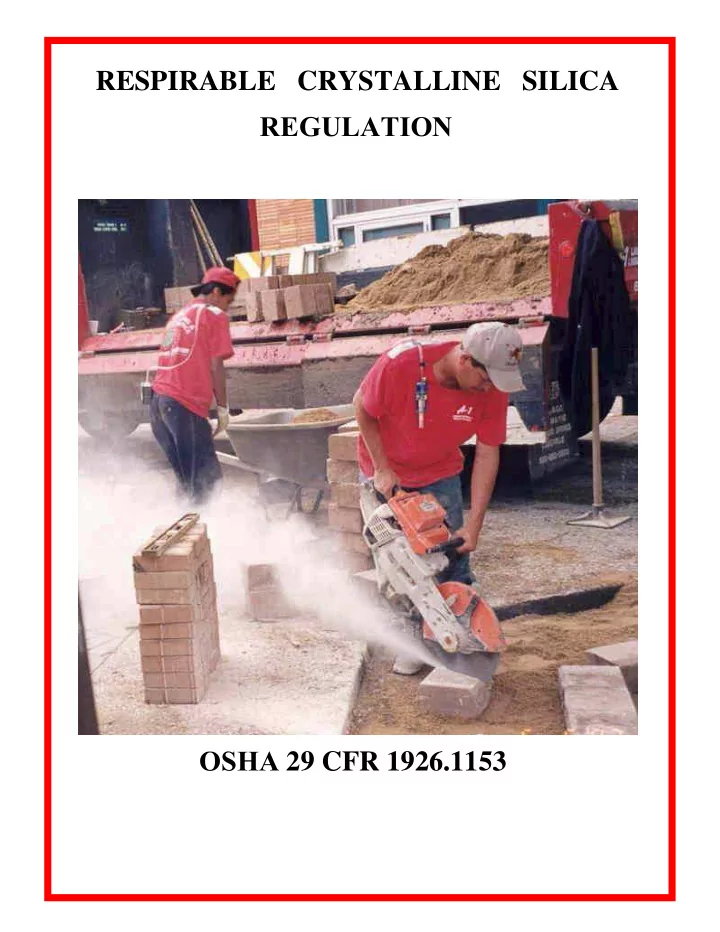
RESPIRABLE CRYSTALLINE SILICA REGULATION OSHA 29 CFR 1926.1153 - - PDF document
RESPIRABLE CRYSTALLINE SILICA REGULATION OSHA 29 CFR 1926.1153 OVERVIEW TERMS and OBJECTIVES FOUND in the NEW SILICA STANDARD OBJECTIVE The new Silica Standard requires employers to; - Consult Table 1 , - Use Engineering Controls in
TERMS and OBJECTIVES FOUND in the NEW SILICA STANDARD OBJECTIVE The new Silica Standard requires employers to;
AIR SAMPLING per OSHA APPENDIX A Employee exposure to silica shall be reliably measured using the sampling and analytical methods found in the Silica Regulation, Appendix A. PERMISSABLE EXPOSURE LIMIT (PEL) A Permissible Exposure Limit is the maximum amount or concentration of a chemical that a worker may be exposed to under OSHA regulations. TIME WEIGHTED AVERAGE (TWA) A Time Weighted Average is the average exposure over eight hours. ACTION LEVEL Action level means a concentration of airborne respirable crystalline silica of 25 μg/m3, calculated as an 8-hour TWA. ASSIGNED PROTECTIVE FACTORS (APF) Assigned Protection Factor means the workplace level of respiratory protection that a respirator or class of respirators is expected to provide to employees when the employer implements a continuing, effective respiratory protection program as specified by the OSHA Standard. ENGINEERING CONTROLS used in CONJUCTION WITH WORK PRACTICES OSHA’s longstanding policy is that Engineering Controls and Work Practice Controls must be the primary means used to reduce employee exposure to toxic chemicals…respiratory protection is required to be used when engineering or work practice controls are infeasible, insufficient, or while said controls are being implemented. RESPIRATORY PROTECTION (N95 MASK) Respiratory Protection shall be used only when Engineering and Work Practice Controls cannot adequately lower the Exposure Level. ( Note: An extensive Respiratory Plan, including Fit Testing, and Medical Evaluation is required for respirators other than the N95 Mask. ) WRITTEN EXPOSURE CONTROL PLAN Requires employers to;
TABLE 1 - GRAPHIC VERSION The table provides compliance options for 18 typical construction tasks that produce high employee exposure to silica dust. Employers that fully and properly implement the controls are not required to measure respiratory crystalline silica exposures. EQUIPMENT Water, Vacuum and Ventiation.
COMPLIANCE DATES Significant dates are; June 23, 2016 Regulation shall become effective Sept 23, 2017* All requirements except methods of sample analysis June 23, 2018. Requirements for methods of sample analysis SCOPE This section applies to all occupational exposures to respirable crystalline silica in construction work, except where employee exposure will remain below 25 micrograms per cubic meter of air as an 8-hour time-weighted average under any foreseeable conditions. DEFINITIONS Time Weighted Average - A time weighted average (TWA) is the average exposure within the workplace to any hazardous contaminant or agent using the baseline of an 8 hour per day
such hazardous contaminants to which workers may be exposed without experiencing significant adverse health effects over the standardized work period. The TWA is expressed in units of parts per million (ppm). Permissible Exposure Limit - Permissible exposure limit (PEL) is the legal limit in the U.S. for maximum concentration of any chemical in the air to which a worker may be exposed continuously for eight hours without any danger to health and safety. Engineering Controls - Engineering controls are physical changes to the work area or process that effectively minimize a worker's exposure to hazards Competent Person - Competent Person means one who is capable of identifying existing and predictable hazards in the surroundings or working conditions which are unsanitary, hazardous, or dangerous to employees, and who has authorization to take prompt corrective measures to eliminate them. CONTROL METHODS For each employee engaged in a task identified on T able 1, the employer shall fully and properly implement; Engineering Controls, Work Practices, and Respiratory Protection _______________________________________________________________________________ *Per OSHA memorandum issued April 6th 2017, Compliance extended from June 23rd to Sept 23rd 2017
ESTABLISHING EXPOSURE The employer shall assess the 8-hour TWA exposure for each employee on the basis of any combination of air monitoring data or objective data sufficient to accurately characterize employee exposures to respirable crystalline silica. SCHEDULED MONITORING The employer shall perform initial monitoring to assess the 8-hour TWA exposure for each employee on the basis of one or more personal breathing zone air samples that reflect the exposures of employees on each shift, for each job classification, in each work area. Where several employees perform the same tasks on the same shift and in the same work area, the employer may sample a representative fraction of these employees in order to meet this requirement. In representative sampling, the employer shall sample the employee(s) who are expected to have the highest exposure to respirable crystalline silica. EMPLOYEE NOTIFICATION Within five working days after completing an exposure assessment, the employer shall individually notify each affected employee in writing of the results of that assessment or post the results in an appropriate location accessible to all affected employees Whenever an exposure assessment indicates that employee exposure is above the PEL, the employer shall describe in the written notification the corrective action being taken to reduce employee exposure to or below the PEL COMPLIANCE METHODS The employer shall use engineering and work practice controls to reduce and maintain employee exposure to respirable crystalline silica to or below the PEL, unless the employer can demonstrate that such controls are not feasible. Wherever such feasible engineering and work practice controls are not sufficient to reduce employee exposure to or below the PEL, the employer shall nonetheless use them to reduce employee exposure to the lowest feasible level and shall supplement them with the use of respiratory protection. USE OF ENCLOSED CABINET OR BOOTH For measures implemented that include an enclosed cab or booth, ensure that; Is maintained as free as practicable from settled dust; Has door seals and closing mechanisms that work properly; Gaskets and seals that are in good condition and working properly; Is under positive pressure maintained through continuous delivery of fresh air; Has intake air that is filtered through a filter that is 95% efficient in the 0.3-10.0 μm range; Has heating and cooling capabilities.
IMPLEMENTING CONTROL MEASURES IN TABLE 1 If you comply with T able 1, you do not need to monitor for silica or comply with the PEL. When implementing the control measures specified in T able 1, each employer shall: For tasks performed indoors or in enclosed areas, provide a means of exhaust as needed to minimize the accumulation of visible airborne dust; For tasks performed using wet methods, apply water at flow rates sufficient to minimize release of visible dust; WRITTEN EXPOSURE CONTROL PLAN The employer shall establish and implement a written exposure control plan that contains at least the following elements: A description of the tasks in the workplace that involve exposure to respirable crystalline silica; A description of; Engineering Controls, Work Practices, and Respiratory Protection A description of the housekeeping measures used to limit employee exposure, A description of the procedures used to restrict access to work areas, The employer shall designate a Competent Person to make frequent and regular inspections of job sites. EMPLOYEE TRAINING The employer shall ensure that each employee covered by this section can demonstrate knowledge and understanding of the following: The health hazards associated with exposure to respirable crystalline silica; Specific tasks in the workplace that could result in exposure to respirable crystalline silica; Specific measures the employer has implemented to protect employees from exposure to respirable crystalline silica, including engineering controls, work practices, and respirators to be used; The contents of the silica regulations; The identity of the Competent Person designated by the employer; and The purpose and a description of the medical surveillance program.
Stationary masonry saws Use saw equipped with integrated water delivery system that continuously feeds water to the blade. Operate and maintain tool in accordance with manufacturer’s instructions to minimize dust emissions. (None required) (None required) Handheld power saws (any blade diameter) Use saw equipped with integrated water delivery system that continuously feeds water to the blade. Operate and maintain tool in accordance with manufacturer’s instructions to minimize dust emissions: When used
(None required) (APF 10 required)
EQUIPMENT USE / TASK ENGINEER. CONTROL LESS THAN 4 HOURS MORE THAN 4 HOURS
When used indoors
(APF 10 required) (APF 10 required) Handheld power saws for cutting fiber-cement board (with blade diameter of 8 inches or less) For tasks performed
Use saw equipped with commercially available dust collection system. Operate and maintain tool in accordance with manufacturer’s instructions to minimize dust emissions. Dust collector must provide the airflow recommended by the tool manufacturer,
have a filter with 99% or greater efficiency. (None required) (None required)
EQUIPMENT USE / TASK ENGINEER. CONTROL LESS THAN 4 HOURS MORE THAN 4 HOURS
Walk-behind saws Use saw equipped with integrated water delivery system that continuously feeds water to the blade. Operate and maintain tool in accordance with manufacturer’s instructions to minimize dust emissions: When used
(None required) (None required) When used indoors
(APF 10 required) (APF 10 required)
EQUIPMENT USE / TASK ENGINEER. CONTROL LESS THAN 4 HOURS MORE THAN 4 HOURS
Drivable saws For tasks performed
Use saw equipped with integrated water delivery system that continuously feeds water to the blade. Operate and maintain tool in accordance with manufacturer’s instructions to minimize dust emissions. (None required) (None required) Rig-mounted core saws or drills Use tool equipped with integrated water delivery system that supplies water to cutting surface. Operate and maintain tool in accordance with manufacturer’s instructions to minimize dust emissions. (None required) (None required)
EQUIPMENT USE / TASK ENGINEER. CONTROL LESS THAN 4 HOURS MORE THAN 4 HOURS
Handheld and stand-mounted drill (including impact and rotary hammer drills) Use drill equipped with commercially available shroud or cowling with dust collection system. Operate and maintain tool in accordance with manufacturer’s instructions to minimize dust emissions. Dust collector must provide the airflow recommended by the tool manufacturer,
have a filter with 99% or greater efficiency and a filtercleaning mechanism. Use a HEPA filtered vacuum when cleaning holes. (None required) (None required) Dowel drilling rigs for concrete For tasks performed
Use shroud around drill bit with a dust collection
collector must have a filter with 99% or greater efficiency and a filtercleaning mechanism. Use a HEPA filtered vacuum when cleaning holes. (APF 10 required) (APF 10 required)
EQUIPMENT USE / TASK ENGINEER. CONTROL LESS THAN 4 HOURS MORE THAN 4 HOURS
Vehicle-mounted drilling rigs for rock and concrete Use dust collection system with close capture hood or shroud around drill bit with a lowflow water spray to wet the dust at the discharge point from the dust collector. (None required) (None required) OR Operate from within an enclosed cab and use water for dust suppression on drill bit. (None required) (None required) Jackhammers & handheld powered chipping tools Use tool with water delivery system that supplies a continuous stream or spray of water at the point of impact: When used
(None required) (APF 10 required)
EQUIPMENT USE / TASK ENGINEER. CONTROL LESS THAN 4 HOURS MORE THAN 4 HOURS
When used indoors
(APF 10 required) (APF 10 required) OR Use tool equipped with commercially available shroud and dust collection system. Operate and maintain tool in accordance with manufacturer’s instructions to minimize dust emissions. Dust collector must provide the airflow recommended by the tool manufacturer,
have a filter with 99% or greater efficiency and a filtercleaning mechanism:
EQUIPMENT USE / TASK ENGINEER. CONTROL LESS THAN 4 HOURS MORE THAN 4 HOURS
When used
(None required) (APF 10 required) When used indoors
(APF 10 required) (APF 10 required)
EQUIPMENT USE / TASK ENGINEER. CONTROL LESS THAN 4 HOURS MORE THAN 4 HOURS
Handheld grinders for mortar removal (i.e., tuckpointing) Use grinder equipped with commercially available shroud and dust collection system. Operate and maintain tool in accordance with manufacturer’s instructions to minimize dust emissions. Dust collector must provide 25 cubic feet per minute (cfm) or greater
inch of wheel diameter and have a filter with 99% or greater efficiency and a cyclonic pre separator or filtercleaning mechanism. (Half mask required) (APF 25 required) Handheld grinders for uses other than mortar removal For tasks performed
Use grinder equipped with integrated water delivery system that continuously feeds water to the grinding surface. Operate and maintain tool in accordance with manufacturer’s instructions to minimize dust emissions. (None required) (None required) OR
EQUIPMENT USE / TASK ENGINEER. CONTROL LESS THAN 4 HOURS MORE THAN 4 HOURS
Use grinder equipped with commercially available shroud and dust collection system. Operate and maintain tool in accordance with manufacturer’s instructions to minimize dust emissions. Dust collector must provide 25 cubic feet per minute (cfm) or greater
inch of wheel diameter and have a filter with 99% or greater efficiency and a cyclonic pre separator or filtercleaning mechanism: When used
(None required) (None required) When used indoors
(None required) (APF 10 required)
EQUIPMENT USE / TASK ENGINEER. CONTROL LESS THAN 4 HOURS MORE THAN 4 HOURS
Walk-behind milling machines & floor grinders Use machine equipped with integrated water delivery system that continuously feeds water to the cutting surface. Operate and maintain tool in accordance with manufacturer’s instructions to minimize dust emissions. (None required) (None required) OR
EQUIPMENT USE / TASK ENGINEER. CONTROL LESS THAN 4 HOURS MORE THAN 4 HOURS
Use machine equipped with dust collection system recommended by the manufacturer. Operate and maintain tool in accordance with manufacturer’s instructions to minimize dust emissions. Dust collector must provide the airflow recommended by the manufacturer,
have a filter with 99% or greater efficiency and a filtercleaning mechanism. When used indoors or in an enclosed area, use a HEPA filtered vacuum to remove loose dust in between passes. (None required) (None required) Small drivable milling machines (less than half- lane) Use a machine equipped with supplemental water sprays designed to suppress dust. Water must be combined with a surfactant. Operate and maintain machine to minimize dust emissions. (None required) (None required)
EQUIPMENT USE / TASK ENGINEER. CONTROL LESS THAN 4 HOURS MORE THAN 4 HOURS
Large drivable milling machines (half-lane and larger) For cuts of any depth on asphalt only: Use machine equipped with exhaust ventilation on drum enclosure and supplemental water sprays designed to suppress dust. Operate and maintain machine to minimize dust emissions. (None required) (None required) For cuts of four inches in depth or less on any substrate: Use machine equipped with exhaust ventilation on drum enclosure and supplemental water sprays designed to suppress dust. Operate and maintain machine to minimize dust emissions. (None required) (None required) OR Use a machine equipped with supplemental water spray designed to suppress dust. Water must be combined with a surfactant. Operate and maintain machine to minimize dust emissions. (None required) (None required)
EQUIPMENT USE / TASK ENGINEER. CONTROL LESS THAN 4 HOURS MORE THAN 4 HOURS
Crushing machines Use equipment designed to deliver water spray or mist for dust suppression at crusher and
where dust is generated (e.g., hoppers, conveyors, sieves/sizing or vibrating components, and discharge points). Operate and maintain machine in accordance with manufacturer’s instructions to minimize dust emissions. Use a ventilated booth that provides fresh, climate controlled air to the operator, or a remote control station. (None required) (None required) Heavy equipment and utility vehicles used to abrade or fracture silica-containing materials (e.g., hoe-ramming, rock ripping) or used during demolition activities involving silica-containing materials Operate equipment from within an enclosed cab. (None required) (None required) When employees outside
the task, apply water and/or dust suppressants as necessary to minimize dust emissions. (None required) (None required)
EQUIPMENT USE / TASK ENGINEER. CONTROL LESS THAN 4 HOURS MORE THAN 4 HOURS
Heavy equipment and utility vehicles for tasks such as grading and excavating but not including: Demolishing, abrading, or fracturing silica-containing matls. Apply water and/or dust suppressants as necessary to minimize dust emissions. (None required) (None required) OR When the equipment
employee engaged in the task, operate equipment from within an enclosed cab. (None required) (None required)
EQUIPMENT USE / TASK ENGINEER. CONTROL LESS THAN 4 HOURS MORE THAN 4 HOURS
FAQ REGARDING THE SILICA STANDARD On March 24, 2016, the Occupational Safety and Health Administration (OSHA) announced its final rule on
March 25, 2016. What Is OSHA’s Silica Rule? OSHA’s final rule on respirable crystalline silica is one of the most significant health standards created by the agency. In the works for over 15 years, the final rule is a legacy project for OSHA under the Obama administration. Does OSHA’s Silica Rule Affect Me? If your employees are exposed to sand or dust, then you may be covered by OSHA’s new rule. OSHA considers employers in the following industries or with employees who work in construction. OSHA specifically exempted agricultural operations and exposures from the final rule. I May Be Covered. What Should I Do? The first step a covered employer may want to take is to conduct an exposure assessment for any employee who is or may reasonably be expected to be exposed to silica above the “Action Level.” The Action Level is 25 micrograms per cubic meter of air as an 8-hour time-weighted average. performing the analysis; the personal protective equipment worn by monitored employees; and the names, social security numbers, and job classifications of all employees represented by the monitoring, as well as identifying which employees were actually monitored. The next step to take depends on the lab results:
complete and you may discontinue monitoring for any employees represented by the monitoring.
“permissible exposure limit” (PEL), which is 50 micrograms per cubic meter (50 μg/m3) of air as an eight-hour time-weighted average, repeat the monitoring within 6 months of the last monitoring. Employees exposed to silica above the Action Level must undergo medical surveillance.
within three months of the last monitoring. Employees exposed to silica above the PEL must also undergo medical surveillance. Begin planning to take all steps necessary to lower exposure levels to below the PEL.
(PLHCP).
Begin formulating your company’s silica exposure control plan (see below for information on silica exposure control plans). Begin respirator programs, and if you are covered by OSHA’s General Industry or Maritime Standards, establish regulated areas. Once the exposure assessment is complete, you must notify affected employees in writing within 5 days if you are in the construction industry, or post the results in an appropriate location accessible to affected employees. If employee exposure is above the PEL, your notice must also describe the corrective action being taken to reduce employee exposure to an amount below the PEL. Can I Send My Samples Off to Any Lab? No. The lab must follow certain testing protocols and be accredited to ANS/ISO/IEC Standard 17025:2005 for crystalline silica analyses by a body that is complaint with ISO/IEC Standard 17011:2004 for implementation of quality assessment programs, among other
When Does the Rule Require Medical Surveillance? OSHA’s rule requires medical surveillance for any affected employee exposed to silica above the Action Level for 30 or more days per year. Compliant medical exams consist of:
respirable crystalline silica, dust, and other agents affecting the respiratory system; any history of respiratory system dysfunction, including signs and symptoms of respiratory disease (e.g., shortness
inspiration recorded on either film—no less than 14 by 17 inches and no more than 16 by 17 inches—
Office’s International Classification of Radiographs of Pneumoconioses by a National Institute for Occupational Safety and Health (NIOSH)-certified “B” reader;
second (FEV1) and the FEV1/FVC ratio, administered by a spirometry technician with a current certificate from a NIOSH-approved spirometry course;
Medical exams must occur at least every three years or sooner if recommended by a PLHCP. Employers must provide PLHCPs with a copy of the OSHA silica standard, along with the following, for each affected employee:
employee’s occupational exposure to respirable crystalline silica;
crystalline silica;
when and for how long the employee has used or will use that equipment; and
employee and currently within the control of the employer. Within 30 days of the exam, the PLHCP must provide two reports:
recommended limitations on the employee’s use of respirators, any recommended limitations on the employee’s exposure to silica, and a referral to a specialist if the chest x-ray is classified as 1/0 or higher by the B reader or if referral to a specialist is otherwise deemed appropriate by the PLHCP; and
met the requirements of the silica standard, and providing any recommended limitations on the employee’s use of respirators. If the employee provides written authorization, the report may also contain any recommended limitations on the employee’s exposure to silica, and a statement of whether the employee should be examined by a specialist. The rule requires employers to ensure that employees also receive a copy of this second report within 30 days of the exam. If there is a referral to a specialist, the employer is required to make a medical exam by a specialist available within 30 days after receiving the PLHCP’s written opinion. The rule requires the employer to provide the specialist with the same information provided to the PLHCP. The specialist must prepare separate reports similar to the reports prepared by the PLHCP and send those reports to the employee and employer within 30 days of the specialist’s exam.
What Do I Do With All These Samples, Lab Reports, and Medical Exam Reports? Keep them for at least the duration of the employee’s employment plus 30 years. Since it is nearly impossible to track such records
How Does Silica Affect Hazard Communication Training? The new rule requires employers to ensure silica is included in their Hazard Communication Program, so make sure employees have access to labels on containers of silica and access to Safety Data Sheets (SDS) on silica. Your hazard communication program must, at the very least, address the hazards of cancer, lung effects, immune system effects, and kidney effects. What Are Employers’ Obligations if Employees Are Exposed to Silica Above the PEL, Establish Regulated Areas? For all areas of the workplace in General Industry and Maritime where employee exposure to silica is or can reasonably be expected to be above the PEL, the employer must demarcate them
whose work duties require them to work in the area, any designated employee representatives, and OSHA
signs must be posted at all entrances to regulated areas with the following language: RESPIRABLE CRYSTALLINE SILICA MAY CAUSE CANCER CAUSES DAMAGE TO LUNGS WEAR RESPIRATORY PROTECTION IN THIS AREA AUTHORIZED PERSONNEL ONLY What Are Employers’ Obligations if Employees Are Exposed to Silica Above the PEL, Establish Engineering and Work Practice Controls. OSHA requires employers to utilize the hierarchy of controls to reduce employee exposure to below the PEL. The hierarchy of controls directs employers to first consider engineering controls to eliminate hazards. If engineering controls cannot be utilized, employers may consider work practice controls. What if Engineering and Work Practice Controls Won’t Get Employees Below the PEL? Can Employers Just Put Respirators on Everyone? No. “Wherever such feasible engineering and work practice controls are not sufficient to reduce employee exposure to or below the PEL,” OSHA explains, “the employer shall nonetheless use them to reduce employee exposure to the lowest feasible level and shall supplement them with the use of respiratory protection.”
Will Employers Get Into Trouble if Employees Are Wearing Respirators? No, unless OSHA feels that an employer has not established adequate engineering or work practice controls to reduce exposure levels to
engineering and work practice controls, or during certain maintenance and repair tasks for which engineering and work practice controls are not feasible. Finally, if all of an employer’s engineering and work practice controls still do not reduce employee exposure to or below the PEL, the employer must outfit affected employees with respirators. What if Engineering or Work Practice Controls Are Too Expensive to Implement? Infeasibility is a defense to an OSHA citation, but the burden will be on the employer to prove that such controls are either economically infeasible (the control is too expensive to implement and maintain) or technologically infeasible (the control does not effectively work to reduce exposure). OSHA historically has taken a dim view of economic infeasibility. Do Employers Have Any Other Alternatives? Yes. If the job task is listed on Table 1, located in the silica rule for construction, then the employer may follow OSHA’s methods (engineering and work practice controls, as well as respiratory protection) and be deemed in compliance. Are Employers Required to Adopt Written Exposure Control Plans? The silica rule requires employers to create written exposure control plans. Such plans must include three things: (1) a description of the tasks in the workplace that involve exposure to respirable crystalline silica; (2) a description of the engineering controls, work practices, and respiratory protections used to limit employee exposure to respirable crystalline silica for each task; and (3) a description of the housekeeping measures used to limit employee exposure to respirable crystalline silica. Employers must review written exposure control plans at least annually and update them as necessary. Written exposure control plans must be made available upon demand to employees, union representatives, and OSHA. Does the Silica Rule Include Special Housekeeping Rules? The new rule allows dry sweeping and brushing, but only when the employer can show wet sweeping or HEPA-filtered vacuuming are not feasible. For instance, wet sweeping will not work in outdoor work sites when temperatures are below freezing. Employers may use compressed air cleaning, but only in conjunction with a ventilation system that effectively captures dust clouds created by the compressed air.
Available as Digital File
Page 1 of 15
RESPIRABLE CRYSTALLINE SILICA PROGRAM PURPOSE This Respirable Crystalline Silica Program was developed to prevent employee exposure to hazardous levels of Respirable Crystalline Silica that could result through construction activities or nearby construction activities
silicosis, chronic obstructive pulmonary disease, and kidney disease. It is intended to meet the requirements of the Respirable Crystalline Silica Construction Standard (29 CFR 1926.1153) established by the Occupational Safety and Health Administration. All work involving chipping, cutting, drilling, grinding, or similar activities on materials containing Crystalline Silica can lead to the release of respirable-sized particles of Crystalline Silica. Crystalline Silica is a basic component of soil, sand, granite and many other minerals. Quartz is the most common form of Crystalline Silica. Many materials found on constructions sites include Crystalline Silica; including but not limited to, stucco, concrete, asphalt, pre-formed structures such as inlets, pipe, etc. This program has been developed to address and control these potential exposures to prevent our employees from experiencing the effects of occupational illnesses related to Respirable Crystalline Silica exposure. SCOPE This program applies to all employees who have the potential to be exposed to Respirable Crystalline Silica when covered by the OSHA Standard. The OSHA Respirable Crystalline Silica Construction Standard applies to all
will remain below 25 micrograms of Respirable Crystalline Silica per cubic meter of air (25 μg/m3) as an 8-hour time-weighted average (TWA) under any foreseeable conditions. DEFINITIONS If a definition is not listed in this section, please contact your supervisor. If your supervisor is unaware of what the term means, please contact the Competent Person or your Safety Department. Action Level means a concentration of airborne Respirable Crystalline Silica of 25 μg/m3, calculated as an 8-hour TWA. Competent Person means an individual who is capable of identifying existing and foreseeable Respirable Crystalline Silica hazards in the workplace and who has authorization to take prompt corrective measures to eliminate or minimize them. Employee Exposure means the exposure to airborne Respirable Crystalline Silica that would occur if the employee were not using a respirator. High-Efficiency Particulate Air (HEPA) Filter means a filter that is at least 99.97 percent efficient in removing monodispersed particles of 0.3 micrometers in diameter. Objective Data means information, such as air monitoring data from industry-wide surveys or calculations based on the composition of a substance, demonstrating employee exposure to Respirable Crystalline Silica associated with a particular product or material or a specific process, task, or activity. The data must reflect workplace conditions closely resembling or with a higher exposure potential than the processes, types of material, control methods, work practices, and environmental conditions in the employer's current operations. Permissible Exposure Limit (PEL) means the employer shall ensure that no employee is exposed to an airborne concentration of Respirable Crystalline Silica in excess of 50 μg/m3, calculated as an 8-hour TWA. Physician or Other Licensed Health Care Professional (PLHCP) means an individual whose legally permitted scope of practice (i.e., license, registration, or certification) allows him or her to independently provide or be delegated the responsibility to provide some or all of the particular health care services required by the Medical Surveillance Section of the OSHA Respirable Crystalline Silica Standard. Respirable Crystalline Silica means Quartz, Cristobalite, and/or Tridymite contained in airborne particles that are determined to be respirable by a sampling device designed to meet the characteristics for respirable-particle size- selective samplers specified in the International Organization for: Air Quality- Particle Size Fraction Definitions for Health-Related Sampling.
Page 2 of 15
COMPANY RESPONSIBILITIES Company Name firmly believes protecting the health and safety of our employees is everyone’s responsibility. This responsibility begins with upper management providing the necessary support to properly implement this
the following positions. Conduct job site assessments for Silica containing materials and perform employee Respirable Crystalline Silica hazard assessments in order to determine if an employee’s exposure will be above 25 μg/m3 as an 8-hour TWA under any foreseeable conditions Select and implement into the project’s ECP the appropriate control measures in accordance with the Construction Tasks identified in OSHA’s Construction Standard Table 1; and potentially including (but not limited to) - a written Exposure Control Plan (ECP), exposure monitoring, Hazard Communication training, medical surveillance, housekeeping and others. Ensure that the materials, tools, equipment, personal protective equipment (PPE), and other resources (such as worker training) required to fully implement and maintain this Respirable Crystalline Silica Program are in place and readily available if needed. Ensure that Forman/Competent Persons, and employees are educated in the hazards of Silica exposure and trained to work safely with Silica in accordance with OSHA’s Respirable Crystalline Silica Construction Standard and OSHA’s Hazard Communication Standard. Managers and Competent Persons may receive more advanced training than other employees. Maintain written records of training (for example, proper use of respirators), ECPs, inspections (for equipment, PPE, and work methods/practices), medical surveillance (under lock and key), respirator medical clearances (under lock and key) and fit-test results. Conduct an annual review (or more often if conditions change) of the effectiveness of this program and any active project ECP’s that extend beyond a year. This includes a review of available dust control technologies to ensure these are selected and used when practical. Coordinate work with other employers and contractors to ensure a safe work environment relative to Silica exposure. EMPLOYEE RESPONSIBILITIES Follow recognized work procedures (such as the Construction Tasks identified in OSHA’s Construction Standard Table 1) as established in the project’s ECP and this program. Use the assigned PPE in an effective and safe manner. Participate in Respirable Crystalline Silica exposure monitoring and the medical surveillance program. Report any unsafe conditions or acts to the Site Manager and/or Competent Person. Report any exposure incidents or any signs or symptoms of Silica illness.
Page 3 of 15
FOREMAN / COMPETENT PERSON RESPONSIBILITIES Ensure all applicable elements of this Respirable Crystalline Silica Program are implemented on the project including the Foreman/Competent Person shall; Assist Company in conduct job site assessments for Silica containing materials and perform employee Respirable Crystalline Silica hazard assessments in order to determine if an ECP, exposure monitoring, and medical surveillance is necessary. Assist in the selection and implementation of the appropriate control measures in accordance with the Construction Tasks identified in OSHA’s Construction Standard Table 1; and potentially including (but not limited to) - a written Exposure Control Plan (ECP), exposure monitoring, Hazard Communication training, medical surveillance, housekeeping and others. Ensure that employees using respirators have been properly trained, medically cleared, and fit-tested in accordance with the company’s Respiratory Protection Program. This process will be documented. Ensure that work is conducted in a manner that minimizes and adequately controls the risk to workers and others. This includes ensuring that workers use appropriate engineering controls, work practices, and wear the necessary PPE. Where there is risk of exposure to Silica dust, verify employees are properly trained on the applicable contents of this program, the project-specific ECP, and the applicable OSHA Standards (such as Hazard Communication). Ensure employees are provided appropriate PPE when conducting such work. Make frequent and regular inspections of job sites, materials, and equipment to implement the written ECP. Identify existing and foreseeable Respirable Crystalline Silica hazards in the workplace and take prompt corrective measures to eliminate or minimize them. Notify the Company of any deficiencies identified during inspections in order to coordinate and facilitate prompt corrective action. Assist the Company in conducting job site assessments for Silica containing materials and perform employee Respirable Crystalline Silica hazard assessments in order to determine if an ECP, exposure monitoring, and medical surveillance is necessary. PROGRAM REQUIREMENTS When possible and applicable, Company Name will conduct activities with potential Silica exposure to be consistent with OSHA’s Construction Standard Table 1. Supervisors will ensure each employee under their supervision and engaged in a task identified on OSHA’s Construction Standard Table 1 have fully and properly implemented the engineering controls, work practices, and respiratory protection specified for the task on Table 1 (unless Company Name has assessed and limited the exposure of the employee to Respirable Crystalline Silica in accordance with the Alternative Exposure Control Methods Section of this program). The task(s) being performed by Company Name identified on OSHA’s Construction Standard
Page 4 of 15
Table 1: Specified Exposure Control Methods When Working With Materials Containing Crystalline Silica Construction Task or Equipment Operation Engineering and Work Practice Control Methods Required Respiratory Protection ≤ 4 hours/shift >4 hours/shift 1 Stationary masonry saws
water delivery system that continuously feeds water to the blade.
accordance with manufacturer's instructions to minimize dust emissions. None None 2a Handheld power saws (any blade diameter) when used outdoors
water delivery system that continuously feeds water to the blade.
accordance with manufacturer's instructions to minimize dust emissions. None N95 (or Greater Efficiency) Filtering Facepiece
2b Handheld power saws (any blade diameter) when used indoors or in an enclosed area
water delivery system that continuously feeds water to the blade.
accordance with manufacturer's instructions to minimize dust emissions. N95 (or Greater Efficiency) Filtering Facepiece
N95 (or Greater Efficiency) Filtering Facepiece
3 Handheld power saws for cutting fiber-cement board (with blade diameter of 8 inches or less) for tasks performed
available dust collection system.
accordance with manufacturer's instructions to minimize dust emissions.
recommended by the tool manufacturer, or greater, and have a filter with 99% or greater efficiency. None None 4a Walk-behind saws when used
water delivery system that continuously feeds water to the blade.
accordance with manufacturer's instructions to minimize dust emissions. None None 4b Walk-behind saws when used indoors
area
water delivery system that continuously feeds water to the blade.
accordance with manufacturer's instructions to minimize dust emissions. N95 (or Greater Efficiency) Filtering Facepiece
N95 (or Greater Efficiency) Filtering Facepiece
5 Drivable saws for tasks performed
water delivery system that continuously feeds water to the blade.
accordance with manufacturer's instructions to minimize dust emissions. None None
Page 5 of 15
Construction Task or Equipment Operation Engineering and Work Practice Control Methods Required Respiratory Protection ≤ 4 hours/shift >4 hours/shift 6 Rig-mounted core saws or drills
water delivery system that supplies water to cutting surface.
accordance with manufacturer's instructions to minimize dust emissions. None None 7 Handheld and stand-mounted drills (including impact and rotary hammer drills)
available shroud or cowling with dust collection system.
accordance with manufacturer's instructions to minimize dust emissions.
recommended by the tool manufacturer, or greater, and have a filter with 99% or greater efficiency and a filter-cleaning mechanism.
cleaning holes. None None 8 Dowel drilling rigs for concrete for tasks performed
collection system.
99% or greater efficiency and a filter cleaning mechanism.
cleaning holes. N95 (or Greater Efficiency) Filtering Facepiece
N95 (or Greater Efficiency) Filtering Facepiece
9a Vehicle-mounted drilling rigs for rock and concrete
capture hood or shroud around drill bit with a low-flow water spray to wet the dust at the discharge point from the dust collector. None None 9b Vehicle-mounted drilling rigs for rock and concrete
and use water for dust suppression on drill bit. None None 10a Jackhammers and handheld powered chipping tools when used
that supplies a continuous stream or spray of water at the point of impact. None N95 (or Greater Efficiency) Filtering Facepiece
10b Jackhammers and handheld powered chipping tools when used indoors
area
that supplies a continuous stream or spray of water at the point of impact. N95 (or Greater Efficiency) Filtering Facepiece
N95 (or Greater Efficiency) Filtering Facepiece
10c Jackhammers and handheld powered chipping tools
available shroud and dust collection system. None N95 (or Greater Efficiency) Filtering
Page 6 of 15
Construction Task or Equipment Operation Engineering and Work Practice Control Methods Required Respiratory Protection ≤ 4 hours/shift >4 hours/shift when used
accordance with manufacturer's instructions to minimize dust emissions.
recommended by the tool manufacturer, or greater, and have a filter with 99% or greater efficiency and a filter-cleaning mechanism. Facepiece
10d Jackhammers and handheld powered chipping tools when used indoors
area
available shroud and dust collection system.
accordance with manufacturer's instructions to minimize dust emissions.
recommended by the tool manufacturer, or greater, and have a filter with 99% or greater efficiency and a filter-cleaning mechanism. N95 (or Greater Efficiency) Filtering Facepiece
N95 (or Greater Efficiency) Filtering Facepiece
11 Handheld grinders for mortar removal (i.e., tuckpointing)
commercially available shroud and dust collection system.
accordance with manufacturer's instructions to minimize dust emissions.
feet per minute (cfm) or greater of airflow per inch of wheel diameter and have a filter with 99% or greater efficiency and a cyclonic pre-separator
N95 (or Greater Efficiency) Filtering Facepiece
Powered Air-Purifying Respirator (PAPR) with P100 Filters 12a Handheld grinders for uses other than mortar removal for tasks performed
water delivery system that continuously feeds water to the grinding surface.
accordance with manufacturer's instructions to minimize dust emissions. None None 12b Handheld grinders for uses other than mortar removal when used
commercially available shroud and dust collection system.
accordance with manufacturer's instructions to minimize dust emissions.
feet per minute (cfm) or greater of airflow per inch of wheel diameter and have a filter with 99% or greater None None
Page 7 of 15
Construction Task or Equipment Operation Engineering and Work Practice Control Methods Required Respiratory Protection ≤ 4 hours/shift >4 hours/shift efficiency and a cyclonic pre-separator
12c Handheld grinders for uses other than mortar removal when used indoors
area
commercially available shroud and dust collection system.
accordance with manufacturer's instructions to minimize dust emissions.
feet per minute (cfm) or greater of airflow per inch of wheel diameter and have a filter with 99% or greater efficiency and a cyclonic pre-separator
None N95 (or Greater Efficiency) Filtering Facepiece
13a Walk-behind milling machines and floor grinders
water delivery system that continuously feeds water to the cutting surface.
accordance with manufacturer's instructions to minimize dust emissions. None None 13b Walk-behind milling machines and floor grinders
collection system recommended by the manufacturer.
accordance with manufacturer's instructions to minimize dust emissions.
recommended by the manufacturer, or greater, and have a filter with 99% or greater efficiency and a filter-cleaning mechanism.
area, use a HEPA-filtered vacuum to remove loose dust in between passes. None None 14 Small drivable milling machines (less than half- lane)
supplemental water sprays designed to suppress dust.
surfactant.
minimize dust emissions. None None 15a Large drivable milling machines (half-lane and larger) for cuts of any depth on asphalt only
ventilation on drum enclosure and supplemental water sprays designed to suppress dust.
minimize dust emissions. None None 15b Large drivable milling machines (half-lane and larger) for cuts of
ventilation on drum enclosure and supplemental water sprays designed to suppress dust. None None
Page 8 of 15
Construction Task or Equipment Operation Engineering and Work Practice Control Methods Required Respiratory Protection ≤ 4 hours/shift >4 hours/shift four inches in depth or less on any substrate
minimize dust emissions. 15c Large drivable milling machines (half-lane and larger) for cuts of four inches in depth or less on any substrate
supplemental water spray designed to suppress dust.
surfactant.
minimize dust emissions. None None 16 Crushing machines
water spray or mist for dust suppression at crusher and other points where dust is generated (e.g., hoppers, conveyers, sieves/sizing or vibrating components, and discharge points).
accordance with manufacturer's instructions to minimize dust emissions.
fresh, climate-controlled air to the
None None 17a Heavy equipment and utility vehicles used to abrade or fracture silica- containing materials (e.g., hoe-ramming, rock ripping) or used during demolition activities involving silica-containing materials
enclosed cab. None None 17b Heavy equipment and utility vehicles used to abrade or fracture silica- containing materials (e.g., hoe-ramming, rock ripping) or used during demolition activities involving silica-containing materials
are engaged in the task, apply water and/or dust suppressants as necessary to minimize dust emissions. None None 18a Heavy equipment and utility vehicles for tasks such as grading and excavating but not including demolishing, abrading, or
as necessary to minimize dust emissions. None None
Page 9 of 15
Construction Task or Equipment Operation Engineering and Work Practice Control Methods Required Respiratory Protection ≤ 4 hours/shift >4 hours/shift fracturing silica- containing materials 18b Heavy equipment and utility vehicles for tasks such as grading and excavating but not including demolishing, abrading, or fracturing silica- containing materials
enclosed cab. None None When implementing the control measures specified in Table 1, Company Name shall: For tasks performed indoors or in enclosed areas, provide a means of exhaust as needed to minimize the accumulation of visible airborne dust; For tasks performed using wet methods, apply water at flow rates sufficient to minimize release of visible dust; For measures implemented that include an enclosed cab or booth, ensure that the enclosed cab or booth: Is maintained as free as practicable from settled dust; Has door seals and closing mechanisms that work properly; Has gaskets and seals that are in good condition and working properly; Is under positive pressure maintained through continuous delivery of fresh air; Has intake air that is filtered through a filter that is 95% efficient in the 0.3-10.0 μm range (e.g., MERV-16
Has heating and cooling capabilities. Where an employee performs more than one task included on OSHA’s Construction Standard Table 1 during the course of a shift, and the total duration of all tasks combined is more than four hours, the required respiratory protection for each task is the respiratory protection specified for more than four hours per shift. If the total duration of all tasks on Table 1 combined is less than four hours, the required respiratory protection for each task is the respiratory protection specified for less than four hours per shift.
Page 10 of 15
ALTERNATE EXPOSURE CONTROL METHODS Alternative Exposure Control Methods apply for tasks not listed in OSHA’s Construction Standard Table 1, or where Company Name cannot not fully and properly implement the engineering controls, work practices, and respiratory protection described in Table 1. First, Company Name will assess the exposure of each employee who is or may reasonably be expected to be exposed to Respirable Crystalline Silica at or above the Action Level in accordance with either the Performance Option, or the Scheduled Monitoring Option. PERFORMANCE OPTION Company Name will assess the 8-hour TWA exposure for each employee on the basis of any combination of air monitoring data or objective data sufficient to accurately characterize employee exposures to Respirable Crystalline Silica. SCHEDULED MONITORING OPTION Company Name will perform initial monitoring to assess the 8-hour TWA exposure for each employee on the basis of one or more personal breathing zone air samples that reflect the exposures of employees on each shift, for each job classification, and in each work area. Where several employees perform the same tasks on the same shift and in the same work area, Company Name will plan to monitor a representative fraction of these
expected to have the highest exposure to Respirable Crystalline Silica. If initial monitoring indicates that employee exposures are below the Action Level, Company Name will probably discontinue monitoring for those employees whose exposures are represented by such monitoring. Where the most recent exposure monitoring indicates that employee exposures are at or above the Action Level but at or below the PEL, Company Name will repeat such monitoring within six months of the most recent monitoring. Where the most recent exposure monitoring indicates that employee exposures are above the PEL, Company Name will repeat such monitoring within three months of the most recent monitoring. Where the most recent (non-initial) exposure monitoring indicates that employee exposures are below the Action Level, Company Name will repeat such monitoring within six months of the most recent monitoring until two consecutive measurements, taken seven or more days apart, are below the Action Level, at which time Company Name will probably discontinue monitoring for those employees whose exposures are represented by such monitoring, except when a reassessment is required. Company Name will reassess exposures whenever a change in the production, process, control equipment, personnel, or work practices may reasonably be expected to result in new or additional exposures at or above the Action Level, or when Company Name has any reason to believe that new or additional exposures at or above the Action Level have occurred. Company Name will ensure that all Respirable Crystalline Silica samples taken to satisfy the monitoring requirements of this program and OSHA are collected by a qualified individual (i.e. a Certified Industrial Hygienist) and the samples are evaluated by a qualified laboratory (i.e. accredited to ANS/ISO/IEC Standard 17025:2005 with respect to Crystalline Silica analyses by a body that is compliant with ISO/IEC Standard 17011:2004 for implementation of quality assessment programs). Within five working days after completing an exposure assessment, Company Name will individually notify each affected employee in writing of the results of that assessment or post the results in an appropriate location accessible to all affected employees. Whenever an exposure assessment indicates that employee exposure is above the PEL, Company Name will describe in the written notification the corrective action being taken to reduce employee exposure to or below the PEL.
Page 11 of 15
SCHEDULED MONITORING OPTION (continued) Where air monitoring is performed, Company Name will provide affected employees or their designated representatives an opportunity to observe any monitoring of employee exposure to Respirable Crystalline Silica. When observation of monitoring requires entry into an area where the use of protective clothing or equipment is required for any workplace hazard, Company Name will provide the observer with protective clothing and equipment at no cost and shall ensure that the observer uses such clothing and equipment. Once air monitoring has been performed, Company Name will determine its method of compliance based on the monitoring data and the hierarchy of controls. Company Name will use engineering and work practice controls to reduce and maintain employee exposure to Respirable Crystalline Silica to or below the PEL, unless Company Name can demonstrate that such controls are not feasible. Wherever such feasible engineering and work practice controls are not sufficient to reduce employee exposure to or below the PEL, Company Name will nonetheless use them to reduce employee exposure to the lowest feasible level and shall supplement them with the use of respiratory protection. In addition to the requirements of this program, Company Name will comply with other programs and OSHA standards (such as 29 CFR 1926.57 [Ventilation]), when applicable where abrasive blasting is conducted using Crystalline Silica-containing blasting agents, or where abrasive blasting is conducted on substrates that contain Crystalline Silica. CONTROL METHODS Company Name will provide control methods that are either consistent with Table 1 or otherwise minimize worker exposures to Silica. These exposure control methods can include; Engineering Controls, Work Practices, and Respiratory Protection. RESPIRATORY PROTECTION Where respiratory protection is required by this program, Company Name will provide each employee an appropriate respirator that complies with the requirements of the company’s Respiratory Protection Program and the OSHA Respiratory Protection Standard (29 CFR 1910.134). Respiratory protection is required where specified by the OSHA Construction Standard Table 1, for tasks not listed in Table 1, or where the company has not fully and properly implemented the engineering controls, work practices, and respiratory protection described in Table 1. Situations requiring respiratory protection include: Where exposures exceed the PEL during periods necessary to install or implement feasible engineering and work practice controls; Where exposures exceed the PEL during tasks, such as certain maintenance and repair tasks, for which engineering and work practice controls are not feasible; and During tasks for which an employer has implemented all feasible engineering and work practice controls and such controls are not sufficient to reduce exposures to or below the PEL. HOUSEKEEPING Company Name does not allow dry sweeping or dry brushing where such activity could contribute to employee exposure to Respirable Crystalline Silica unless wet sweeping, HEPA-filtered vacuuming, or other methods that minimize the likelihood of exposure are not feasible. Company Name does not allow compressed air to be used to clean clothing or surfaces where such activity could contribute to employee exposure to Respirable Crystalline Silica unless: The compressed air is used in conjunction with a ventilation system that effectively captures the dust cloud created by the compressed air; or No alternative method is feasible.
Page 12 of 15
WRITTEN EXPOSURE CONTROL PLAN (ECP) When employee exposure on a construction project is expected to be at or above the Action Level, a Written Exposure Control Plan (ECP) will be established and implemented. This ECP will contain at least the following elements: A description of the tasks in the workplace that involve exposure to Respirable Crystalline Silica; A description of the engineering controls, work practices, and respiratory protection used to limit employee exposure to Respirable Crystalline Silica for each task; A description of the housekeeping measures used to limit employee exposure to Respirable Crystalline Silica; and A description of the procedures used to restrict access to work areas, when necessary, to minimize the number of employees exposed to Respirable Crystalline Silica and their level of exposure, including exposures generated by other employers or sole proprietors. The written ECP will designate a Competent Person to make frequent and regular inspections of job sites, materials, and equipment to ensure the ECP is implemented. The written ECP will be reviewed at least annually to evaluate the effectiveness of it and update it as necessary. Having said this, ECP’s are project specific and most project durations do not exceed a year. The written ECP will be readily available for examination and copying, upon request, to each employee covered by this program and/or ECP, their designated representatives, and OSHA. MEDICAL SURVEILLANCE Medical surveillance will be made available for each employee who will be required to use a respirator for 30 or more days per year due to their Respirable Crystalline Silica exposure. Medical surveillance (i.e. medical examinations and procedures) will be performed by a PLHCP and provided at no cost to the employee at a reasonable time and place. 1 Company Name will make available an initial (baseline) medical examination within 30 days after initial assignment, unless the employee has received a medical examination that meets the requirements of the OSHA Respirable Crystalline Silica Construction Standard within the last three years. The examination shall consist of: A medical and work history, with emphasis on past, present, and anticipated exposure to Respirable Crystalline Silica, dust, and other agents affecting the respiratory system in addition to any history of respiratory system dysfunction, including signs and symptoms of respiratory disease (e.g., shortness of breath, cough, wheezing), history of tuberculosis, and smoking status and history; A physical examination with special emphasis on the respiratory system; A chest X-ray (a single postero-anterior radiographic projection or radiograph of the chest at full inspiration recorded on either film [no less than 14 x 17 inches and no more than 16 x 17 inches] or digital radiography systems) interpreted and classified according to the International Labour Office (ILO) International Classification of Radiographs of Pneumoconiosis by a NIOSH-certified B Reader; A pulmonary function test to include forced vital capacity (FVC) and forced expiratory volume in one second (FEV1) and FEV1/FVC ratio, administered by a spirometry technician with a current certificate from a NIOSH-approved spirometry course; Testing for latent tuberculosis infection; and Any other tests deemed appropriate by the PLHCP. Company Name will make available medical examinations that include the aforementioned procedures (except testing for latent tuberculosis infection) at least every three years. If recommended by the PLHCP, periodic examinations can be more frequently than every three years.
________________________________________________________________________________________________________________________________ Applies to General Industry. The Construction Standard requires medical surveillence if the employee is required to wear a respirator 30 times, or more, per year.
Page 13 of 15
MEDICAL SURVEILLANCE (Continued) Company Name will ensure that the examining PLHCP has a copy of the OSHA Respirable Crystalline Silica Construction Standard, this program, and the following information: A description of the employee's former, current, and anticipated duties as they relate to the employee's
The employee's former, current, and anticipated levels of occupational exposure to Respirable Crystalline Silica; A description of any personal protective equipment (PPE) used or to be used by the employee, including when and for how long the employee has used or will use that equipment; and Information from records of employment-related medical examinations previously provided to the employee and currently within the control of Company Name. Company Name will ensure that the PLHCP explains to the employee the results of the medical examination and provides each employee with a written medical report within 30 days of each medical examination performed. The written report shall contain: A statement indicating the results of the medical examination, including any medical condition(s) that would place the employee at increased risk of material impairment to health from exposure to Respirable Crystalline Silica and any medical conditions that require further evaluation or treatment; Any recommended limitations on the employee's use of respirators; Any recommended limitations on the employee's exposure to Respirable Crystalline Silica; and; A statement that the employee should be examined by a Specialist if the chest X-ray is classified as 1/0
Company Name will also obtain a written medical opinion from the PLHCP within 30 days of the medical
The date of the examination; A statement that the examination has met the requirements of the OSHA Respirable Crystalline Silica Construction Standard; and Any recommended limitations on the employee's use of respirators. If the employee provides written authorization, the written opinion shall also contain either or both of the following: Any recommended limitations on the employee's exposure to Respirable Crystalline Silica; and/or A statement that the employee should be examined by a Specialist if the chest X-ray is classified as 1/0
If the PLHCP's written medical opinion indicates that an employee should be examined by a Specialist, Company Name will make available a medical examination by a Specialist within 30 days after receiving the PLHCP's written opinion. Company Name will ensure that the examining Specialist is provided with all of the information that the employer is obligated to provide to the PLHCP.
Page 14 of 15
MEDICAL SURVEILLANCE (Continued) Company Name will ensure that the Specialist explains to the employee the results of the medical examination and provides each employee with a written medical report within 30 days of the examination. The written report will contain: A statement indicating the results of the medical examination, including any medical condition(s) that would place the employee at increased risk of material impairment to health from exposure to Respirable Crystalline Silica and any medical conditions that require further evaluation or treatment; Any recommended limitations on the employee's use of respirators; and Any recommended limitations on the employee's exposure to respirable crystalline Silica. In addition, Company Name will obtain a written opinion from the Specialist within 30 days of the medical
The date of the examination; Any recommended limitations on the employee's use of respirators; and If the employee provides written authorization, the written opinion shall also contain any recommended limitations on the employee's exposure to Respirable Crystalline Silica. HAZARD COMMUNICATION PROGRAM Company Name will include Respirable Crystalline Silica in the company’s GHS Hazard Communication Program established to comply with the OSHA Hazard Communication Standard (29 CFR 1910.1200). Company Name will ensure that each employee has access to labels on containers of Crystalline Silica and those containers respective Safety Data Sheets (SDS’s). All employees will be trained in accordance with the provisions of the OSHA Hazard Communication Standard and the Training Section of this program. This training will cover concerns relating to cancer, lung effects, immune system effects, and kidney effects. Company Name will ensure that each employee with the potential to be exposed at or above the Action Level for Respirable Crystalline Silica can demonstrate knowledge and understanding of at least the following: The health hazards associated with exposure to Respirable Crystalline Silica; Specific tasks in the workplace that could result in exposure to Respirable Crystalline Silica; Specific measures Company Name has implemented to protect employees from exposure to Respirable Crystalline Silica, including engineering controls, work practices, and respirators to be used; The contents of the OSHA Respirable Crystalline Silica Construction Standard; The identity of the Competent Person designated by Company Name; and The purpose and a description of the company’s Medical Surveillance Program. Company Name will make a copy of the OSHA Respirable Crystalline Silica Construction Standard readily available without cost to any employee who requests it.
Page 15 of 15
RECORDKEEPING Company Name will make and maintain an accurate record of all exposure measurements taken to assess employee exposure to Respirable Crystalline Silica. This record will include at least the following information: The date of measurement for each sample taken; The task monitored; Sampling and analytical methods used; Number, duration, and results of samples taken; Identity of the laboratory that performed the analysis; Type of personal protective equipment (PPE), such as respirators, worn by the employees monitored; and Name, social security number, and job classification of all employees represented by the monitoring, indicating which employees were actually monitored. Company Name will ensure that exposure records are maintained and made available in accordance with 29 CFR 1910.1020. Exposure records will be kept for at least 30 years. The employer shall make and maintain an accurate record of all objective data relied upon to comply with the requirements of the OSHA Respirable Crystalline Silica Construction Standard. This record shall include at least the following information: The Crystalline Silica-containing material in question; The source of the objective data; The testing protocol and results of testing; A description of the process, task, or activity on which the objective data were based; and Other data relevant to the process, task, activity, material, or exposures on which the objective data were based. Company Name will ensure that objective data are maintained and made available in accordance with 29 CFR 1910.1020. Objective data records will be kept for at least 30 years. Company Name will make and maintain an accurate record for each employee enrolled in the Medical Surveillance portion of this program. The record shall include the following information about the employee: Name and social security number; A copy of the PLHCPs' and/or Specialists' written medical opinions; and A copy of the information provided to the PLHCPs and Specialists. Company Name will ensure that medical records are maintained and made available in accordance with 29 CFR 1910.1020. Medical records will be kept under lock and key for at least the duration of employment plus 30 years. It is necessary to keep these records for extended periods because Silica-related diseases such as cancer often cannot be detected until several decades after exposure. However, if an employee works for an employer for less than one year, the employer does not have to keep the medical records after employment ends, as long as the employer gives those records to the employee.
Introduction Comment OSHA Standard 29 CFR 1926.1153 - Construction What is Silica Quartz; sand, stone, concrete, brick, block & mortar Exposure Control Plans Required by All Companies There are Two Silica Standards Comment General Industry & Maritime 29 CFR 1910.1053 Effective June 23rd 2018 Construction 29 CFR 1926.1153 Effective September 23rd 2017 All Companies Must Have an Exposure Control Plan Comment Program Must Include; Exposure Assessment Description of Task Specific to Subcontractor Engineering Controls First Choice Work Practices Second Choice, and Often Used w/ Engineering Controls Respiratory Protection Used When Engineering & Work Practices are Not Sufficient Medical Surveilleance Requirements of General Industry & Construction Differ Housekeeping No Dry Sweeping, No Compressed Air Clean Up Restricted Area Annually Evaluated Available to Employees Upon Request Employee Training Tailored to Subcontractors' Tasks Competent Person Designated Generally a Foreman Table 1 Comment Table 1 Measurement Not Required for Listed Tasks 18 Typical Constrution Tasks Provides Method of Abatement Typical Abatement Wet Method, Vacuum, and N95 Mask Methods of Compliance Comment Engineering Preferred Work Practices Often in Conjuction with Engineering Respiratory Protection Used When Engineering & Work Practices are Not Sufficient Housekeeping Comment No Dry Sweeping No Compressed Air Medical Surveillance Comment Free to Employee Licensed Professional Physcians & Licensed Healtcare Professionals (PLHCP) Identify Adverse Impact Establish Physical Fitness to Use Respiratory Protection Full Physical X-Ray TB Exam Results are Provided Only to Employee Training Comment Performance Based Address Specific Exposures Address Specific Measures to be Taken; Engineering Controls First Choice Work Practices Second Choice Respiratory Protection Written Program Third Choice Methods of Sample Analysis Air Sampling Section 1 Silica Related Diseases Section 2 Components of Medical Surveillance Program Section 3 Physicians & Licensed Health Care Professional Referred to as PLHCP Section 4 Confidentiality Section 5 Resources Section 6 References Section 7 Sample Forms APPENDIX A SAMPLE ANALYSIS APPENDIX B MEDICAL SURVEILLENCE RESPIRABLE CRYSTALLINE SILICA 29 CFR 1926.1153 - CONSTRUCTION STANDARD