APNA 30th Annual Conference Session 4034: October 22, 2016 Steve - - PDF document

apna 30th annual conference session 4034 october 22 2016
SMART_READER_LITE
LIVE PREVIEW

APNA 30th Annual Conference Session 4034: October 22, 2016 Steve - - PDF document

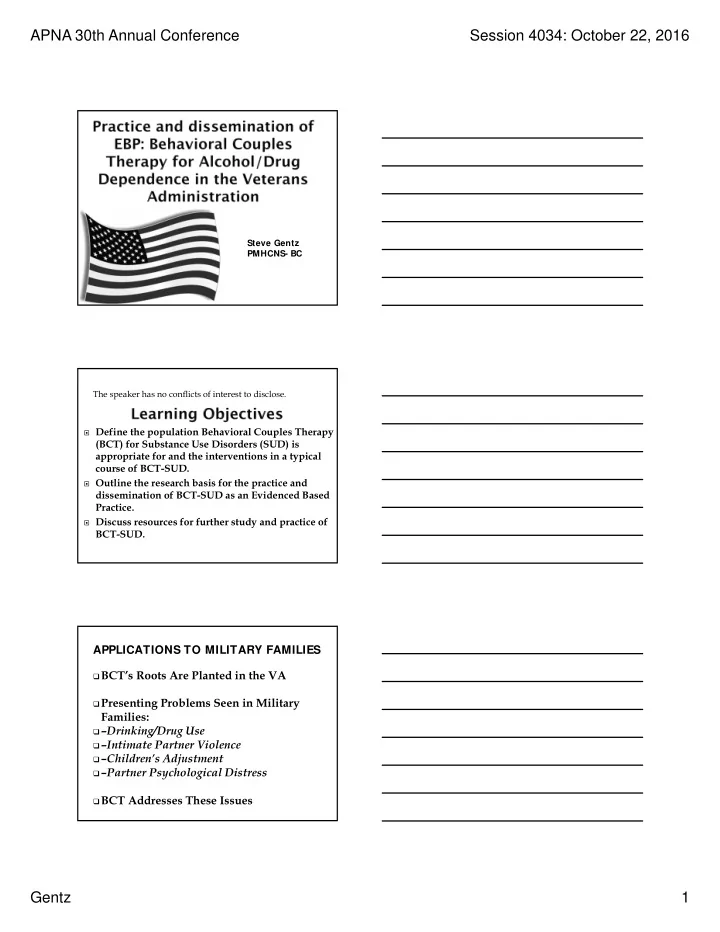
APNA 30th Annual Conference Session 4034: October 22, 2016 Steve Gentz PMHCNS- BC The speaker has no conflicts of interest to disclose. Define the population Behavioral Couples Therapy (BCT) for Substance Use Disorders (SUD) is appropriate


slide-1
SLIDE 1

APNA 30th Annual Conference Session 4034: October 22, 2016 Gentz 1

Steve Gentz PMHCNS- BC

 Define the population Behavioral Couples Therapy

(BCT) for Substance Use Disorders (SUD) is appropriate for and the interventions in a typical course of BCT-SUD.

 Outline the research basis for the practice and

dissemination of BCT-SUD as an Evidenced Based Practice.

 Discuss resources for further study and practice of

BCT-SUD.

The speaker has no conflicts of interest to disclose.

APPLICATIONS TO MILITARY FAMILIES

BCT’s Roots Are Planted in the VA Presenting Problems Seen in Military

Families:

–Drinking/Drug Use –Intimate Partner Violence –Children’s Adjustment –Partner Psychological Distress BCT Addresses These Issues

slide-2
SLIDE 2

APNA 30th Annual Conference Session 4034: October 22, 2016 Gentz 2

Research by O’Farrell

 Lower Levels of Drinking, Drug Use, and Other Related

Behaviors

 Higher Relationship Satisfaction  Lower Levels of Partner/Family Violence  Improved Children Adjustment  Better Emotional Adjustment for Family Members

 More abstinence and better relationship adjustment vs. individual treatment (medium effect in meta-analyses – Powers et al 2008; Meis et al 2013)  U.S. & U.K. government panels recommend BCT-SUD for use by substance abuse clinicians  Despite research support and policy maker’s guidance, BCT- SUD is not well-utilized.

 Survey of SUD treatment providers found BCT-

SUD was one of the least used of the EBPs surveyed (McGovern et al 2004)

 2010 national survey of 185 VA outpatient SUD

treatment programs found only 6 programs using BCT-SUD (Gifford 2012)

 Recent reviews say dissemination is highest

priority for BCT-SUD research (Meis et al 2013; O’Farrell & Clements 2012)

 30%+ of VA SUD pts live with a partner  BCT is NOT just for patients with obvious

relationship problems

 All patients with a partner may benefit

from BCT support for abstinence

 VHA Handbook says BCT-SUD an EBP that

VA should use for SUD pts

slide-3
SLIDE 3

APNA 30th Annual Conference Session 4034: October 22, 2016 Gentz 3

 Engage both members of the couple  Support abstinence with a Recovery Contract (a daily ritual

to reward abstinence) and other support for abstinence

 Improve relationship by increasing positive activities and

improving communication

 Continuing recovery and relapse prevention

SUBSTANCE USE FAMILY PROBLEMS

Denial, Poor Problem Solving, Cognitive Distortions, “checking out” Nagging, Fighting, “4 O’clock Happy Hour inadvertent Reinforcement of use

SUBSTANCE ABUSE RECOVERY HAPPIER RELATIONSHIPS

Communication Skills Training Positive Activities

Self-Help Support Recovery contract

Typical sequence of sessions

 BAL or urine screen  Review of urges/use in past week  Review of relationship problems/issues in

past week

 Promises  Review of last session, home practice and

perform trust discussion in session.

 New material- instruction, modeling, in-

session practice.

 Assign home practice:

slide-4
SLIDE 4

APNA 30th Annual Conference Session 4034: October 22, 2016 Gentz 4

“I have been drug and alcohol free for the last 24 hours and plan to remain drug and alcohol free for the next 24 hours. Thank you for listening and being supportive of my effort to be drug and alcohol free.” “Thank you for staying drug and alcohol free for the last 24 hours. Let me know how I can help during the next 24 hours.”

Client Partner

Daily Trust Discussion Formula

 Catch Your Partner Doing

Something Nice

 Shared Rewarding Activities  Caring Day Assignment

slide-5
SLIDE 5

APNA 30th Annual Conference Session 4034: October 22, 2016 Gentz 5

Filter

Mood- depression Anger Past experiences Stress

MESSAGE

Message Intended Message Received

Listening Skills Expressing Feelings Directly Communication Sessions

 Plan to talk privately, face-to face, without distractions

each giving the other full attention

 Plan three 10 minute sessions  Sit face-to-face  Choose a place where you will have privacy and no

distractions-TV, cell phones, radio.

 Start by acknowledging the caring behavior you

noticed that day then continue

 NEUTRAL OR POSITIVE TOPICS  Work together taking turns, decide who will be

speaker first.

 Speaker should be brief!!  Listener does not respond except to ask related

questions.

 PAY ATTENTION TO BODY LANGUAGE, TONE OF

VOICE, AND FILTERS.

 Negotiating for

Requests/Compromise

 Problem solving skills  Conflict, time-out, physical

aggression, flooding

slide-6
SLIDE 6

APNA 30th Annual Conference Session 4034: October 22, 2016 Gentz 6

Timothy O’Farrell, Jeremiah Schumm, Heidi Kar, Maryann Gnys, Shirley Glynn, Keith Klostermann

Evidence-Based Psychotherapy Training Program Mental Health Services, U.S. Dept. of Veterans Affairs

 4 training cohorts enrolled since Sept 2012  92 licensed therapists enrolled in program - mostly social

workers and psychologists

 74% of therapists completed all program requirements OVERVIEW:

Evaluation of Training Workshop Cohorts 3 & 4 Self-Efficacy Pre/Post Workshop Cohorts 3 & 4

Participant confidence across 3 therapy skill categories: General skills, BCT specific skills, and BCT Crisis Management

2.00 3.00 4.00 5.00 General Skills BCT Protocol Crisis Mgmt 4.50 4.14 3.97

4.93* 4.85* 4.70*

Degree of Confidence Competency Areas Pre Survey Post Survey

slide-7
SLIDE 7

APNA 30th Annual Conference Session 4034: October 22, 2016 Gentz 7

 N = 40 SUD patients in treatment at VA  Completed BCT by therapist in training during consultation

phase of training

 Average 50 years of age & 14 years education  Married or cohabiting for 15 years on average  SUD Diagnosis - over 80% alcohol, 55% other drugs  MH Diagnosis - 53% PTSD, 20% depression or anxiety

slide-8
SLIDE 8

APNA 30th Annual Conference Session 4034: October 22, 2016 Gentz 8

45 50 55 60 65 Baseline End of Treatment 54.54 60.57 Mean Score Couple Satisfaction Index - Patients

p = .056