Development of the Integrated Care Competency Assessment Tool - - PDF document

development of the integrated care competency assessment
SMART_READER_LITE
LIVE PREVIEW

Development of the Integrated Care Competency Assessment Tool - - PDF document

APNA 30th Annual Conference Session 3017: October 21, 2016 Development of the Integrated Care Competency Assessment Tool (ICCAT) APNA 30 th Annual Conference Hartford, CT Session #3017.2 October 21, 2016 Presenter Joyce Shea, DNSc, PMHCNS


slide-1
SLIDE 1

APNA 30th Annual Conference Session 3017: October 21, 2016 Shea 1

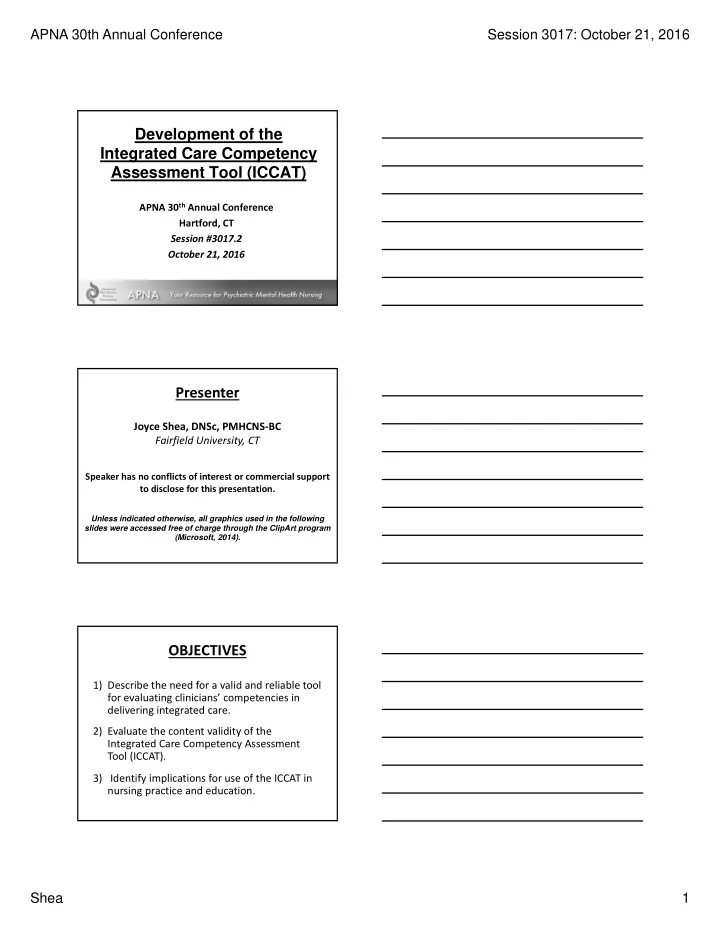
Development of the Integrated Care Competency Assessment Tool (ICCAT)

APNA 30th Annual Conference Hartford, CT Session #3017.2 October 21, 2016

Presenter

Joyce Shea, DNSc, PMHCNS‐BC Fairfield University, CT

Speaker has no conflicts of interest or commercial support to disclose for this presentation.

Unless indicated otherwise, all graphics used in the following slides were accessed free of charge through the ClipArt program (Microsoft, 2014).

OBJECTIVES

1) Describe the need for a valid and reliable tool for evaluating clinicians’ competencies in delivering integrated care. 2) Evaluate the content validity of the Integrated Care Competency Assessment Tool (ICCAT). 3) Identify implications for use of the ICCAT in nursing practice and education.

slide-2
SLIDE 2

APNA 30th Annual Conference Session 3017: October 21, 2016 Shea 2

Forces Shaping Integrated Care

  • Population-Based Needs

– BH Needs of Primary Care Clients – Primary Care Needs of BH Clients

  • Policy Development

– IOM (2006) – Agency for Healthcare Research & Quality (2008) – Affordable Care Act (2010)

Forces Shaping Integrated Care

  • Consumer Voices

– Patient Rights – Person-Centered Care – Shared Decision-Making

  • Disciplinary Perspectives

– Medicine, Psychology, Behavioral Health Providers – Nursing: Holistic Assessment, Integrated Care Planning – Statements on IC by APNA and American Academy

  • f Nursing (2013)

Models of Integrated Care

  • Four-Quadrant Clinical Integration

Model

– National Council for Community Behavioral Healthcare (2009)

  • Vertical and Horizontal Models

– Curry & Ham (2010)

  • Levels of Collaboration Model

– Center for Integrated Health Solutions (2013)

slide-3
SLIDE 3

APNA 30th Annual Conference Session 3017: October 21, 2016 Shea 3

Definition of Integrated Care (IC)

“The care that results from a practice team of primary care and behavioral health clinicians, working together with patients and families, using a systematic and cost‐effective approach to provide patient‐centered care for a defined population.”

(AHRQ, 2013, p. 2)

Evaluation of Integrated Care

  • Assessment of Organizational

Structure

– Stakeholder Buy-In, “Fit” with Mission & Vision, Resources

  • Assessment of Outcomes

– From Patient, Provider, and Organization Perspectives

  • Assessment of Provider Competencies

– Center for Integrated Health Solutions (2013)

Development of the ICCAT: Categories of Essential Competencies

  • Interpersonal

Communication

  • Collaboration and

Teamwork

  • Screening and

Assessment

  • Care Planning and

Care Coordination

  • Intervention
  • Cultural

Competence & Adaptation

  • Systems Oriented

Practice

  • Practice Based

Learning and QI

  • Informatics
slide-4
SLIDE 4

APNA 30th Annual Conference Session 3017: October 21, 2016 Shea 4

Development of the ICCAT: Establishing Content Validity

  • Original 24 items for the ICCAT derived from current

literature on best practices in integrated or collaborative care and from list of competencies under the CIHS Core Categories

  • Recruited 10 members for Expert Panel; represented a

variety of healthcare disciplines

  • Members asked to rate each item for relevancy and clarity
  • n a 4-point scale (Lynn, 1986)
  • Multi-stage Delphi technique used to arrive at consensus
  • n each proposed item
  • Content validity was determined to be established when

80% or more of the Expert Panel members expressed agreement with the items in the tool

Development of the ICCAT

  • Next steps
  • Trial with current FNP and PMHNP students
  • Establish baseline parameters
  • Employ to measure outcomes for HRSA grant
  • Trial with other healthcare disciplines (e.g. medicine,

psychology, social work)

  • Assessing Psychometrics
  • Factor Analysis
  • Internal Validity
  • Reliability

Implications for Nursing Education, Practice and Research

  • Role of measurement in practice and

education settings

  • Developing valid, reliable measures of required outcomes
  • Use of the ICCAT in Nursing Education
  • Measuring what students have learned/can demonstrate in practice

settings

  • Use of the ICCAT in Nursing Practice
  • Measuring the impact of advanced nursing practice in IC settings
  • Use of the ICCAT in future research
slide-5
SLIDE 5

APNA 30th Annual Conference Session 3017: October 21, 2016 Shea 5

Ques Questions?? tions?? Thank y Thank you!! u!!

Contact Information

jshea@fairfield.edu