APNA Recovery Resilience Innovations ABCS of Resilience APNA - - PDF document

apna recovery resilience innovations
SMART_READER_LITE
LIVE PREVIEW

APNA Recovery Resilience Innovations ABCS of Resilience APNA - - PDF document

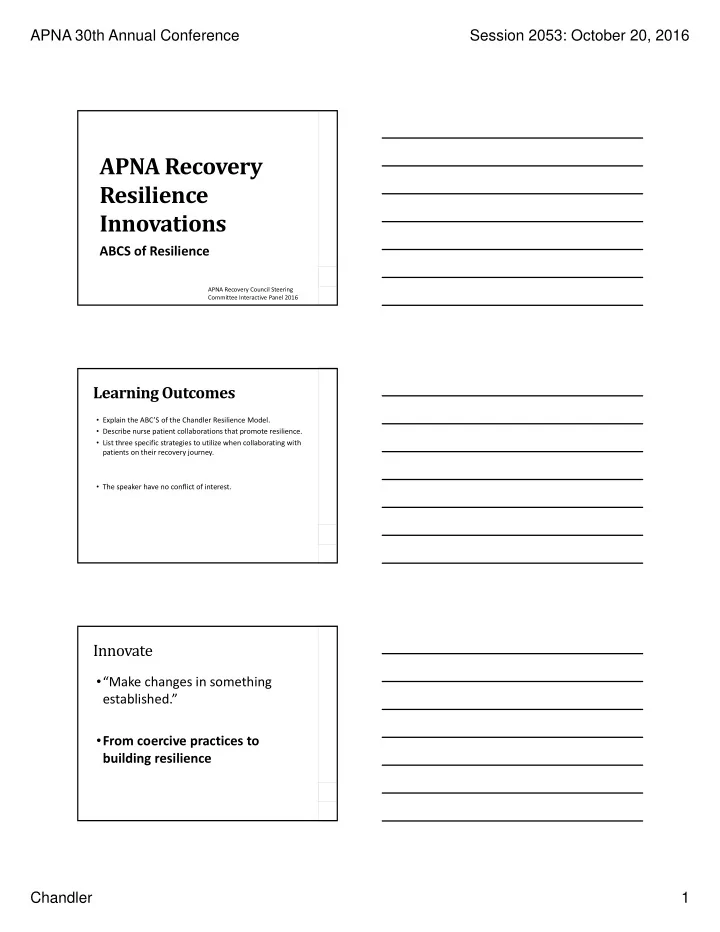
APNA 30th Annual Conference Session 2053: October 20, 2016 APNA Recovery Resilience Innovations ABCS of Resilience APNA Recovery Council Steering Committee Interactive Panel 2016 Learning Outcomes Explain the ABCS of the Chandler Resilience


slide-1
SLIDE 1

APNA 30th Annual Conference Session 2053: October 20, 2016 Chandler 1

APNA Recovery Resilience Innovations

ABCS of Resilience

APNA Recovery Council Steering Committee Interactive Panel 2016

Learning Outcomes

  • Explain the ABC’S of the Chandler Resilience Model.
  • Describe nurse patient collaborations that promote resilience.
  • List three specific strategies to utilize when collaborating with

patients on their recovery journey.

  • The speaker have no conflict of interest.

Innovate

  • “Make changes in something

established.”

  • From coercive practices to

building resilience

slide-2
SLIDE 2

APNA 30th Annual Conference Session 2053: October 20, 2016 Chandler 2

Focus on the Solution: moving from

problem focus to solution approach

  • Joining: getting to know the person in addition to the

diagnosis

  • Building: Collaborating to build skills to recover and adapt
  • What has worked in the past?
  • What are moments that work now?
  • What is a future that is preferred?
  • Extending: Creating opportunities to practice new skills and

increase social support.

McAllister, M. (2007). Solution focused nursing: Rethinking practice. New York, NY: Palgrave Macmillan.

How the ABCS of Resilience are encouraged in Recovery

  • Active Coping
  • Building Strength
  • Cognitive Awareness
  • Social Support

Chandler, G., Robert, S., & Chiodo, L. (2015). Resilience intervention for young adults with adverse childhood experiences. Journal of American Psychiatric Nursing Association, 21(6), 406‐416.

Active Coping

Activating Your Potential

slide-3
SLIDE 3

APNA 30th Annual Conference Session 2053: October 20, 2016 Chandler 3

“Between stimulus and response there is a space. In that space is our power to choose our response. In our response lies our growth and our freedom.”

Victor E. Frankl

Active vs Passive Coping Strategies

Active Coping

  • Refers to the utilization
  • f those psychological or

behavioral coping efforts that are characterized by an attempt to use one's

  • wn resources to deal

with a problem situation (Zeidner & Endler, 199).

Passive Coping

  • Refers to feeling

helplessness to deal with the stressor.

  • Relying on others to

resolve the stressful event or situation (Zeidner & Endler, 1996).

  • AVOIDANCE

It is All About Choice

  • Developing resilience is

a personal journey and a choice.

  • The ABC’S of Resilience
  • ffer multiple

strategies.

  • Avoidance may work for

a while, but doesn’t promote growth, evolution or expansion.

  • Active coping does.

Deepak Chopra. (n.d.). BrainyQuote.com. Retrieved August 20, 2016, from BrainyQuote.com Web site: http://www.brainyquote.com/quotes/quotes/d/deep akchop453986.html

slide-4
SLIDE 4

APNA 30th Annual Conference Session 2053: October 20, 2016 Chandler 4

Examples of Active Coping

Mindfulness Structured Writing Lifestyle

https://juliegeller.wordpress.com/2013/04/08/start‐where‐you‐are/

Mindfulness

Being present for what’s going on in your life with acceptance.

A Simple Mindfulness Practice Close your eyes and identify five sounds you hear in this moment “Just watch this moment, without trying to change it at all. What is happening? What do you feel? What do you see? What do you hear?” ― Jon Kabat‐Zinn

http://www.inspiredliving.com/relaxation‐products/inner‐peace.htm

Structured Writing

Amherst Writers and Authors Method: The Five Essential Practices

A non‐hierarchial spirit is offered. Safety is a priority Confidentiality is maintained. Privacy of the writer is protected. All writing is treated as fiction. Absolutely no criticism, suggestion or question is directed toward the writer

“ “ What I

at I am am good at...” good at...”

Today’s Prompt…..

slide-5
SLIDE 5

APNA 30th Annual Conference Session 2053: October 20, 2016 Chandler 5

Lifestyle

Pursue positivity Live to Learn Open Your Heart Take Care of Yourself Laugh

http://www.metamorphicjourneys.com/open‐your‐heart‐workshop‐evening/

Building Strength

What are you good at?

Strength based inquiry

  • What has worked in the past?
  • What works well now?
  • How do we help our patients build on what

they do well?

slide-6
SLIDE 6

APNA 30th Annual Conference Session 2053: October 20, 2016 Chandler 6

Cognitive Awareness

Aware of automatic thinking

Cognitive Awareness

  • Becoming cognizant of automatic thinking patterns in order to

be more flexible in responding “The basic question to ask when a patient is reporting a distressing situation, emotion, or dysfunctional behavior is, ‘What is going through your mind right now?’”

(Aaron Beck, www.beckinstitute.org)

How it Helps

distress

  • Experience distress
  • Locate distress in mind/body

awareness

  • Identify the automatic thought
  • Examine the evidence

relief

  • Choose a different thought
  • Experience relief
slide-7
SLIDE 7

APNA 30th Annual Conference Session 2053: October 20, 2016 Chandler 7

Resilience is Collaborative

Client Nurse

Words Matter

Thoughts

Actions

Words

Habit

Resiliency Includes Environment

Client

Nurse World

Physician &Support

Family & Community

slide-8
SLIDE 8

APNA 30th Annual Conference Session 2053: October 20, 2016 Chandler 8

Social Support

  • The most important task for all patients is to meet the separation

challenges of illness with attachment solutions.

  • Mount, Boston and Cohen 2007: Healing connections: on

moving from suffering to a sense of well‐being. Connections to 1) inner self, 2) OTHERS, 3) the natural world of the senses; and 4) to God or Ultimate Meaning. A movement in healthcare‐‐ Whole Person Care: preparing nurses to enhance the attachment solutions of their patients to the separation challenges of illness. This involves support of a patient’s healing process in which he/she grows toward a life with a greater sense of connection and meaning and a new relationship to suffering and separation.

Social Support –Attachment solutions

  • Maunder and Lauder, 2001

Stress!!! SeparationC hallenge Allostatic Loading Stress Response Systems

Brain Dissonance Cardiac Dissonance Imunollogic Dissonance

Social support network: Education and Planning

  • What types of support do you need and lack?
  • (Emotional support, practical support, spiritual support,

information and new points of view, good advice……)

  • Communicating your needs to current support people
  • Building social courage and outreach to others
  • Create new opportunities‐ “be a joiner”
  • Be patient with yourself and others
  • Let go of unhealthy ties and avoid negative relationships
  • Take good care of your relationships!
slide-9
SLIDE 9

APNA 30th Annual Conference Session 2053: October 20, 2016 Chandler 9

References

  • Chandler, G., Robert, S., & Chiodo, L. (2015). Resilience intervention for

young adults with adverse childhood experiences. Journal of American Psychiatric Nursing Association, 21(6), 406‐416.

  • Frankl, V. (1946). Man’s search for meaning. Boston, MA: Beacon Books.
  • Kabat‐Zin, J. (1994). Whereever you go there you are: Mindfulness

meditation in everyday life. New York, NY: Hyperion Books.

  • Maunder, RG and Hunter, JJ. Attachment and psychosomatic medicine:

development contributions to stress and disease. Psychosom. Med 2001, July‐Aug:63(4); 556‐67.

  • Mount, BM, Boston PH and Cohen, SR Healing connections: on moving

from suffering to a sense of well‐being Journal of Pain Management and symptom Management, 2007April: 33(4); 372‐388.

  • Schneider, P. (2003). Writing alone and with others. New York, NY:

Oxford University Press.

  • Zeidner, M. & Endler, N. (Eds.). (1996). Handbook of coping. Hoboken,

NJ: Wiley.