APNA 30th Annual Conference Session 2014: October 20, 2016 APNA 2016 - - PDF document

apna 30th annual conference session 2014 october 20 2016
SMART_READER_LITE
LIVE PREVIEW

APNA 30th Annual Conference Session 2014: October 20, 2016 APNA 2016 - - PDF document

APNA 30th Annual Conference Session 2014: October 20, 2016 APNA 2016 Annual Conference Jake Creviston , DNP, RN, PMHNP BC Michael Polacek , MSN, RN BC Participants w ill be able to: Creviston 1 APNA 30th Annual Conference Session 2014:


slide-1
SLIDE 1

APNA 30th Annual Conference Session 2014: October 20, 2016 Creviston 1

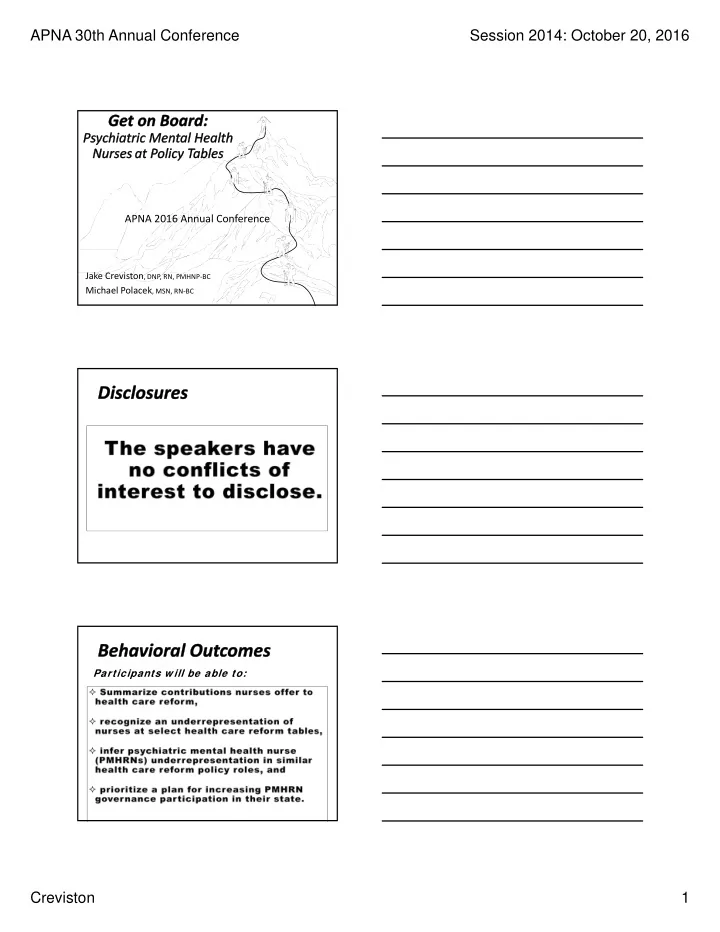
Jake Creviston, DNP, RN, PMHNP‐BC Michael Polacek, MSN, RN‐BC

APNA 2016 Annual Conference

Participants w ill be able to:

slide-2
SLIDE 2

APNA 30th Annual Conference Session 2014: October 20, 2016 Creviston 2

1840’s Sisters of Charity (initial ascent) The Nightingale Shift (progress and formalization) Contemporary Reforms (regrouping) State of the state (summit in view) Idealized leadership (summit!)

Nursing Leadership and Reformation (base camp)

 Healthcare Reform is a continual process  “History is revelation” (Libster & McNeil, 2009)  1840 Sister Matilda and Dr. Hughes Stokes open Mount Hope  Roles of the “nurse” and physician  Action evolves from care  Advices Concerning the Sick predated Notes on Nursing  Reformed care environment  Statistics and healthcare  Formal educational curriculum  Societal respect as a reformer

slide-3
SLIDE 3

APNA 30th Annual Conference Session 2014: October 20, 2016 Creviston 3

 Dix: advocacy for humane care  Barton: bedside to global care  Peplau: practice based on engagement  Bolton: leader in modern healthcare reform

 “Nurse‐Doctor Game” (Stein et al., 1967)  Oppressed‐group dynamics  Nurses underrepresented on boards

 2‐4% of hospital boards (Prybil, 2009)  2% of health care boards (Curran & Totten,

2010)

 To Err is Human (IOM, 2000)  Crossing the Quality Chasm (IOM, 2001)  Social Determinants of Health

(Commission on Social Determinants of health, 2008)

slide-4
SLIDE 4

APNA 30th Annual Conference Session 2014: October 20, 2016 Creviston 4

 The Triple Aim (Berwick, Nolan, &

Whittington, 2008)

 Affordable Care Act (PPACA,

2010)

 ACOs, CCOs and  behavioral health integration

 Future of Nursing (IOM, 2011)

 8 recommendations  4 key messages

 Interprofessional movement (IPEC, 2011)

 National  MHPA, TARP, Patrick Kennedy, the rules  Corrections: 16%‐24% SMI

(Durmont, et al., 2012)

 Oregon (MHA, 2015)  MH Statistics  Coordinated Care Organizations boards: 2.7% nurses (Creviston, 2015)  Oregon Strategic Plan: 18‐ member board 0 nurses

(OHA, 2015)

 Time, incentive, preparation, desire and lack of invitation limit maximal leadership (Creviston,

2015)

 Nurses least likely to drive reform (Khoury et

al., 2011) Fall warning, crevasses in area. ! Avalanche warning take alternative route. Watch out, winter storm ahead Caution high winds in area. Warning low oxygen levels.

!

But we are the most trusted profession 11 we have clinical and leadership expertise

  • ur leadership promotes patient outcomes 16

we are the largest segment of the workforce 15 and we are more successful in teams…10

slide-5
SLIDE 5

APNA 30th Annual Conference Session 2014: October 20, 2016 Creviston 5

 National Initiatives  Future of Nursing Campaign for Action  Nurses on Boards Coalition (10,000 nurses by 2020)  Culture of Health

 Oregon Initiatives

 Oregon Action Coalition; Nurses on Boards grant  ORAPNA Resource Center Scroll down to bottom and click appropriate link:

Now Now go go to to:

www.Nur .NursesOnBoar sesOnBoardsCoal sCoaliti tion.

  • n.org
slide-6
SLIDE 6

APNA 30th Annual Conference Session 2014: October 20, 2016 Creviston 6

Nurses are ideally prepared to contribute towards health care reform to optimize patient outcomes. We believe that nurses are crucial health care stakeholders. This requires participation at all leadership levels and nurses on EVERY BOARD!

Research:

 Measure nurse trustee impact on health

Prepare:

 Seek and provide governance mentorship and training  Start small e.g., nursing professional org

Participate:

 Promote national and local efforts  Join your state RWJF Action Coalition  Communicate via APNA member bridge  Follow the CampaignForAction.org

Do not wait for an invitation

Jake Creviston, DNP, RN, PMHNP‐BC

Assistant Professor Linfield Good Samaritan School of Nursing, Portland, Oregon

jcrevis@linfield.edu

Michael Polacek, MSN, RN‐BC

Professional Development Specialist, Salem Health, Oregon

fetchwood@gmail.com

slide-7
SLIDE 7

APNA 30th Annual Conference Session 2014: October 20, 2016 Creviston 7

  • 1. Berwick D.M., Nolan T.W., & Whittington, J. (2008). The triple aim: Care, health and
  • cost. Health Affairs 27(3):759‐769.
  • 2. Commission on Social Determinants of Health. (2008). Closing the gap in a

generation: Health equity through action on the social determinants of health. Final report of the commission on social determinants of health. Geneva, Switzerland: World Health Organization.

  • 3. Creviston, J. (2015). Doctor of Nursing Practice (DNP) perceptions of leadership

abilities in policy and governance: Clinical inquiry project. [Doctoral Scholarly Project]. Retrieved from http://digitalcommons.ohsu.edu/etd/3695/

  • 4. Dumont, D. M., Brockmann, B., Dickman, S., Alexander, N., & Rich, J. D. (2012). Public

health and the epidemic of incarceration. Annual review of public health, 33, 325.

  • 5. Institute of Medicine (IOM). (2001). Crossing the quality chasm: A new health system

for the 21st century. Washington, DC: National Academy Press.

  • 6. IOM. (2001). Crossing the quality chasm: A new health system for the 21st century.

Washington, DC: National Academy Press.

  • 7. Interprofessional Education Collaborative Expert Panel (IPEC). (2011). Core

competencies for interprofessional collaborative practice: Report of an expert

  • panel. Washington, D.C.: Interprofessional Education Collaborative.
  • 8. Khoury, C., Blizzard, R., Moore, L., & Hassmiller, S. (2011). Nursing leadership from

bedside to boardroom: A Gallup national survey of opinion leaders. Journal Of Nursing Administration, 41(7/8), 299‐305. doi:10.1097/NNA.0b013e3182250a0d

  • 9. Libster, M.M., & McNeil, B.A. (2009). Enlightened charity. Naperville, IL: Golden

Apple Publications

  • 10. Mental Health America. (2015). Parity or disparity: The state of mental health in

America 2015. Retrieved from www.mentalhealthamerica.net/sites/default/files/Parity%20or%20Disparity%20201 5%20Report.pdf

  • 11. Newhouse, R., Stanik‐Hutt, J., White, K., Johantgen, M., Bass, E., Zangaro, G., & ...

Weiner, J. P. (2011). Advanced practice nurse outcomes 1990‐2008: a systematic

  • review. Nursing Economic$, 29(5), 230‐251.
  • 12. Oregon Health Authority. (2015). 2015‐2018 behavioral health strategic plan. Oregon

Health Authority: Addictions and Mental Health Division. Retrieved from http://www.oregon.gov/oha/amh/CSAC%20Meeting%20Shedule/Behavioral%20Heal th%20Strategic%20Plan%202015‐2018.pdf

  • 13. Riffkin, R. (2014). Americans rate nurses highest on honesty, ethical standards.

Retrieved from http://www.gallup.com/poll/180260/americans‐rate‐nurses‐highest‐ honesty‐ethical‐standards.aspx

  • 14. Stein, L., Watts, D., & Howell, T. (1990). The doctor‐nurse game revisited. New

England Journal of Medicine, 322(8), 264

  • 15. U.S. Census Bureau. (2010). Table 616. Employed civilians by occupation, sex, race,

and Hispanic origin: 2010. Retrieved from https://www.census.gov/compendia/statab/2012/tables/12s0616.pdf

  • 16. Wong, C., Cummings, G., & Ducharme, L. (2013). The relationship between nursing

leadership and patient outcomes: a systematic review update. Journal Of Nursing Management, 21(5), 709‐724. doi:10.1111/jonm.12116