APNA 30th Annual Conference Session 2034: October 20, 2016 Using - - PDF document

apna 30th annual conference session 2034 october 20 2016
SMART_READER_LITE
LIVE PREVIEW

APNA 30th Annual Conference Session 2034: October 20, 2016 Using - - PDF document

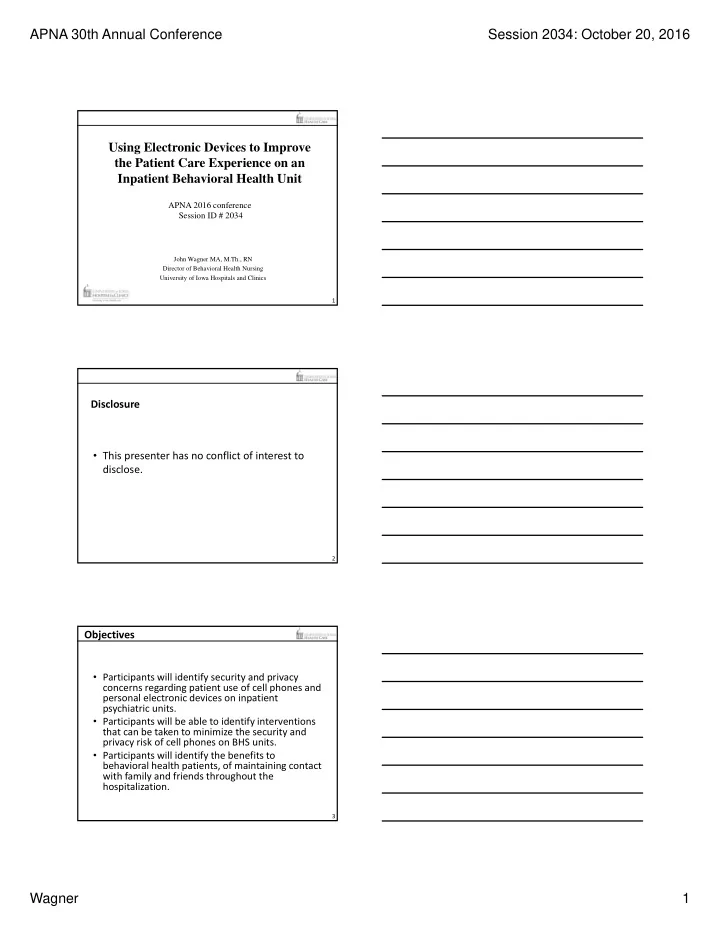
APNA 30th Annual Conference Session 2034: October 20, 2016 Using Electronic Devices to Improve the Patient Care Experience on an Inpatient Behavioral Health Unit APNA 2016 conference Session ID # 2034 John Wagner MA, M.Th., RN Director of


slide-1
SLIDE 1

APNA 30th Annual Conference Session 2034: October 20, 2016 Wagner 1

1

Using Electronic Devices to Improve the Patient Care Experience on an Inpatient Behavioral Health Unit

APNA 2016 conference Session ID # 2034

John Wagner MA, M.Th., RN Director of Behavioral Health Nursing University of Iowa Hospitals and Clinics 2

Disclosure

  • This presenter has no conflict of interest to

disclose.

3

Objectives

  • Participants will identify security and privacy

concerns regarding patient use of cell phones and personal electronic devices on inpatient psychiatric units.

  • Participants will be able to identify interventions

that can be taken to minimize the security and privacy risk of cell phones on BHS units.

  • Participants will identify the benefits to

behavioral health patients, of maintaining contact with family and friends throughout the hospitalization.

slide-2
SLIDE 2

APNA 30th Annual Conference Session 2034: October 20, 2016 Wagner 2

4

History of Cell Phones Development

  • 1992 The first digital cellphone
  • 1996 The first flip phone
  • 2002 The first camera phone
  • 2003 The first Blackberry
  • 2004 The first Smartphone
  • 2007 The first I-Phone

5

Adults in the USA who own a:

Cellphone Smartphone

  • 2002

64% 0%

  • 2004

68% 0%

  • 2008

78% 0%

  • 2010

82% 35%

  • 2012

84% 45%

  • 2014

90% 58%

  • 2015

92% 68%

6

Cellphones have become imbedded into the lives of many adults.

  • Much like individuals who smoke or drink

may experience varying withdrawal reactions when hospitalized

  • Loss of access to cell phones can cause anxiety

ranging from minimal to severe

slide-3
SLIDE 3

APNA 30th Annual Conference Session 2034: October 20, 2016 Wagner 3

7

Cellphone use by hospitalized patients

  • Once use was prohibited
  • Safety Concerns
  • Now use is common
  • Even expected
  • Tool to increase patient satisfaction
  • Avoidance of negative encounters
  • Maintain contact with friends and family

8

Smart phone use in hospitals?

Study done at a large hospital in California

  • 79% for Entertainment or Games
  • 48% Access their Personal Health Record (PHR)
  • 44% Read about Condition/Treatment
  • 29% Read about Providers
  • 27%Read about Hospital Polices

9

Use of cellphones by those with persistent mental illness

2014 Study involving over 1,500 individuals

  • 98.8% owned a mobile device
  • 91.6% used it to talk
  • 38.8% used it to text
  • 33.2% used it to access the internet
slide-4
SLIDE 4

APNA 30th Annual Conference Session 2034: October 20, 2016 Wagner 4

10

Things Change?

  • Most patients on BHS units own cellphones

– Of these, more and more are smart phones

  • BHS patients like to use their cell/smart phones
  • Just like everyone else
  • Not allowing access to cell phone causes issues
  • Don’t know the phone numbers of family and friends
  • Text is often the preferred method to communicate
  • View this restriction more and more as unacceptable

10 11

Why cellphones aren’t allowed on Behavioral Health Units

  • Confidentiality
  • Cameras
  • Sound recording
  • Expense
  • Perceived danger

12

Why Cell Phones aren’t allowed on BHS units (cont.)

  • Unforeseen consequences
  • Unknown Contacts
  • Illicit contacts
  • Loss of control
slide-5
SLIDE 5

APNA 30th Annual Conference Session 2034: October 20, 2016 Wagner 5

13

Why we considered change at UIHC

  • Patients were becoming increasingly affected
  • Staff spending more effort on this issue
  • An unnecessary restriction for most patients
  • Because of the concerns of a few
  • Inconsistent with other precautions
  • Suicide
  • Phone Restrictions
  • Sexually acting out behaviors

13 14

In the end, the difficulties were to great

  • Psychiatrists
  • Administration
  • Hospital Legal
  • Compliance
  • Security

And then it all changed with one visit And a strong partnership with Psychiatry

14 15

Cellphone Camera

  • Industrial Espionage Tape
  • Changes color when removed
  • Check the phones daily to determine if phone has

been removed

  • Zero tolerance for removal of strip
  • Collaboration with Hospital Legal and Security
  • Most Wired Hospital status is helpful

15

slide-6
SLIDE 6

APNA 30th Annual Conference Session 2034: October 20, 2016 Wagner 6

16

Develop patient cellphone expectations

  • All staff/disciplines need to be in agreement
  • Use of cellphone is a privilege not a right
  • No use of cellphones in groups
  • Camera strip must remain inplace
  • No use of sound recording
  • Patient cannot choose to use phone instead of

attending therapies

  • Assess every patient for risk
  • Sexually Acting Out Behaviors
  • Manic patients

16 17

Lessons learned from previous innovation

  • There is an expectation to determine what

success looks like

  • To determine an intervention
  • Measure the effect of the intervention
  • Evaluate the data
  • Make decisions improvements based on that data
  • The Iowa Model

17 18

Methodology of the Study

Established survey tool

  • Social and Emotional Loneliness Scale for Adults

UIHC developed survey tool

  • No survey tool existed to meet our needs
  • Developed for inpatient psychiatric unit
  • Measured perception of remaining connected
  • Measure connectedness to society

18

slide-7
SLIDE 7

APNA 30th Annual Conference Session 2034: October 20, 2016 Wagner 7

19

Methodology of the Study (cont.)

  • Pre and Post Survey Strategy
  • Magnet Project
  • One pre survey group
  • Three follow up survey groups
  • Survey population
  • Types of units involved
  • Types of patients

19 20

Results

20 21

Lessons Learned

21

slide-8
SLIDE 8

APNA 30th Annual Conference Session 2034: October 20, 2016 Wagner 8

22

Questions?

22