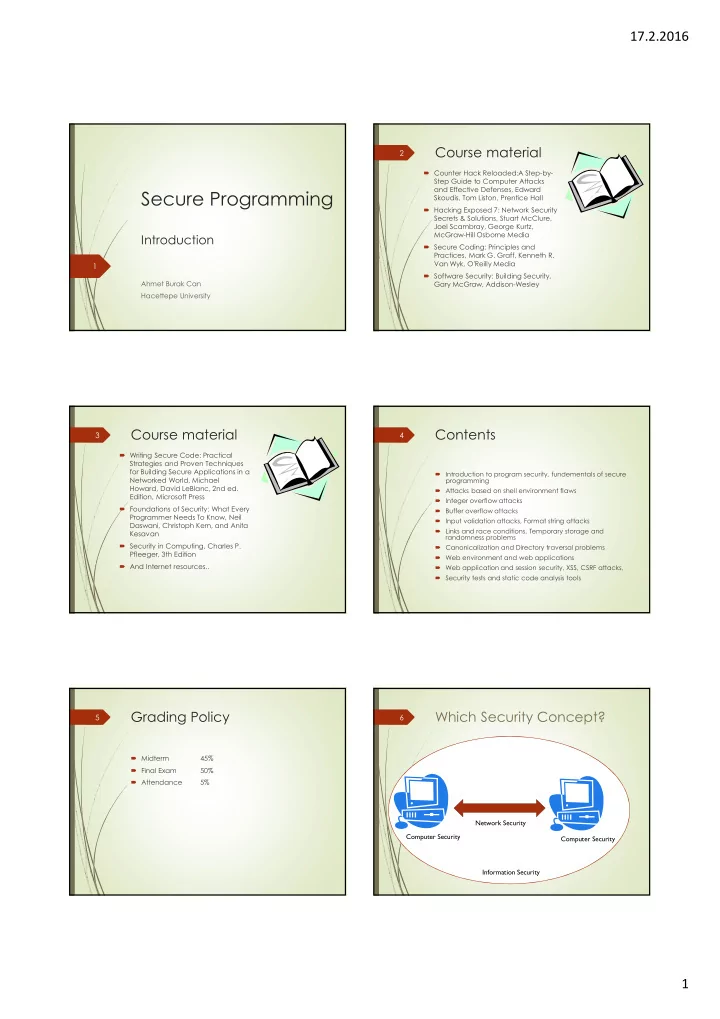
Secure Programming Skoudis, Tom Liston, Prentice Hall Hacking - - PDF document

secure programming
SMART_READER_LITE
LIVE PREVIEW

Secure Programming Skoudis, Tom Liston, Prentice Hall Hacking - - PDF document

17.2.2016 Course material 2 Counter Hack Reloaded:A Step by Step Guide to Computer Attacks and Effective Defenses, Edward Secure Programming Skoudis, Tom Liston, Prentice Hall Hacking Exposed 7: Network Security Secrets &


slide-1
SLIDE 1

17.2.2016 1

Secure Programming

Introduction

Ahmet Burak Can Hacettepe University

1

Course material

Counter Hack Reloaded:A Step by Step Guide to Computer Attacks and Effective Defenses, Edward Skoudis, Tom Liston, Prentice Hall Hacking Exposed 7: Network Security Secrets & Solutions, Stuart McClure, Joel Scambray, George Kurtz, McGraw Hill Osborne Media Secure Coding: Principles and Practices, Mark G. Graff, Kenneth R. Van Wyk, O'Reilly Media Software Security: Building Security, Gary McGraw, Addison Wesley

2

Course material

Writing Secure Code: Practical Strategies and Proven Techniques for Building Secure Applications in a Networked World, Michael Howard, David LeBlanc, 2nd ed. Edition, Microsoft Press Foundations of Security: What Every Programmer Needs To Know, Neil Daswani, Christoph Kern, and Anita Kesavan Security in Computing, Charles P. Pfleeger, 3th Edition And Internet resources..

3

Contents

Introduction to program security, fundementals of secure programming Attacks based on shell environment flaws Integer overflow attacks Buffer overflow attacks Input validation attacks, Format string attacks Links and race conditions, Temporary storage and randomness problems Canonicalization and Directory traversal problems Web environment and web applications Web application and session security, XSS, CSRF attacks, Security tests and static code analysis tools

4

Grading Policy

Midterm 45% Final Exam 50% Attendance 5%

5

Which Security Concept?

6

slide-2
SLIDE 2

17.2.2016 2

Security Goals

  • Privacy (secrecy, confidentiality)
  • nly the intended recipient can see the communication
  • Authenticity (integrity)

the communication is generated by the alleged sender

  • Authorization

limit the resources that a user can access

  • Availability

make the services available 99.999…% of time

  • Non repudiation

no party can refuse the validity of its actions

  • Auditing

Take a log of everything done in the system

7

Why Computer Security?

Computers are under attacks and suffer damages Who are the attackers?

bored teenagers, criminals, organized crime

  • rganizations, rogue states, industrial espionage,

angry employees, …

Why they do it?

enjoyment, fame, profit, … computer systems are where the moneys are

8

Computer Security Issues

Computer worms

E.g., Morris worm (1988), Melissa worm (1999)

Computer viruses Distributed denial of service attacks Computer break ins Email spams

E.g., Nigerian scam, stock recommendations

Identity theft Botnets Serious security flaws in many important systems

electronic voting machines

Spyware

9

How big is the security problem?

10

CERT Vulnerabilities reported

CERT Vulnerabities in 2012

11

https://www.us cert.gov/sites/default/files/US CERT_2012_Trends In_Retrospect.pdf

Why does this happen?

Lots of buggy software & wrong configurations...

Awareness is the main issue

Some contributing factors

Few courses in computer security Programming text books do not emphasize security Few security audits Unsafe program languages Programmers are lazy Consumers do not care about security Security may make things harder to use Security is difficult, expensive and takes time

12

slide-3
SLIDE 3

17.2.2016 3

What is This Course About?

Learn how to prevent attacks and/or limit their consequences.

No silver bullet; man made complex systems will have errors; errors may be exploited Large number of ways to attack Large collection of specific methods for specific purposes

Learn to think about security when doing things Learn to understand and apply security principles

13

Terminologies

Vulnerabilities (weaknesses) : A flaw in software, hardware, or a protocol that can be leveraged to violate security policies Threats (potential scenario of attack) Attack

Exploit (n) Code that takes advantage of a vulnerability Exploit (v) To use an exploit to compromise a system through a vulnerability

Controls (security measures)

14

Security Principles

Principle of weakest link Principle of adequate protection

Goal is not to maximize security, but to maximize utility while limiting risk to an acceptable level within reasonable cost

Principle of effectiveness

Controls must be used−and used properly−to be

  • effective. they must be efficient, easy to use, and

appropriate Psychological acceptability

Principle of defense in depth Security by obscurity doesn’t work 15

Layers of Computer Systems

Computer systems has multiple layers

Hardware Operating systems System software, e.g., databases Applications

Computer systems are connected through networks Computer systems are used by humans

16

Why old software can become insecure?

  • Security objectives or policies have changed

Laws have changed Business model changed Company processes changed

  • Environment has changed

Configuration is out of date Operating system has changed Risks are different Protections have changed (e.g., firewall rules) Employees, units responsibilities have changed

  • Vulnerabilities have been found

Exploits, worms, viruses exploit them

  • Input has changed

e.g., old application made to work online (with a wrapper) Protocol changed

17

Ethical use of security information

We discuss vulnerabilities and attacks

Most vulnerabilities have been fixed Some attacks may still cause harm Do try these at home

Purpose of this class

Learn to prevent malicious attacks Use knowledge for good purposes

Learn about cyber crimes:

https://tr.wikipedia.org/wiki/BiliLim_suçları http://www.atamer.av.tr/bilisim suclari/

18

slide-4
SLIDE 4

17.2.2016 4

Law enforcement

David Smith

Melissa virus: 20 months in prison

Ehud Tenenbaum (“The Analyzer”)

Broke into US DoD computers sentenced to 18 months in prison, served 8 months

Dmitry Sklyarov

Broke Adobe ebooks Arrested by the FBI, prosecuted under DMCA, stayed in jail for 20 days

Onur Kıpçak

http://www.hurriyet.com.tr/bilgisayar korsanina 135 yil hapis cezasi daha 40038386

19