APNA 30th Annual Conference Session 3012: October 21, 2016 - - PDF document

apna 30th annual conference session 3012 october 21 2016
SMART_READER_LITE
LIVE PREVIEW

APNA 30th Annual Conference Session 3012: October 21, 2016 - - PDF document

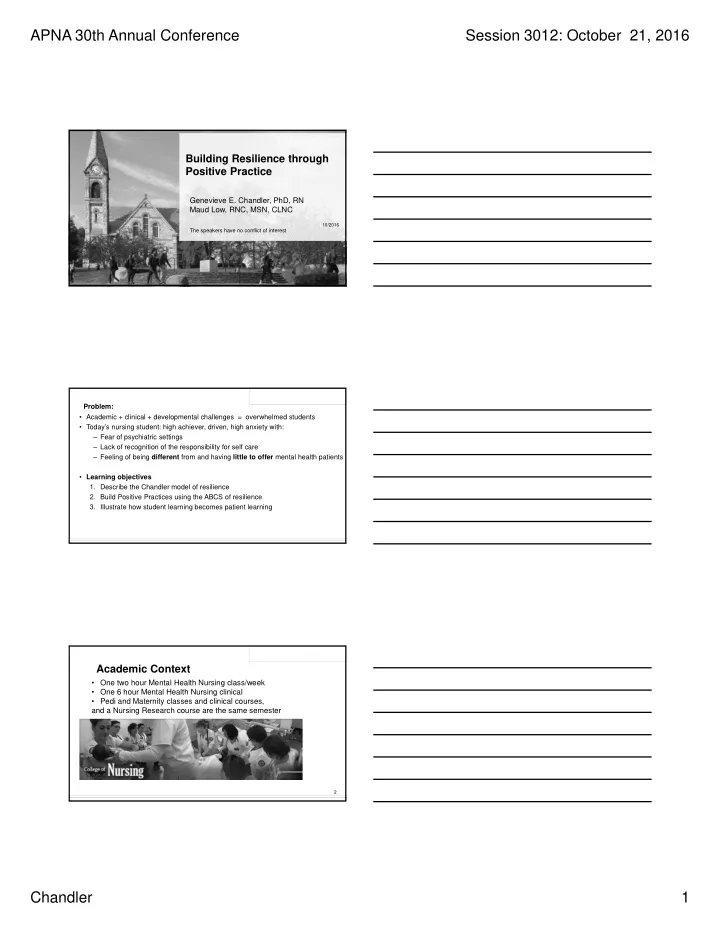
APNA 30th Annual Conference Session 3012: October 21, 2016 Building Resilience through Positive Practice Genevieve E. Chandler, PhD, RN Maud Low, RNC, MSN, CLNC 10/2016 The speakers have no conflict of interest Problem: Academic +


slide-1
SLIDE 1

APNA 30th Annual Conference Session 3012: October 21, 2016 Chandler 1

Genevieve E. Chandler, PhD, RN Maud Low, RNC, MSN, CLNC

The speakers have no conflict of interest

Building Resilience through Positive Practice

10/2016

Problem:

  • Academic + clinical + developmental challenges = overwhelmed students
  • Today’s nursing student: high achiever, driven, high anxiety with:

– Fear of psychiatric settings – Lack of recognition of the responsibility for self care – Feeling of being different from and having little to offer mental health patients

  • Learning objectives
  • 1. Describe the Chandler model of resilience
  • 2. Build Positive Practices using the ABCS of resilience
  • 3. Illustrate how student learning becomes patient learning

2

Academic Context

  • One two hour Mental Health Nursing class/week
  • One 6 hour Mental Health Nursing clinical
  • Pedi and Maternity classes and clinical courses,

and a Nursing Research course are the same semester

slide-2
SLIDE 2

APNA 30th Annual Conference Session 3012: October 21, 2016 Chandler 2

Student Context

– Society’s stigma of mental health issues, cultural biases

  • r beliefs about mental illness

– Personal or familial experiences with mental illness – Media depiction of mental health problem – Intra-professional stigma – Student limited life experiences

3 4

  • Poised for stress & protection
  • Experience-dependent neuroplasticity
  • Weekly positive practices: Neurons that fire

together, wire together

  • Tools are developed to collaborate with patients

Neuroscience

http://www.istockphoto.com/photo/the-cognitive-mind-gm490182054-75073341 Free photo

  • Students self care tool kit

– Develop positive practices through exercises – journaling about the experiences – feedback and support from faculty – Outcomes:

  • Increases self-knowledge
  • Strengthens efficacy with patients

Self-Care Resilience

Hanson, R. (2011) Just one thing. Oakland, CA: New Harbinger Publications.

slide-3
SLIDE 3

APNA 30th Annual Conference Session 3012: October 21, 2016 Chandler 3

6

ABCS of Resilience:

  • Active Coping
  • Building Strength
  • Cognitive Awareness
  • Social Support

Chandler, G., Robert, S., & Chiodo, L. (2015). Resilience intervention for young adults with adverse childhood experiences. Journal of American Psychiatric Nursing Association, 21(6), 406-416.

Active Coping

– Weekly practice assigned – Student defined active coping: eating, exercise, friends, mom – Journaling about positive practice – Listen for opportunity to assist patient to develop positive practices

7

Building strength

– Recognize character strengths in their journal about practices – Recognizing patients strengths support with practices – Collaborate with patient to recognize opportunities to challenge old thinking or reframe events – Integrate practice into daily routine

8

slide-4
SLIDE 4

APNA 30th Annual Conference Session 3012: October 21, 2016 Chandler 4

Cognitive Awareness

– Students recognize their automatic thinking – Mindfulness practice – Integrate positive practice into daily life – Support for patient in noticing their thought patterns, using positive practice

9

Social Support

  • Faculty empower student through positive feedback
  • Student emphasizes patient recognition of importance
  • f social support
  • Student empowers patient through positive feedback

10