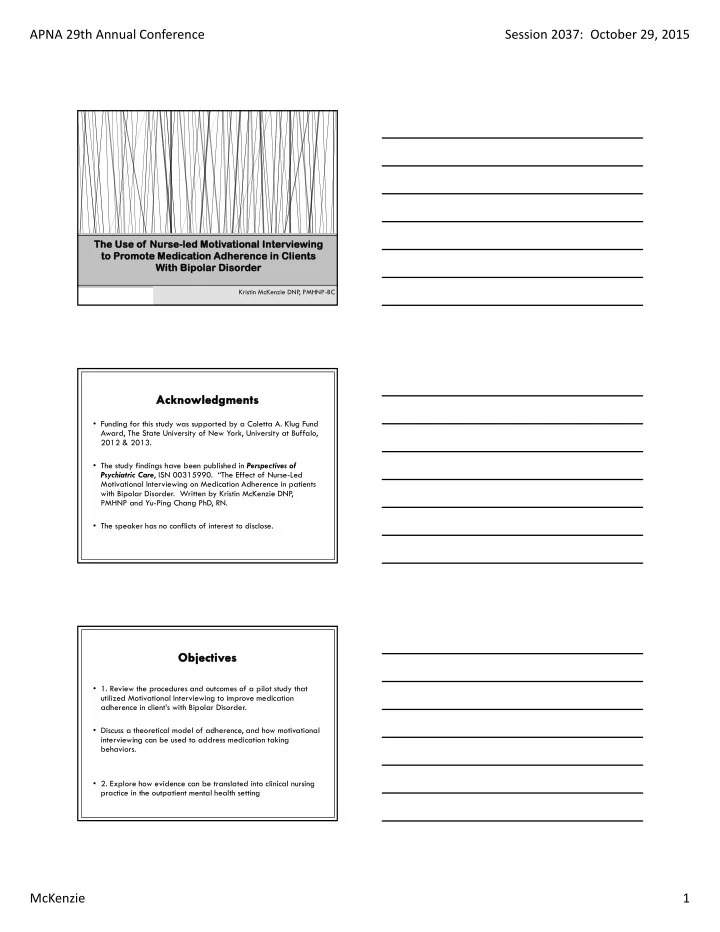
APNA 29th Annual Conference Session 2037: October 29, 2015 Kristin - - PDF document

apna 29th annual conference session 2037 october 29 2015
SMART_READER_LITE
LIVE PREVIEW

APNA 29th Annual Conference Session 2037: October 29, 2015 Kristin - - PDF document

APNA 29th Annual Conference Session 2037: October 29, 2015 Kristin McKenzie DNP , PMHNP-BC Funding for this study was supported by a Coletta A. Klug Fund Award, The State University of New York, University at Buffalo, 2012 & 2013.


slide-1
SLIDE 1

APNA 29th Annual Conference Session 2037: October 29, 2015 McKenzie 1

Kristin McKenzie DNP , PMHNP-BC

  • Funding for this study was supported by a Coletta A. Klug Fund

Award, The State University of New York, University at Buffalo, 2012 & 2013.

  • The study findings have been published in Perspectives of

Psychiatric Care, ISN 00315990. “The Effect of Nurse-Led Motivational Interviewing on Medication Adherence in patients with Bipolar Disorder. Written by Kristin McKenzie DNP , PMHNP and Yu-Ping Chang PhD, RN.

  • The speaker has no conflicts of interest to disclose.
  • 1. Review the procedures and outcomes of a pilot study that

utilized Motivational Interviewing to improve medication adherence in client’s with Bipolar Disorder.

  • Discuss a theoretical model of adherence, and how motivational

interviewing can be used to address medication taking behaviors.

  • 2. Explore how evidence can be translated into clinical nursing

practice in the outpatient mental health setting

slide-2
SLIDE 2

APNA 29th Annual Conference Session 2037: October 29, 2015 McKenzie 2

  • Bipolar Disorder (BD) treatment outcomes and prognosis are dependent upon

medication adherence, yet non-adherence rates average between 35-60% for this population. (Berk et al., 2010; Sajatovic, Valenstein, Blow, Ganoczy, & Ignacio, 2006; NIMH, 2008; Otto, Reilly-

Harrington, & Sachs, 2003; Scott & Tacchi, 2002; Stahl, 2009).

  • Lack of Evidence-based Nursing Interventions or Standards of Practice for

promoting medication adherence in outpatient psychiatry (APA, 2002; NIMH, 2008)

  • Need for an applicable nursing theory and model of adherence to support

further use of MI by psychiatric nurses * See Handout (Adamian, et al., 2004)

  • Four principles of MI:
  • 1. Express Empathy
  • 2. Develop Discrepancy
  • 3. Support Self Efficacy
  • 4. Roll with Resistance
  • The Spirit of MI:
  • Collaboration- Build rapport with empathy and understanding
  • Autonomy- Explore Internal Motivators + Barriers to Change
  • Evocation- Reflective statements, Empowerment, Praise
slide-3
SLIDE 3

APNA 29th Annual Conference Session 2037: October 29, 2015 McKenzie 3

Medication Adherence Rating Scale (MARS)

Sajatovic, et al. (2010), Thompson, et al. (2000).

Timeline Follow Back (TLFB)

Braithewait et al. (2005)

Motivational Rulers (MIR)

Miller & Rollnick (2002)

Self-Efficacy and Appropriate Medication use Scale (SEAMS) Risser, Jacobson, & Kripalani (2007) Patient Satisfaction Questionnaire

  • Aim 1: To measure changes in medication adherence by

comparing pre and post scores on the MARS & TLFB calendar during a one month MI intervention

  • Aim 2: To determine if the MIR and the SEAMS can

demonstrate change in scores collected over a three week intervention period.

  • Aim 3: To evaluate treatment satisfaction after three MI

sessions using the Participant Satisfaction Questionnaire

INTERVENTION

  • Exploratory Pretest-Posttest design
  • Intervention Manuscript used by PI during all 3 MI interventions.
  • Participant Packet sent home to complete during telephone sessions.
slide-4
SLIDE 4

APNA 29th Annual Conference Session 2037: October 29, 2015 McKenzie 4

4 week Motivational Interviewing intervention * See Handout

  • 1. MI Session 1: Onsite 1:1 intervention = 35-60 minutes
  • 2. MI Session 2: Telephone session = 10-25 minutes
  • 3. MI Session 3: Telephone session = 15-25 minutes
  • 4. Post-test: Onsite follow-up testing = 10-15 minutes

INTERVENTION

  • SAMPLE
  • 14 total participants received MI and completed post-test
  • All Caucasian, English speaking, w/Bipolar 1, 2 or NOS diagnosis
  • 11 Females, 4 Males
  • Age range 23-57 years old, with a mean age of 35 (11.1)
  • 80% (N=12) of subjects graduated from high school
  • DATA ANALYSIS
  • Descriptive Statistics: Measure of variability and central tendency
  • Paired Samples T-tests: Pre-Post data from MARS, TLFB, and SEAMS
  • Repeated measures ANOVA on Pre-Mid-Post data from MIR and SEAMS
slide-5
SLIDE 5

APNA 29th Annual Conference Session 2037: October 29, 2015 McKenzie 5

Study Outcomes

  • Aim 1: Review of the MARS and TLFB showed a significant increase in

medication adherence at 30 day post-test.

  • Aim 2: MIR showed a progressive ↑ in individual and total scores when

rating Importance, Motivation and Confidence to change medication taking

  • behavior. SEAMS demonstrated steady increase in scores over a 4 week

period

  • Aim 3: Overall Patient Satisfaction ranked between 4.6 and 5 /5= good

to very good ratings; reflecting level of comfort with PI and the PI sensitivity to their needs during intervention

  • Pre-intervention testing showed participants started with moderate medication

adherence scores on TLFB and MARS

  • Individual questions helped identify areas that needed change, which ultimately

resulted in improved medication adherence

  • Self-efficacy is a causal element of change, and breakdown of collected data

showed that self-evaluation skills and building confidence made a positive impact on adherence

  • Statistically Identified Barriers to Adherence:

Forgetfulness, Medication side effects, and Daily routine

Study Limitations

  • small homogenous sample
  • poor external and internal validity
  • lacking objective and longitudinal data
  • no double blind
slide-6
SLIDE 6

APNA 29th Annual Conference Session 2037: October 29, 2015 McKenzie 6

  • MI Techniques applied in this study:
  • Discuss past/current experiences along with personal beliefs about medication
  • Provide empathy; Recognize and praise “change talk”; Use reflective listening
  • Assess readiness to change; Assist personal goal development; Support Self-Efficacy
  • The SEAMS and MIR can identify progressive change throughout MI intervention, and

Pre/Post testing with MAR and TLFB can demonstrate change at one month follow-up

  • The application of fundamental elements of MI and the utilization of evidence-

based rating scales can improve medication adherence when used in outpatient psychiatry.

  • Motivational Interviewing Training: Nurses require adequate training for

the application of MI techniques in clinical practice

  • Future Nursing Research:

1. Expand clinical trials to provide a higher level of scientific evidence 2. Test and implement the use of medication adherence assessment tools

  • Client’s with Bipolar Disorder can change medication taking

behaviors after 3 brief MI interventions

  • This Pilot study contributes to current evidence that supports the

use of nurse-led motivational interviewing in outpatient mental health settings to improve medication adherence.

  • Need for further Nursing Research to inform clinical practice

and promote the use of MI techniques as a standard of care for

  • utpatient medication management
slide-7
SLIDE 7

APNA 29th Annual Conference Session 2037: October 29, 2015 McKenzie 7

Please take time to complete post-test questions, thank you

American Psychiatric Association (2002) Practice guideline for the treatment of patients with bipolar disorder (revision). American Journal of Psychiatry, 159: 1–50. Adamian, M. S., Golin, C. E., Shain, L. S., & DeVellis, B. (2004). Brief motivational interviewing to improve adherence to antiretroviral therapy: Development & qualitative pilot assessment of an intervention. AIDS Patient Care and STDs, 18(4), 229-238. Berk, L., Hallam, K. T., Colom, F., Vieta, E., Hasty, M., Macneil, C., & Berk, M. (2010). Enhancing medication adherence in patients with bipolar disorder. Human Psychopharmacology: Clinical & Experimental, 25(1), 1-16. Braithwaite, R. S., McGinnis, K. A., Conigliaro, J., Maisto, S. A., Crystal, S., Day, N., . . . Justice, A. C. (2005). A temporal and dose-response association between alcohol consumption and medication adherence among Veterans in care. Alcoholism: Clinical and Experimental Research, 29(7), 1190-1197. DiClemente, C. C., Nidecker, M., & Bellack, A. S. (2008). Motivation and the stages of change among individuals with severe mental illness and substance abuse disorders. Journal of Substance Abuse Treatment, 34(1), 25-35. Garfinkle, P.E., & Goldbloom, D.S. (2000). Mental health- getting beyond stigma and categories. Bulletin of the World Health Organization, 78: 503-505. Miller, W.R., & Rollnick, S. (2002). Motivational Interviewing: Preparing people for change (2nd ed.). New York, NY: The Guildford Press. National Institute of Mental Health (2008). Bipolar Disorder. U.S. Department of Health and Human

  • Services. http://nimh.nih.gov/health/publications/bipolar-disorder/index.shtml.

Otto, M. W., Reilly-Harrington, N., & Sachs, G. S. (2003). Psychoeducational and cognitive behavioral strategies in the management of bipolar disorder. Journal of Affective Disorders, 73(1), 171-181. Risser, J., Jacobson, T. A., & Kripalani, S. (2007). Development and psychometric evaluation of the Self Efficacy for Appropriate Medication Use Scale (SEAMS) in low literacy patients with chronic disease. Journal of Nursing Measurement,15(3),203-219 Sajatovic, M., Valenstein, M., Blow, F. C., Ganoczy, D., & Ignacio, R. V. (2006). Treatment adherence with antipsychotic medications in bipolar disorder. Bipolar Disorders, 8(3), 232-241. Sajatovic, M., Velligan, D. I., Weiden, P. J., Valenstein, M. A., & Ogedegbe, G. (2010). Measurement

  • f psychiatric treatment adherence. Journal of Psychosomatic Research, 69(6), 591-599.

World Health Organization (WHO). (2003). Adherence to long-term therapies: Evidence for action. Geneva: WHO.