APNA 29th Annual Conference Session 2033.2: October 29, 2015 - - PDF document

apna 29th annual conference session 2033 2 october 29 2015
SMART_READER_LITE
LIVE PREVIEW

APNA 29th Annual Conference Session 2033.2: October 29, 2015 - - PDF document

APNA 29th Annual Conference Session 2033.2: October 29, 2015 Distinguishing Warning S igns and Risk Factors of S uicide for Teens Using the APNA Psychiatric Nurse Essential Competencies for Assessment and Management of Individuals at Risk for


slide-1
SLIDE 1

APNA 29th Annual Conference Session 2033.2: October 29, 2015 Puntil 1

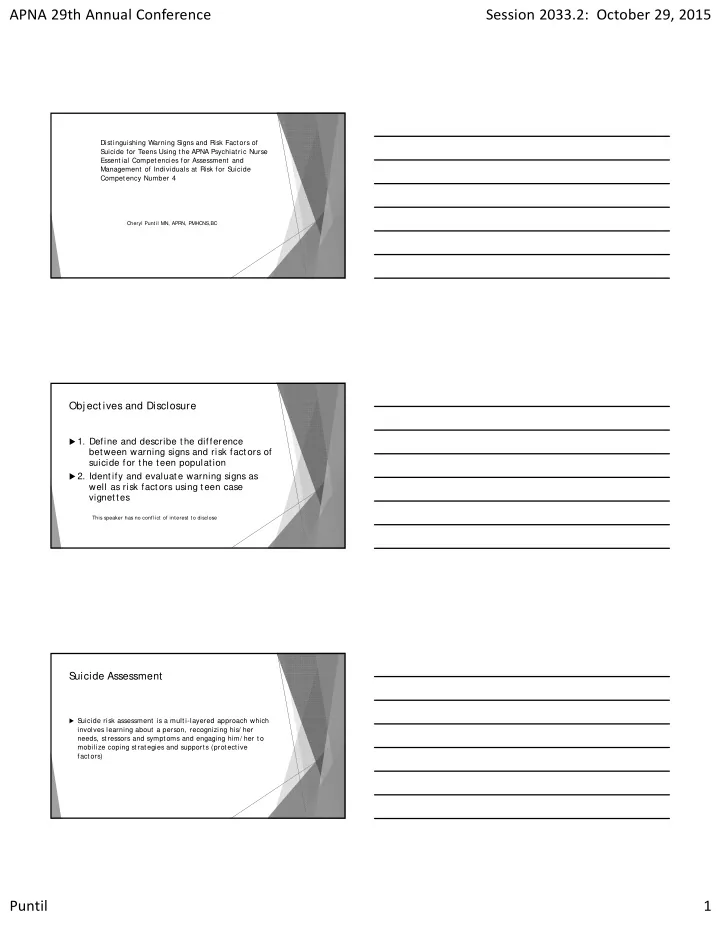
Distinguishing Warning S igns and Risk Factors of S uicide for Teens Using the APNA Psychiatric Nurse Essential Competencies for Assessment and Management of Individuals at Risk for S uicide Competency Number 4

Cheryl Puntil MN, APRN, PMHCNS ,BC

Obj ectives and Disclosure

 1. Define and describe the difference

between warning signs and risk factors of suicide for the teen population

 2. Identify and evaluate warning signs as

well as risk factors using teen case vignettes

This speaker has no conflict of interest to disclose

S uicide Assessment

 S

uicide risk assessment is a multi-layered approach which involves learning about a person, recognizing his/ her needs, stressors and symptoms and engaging him/ her to mobilize coping strategies and supports (protective factors)

slide-2
SLIDE 2

APNA 29th Annual Conference Session 2033.2: October 29, 2015 Puntil 2

Thoughts to consider about teens

 S

uicide is the third leading cause of death among persons aged 10-14, the second among persons aged 15-34 years, … .(CDC,2013)

 Often related to depression and anxiety and feeling trapped

with no way out.

 The difference between boys and girls  Consider the developmental level  Bullying and the Internet  Contagious Factors- exposure to friends or family members

suicide

 LGBT youth

Definitions

 Risk Factors-

refer to personal or environmental characteristics that are associated with suicide. The environment includes social and cultural environment as well as the physical environment. (S AMHS A, 2012)

 Warning Signs-

are factors that may set into motion the process of suicide in the short term ( ie: minutes and days) Warning signs present tangible evidence to the clinician that a person is at a heightened risk of suicide in the short term.

Warning signs of teen suicide

Disinterest in favorite extracurricular activities

Problems at work and losing interest in a j ob

Substance abuse, including alcohol and drug (illegal and legal drugs) use

Behavioral problems

Withdrawing from family and friends

Sleep changes

Changes in eating habits

Begins to neglect hygiene and other matters of personal appearance

Emotional distress brings on physical complaints (aches, fatigues, migraines)

Hard time concentrating and paying attention

Declining grades in school

Loss of interest in schoolwork

Risk taking behaviors

Complains more frequently of boredom

Does not respond as before to praise

slide-3
SLIDE 3

APNA 29th Annual Conference Session 2033.2: October 29, 2015 Puntil 3

Teen S uicide Warning S igns: indications of a suicide plan

There are some things that teens might do that could indicate that they are contemplating, or even planning, suicide. It is important that you make yourself aware of these actions, and use them as starting points to draw your teenager out and perhaps express what is bothering him or

  • her. Here are some of the indications of a suicide plan:
  • Actually says, “I’m thinking of committing suicide” or “I want to kill myself” or “I wish I could die.”
  • There are also verbal hints that could indicate suicidal thoughts or plans. These include such

phrases as: “I want you to know something, in case something happens to me” or “I won’t trouble you anymore.”

  • Teenager begins giving away favorite belongings, or promising them to friends and family

members.

  • Throws away important possessions.
  • Shows signs of extreme cheerfulness following periods of depression.
  • Creates suicide notes.
  • Expresses bizarre or unsettling thoughts on occasion.

Protective Factors can buffer the effects

  • f risk factors

 Family and S chool Connectedness  Academic achievement  S elf esteem  Friends are often the first to know  Coping skills, including conflict resolution and non violent handling of disputes  S piritual faith or regular church attendance  Restricted access to firearms, over the counter medications and prescriptions  Restricted access to alcohol  Test your knowledge and identify the risk factors , warning signs and imminent risk.

References

APNA Psychiatric-Mental Health Nurse Essential Competencies for Assessment and Management of Individuals at Risk for S uicide retrieved 10-6-2015 from: http:/ / www.apna.org/ files/ public/ Resources/ S uicide% 20Competencies% 20f

  • r%

20Psychiatric-Mental% 20Health% 20Nurses(1).pdf CDC S uicide Facts at a Glance retrieved 10-6-2015 from http:/ / www.cdc.gov/ violenceprevent ion/ pdf/ suicide-datasheet-a.pdf Centers for Disease Control and Prevention (CDC). Web-based Inj ury S tatistics Query and Reporting S ystem (WIS QARS) [Online]. (2013, 2011) National Center for Inj ury Prevention and Control, CDC (producer). Available from www.cdc.gov/ inj ury/ wisqars/ index.html. National Institute of Mental Health S uicide S tatistics retrieved 10-6-2015 from: http:/ / www.nimh.nih.gov/ health/ topics/ suicide-prevent ion/ index.shtml#part _149722 S ubstance Abuse and Mental Health S ervices Administration. Preventing S uicide: A Toolkit for High S

  • chools. HHS

Publication No. S MA-12-4669. Rockville, MD: Center for Mental Health S ervices, S ubstance Abuse and Ment al Health S ervices Administration, 2012. Teen Warning S igns and Teen Indications of a S uicide Plan retrieved 10-6-2015 from: http:/ / www.teensuicide.us/ articles2.html-