anyone? Edible-bovine-cell burgers, anyone? Potential regulatory - - PowerPoint PPT Presentation

anyone
SMART_READER_LITE
LIVE PREVIEW

anyone? Edible-bovine-cell burgers, anyone? Potential regulatory - - PowerPoint PPT Presentation

anyone? Edible-bovine-cell burgers, anyone? Potential regulatory pathways for lab made meat in Canada Dr. Don Buckingham, President and CEO of CAPI Presentation to the CFAs Committee on Lab Made Commodities Quebec City, Quebec Monday,


slide-1
SLIDE 1

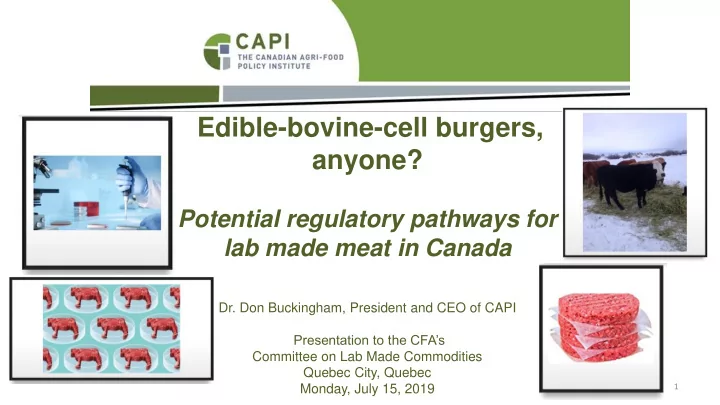
anyone? Edible-bovine-cell burgers, anyone?

Potential regulatory pathways for lab made meat in Canada

  • Dr. Don Buckingham, President and CEO of CAPI

Presentation to the CFA’s Committee on Lab Made Commodities Quebec City, Quebec Monday, July 15, 2019

1

slide-2
SLIDE 2

My ag and food roots are showing …

2

slide-3
SLIDE 3

Overview of session

Who we are? What we do? So what?

About CAPI

Clean, cultured, synthetic & fake

Name-calling

What it is and how it is made?

In vitro meat and some tech challenges

Existing structures and new directions

Regulatory possibilities

“Celebrity Status” or “Monsanto Blues – Part 2”

Public trust

A B C D E

3

slide-4
SLIDE 4

Who is CAPI?

  • FORMED in 2004 as an independent, neutral agricultural policy

think tank consolidating sound research and stimulating thinking about policy issues for a more viable Canadian agriculture and food sector

  • VISION: providing global leadership in trusted sustainable

agriculture and food systems that enhance the health, wealth and well-being of Canadians

  • MISSION: leading, catalyzing and coordinating independent

strategic and policy analysis on emerging agri-food issues, engaging stakeholders in dialogue, and advancing public policy

4

slide-5
SLIDE 5

How do we operate?

  • Core Professional Staff (in Ottawa)
  • Board of Directors (with deep experience and expertise in all

parts of the agri-food value chain)

  • Advisory Committee (for general and specific value-chain

insights)

  • Full, Associate and Honourary Members (for particular insights)
  • Leveraged Researchers (for academic and policy contributions)

5

slide-6
SLIDE 6

Looking forward

  • Concentrating our efforts under 4 primary and 1 cross-cutting pillars

* Enhancing Natural Capital * Optimizing Growth * Facilitating Trade * Securing Public Trust * Innovation and Uptake of Technology

  • Channelling our policy research through:

* Promoting dialogue among agri-food stakeholders * Synthesizing research and policy approaches * Completing “gap” research

  • An active, engaged, neutral think-network for agri-food

6

slide-7
SLIDE 7

Name-calling – What is “meat”? What is “lab-made meat”?

7

Meat

– Oxford English Dictionary – “the flesh of an animal or bird eaten as food” – (CAN) Food and Drug Regulations – “the edible part of the skeletal muscle of an animal that was healthy at the time of slaughter” (s. 14.002)

Meat product

– (CAN) Safe Food for Canadians Regulations – “the carcass of a food animal, the blood of a food animal or a product or by-product of its carcass or any food that contains the blood of a food animal or a product or by- product of its carcass” (s. 1)

Lab made meat – (also known as cultured meat, in vitro meat, synthetic meat, cellular meat, cell-cultured meat, clean meat, fake

meat) – is it meat? (Plant-based “meats” are another story)

slide-8
SLIDE 8

Proteins “Wars” – Really?

8

  • The players
  • Conventional animal meat protein
  • Plant-based meat replacement protein
  • Cellular lab made meat protein
  • The current state of play
  • Animal protein replacement market currently at

less than 1% but growing

  • Strong social media, marketing and $$ push
  • No commercially-available lab made meat yet
  • The challenges
  • Taste and price
  • Technological hurdles to scaling up
  • Regulatory environment
  • Consumer uptake

5.8. Challenges in agri-food sector

slide-9
SLIDE 9

Lab-made meat – why it is a news and investment phenomenon

9

  • Promises
  • Resolution of animal welfare

issues

  • Elimination of GHG emissions

and biodiversity benefits through displacement of conventional meat animals

  • Potential for designer health and

nutrition outcomes for humans

slide-10
SLIDE 10

Brewing up lab meat – what you need

10

  • Starter cells
  • A medium with nutrients
  • An oxygenator
  • A scaffold
  • A bioreactor
  • A collection system
slide-11
SLIDE 11

Brewing up lab meat – it’s a bit complicated!

11

  • Starter cells
  • A medium
  • An oxygenator
  • A scaffold
  • A biogenerator
  • A collection system
slide-12
SLIDE 12

12

1. Current regulatory scheme is sufficient

  • Two avenues
  • lab made meat is “meat”

like conventional meat

  • Lab made meat is a

“novel” food 2. Regulatory scheme will need to create a new process for approval of lab made meat 3. At very least, regulatory amendments will be required Regulatory Possibilities in Canada

slide-13
SLIDE 13

13

  • Approvals of “Novel Foods”
  • No provision for animals

yet in Canada

  • Adapting plant and

microbial provisions

  • What are the Americans

doing?

Future Meat Technologies Animal Free, Earth Friendly

slide-14
SLIDE 14

14

Meeting the standard of “novel” food

  • “Novel” because:
  • Lab made meat won’t be

considered to fit definition of “meat”

  • Components of lab made

meat are novel

  • Processes of lab made meat

are novel

  • Lab made meat will rely on

GM components

slide-15
SLIDE 15

15

  • Licencing and inspection of

production facilities

  • Naming and labelling
  • Instructions for use and post-

purchase care of product

  • Applying these rules to imports

Ongoing Regulatory Structures for all Meat

slide-16
SLIDE 16

16

  • Taste
  • Cost
  • Fulfillment of claims re:
  • GHG emissions
  • Safety
  • Health and nutrition
  • Hype and investment
  • The “GMO shadow”
  • Push-back from conventional producers

Uptake of lab made meat and public/consumer trust

slide-17
SLIDE 17

CAPI - ICPA buckinghamd@capi-icpa.ca www.capi-icpa.ca @CdnAgriFood

CHECK OUT OUR WEBSITE EMAIL ME FOLLOW US ON SOCIAL MEDIA

How can CAPI help?

Thanks for your attention.