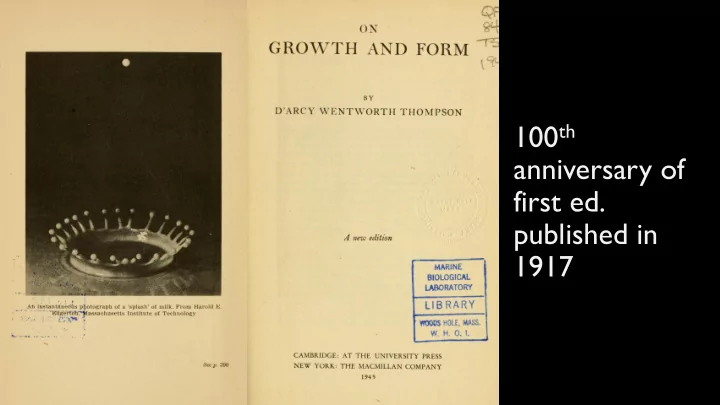
anniversary of first ed. published in 1917 About physical laws - - PowerPoint PPT Presentation
100 th anniversary of first ed. published in 1917 About physical laws and forces governing biological form Pioneered the use of math in biology First ed. in 1917, second in 1942 (won an award from the US National Academy of
- About physical laws and forces governing biological form
- Pioneered the use of math in biology
- First ed. in 1917, second in 1942 (won an award from the US
National Academy of Sciences)
- Very influential (cited over 7000 times, reprinted over forty
times since first ed.); influenced: biologists, mathematicians, architects, engineers, artists
- Praised for being well written
- Criticized for lack of recognition of evolutionary forces
- Overall: a classic, a pioneering work
D’Arcy Wentworth Thompson
- 1860-1948
- Scottish
- Professor of Natural History at University College, Dundee for 32
years, then St Andrews for 31 years
- Created Zoology Museum for teaching a research, Uni. of Dundee
- Published around 300 articles and books, most important being:
- “On growth and form”
- Translation from Greek of Aristotle’s “History of animals”
- Glossaries of Greek birds and fishes
- Received many honors and awards, knighted
- Extracurricular activities (e.g., served on committee of management
- f Dundee Private Hospital for Women)
Dundee
Chapter 15: On the shape of eggs and other hollow structures
Harvard Museum of Comparative Zoology
Chapter 9: On concretions, spicules, and specular
Van Soest RWM et al 2012 PLoS ONE www.spongeguide.org
Chapter 11: The logarithmic spiral
Morn the Gorn, www.Wikipedia.org Luiz Real, commons.Wikimedia.org
Concept word:
FORCES
- Physical forces that determine biological form
- They are invisible but we can infer about them from observation of forms
- Can be described using mathematical language
Why?
- Because they are real
- And affect EVERYTHING inside us and around us
- Allow us to better understand the world we live in
- Without this understanding, we would still live in caves
Spare slides
Common murre Quail, ostrich, chicken www.indianexpress.com Spur-winged lapwing
Chris 73, Wikipedia.org
Chapter 17: On the Theory of Transformations, or the Comparison of Related Forms
Thompson illustrated the transformation of Argyropelecus
- lfersi into Sternoptyx diaphana by applying a shear mapping.
www.wikipedia.org Durer, www.wikipedia.org
Radiolaria sceletons (one-cell organisms) drawn by Ernst Haeckel, 1904
- www.knowyourmeme.com