
SLIDE 1
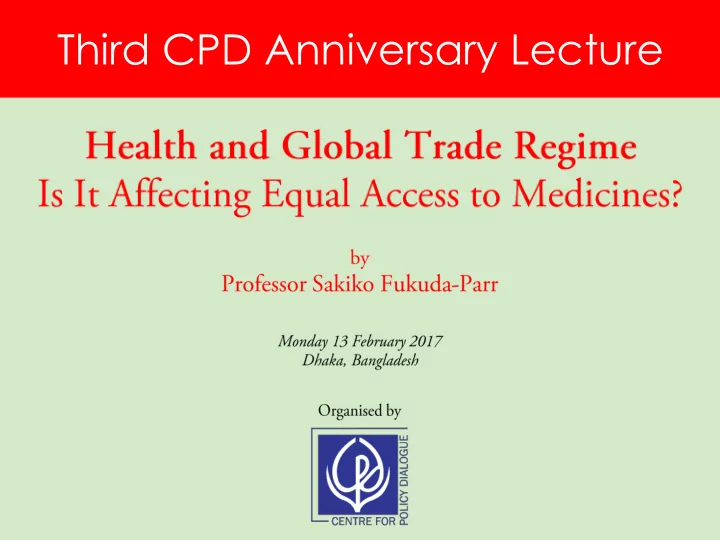
Third CPD Anniversary Lecture Third CPD Anniversary lecture Trade - - PowerPoint PPT Presentation
Third CPD Anniversary Lecture Third CPD Anniversary lecture Trade and Health SAKIKO FUKUDA-PARR P R O F E S S O R O F I N T E R N A T I O N A L A F F A I R S T H E N E W S C H O O L , N E W Y O R K C E N T R E F O R P O L I C Y D I A
SAKIKO FUKUDA-PARR
P R O F E S S O R O F I N T E R N A T I O N A L A F F A I R S T H E N E W S C H O O L , N E W Y O R K C E N T R E F O R P O L I C Y D I A L O G U E , D H A K A 1 3 F E B R U A R Y , 2 0 1 7
C O N S E Q U E N C E S F O R G L O B A L H E A L T H I N E Q U A L I T Y
US AFL-CIO
http://www.aflcio.org/Issues/Trade/Trans-Pacific-Partnership-Free-Trade- Agreement-TPP Joseph Stiglitz (Nobel laureate)
https://www.theguardian.com/business/2016/jan/10/in-2016-better-trade- agreements-trans-pacific-partnership
1948 – GATT: reduction in tariffs 1994 - WTO multilateral agreements: tariffs plus ‘behind the border’ issues e.g. TRIPS,
sanitary and phytosanitary measures, services, etc. that affect investment.
2001 – Doha Round: development agenda e.g. agricultural support in US, EU.
Negotiations stalled since 2008.
2000’s – Proliferation and importance of bilateral and regional trade agreements,
especially led by the US with broader agendas: more ‘behind the border’ investment provisions.
2016 – Bilateral and Regional FTAs (TISA, RCEP, CETA, EU-ASEAN, EU-India...) and
Mega regional agreements: Trans Pacific Partnership Agreement (TPP) agreed, TTIP under negotiations – overtaking the WTO agreements with strong ‘behind the border’ provisions
2017 – demise of TPP/TTIP, uncertainty, bilateral agreements?
Scope and depth: no longer about tariffs and trade, more
Format: bilateral/regional not multilateral (WTO) - less
Process: negotiated in secret, not subject to political
Implications: more intrusive to national policy making e.g.
30 chapters - Only 5 on trade 25 chapters on “regulatory discipline” in international
Provides unprecedented rights of market access, investment
Process – negotiated in secrecy, lack of public consultation. Confidential to Congress and public. Of the 566 individuals involved, private industry and trade groups represent 480, or 85% of the
total:
Standard argument for free trade: efficiency, growth and job
US Int’l Trade Commission estimates for 2032 (15 yrs)
US GDP - $42.7 (0.15% higher than baseline scenario) US real annual income - $57 billion (0.23%) US employment – 128,000 full time (0.07%) exports - $34.6 billion (18.7%) imports - $23.4 billion (10.4%) Benefit: ‘establish trade-related disciplines’
especially intellectual property rights, technical barriers to trade, etc.....
Exports (%GDP) Net Exports (% GDP) GDP % Australia 4.5 0.6 Japan 14.0 2.2 Malaysia 12.4 6.1 Canada 2.6 0.5 Peru 7.1 1.4 USA 4.4 0.4 Viet Nam 37.3 13.6
Labor share of GDP (%) Employment (‘000) USA
Canada
Japan
Australia
Brunei, Malaysia, Singapore, VN
Mexico
Chile, Peru
ISDS - ‘Regulatory chill’ - threat of costly arbitration discourages
Transparency and Procedural Fairness chapter – could restrict
Technical barriers to trade chapter – restricts government ability
UK – concern that ISDS will threaten the National Health Service
Intellectual property provisions strengthens patent protection beyond TRIPS:
lengthen patent terms; lower patentability criteria to include modifications “evergreening”; data exclusivity – barriers to introduction of generics after patent expiry;
Investor-state dispute settlement (ISDS):
foreign investors to challenge national laws for depriving future/anticipated profits; foreign investors equal treatment as host country investors; separate, parallel channel of dispute resolution outside of host country legal system
Transparency annex, government procurement, state enterprises etc. constrain
national governments scope of action for public health priorities e.g. management
Example: Brunei: Drug purchasing is performed by the Department of
Pharmaceutical Services, Ministry of Health. The agency negotiates with pharma corporations on pricing prior to importing medicines. TPPTransparency & Corruption and Government Procurement chapters would require agency to make their decisions public and subject to appeal by corporations submitting bids for supplying the drugs.
respect protect fulfill
protect respect remedy
ACCESS TO MEDICINES AND INNOVATION
Innovation gaps: Inadequate R&D for global priorities: antibiotics,
Access gaps: Prices of life saving medicines out of reach: HIV
26 (NTDs) contribute to 14% of the global disease burden, but only
only 4 products registered 2000-2011
21
TB is treated with antibiotics. When bacteria becomes resistant
Only two new drugs approved in 50 years. Underinvestment due to low financial incentives for companies
Declining investment, 1/3 lower than in 2011, since 2012 Pfizer,
95% of TB cases are in low-middle income countries Private-sector investment in TB R&D has fallen by a third since
United States government and the Bill & Melinda Gates
22
23
Sovaldi Original research by Pharmasset, cost US$376,355 financed by US
Pharmasset announced price US$36,000 for course of treatment Pharmasset purchased by Gilead for US$11 billion Gilead then charges US$84,000 for full course of treatment
Generic version is sofosbuvir - created in Bangladesh for US$840 for
Cost of drug driven by high cost of API imported from India API under patent in India, including when exported for generic
25
Tecentriq (atezolizumab): Biologic to treat bladder cancer.
US$12,500 / month.
Venclexta (venetoclax): Chronic Lymphocytic Leukemia.
US$109,500 / year.
Keytruda (pembrolizumab): Biologic used to treat Head and Neck
Opdivo (nivolumab): Biologic used to treat Hodgkin Lymphoma,
non-small cell lung cancer, kidney cancer, melanoma skin cancer, and head and neck cancer. $US12,500 / month
Halaven (eribulin): Liposarcoma. This drug is already approved to
treat breast cancer. US$4,977 per treatment cycle
Xalkori (crizotinib): Biologic for non small cell lung cancer.
US$115,000 / year.
Social compact to promote innovation IP provides a temporary monopoly IP policy design to serve public priorities:
weak patents in technology follower phase to promote access to
technology and capacity building (Japan until 1970s, India.....);
exemption of essential products for public health (India)
many developing countries did not grant patents on pharmaceutical
products in early 1990s
Leads to high prices (prices set at what market will bear, not by market
competition amongst producers)
Does not create incentives for innovation in public health priorities
without high market return
Safeguards to protect public health priorities and comply with
“Members may.... adopt measures necessary to protect public
Main mechanisms: Compulsory Licensing; Parallel Imports;
LDCs – extention of transition period to 2021 in general, and
1990s – application of flexibilities challenged by pharmaceutical
industry and governments.
Doha Declaration on the TRIPS Agreement and Public Health
(2001):”TRIPS agreement does not and should not prevent members from taking measures to protect public health..... can and should be interpreted in a manner supportive of WYP members’ right to protect public health, and in particular, to promote access to medicines for all.”
2001-present: proliferation of TRIPS plus IP provisions; rare use of CL
and other flexibilities; retaliation, political pressure and other obstacles to use
Voluntary donations Tiered pricing Voluntary licenses Generic competition (some cases e.g. HIV antiretrovirals)
Private/public partnerships for product development Public funding Philanthropic funding Pooling of patents/patent donations
Alternative business models – delinkage - R & D financing from high prices and
volumes:
Push mechanisms - public and philanthropic financing Pull mechanisms – prizes, tax breaks, incentives, prizes, advance market commitments Pooling – funding, data and IP pooled to facilitate R&D Open collaborative research Public-private partnerships and product development partnerships – target public
priorities making use of above mechanisms for financing and foregoing exclusivities
AMR Political Declaration from High Level session of UN GA September 2016
called for new incentives for investment in R & D, emphasizing affordability and access as a global priority:
delinking cost of investment from price and volume of sales
puruse innovation models that address unique set of challenges of AMR including rational use and promoting access to affordable medicines
affordability and access, a global priority
national governments promote full use, amend
WTO to monitor retaliatory measures
Target 3.7 – Achieve universal health coverage (UHC), including
3.8 Achieve universal health coverage, including financial risk
Overall theme: ‘Leave noone behind’.
C O N T A C T : F U K U D A P S @ N E W S C H O O L . E D U
U N S G ’ S H I G H L E V E L P A N E L O N A C C E S S T O M E D I C I N E S H T T P : / / W W W . U N S G A C C E S S M E D S . O R G / H L P I N D E P E N D E N T P A N E L O N G L O B A L G O V E R N A N C E F O R H E A L T H , P O L I T I C A L O R I G I N S O F H E A L T H I N E Q U I T I E S : T R A D E A N D I N V E S T M E N T H T T P : / / W W W . T H E L A N C E T . C O M / J O U R N A L S / L A N C E T / A R T I C L E / P I I S 0 1 4 0 - 6 7 3 6 ( 1 6 ) 3 1 0 1 3 - 3 / A B S T R A C T L A N C E T - O S L O C O M M I S S I O N O N G L O B A L G O V E R N A N C E F O R H E A L T H , T H E P O L I T I C A L O R I G I N S O F H E A L T H I N E Q U I T Y : P R O S P E C T S F O R C H A N G E H T T P : / / T H E L A N C E T . C O M / J O U R N A L S / L A N C E T / A R T I C L E / P I I S 0 1 4 0 - 6 7 3 6 ( 1 3 ) 6 2 4 0 7 - 1 / F U L L T E X T