
SLIDE 1
City of Portland Residents and Transportation Issues
July 2017
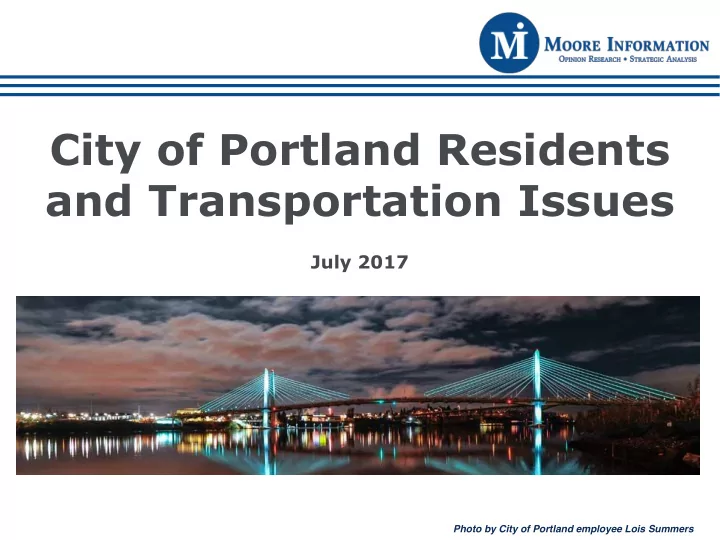
Photo by City of Portland employee Lois Summers
and Transportation Issues July 2017 Photo by City of Portland - - PowerPoint PPT Presentation
City of Portland Residents and Transportation Issues July 2017 Photo by City of Portland employee Lois Summers Methodology 2 400 live interviews among a representative sample of adult residents age 18 and older in the Sample City of
July 2017
Photo by City of Portland employee Lois Summers
2
400 live interviews among a representative sample of adult residents age 18 and older in the City of Portland, plus an
97266, for a total of N=100 interviews in this Outer East area. Landline and cell phone interviews conducted July 13-16, 2017. +/-5% for the N=400 sample; +/-10% for the N=100 sample, computed at the 95% confidence level.
Sample Method Sampling Error
3
Right direction 36% Don’t know 16% Wrong track 48%
“Generally speaking, would you say things in the City of Portland are headed in the right direction, or do you think things are pretty much headed off on the wrong track?” (Q1)
4
Right direction Don’t know Wrong track Net right direction All 36% 16% 48%
Region N 35% 15% 50%
NE 38% 14% 48%
SW 46% 16% 38% +8% SE 34% 18% 48%
NW (N=26) 30% 8% 62%
Outer East (N=100) 35% 12% 53%
Age 18-34 43% 18% 40% +3% 35-44 23% 18% 59%
45-54 48% 10% 41% +7% 55-64 26% 14% 60%
65+ 37% 17% 46%
SW Portland residents and those age 45-54 and 18-34 are among the most optimistic. Majorities or pluralities of most other key subgroups are pessimistic.
5
Right direction Don’t know Wrong track Net right direction All 36% 16% 48%
Distance from Downtown Portland Less than 3 miles 45% 14% 41% +4% 3-4 miles 36% 20% 44%
5-6 miles 36% 16% 49%
7-11+ miles 29% 12% 57%
Change in commute time last 3 years? Yes 27% 17% 56%
No 58% 15% 27% +31% Income Less than $35K 45% 17% 38% +7% $35-$49K 41% 15% 44%
$50K+ 31% 15% 54%
Pessimism increases with distance from downtown Portland, and with income. Commuters who have experienced a change in their commute time in last three years are among the most pessimistic, while those commuters who have not, are among most optimistic.
6
27% 9% 7% 6% 5% 5% 1% 10% 0% 10% 20% 30% 40% Traffic/congestion Poor road conditions/maintenance Highway traffic Lack of mass transit/public transportation (general) Highways/roads need widening/more lanes Overpopulation/population growth None/nothing Don't know “What, in your opinion, is the most important transportation-related issue facing people in the City of Portland today?” (Q2OE)
7
Region All N NE SW SE NW (N=26) Outer East (N=100) Traffic/congestion 27% 34% 29% 24% 24% 31% 22% Poor road conditions/ maintenance 9% 15% 7% 7% 9% 10% 13% Highway traffic 7% 2% 6% 13% 6% 22% 7% Lack of mass transit/ public transportation (general) 6% 6% 8% 7% 4% 2% 2% Highways/roads need widening/more lanes 5% 4% 1% 7% 8% 3% 3% Overpopulation/ population growth 5% 6% 6%
5% 6%
Traffic/congestion is the leading problem throughout the city, in every region. Only 2 people (both in SE) say “lack of bike lanes.”
8
6% 42% 48% 27% 22% 14% 8% 3% 0% 20% 40% 60% Excellent Good Total excellent/ good Average Total below average/ poor Below average Poor Don’t know
“How would you rate the transportation system throughout the City of Portland overall?” (Q3)
9
Excellent/ good Average Below average/poor Net excellent/good All 48% 27% 22% +26% Region N 48% 29% 22% +26% NE 43% 30% 23% +20% SW 61% 23% 16% +45% SE 49% 26% 20% +29% NW (N=26) 36% 31% 33% +3% Outer East (N=100) 40% 30% 25% +15% Gender Men 42% 31% 24% +18% Women 54% 24% 19% +35% Age 18-34 54% 25% 18% +36% 35-44 44% 28% 24% +20% 45-54 55% 33% 10% +45% 55-64 42% 18% 35% +7% 65+ 39% 33% 25% +14% Income Less than $35K 58% 22% 14% +44% $35-$49K 47% 35% 15% +32% $50-$74K 48% 25% 27% +21% $75K or more 39% 28% 30% +9% SW residents, women and residents age 18-34 and 45-54 are among the most positive. Lower income households are also more likely than higher income households to give higher ratings.
10 10
Excellent/ good Average Below average/poor Net excellent/ good All 48% 27% 22% +26% Ethnicity Caucasians 45% 29% 23% +22% Non-Caucasians 56% 24% 19% +37% Distance from Downtown Portland Less than 3 miles 58% 25% 14% +44% 3-4 miles 53% 26% 17% +36% 5-6 miles 41% 28% 27% +14% 7-10 miles 46% 29% 21% +25% 11+ miles 33% 38% 29% +4% Change in commute time last 3 years? Yes 41% 29% 27% +14% No 61% 18% 17% +44%
Non-Caucasians are more positive than Caucasians, and residents who live closer to downtown are more positive than those who live further away. By commute status, those whose commute hasn’t changed in the past three years are more positive.
11 11
27% 9% 8% 7% 7% 6% 6% 4% 0% 10% 20% 30% 40% Sufficient public transportation availability (general) Sufficient MAX/light rail availability Good system/works well (general) System could be improved/ conditions vary Better than other cities Sufficient bus/bus route availability Easy to get around/travel Reliable system IF EXCELLENT/GOOD: “Why do you give that rating?” (Q4.1OE, N=192)
12 12
11% 14% 17% 8% 2% 5% 7% 1% 20% 15% 1% 4% 10% 6% 0% 8% 0% 10% 20% 30% 40% Poor road conditions/maintenance Heavy traffic System could be improved/conditions vary/average Lack of public transportation/route availability (general) Overpopulation/many people on roads Slow system/long commute Sufficient public transportation availability (general) Inefficient city planning/no room for growth Average (N=110) Below average/poor (N=86) IF AVERAGE/BELOW AVERAGE/POOR: “Why do you give that rating?” (Q4.2OE, N=196)
13 13
14% 35% 49% 22% 16% 7% 9% 13% 0% 20% 40% 60% Excellent Good Total excellent/ good Average Total below average/ poor Below average Poor Don’t know
“How would you rate the transportation system in Downtown Portland, specifically?” (Q5)
14 14
Excellent/ good Average Below average/poor Net excellent/good All 49% 22% 16% +33% Region N 50% 16% 18% +32% NE 48% 27% 13% +35% SW 58% 19% 11% +47% SE 47% 20% 17% +30% NW (N=26) 42% 30% 28% +14% Outer East (N=100) 31% 22% 21% +10% Gender Men 46% 18% 21% +25% Women 51% 25% 12% +39% Age 18-34 56% 26% 12% +44% 35-44 41% 17% 21% +20% 45-54 62% 20% 12% +50% 55-64 44% 18% 25% +19% 65+ 33% 25% 14% +19% Income Less than $35K 51% 19% 14% +37% $35-$49K 48% 28% 16% +32% $50-$74K 47% 32% 11% +36% $75K or more 49% 15% 21% +28% SW residents and residents age 18-34 and 45-54 are among the most likely to give positive
15 15
Excellent/ good Average Below average/ poor Net excellent/ good All 49% 22% 16% +33% Ethnicity Caucasians 49% 22% 12% +37% Non-Caucasians 48% 20% 21% +27% Distance from Downtown Portland Less than 3 miles 57% 23% 12% +45% 3-4 miles 51% 21% 17% +34% 5-6 miles 46% 26% 15% +31% 7-10 miles 46% 15% 20% +26% 11+ miles 42% 28% 18% +24% Change in commute time in last 3 years? Yes 47% 18% 23% +24% No 65% 17% 10% +55%
Residents who live closer to Downtown are more positive than those who live farther away. Commuters who have not experienced a change in their commute time in past 3 years are more positive.
16 16
48% 27% 22% 3% 49% 22% 16% 13% 0% 20% 40% 60% Total excellent/good Average Total below average/poor Don’t know City Downtown
17 17
4% 12% 16% 24% 59% 22% 37% 1% 0% 20% 40% 60% Excellent Good Total excellent/ good Average Total below average/ poor Below average Poor Don’t know
“How would you rate the job the City of Portland has done repairing potholes and improving the quality of City streets and roads?” (Q6)
All key subgroups rate the City’s performance as “below average/poor.”
18 18
Excellent/good Average Below average/poor Net excellent/good All 16% 24% 59%
Region N 15% 16% 67%
NE 11% 24% 64%
SW 16% 32% 46%
SE 19% 25% 55%
NW (N=26) 12% 23% 65%
Outer East (N=100) 19% 20% 58%
Residents in each of the City’s regions are unimpressed, but SW Portland residents are not as negative as those living elsewhere in the City.
19 19
56% 11% 9% 5% 3% 3% 3% 3% 1% 5% 2% 0% 20% 40% 60%
Congestion Lack of certainty about how long it will take to get there by car Parking issues Lack of certainty about how long it will take to get there by bus, light rail or street car service Lack of bus, light rail or street car service Road construction Lack of sidewalks Safety issues when biking and walking Lack of bike ways Other Don’t know
“Thinking now from a personal standpoint, which one of the following is the biggest problem for you when getting from one place to another in the City of Portland?” (Q7)
All key subgroups say “congestion” is the biggest problem.
20 20
Region All N NE SW SE NW (N=26) Outer East (N=100) Congestion 56% 57% 61% 54% 52% 60% 53% Lack of certainty about how long it will take to get there by car 11% 9% 8% 13% 13% 10% 11% Parking issues 9% 11% 5% 5% 10% 15% 10% Lack of certainty about how long it will take to get there by bus, light rail or street car service 5% 5% 5% 2% 6% 5% 4% Lack of bus, light rail or street car service 3% 5% 4% 10% 1%
3% 1% 4% 2% 4%
Lack of sidewalks 3% 3% 3% 2% 3%
Safety issues when biking and walking 3% 4% 4%
3% 8% Lack of bike ways 1%
7%
5% 2% 4% 8% 6%
Don’t know 2% 2% 1% 4% 1%
Congestion is the leading complaint from residents in all areas of the City.
21 21
68% 63% 56% 56% 53% 13% 14% 14% 20% 21% 0% 20% 40% 60% 80% Widen or improve existing roads and highways (Q9) People using their cars less often (Q11) More people riding with others in carpools or vanpools (Q12) More parking (Q18) More or different MAX lines (Q10) Total impact (4-5) Total no impact (1-2)
% Major impact = 45% % Major impact = 42% % Major impact = 30% % Major impact = 32% % Major impact = 23%
“Using a five-point scale, where five would mean a major impact and one is no impact at all, what number between five and one best describes how much impact you believe each of the following would have in addressing transportation problems in the City of Portland?”
22 22
49% 46% 46% 43% 38% 34% 29% 23% 24% 32% 35% 40% 0% 20% 40% 60% 80% More new roads (Q17) More or different bus routes (Q8) More people driving during non-rush hours (Q16) More sidewalks and crosswalk signals (Q14) More streetcar transit service (Q15) More bike ways (Q13) Total impact (4-5) Total no impact (1-2)
% Major impact = 30% % Major impact = 20% % Major impact = 24% % Major impact = 24% % Major impact = 16% % Major impact = 18%
23 23
% Major Impact (5) Region All N NE SW SE NW (N=26) Outer East (N=100) Widen or improve existing roads and highways (Q9) 45% 40% 43% 41% 48% 51% 50% People using their cars less often (Q11) 42% 46% 41% 52% 39% 28% 26% More parking (Q18) 32% 33% 32% 27% 34% 31% 40% More people riding with others in carpools or vanpools (Q12) 30% 38% 25% 25% 32% 31% 26% More new roads (Q17) 30% 28% 33% 30% 28% 33% 35% More sidewalks and crosswalk signals (Q14) 24% 32% 27% 25% 22%
More people driving during non-rush hours (Q16) 24% 24% 19% 24% 29% 16% 27% More or different MAX lines (Q10) 23% 31% 18% 27% 20% 32% 14% More or different bus routes (Q8) 20% 25% 23% 12% 20% 12% 13% More bike ways (Q13) 18% 18% 15% 29% 18% 18% 16% More streetcar transit service (Q15) 16% 25% 12% 19% 14% 22% 12%
At least four-in-ten residents in all areas of the city say widened/improved existing roads/highways would have a major impact. Outer East residents are less apt to see using cars less often as something that would have an impact.
24 24
% Major Impact (5) Age All 18-34 35-44 45-54 55-64 65+ Widen or improve existing roads and highways (Q9) 45% 47% 47% 41% 51% 38% People using their cars less often (Q11) 42% 48% 36% 44% 34% 41% More parking (Q18) 32% 34% 31% 29% 30% 36% More people riding with others in carpools or vanpools (Q12) 30% 34% 19% 31% 23% 42% More new roads (Q17) 30% 33% 28% 28% 33% 27% More sidewalks and crosswalk signals (Q14) 24% 31% 21% 22% 18% 23% More people driving during non-rush hours (Q16) 24% 22% 26% 28% 22% 22% More or different MAX lines (Q10) 23% 32% 19% 24% 18% 14% More or different bus routes (Q8) 20% 27% 13% 23% 22% 11% More bike ways (Q13) 18% 23% 13% 22% 16% 14% More streetcar transit service (Q15) 16% 21% 13% 17% 12% 15%
Seniors are more likely to say rideshares would have an impact. Younger residents (18-34) are among the most enthusiastic about MAX expansion.
25 25
% Major Impact (5) Income All Less than $35K $35- $49K $50- $74K $75K
Widen or improve existing roads and highways (Q9)
45% 39% 50% 45% 47%
People using their cars less often (Q11)
42% 50% 37% 37% 42%
More parking (Q18)
32% 29% 43% 36% 26%
More people riding with others in carpools
30% 39% 23% 27% 28%
More new roads (Q17)
30% 28% 31% 32% 32%
More sidewalks and crosswalk signals (Q14)
24% 33% 23% 21% 17%
More people driving during non-rush hours (Q16)
24% 24% 28% 22% 21%
More or different MAX lines (Q10)
23% 31% 20% 22% 18%
More or different bus routes (Q8)
20% 33% 10% 21% 11%
More bike ways (Q13)
18% 25% 17% 20% 13%
More streetcar transit service (Q15)
16% 16% 19% 19% 13%
Higher income households are more likely to say road improvements will have an impact, while lower income households are more supportive of alternatives/public transit projects. Parking is more of a concern for middle-income households.
26 26
% Major Impact (5) Distance From Downtown Portland Change in Commute Time Last 3 Years? All <3 miles 3-4 miles 5-6 miles 7-10 miles 11+ miles Yes No
Widen or improve existing roads and highways (Q9)
45% 32% 42% 47% 47% 63% 51% 48%
People using their cars less often (Q11)
42% 56% 41% 41% 40% 30% 38% 47%
More parking (Q18)
32% 37% 20% 30% 32% 54% 36% 23%
More people riding with others in carpools or vanpools (Q12)
30% 47% 22% 22% 39% 23% 25% 34%
More new roads (Q17)
30% 23% 26% 32% 30% 49% 33% 31%
More sidewalks and crosswalk signals (Q14)
24% 25% 21% 19% 27% 30% 25% 33%
More people driving during non-rush hours (Q16)
24% 33% 15% 20% 33% 18% 23% 29%
More or different MAX lines (Q10)
23% 32% 24% 20% 17% 23% 27% 18%
More or different bus routes (Q8)
20% 19% 20% 18% 22% 18% 21% 24%
More bike ways (Q13)
18% 22% 21% 10% 20% 15% 22% 21%
More streetcar transit service (Q15)
16% 18% 18% 10% 15% 27% 15% 21%
Support for road improvements increases the farther people get from downtown.
27 27
42% 13% 11% 7% 5% 4% 4% 3% 2% 1% 1% 5% 2% 0% 20% 40% 60% Widen or improve existing roads and highways More or different MAX lines More or different bus routes More new roads People using their cars less often More parking More people driving during non- rush hours More people riding with others in carpools or vanpools More sidewalks and crosswalk signals More streetcar transit service More bike ways Other Don’t know
“Out of all the ways to address transportation problems in the City of Portland that you just heard, which one would be your first priority to receive transportation funding?” (Q19)
28 28
All N NE SW SE NW (N=26) Outer East (N=100) Widen or improve existing roads and highways 42% 35% 42% 36% 47% 33% 47% More or different MAX lines 13% 18% 10% 10% 9% 32% 8% More or different bus routes 11% 18% 12% 17% 8% 2% 9% More new roads 7% 2% 12% 8% 6% 12% 10% People using their cars less often 5% 3% 4% 4% 7%
4% 3% 2%
9% 4% More people driving during non-rush hours 4% 5% 3% 2% 4%
More people riding with others in carpools or vanpools 3% 9% 1% 2% 3%
More sidewalks and crosswalk signals 2% 2% 4% 5% 1%
More streetcar transit service 1%
7% 1%
More bike ways 1% 2% 1%
Funding existing roads is a top priority.
29 29
56% 23% 79% 4% 17% 6% 12% 0% 20% 40% 60% 80%
Strongly maintain existing capacity for cars Maintain existing capacity for cars Total maintain existing capacity for cars Don’t know Total removing car lanes to make way for more bike lanes Removing car lanes to make way for more bike lanes Strongly removing car lanes to make way for more bike lanes
“Which one of the following is most important to you personally, maintaining existing capacity for cars on existing city streets, or removing car lanes to make way for more bike lanes?” (Q20)
Wide majorities in all key subgroups want to maintain car capacity, rather than make way for more bikes.
30 30
Strongly maintain Total maintain All 56% 79% Region N 47% 72% NE 56% 83% SW 43% 69% SE 63% 83% NW (N=26) 59% 76% Outer East (N=100) 68% 89%
All regions want to maintain car capacity. Support reaches nearly 90% in Outer East Portland.
31 31
“How often do you use each of the following transportation methods in getting from one place to another in the City
Daily Total more than
week Once a week Total less
Never Your own car (Q24) 62% 82% 4% 4% 9% Walk (Q26) 38% 56% 10% 20% 14% Bike (Q21) 7% 20% 6% 22% 51% Carpool (Q25) 5% 16% 7% 27% 51% Bus (Q23) 6% 15% 5% 43% 36% MAX (Q22) 5% 13% 6% 56% 26% Lyft/Uber (Q27) 1% 3% 3% 39% 55% Rideshare (Q28) 1% 3% 1% 9% 83%
City of Portland residents are heavily car-dependent.
32 32
Daily Total more than
Once a week Total less
Never All 7% 20% 6% 22% 51% Region N 6% 21% 8% 27% 44% NE 8% 13% 12% 17% 57% SW 3% 12%
60% SE 8% 23% 5% 23% 48% NW (N=26) 5% 35% 2% 7% 50% Outer East (N=100) 3% 9% 4% 27% 61% Gender/age Men 10% 24% 7% 23% 45% Men 18-44 11% 27% 7% 19% 47% Men 45+ 8% 20% 6% 28% 42% Women 5% 16% 6% 20% 57% Women 18-44 6% 22% 8% 25% 43% Women 45+ 3% 11% 4% 15% 70%
33 33
Daily Total more than
Once a week Total less
Never All 7% 20% 6% 22% 51% Income Less than $35K 7% 16% 6% 20% 57% $35-$49K 8% 24%
53% $50-$74K 4% 19% 8% 17% 55% $75K or more 9% 23% 8% 27% 42% Ethnicity Caucasians 8% 22% 7% 21% 48% Non-Caucasians 3% 9% 2% 27% 61% Distance from Downtown Portland Less than 3 miles 7% 23% 6% 24% 46% 3-4 miles 10% 24% 9% 25% 42% 5-6 miles 6% 26% 4% 20% 47% 7-10 miles 6% 12% 4% 17% 65% 11+ miles 4% 10% 4% 27% 59%
34 34
Daily Total more than
Once a week Total less
Never All 5% 13% 6% 56% 26% Region N 12% 23% 3% 54% 20% NE 2% 9% 6% 53% 32% SW 4% 12% 6% 54% 28% SE 4% 10% 6% 58% 26% NW (N=26) 5% 17% 8% 64% 11% Outer East (N=100) 3% 6% 6% 51% 36% Gender Men 3% 9% 4% 59% 27% Women 6% 16% 7% 52% 24% Age 18-34 7% 17% 6% 60% 16% 35-44 6% 15% 3% 55% 27% 45-54 3% 9% 8% 64% 19% 55-64 2% 7% 3% 49% 41% 65+ 3% 13% 7% 45% 35% Income Less than $35K 7% 15% 9% 51% 25% $35-$49K 5% 16% 3% 51% 30% $50-$74K 5% 16% 3% 61% 21% $75K or more 2% 6% 6% 62% 27%
35 35
Daily Total more than
Once a week Total less
Never All 5% 13% 6% 56% 26% Ethnicity Caucasians 3% 9% 6% 58% 26% Non-Caucasians 5% 19% 6% 51% 24% Distance from Downtown Portland Less than 3 miles 8% 14% 4% 54% 29% 3-4 miles 2% 13% 5% 58% 23% 5-6 miles 3% 9% 7% 62% 22% 7-10 miles 5% 13% 9% 51% 27% 11+ miles 9% 11% 5% 58% 26%
36 36
Daily Total more than
Once a week Total less
Never All 6% 15% 5% 43% 36% Region N 14% 25% 7% 41% 27% NE 4% 15% 5% 43% 37% SW 2% 8% 7% 44% 40% SE 6% 15% 5% 44% 35% NW (N=26) 5% 5%
54% Outer East (N=100) 5% 6% 4% 34% 56% Gender Men 4% 12% 5% 41% 42% Women 9% 18% 6% 45% 31% Age 18-34 9% 20% 7% 46% 26% 35-44 11% 23% 5% 35% 37% 45-54 3% 12% 3% 52% 33% 55-64 3% 5% 3% 46% 46% 65+ 1% 9% 8% 34% 50% Income Less than $35K 10% 21% 6% 42% 31% $35-$49K 5% 16% 1% 45% 38% $50-$74K 8% 14% 6% 43% 37% $75K or more 1% 9% 6% 45% 39%
37 37
Daily Total more than
Once a week Total less
Never All 6% 15% 5% 43% 36% Ethnicity Caucasians 4% 13% 6% 44% 37% Non-Caucasians 8% 19% 6% 40% 34% Distance from Downtown Portland Less than 3 miles 5% 13% 3% 54% 30% 3-4 miles 6% 20% 5% 44% 30% 5-6 miles 4% 11% 10% 53% 27% 7-10 miles 6% 16% 4% 32% 48% 11+ miles 7% 9% 5% 31% 55%
38 38
Daily Total more than
Once a week Total less
Never All 62% 82% 4% 4% 9% Region N 49% 67% 8% 8% 16% NE 61% 82% 5% 3% 10% SW 69% 95%
3% SE 64% 84% 4% 3% 8% NW (N=26) 68% 83% 5% 12%
60% 81% 9% 3% 8% Gender Men 62% 84% 5% 3% 8% Women 61% 80% 4% 5% 9% Age 18-34 57% 74% 5% 3% 16% 35-44 63% 82% 8% 6% 3% 45-54 76% 95% 2%
55-64 69% 89% 2% 4% 5% 65+ 46% 75% 4% 9% 11% Income Less than $35K 57% 73% 4% 1% 21% $35-$49K 60% 86% 4% 6% 4% $50-$74K 66% 83% 4% 8% 4% $75K or more 67% 89% 6% 3% 1%
39 39
Daily Total more than
Once a week Total less
Never All 62% 82% 4% 4% 9% Ethnicity Caucasians 64% 84% 4% 4% 7% Non-Caucasians 59% 77% 5% 4% 13% Distance from Downtown Portland Less than 3 miles 48% 83%
9% 3-4 miles 66% 80% 8% 2% 10% 5-6 miles 67% 87% 5% 2% 5% 7-10 miles 62% 85% 4% 5% 4% 11+ miles 74% 77% 6% 3% 13%
40 40
Daily Total more than
Once a week Total less
Never All 5% 16% 7% 27% 51% Region N
4% 34% 48% NE 6% 18% 6% 25% 51% SW 6% 12% 7% 26% 54% SE 6% 16% 10% 25% 50% NW (N=26) 11% 17%
56% Outer East (N=100) 9% 21% 10% 19% 50% Gender Men 5% 15% 4% 24% 57% Women 6% 16% 10% 29% 45% Age 18-34 6% 25% 15% 26% 34% 35-44 7% 18% 3% 31% 48% 45-54 7% 10% 2% 34% 54% 55-64 5% 9% 6% 17% 68% 65+ 1% 9% 2% 22% 65% Income Less than $35K 6% 17% 15% 27% 41% $35-$49K 2% 15% 2% 31% 51% $50-$74K 6% 17% 1% 27% 55% $75K or more 5% 13% 6% 25% 56%
41 41
Daily Total more than
Once a week Total less
Never All 5% 16% 7% 27% 51% Ethnicity Caucasians 5% 13% 6% 27% 53% Non-Caucasians 2% 20% 11% 30% 37% Distance from Downtown Portland Less than 3 miles 5% 14% 5% 32% 48% 3-4 miles 4% 12% 8% 19% 60% 5-6 miles 3% 11% 6% 35% 47% 7-10 miles 8% 26% 5% 19% 50% 11+ miles 6% 14% 8% 34% 44%
42 42
Daily Total more than
Once a week Total less
Never All 38% 56% 10% 20% 14% Region N 52% 64% 8% 17% 12% NE 34% 58% 8% 21% 13% SW 30% 40% 8% 35% 17% SE 37% 56% 14% 14% 15% NW (N=26) 48% 58% 5% 26% 11% Outer East (N=100) 20% 37% 12% 24% 27% Gender Men 39% 54% 10% 19% 16% Women 38% 58% 10% 20% 12% Age 18-34 38% 55% 12% 21% 12% 35-44 49% 65% 2% 18% 15% 45-54 42% 62% 14% 21% 3% 55-64 30% 47% 12% 21% 20% 65+ 32% 49% 11% 17% 24% Income Less than $35K 42% 59% 14% 17% 10% $35-$49K 31% 50% 11% 18% 21% $50-$74K 43% 59% 9% 22% 10% $75K or more 35% 55% 9% 23% 13%
43 43
Daily Total more than
Once a week Total less
Never All 38% 56% 10% 20% 14% Ethnicity Caucasians 37% 55% 11% 20% 14% Non-Caucasians 36% 54% 8% 23% 15% Distance from Downtown Portland Less than 3 miles 49% 77% 6% 13% 4% 3-4 miles 40% 60% 12% 16% 12% 5-6 miles 44% 58% 8% 25% 9% 7-10 miles 25% 40% 19% 24% 18% 11+ miles 25% 38% 6% 23% 32%
44 44
Daily Total more than
Once a week Total less
Never All 1% 3% 3% 39% 55% Region N
56% NE
2% 33% 61% SW 2% 2% 5% 45% 46% SE * 1% 3% 41% 54% NW (N=26) 5% 9% 9% 22% 61% Outer East (N=100)
29% 65% Gender Men
3% 35% 61% Women 1% 4% 3% 42% 51% Age 18-34 2% 7% 4% 51% 38% 35-44
42% 51% 45-54
58% 55-64 1% 1% 2% 25% 72% 65+
23% 73% Income Less than $35K 1% 3% 2% 32% 62% $35-$49
53% $50-$74K
5% 31% 61% $75K or more 1% 4% 4% 46% 47%
* Less than one-half of one percent
45 45
Daily Total more than
Once a week Total less
Never All 1% 3% 3% 39% 55% Ethnicity Caucasians * 2% 4% 38% 55% Non-Caucasians
50% Distance from Downtown Portland Less than 3 miles 2% 5%
53% 3-4 miles
6% 38% 53% 5-6 miles
3% 47% 48% 7-10 miles
35% 60% 11+ miles 1% 1%
73%
* Less than one-half of one percent
46 46
Daily Total more than
Once a week Total less
Never All 1% 3% 1% 9% 83% Region N 1% 2%
80% NE
1% 7% 88% SW 4% 8% 5% 9% 72% SE 2% 4% * 9% 83% NW (N=26)
90% Outer East (N=100)
10% 83% Gender Men Women 1% 2% 1% 9% 85% Age 2% 4% 1% 9% 81% 18-34 35-44 2% 4% 1% 7% 80% 45-54
77% 55-64
2% 10% 85% 65+ 3% 6% 2% 2% 89% Income 1% 2% 1% 8% 87% Less than $35K $35-$49 1% 4% 2% 2% 88% $50-$74K
76% $75K or more 3% 4%
81%
* Less than one-half of one percent
47 47
Daily Total more than
Once a week Total less
Never All 1% 3% 1% 9% 83% Ethnicity Caucasians 1% 3% 1% 10% 82% Non-Caucasians
2% 5% 85% Distance from Downtown Portland Less than 3 miles 4% 6% 1% 13% 80% 3-4 miles
2% 9% 84% 5-6 miles 1% 2%
84% 7-10 miles 2% 4% 1% 8% 86% 11+ miles 1% 1% 3% 6% 80%
48 48
Minor problem 17% Major problem 80% No problem at all 2% Don’t know 1%
“Would you say traffic congestion in the City of Portland is a minor problem, a major problem, or no problem at all?” (Q29) Wide majorities in all key subgroups say traffic congestion is a major problem.
Total problem: 97%
49 49
Major problem Total problem All 80% 97% Region N 84% 100% NE 84% 97% SW 77% 97% SE 76% 97% NW (N=26) 84% 97% Outer East (N=100) 83% 97% Sentiment is universal, traffic congestion is a problem.
50 50
Yes 80% No 20%
“Has traffic congestion caused you to change your travel behavior?” (Q30) Wide majorities in all key subgroups have changed their travel behavior.
38% 14% 10% 5% 5% 4% 3% 3% 3% 0% 10% 20% 30% 40% 50% Change time of day usually traveling Alternative routes/different route Take fewer car trips Take public transit/bus/MAX Leave earlier/allow more time Do not drive/travel as much Avoid highways Take backroads/side roads Bike
IF YES: “How has your travel behavior changed?” (Q30.1OE, N=319)
51 51
Region All N NE SW SE NW (N=26) Outer East (N=100) Change time of day usually traveling 38% 47% 35% 49% 34% 27% 44% Alternative routes/different route 14% 8% 17% 3% 18% 9% 17% Take fewer car trips 10% 7% 15% 12% 6% 12% 8% Take public transit/bus/MAX 5% 6% 4% 2% 8%
Leave earlier/allow more commute times 5% 5% 5% 6% 3% 12% 4% Do not drive/travel as much 4%
15% 2% 3% 3% Avoid highways 3% 1% 6% 4% 3%
Take backroads/side roads 3% 3% 3% 3% 4%
3% 5% 4%
Combine car trips 2% 5% 2%
9%
2% 2% 2%
11% 2% Monitor traffic conditions/accidents 2%
Moved 2%
3%
Residents throughout the city are changing the times they travel.
52 52
Yes 67% No/don’t know 33%
“Do you commute to work or school?” (Q31)
2% 10% 11% 60% 8% 9% 0% 20% 40% 60% 80% 1 2 3 4 5 6 7 Don’t know
* * * Less than one-half of one percent “How many days a week do you commute?” (Q31.1, N=270)
Residents age 18-54 are more likely to be commuters.
53 53
Region All N NE SW SE NW (N=26) Outer East (N=100) 1 *
2 2% 3% 2%
4% 2% 3 10% 8% 12% 8% 10% 13% 10% 4 11% 6% 10% 7% 15%
5 60% 72% 57% 78% 53% 67% 44% 6 8% 5% 12% 2% 7% 8% 14% 7 9% 6% 7% 2% 12% 9% 11% Don’t know *
commute 5 days a week.
54 54
IF YES: “Do you commute to Downtown Portland, or elsewhere?” (Q32, N=270)
71% 7% 7% 5% 5% 3% 1% 0% 20% 40% 60% 80% Your own car Bike MAX Bus Walk Carpool Other Lyft/Uber
* * Less than one-half of one percent IF YES: “For commuting travel, what mode do you use most often?” (Q33, N=270)
25% 68% 7% 0% 20% 40% 60% 80% Downtown Elsewhere Don’t know
55 55
(Q32) Region All N NE SW SE NW (N=26) Outer East (N=100) Downtown 25% 37% 26% 25% 19% 34% 11% Elsewhere 68% 59% 70% 65% 71% 58% 75% (Q33) Region All N NE SW SE NW (N=26) Outer East (N=100) Bike 7% 9% 8% 3% 8%
MAX 7% 17% 4% 4% 5% 7% 2% Bus 5% 5% 10%
Your own car 71% 48% 74% 82% 75% 76% 82% Carpool 3% 3% 3% 11%
5% 12%
8% 8%
North residents are most likely to commute downtown and most likely to take the
downtown commuters are using their own car.
56 56
(Q33) Distance from Downtown All <3 miles 3-4 miles 5-6 miles 7-10 miles 11+ miles Bike 7% 10% 15% 8%
7% 1% 6% 7% 8% 5% Bus 5% 3% 3% 4% 12% 4% Your own car 71% 70% 71% 68% 75% 83% Carpool 3% 3%
Walk 5% 13% 4% 7% 3%
57 57
“On an average day, how far is your commute, one way?” (Q34)
3% 18% 23% 28% 11% 4% 4% 7% 2% 0% 10% 20% 30% 40% Less than a mile 1-3 miles 4-5 miles 6-10 miles 11-15 miles 16-20 miles 21-25 miles 26 or more miles Don’t know/NA
58 58
Region All N NE SW SE NW (N=26) Outer East (N=100) Less than a mile 3% 10% 2% 5% 2%
1-3 miles 18% 14% 15% 12% 24% 15% 10% 4-5 miles 23% 25% 28% 27% 18% 18% 23% 6-10 miles 28% 25% 25% 25% 29% 42% 36% 11-15 miles 11% 9% 11% 18% 11% 9% 10% 16-20 miles 4%
7% 4% 17% 8% 21-25 miles 4% 3% 4% 2% 5%
miles 7% 12% 5% 4% 7%
Don’t know/NA 2% 3% 6%
Most residents are traveling between 4-10 miles each way.
59 59
Yes, changed 62% No/don’t know 38%
“Has the length of time you spend commuting changed over the last three years, or not?” (Q35)
52% 38% 91% 8% 3% 5% 1% 0% 20% 40% 60% 80% 100% Significantly longer Somewhat longer Total longer Total shorter Somewhat shorter Significantly shorter Don’t know
IF YES, CHANGED: “Over the last three years, has your commute gotten…” (Q35.1, N=168)
Majorities among all key subgroups have seen a change in the length of time they spend commuting.
60 60
Region All N NE SW SE NW (N=26) Outer East (N=100) Yes, changed 62% 53% 57% 59% 69% 66% 73% No/don’t know 38% 47% 43% 41% 31% 34% 27% Region All N NE SW SE NW (N=26) Outer East (N=100) Longer 91% 94% 93% 93% 88% 94% 87% Shorter 8% 6% 7% 7% 9% 6% 13% Don’t know 1%
increased length of time.
61 61
Yes 23% No/don’t know 77%
“Does your commute involve transporting children or dependents to and from school, daycare or other activities?” (Q36, N=270) “In your opinion, does transportation of children or dependents limit your transportation options, or not?” (Q37, N=61)
46% 22% 13% 9% 9% 8% 6% 5% 5% 5% 18% 0% 10% 20% 30% 40% 50% Yes, limits Time spent/long commutes Forced to use my car Bike more Unable to use public transportation Not within biking distance Multiple destinations No routes in my area Need booster seat The bus is gross Don't know
IF YES: “How has it limited your transportation
More likely to be transporting children:
62 62
Full-time or part-time job
72%
28% Distance from Downtown Portland?
5% mile/in Downtown
12%
22%
24%
13%
7%
12%
Income
12%
10%
Ethnicity
4%
3%
Gender
48%
52% Employer-Provided Transportation Subsidy
69%
31%
53%
18%
29% Zip Code Area
16%
26%
13%
40%
6% Job Location
24% County
Area
4%
➢ Traffic/congestion is the leading top-of-mind response (for 27%) when asked the most important transportation-related issue facing people in Portland today, along with many
including “highway traffic” (7%) and “highway/road widening/more lanes” (5%). ➢ Fully 56% say congestion is the biggest problem getting from one place to another in the City, followed by another 11% who say the biggest problem is uncertainty about how long it will take to get someplace by
➢ There is nearly universal agreement that traffic congestion is a “major” problem (80%)
➢ Congestion has changed the travel behavior
being the time they are travelling (for 38%). ➢ 62% of residents say the length of time they spend commuting has changed over the last three years, with the overwhelming majority (91%) of commutes getting longer – including 52% who say their commute is “significantly” longer now than three years ago.
Traffic and congestion are a top concern for Portland residents. No
issue even comes close.
When it comes to projects that could have a “major” impact addressing transportation problems, the top projects are all car/road/parking related. Furthermore, after hearing all 11 potential projects, 42% of residents say, “widen or improve existing roads and highways” would be their priority to receive transportation funding.
➢ Nearly eight-in-ten (79%) say it is more important to maintain existing
capacity for cars rather than removing car lanes to make way for more bike lanes (17%).
➢ 82% of residents are using their own car more than once a week/daily to
get from one place to another in the City, compared to biking (20%), MAX (13%), bus (15%) and carpool (16%). Another 56% are walking more than once a week/daily to get from one place to another in the City.
➢ Two-in-three (67%) residents are commuting to work or school, with 60%
commuting five days a week. Among commuters, 25% are going Downtown and 68% are going elsewhere, with fully 71% using their own car to get there.
➢ However, on the whole, Outer East residents are more strongly committed to their car use and maintaining car capacity on roads. ➢ Outer East residents are far less likely to see “using cars less
among the most likely to want more parking, and are also among the least likely to want more or different MAX/bus lines/bike ways. ➢ Further proof of Outer East car dependence, these residents are among the most likely to say they never walk, bike, MAX or take the bus.
Outer East residents are similar to residents in
many ways, including their concern with traffic/congestion.
66 66
www.moore-info.com www.facebook.com/mooreinformation Erik Iverson erik@moore-info.com Bob Moore bobm@moore-info.com Hans Kaiser hansk@moore-info.com 1821 South Avenue West Suite 406 Missoula, MT 59801 2130 SW Jefferson Street Suite 200 Portland, OR 97201 428 4th Street Suite 8 Annapolis, MD 21403 406.544.8310 503.221.3100 410.216.9856