Ancillary Study Cal MacLennan on behalf of the MAL055 RTS,S- AS01 - - PowerPoint PPT Presentation

ancillary study
SMART_READER_LITE
LIVE PREVIEW

Ancillary Study Cal MacLennan on behalf of the MAL055 RTS,S- AS01 - - PowerPoint PPT Presentation

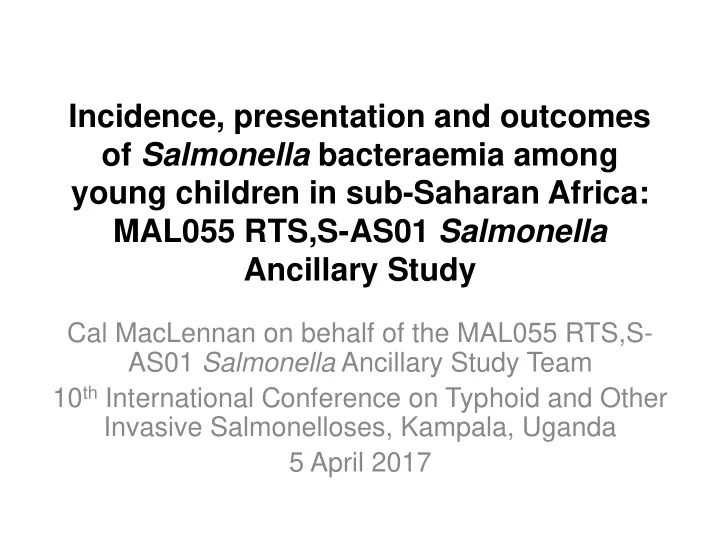
Incidence, presentation and outcomes of Salmonella bacteraemia among young children in sub-Saharan Africa: MAL055 RTS,S-AS01 Salmonella Ancillary Study Cal MacLennan on behalf of the MAL055 RTS,S- AS01 Salmonella Ancillary Study Team 10 th


slide-1
SLIDE 1

Incidence, presentation and outcomes

  • f Salmonella bacteraemia among

young children in sub-Saharan Africa: MAL055 RTS,S-AS01 Salmonella Ancillary Study

Cal MacLennan on behalf of the MAL055 RTS,S- AS01 Salmonella Ancillary Study Team 10th International Conference on Typhoid and Other Invasive Salmonelloses, Kampala, Uganda 5 April 2017

slide-2
SLIDE 2

Average follow-up 18 months and 9 months

  • Approx. 500 cases of Salmonella bacteraemia per 100,000 PYO
slide-3
SLIDE 3

11 sites selected to represent diversity of malaria endemicity in sub-Saharan Africa Children randomised into 3 groups:

  • RTS,S-AS01 3 doses + booster
  • RTS,S-AS01 3 doses
  • Comparator vaccine

Cohorts: 6-12 weeks & 5-17 months Median follow-up: 38 & 48 months Duration: 2009 to 2014 Passive surveillance Blood cultures for febrile admissions WGS of isolates (ongoing) AMR profiling (ongoing)

The RTS,S-AS01 phase 3 trial: MAL055

slide-4
SLIDE 4
  • Main exclusion criteria included

– Malnutrition requiring hospitalisation – Severe anaemia (<5 g/dL)

  • 15,460 children enrolled
  • Mean baseline Hb = 10.3 g/dl (IQR 9.3 to 11.2).
  • Mean height-for-weight z score = 0.2 (IQR -0.7 to 1.1)
  • HIV not systematically tested
  • Incidence of clinical malaria

– (min) Kilifi, Kenya 0.05 cases per person year – (max) Siaya, Kenya 4.41 and 5.41 per person year Our Aim: Use data from MAL055 to determine incidence of Salmonella bacteraemia in children under five years across sub-Saharan Africa. Workshop held in Nairobi, Kenya, September 2016.

slide-5
SLIDE 5

Incidence and Prevalence

257 episodes of Salmonella bacteraemia. 50,280 person years of observation Incidence*: per 100,000 PYO (95% CIs) All Salmonella 534 (471, 604)

  • S. Typhi

66.5 (45.5, 93.9) n=32 NTS 461 (402, 526) n=222

  • S. Typhimurium

283 (237, 334) n=136

  • S. Enteritidis

133 (102, 170) n=64 Prevalence*: approx 60% of all bacteraemias

*subject to confirmation

slide-6
SLIDE 6

Incidence by Study Site

lines = 95%CIs

slide-7
SLIDE 7

Incidence by Age – cases per 100,000 PYO (95%CIs)

Typhimurium Enteritidis Typhi Other 0-12 months 517 (362-716) 216 (121-356) 14.4 (0.363-80.1) 43.1 (8.9-126.0) 12-24 months 438 (335-566) 168 (107-253) 80.6 (40.2-144) 95.2 (50.7-162) 24-60 months 236 (183-301) 109 (74-156) 80.0 (50.2-121) 32.7 (15.0-62.2) Overall 283 (237-334) 133 (102-170) 66.5 (45.5-93.9) 45.7 (28.7-69.3)

slide-8
SLIDE 8

Incidence by Age

slide-9
SLIDE 9

Incidence Association with Malaria and HIV by Site

Siaya Siaya Kintampo Kintampo Kombewa Kombewa Manhica Nanoro Agogo Korogwe Agogo Lilongwe Lilongwe Korogwe

slide-10
SLIDE 10

Fatality Outcomes

Following Salmonella bacteraemia Throughout study

slide-11
SLIDE 11

Salmonella bacteraemia association with malaria

83.8% cases are aparasitaemic at presentation Positive association with number of malaria infections/year: incidence incidence ratio p value

  • 0 infections

136 reference

  • 0-1 infections

300 2.09 0.009

  • 1-2 infections

774 5.37 <0.001

  • >2 infections

1217 8.50 <0.001 Non-significant reduction in bacteremia in RTS,S-AS01 group compared with comparator vaccine

  • incidence rate ratio = 0.83 (95%CI 0.63-1.10)
slide-12
SLIDE 12

Conclusions

  • Salmonella is a major and persistent cause of bacteremia among

children under five years across sub-Saharan Africa

  • 3 commonest serovars:
  • 1. S. Typhimurium
  • 2. S. Enteritidis
  • 3. S. Typhi
  • iNTS disease 7x higher incidence than typhoid fever
  • A monovalent typhoid vaccine could have prevented 12.5% of

bacteraemias in this study.

  • A trivalent Salmonella vaccine could have prevented 90.3% of

bacteraemias in this study.

  • A vaccine able to protect against all three serovars could have a major

public health impact

slide-13
SLIDE 13

Acknowledgements

Clinical Trials Partnership Committee Investigators

Simon Kariuki KP Asante Agnadji Selidji Todagbe Ali Mtoro Arsenio Nhacolo Ben Andagalu Ben-Sorel Nhuele Bruno Mmbando Daniel Ansong David Dosoo Francis Martinson Hermann Sorgho Inacio Mandomando Isaac Nyanor John Lusingu Lucas Otieno Marc Tahita Martina Oneka Patricia Njuguna Stephaney Gyaase Tapiwa Tembo Umni Abdul

Centres for Disease Control

Ryan Wiegand Nelli Westercamp Mary Hamel

KEMRI Nairobi

Robert Onsare Sam Kariuki

WTSI

Gordon Dougan Andrew Page

Institute of Tropical Medicine, Antwerp

Sandra Van Puyvelde

University of Otago

John Crump

LSHTM

Brian Greenwood

GSK Vaccines

Marc Lievens

PATH

Chris Odero