New Mexico Healthcare-associated Infections (HAI) Initiative - - PDF document

new mexico healthcare associated infections hai initiative
SMART_READER_LITE
LIVE PREVIEW

New Mexico Healthcare-associated Infections (HAI) Initiative - - PDF document

NM LHHS Committee Presentation August 13, 2012 New Mexico Healthcare-associated Infections (HAI) Initiative Presentation to the New Mexico Legislative Health and Human Services N M i L i l ti H lth d H S i Committee August 2012


slide-1
SLIDE 1

NM LHHS Committee Presentation August 13, 2012 1

New Mexico Healthcare-associated Infections (HAI) Initiative

Presentation to the N M i L i l ti H lth d H S i New Mexico Legislative Health and Human Services Committee August 2012

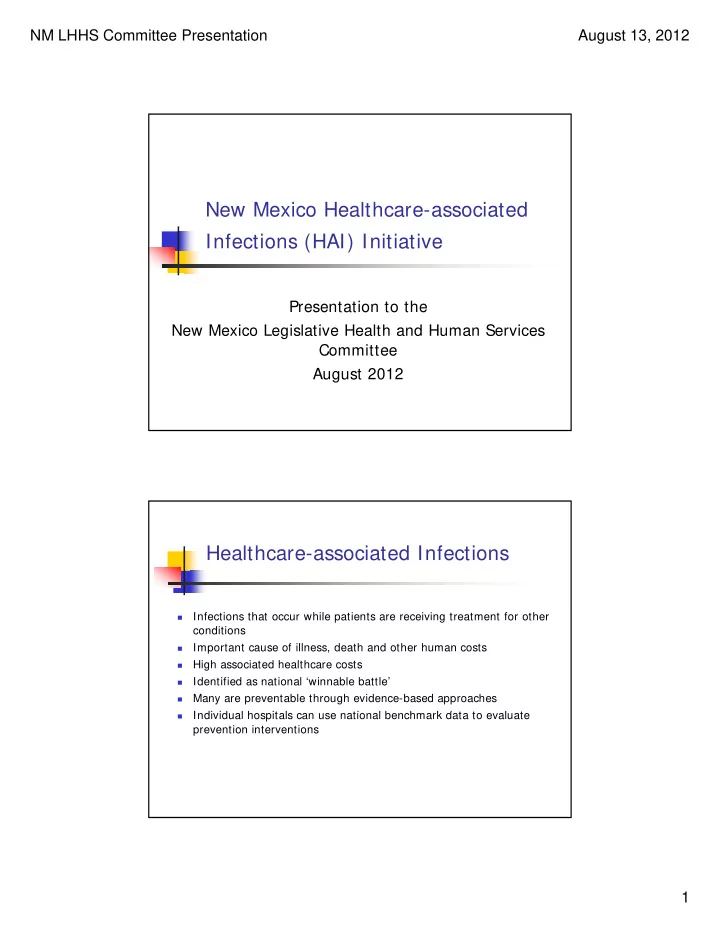
Healthcare-associated Infections

Infections that occur while patients are receiving treatment for other conditions

Important cause of illness, death and other human costs

High associated healthcare costs

Identified as national ‘winnable battle’

Many are preventable through evidence-based approaches I di id l h it l ti l b h k d t t l t

Individual hospitals can use national benchmark data to evaluate prevention interventions

slide-2
SLIDE 2

NM LHHS Committee Presentation August 13, 2012 2 New Mexico Healthcare-associated Infections (HAI)

Vision: Improve health status of New Mexicans through

improved healthcare outcomes

Goal: Work with stakeholders across New Mexico to reduce the

number of healthcare-associated infections that occur while patients are receiving healthcare

New Mexico Healthcare-associated Infections (HAI)

Background Background

2007: HJM 67 for New Mexico Department of Health (NMDOH) to lead an assessment of the feasibility of gathering statewide HAI information

2008: New Mexico Healthcare-associated Infections Advisory Committee was established

A national, standardized electronic reporting database available free to all facilities was selected - National Healthcare Safety Network (NHSN)

2 HAI measures were identified for surveillance and data submission

Healthcare personnel (HCP) influenza vaccination rates

Central line-associated bloodstream infections (CLABSI), which can occur if a patient’s central line is not properly cared for and organisms invade a patient’s bloodstream

slide-3
SLIDE 3

NM LHHS Committee Presentation August 13, 2012 3 New Mexico Healthcare-associated Infections (HAI)

HAI Advisory Committee Composition

Consumer

New Mexico (NM) Association for Professionals in Infection Control and Epidemiology (APIC)

New Mexico Department of Health (NMDOH)

NM hospitals (including large urban and smaller rural settings)

NM Hospital Association (NMHA)

NM Infection Preventionists (IPs)

HealthInsight New Mexico (formerly New Mexico Medical Review Association)

Society for Hospital Epidemiology of America (SHEA)

New Mexico Healthcare-associated Infections (HAI)

2009

NM Statute § 24-29-1 (2009) known as the Hospital-Acquired Infection Act was enacted which formalized the structure and role

  • f the Healthcare-associated Infections Advisory Committee

NMDOH leads the Advisory Committee to provide guidance for facilities to identify and prevent HAIs

First public report, including pilot project findings

Department of Health awarded American Recovery and Reinvestment Act of 2009 (ARRA) funds for HAI surveillance and prevention

 Established HAI Program at NMDOH  Supported expanded prevention activities

slide-4
SLIDE 4

NM LHHS Committee Presentation August 13, 2012 4 New Mexico Healthcare-associated Infections (HAI)

  • 2010
  • 2010
  • Submission of NM HAI Prevention Plan to U.S. Department of

Health and Human Services

  • Ongoing expansion of participating facilities and HAI measures
  • Statewide HAI prevention collaborative to prevent CLABSI
  • Release of annual public report
  • Start of multi-state CDC-led pilot of healthcare personnel

influenza vaccination standardized reporting (continued through influenza vaccination standardized reporting (continued through July 2012)

New Mexico Healthcare-associated Infections (HAI)

  • 2011

2011

  • First public report with facility-identified data
  • Measures aligned with initiation of federal reporting for Centers for

Medicare and Medicaid Services (CMS)

  • Statewide HAI prevention collaborative to prevent Clostridium

difficile infections (CDI)

  • Participation in 10-state population-based CDI surveillance
  • Two phases of CLABSI validation
  • p a
  • a da o
slide-5
SLIDE 5

NM LHHS Committee Presentation August 13, 2012 5 New Mexico Healthcare-associated Infections (HAI)

2012 Updates

2012 Updates

Resources significantly reduced with end of ARRA funding (12/2011)

Addition of select HAI to Administrative Code, Notifiable Diseases or Conditions in NM

CLABSI & CDI data from acute care facilities

Ongoing voluntary submission of healthcare personnel influenza vaccination data and training on NHSN data submission

Second public report with facility-identified data p p y

HealthInsight New Mexico Learning & Action Network implementation and workshops, including catheter-associated urinary tract prevention (CAUTI) and antimicrobial stewardship

NMHA Hospital Engagement Network recruitment and trainings

New Mexico Healthcare-associated Infections (HAI)

Recent Additions

Regional CDI prevention project in San Juan County

New voluntary NM HAI measure (laboratory-identified methicillin- resistant Staphylococcus aureus [MRSA] bacteremia) to begin January 2013 in acute care facilities

NMDOH NHSN Reporting Group expansion & monitoring C ti t l k f f t f di t iti

Continue to look for future funding opportunities

Collaboration of HAI Advisory Committee and NM stakeholders in aligning HAI resources

slide-6
SLIDE 6

NM LHHS Committee Presentation August 13, 2012 6 New Mexico Healthcare-associated Infections (HAI)

N M i ti li t ith ti l di ti New Mexico continues alignment with national directions

Prepare for upcoming CMS requirements for HAI reporting such as MRSA bacteremia and CDI as of January 2013

Participate in CDC special HAI research and prevention projects

Modify public reporting presentations to align with national reporting (e.g., Hospital Compare) and to be meaningful to NM consumers and other stakeholders Support new healthcare facility types (e g long term acute care

Support new healthcare facility types (e.g., long term acute care facilities) in NHSN enrollment and data submission

New Mexico Healthcare-associated Infections (HAI)

C t t Contacts

NM HAI Prevention Coordinator

Joan Baumbach, MD, MPH, MS Infectious Disease Epidemiology Bureau Chief New Mexico Department of Health 505.827.0011 or joan.baumbach@state.nm.us

NM HAI Program Manager

Lisa Bowdey Infectious Disease Epidemiology Bureau New Mexico Department of Health New Mexico Department of Health 505.476.3520 or lisa.bowdey@state.nm.us For Additional Information

www.hospitalcompare.hhs.gov

www.nmhealth.org/HAI (includes link to Summer 2012 Annual Report)

slide-7
SLIDE 7

New Mexico Healthcare-associated Infections Report - Summer 2012 Executive Summary

Prepared by: New Mexico Healthcare-associated Infections Advisory Committee

This document and further New Mexico healthcare-associated infection information can be found at www.nmhealth.org/HAI

Healthcare-associated infections are acquired by patients in healthcare settings during the course of receiving treatment for other conditions. Many healthcare-associated infections are preventable through proven practices. They have been recognized by the Centers for Disease Control and Prevention as a top “winnable battle” in public health and as a priority for improving the quality of healthcare and patient safety. New Mexico (NM) continues its initiative to monitor and prevent healthcare-associated infections and to make findings known to the public. This is the fourth NM public report and the second that includes facility-specific data. The NM Healthcare-associated Infections Advisory Committee is comprised of stakeholders including consumers, the Association for Professionals in Infection Control and Epidemiology NM, the NM Hospital Association, NM hospitals, HealthInsight New Mexico (the state healthcare quality improvement organization), local representation from the Society for Healthcare Epidemiology of America and the NM Department of Health. The Committee developed the NM Healthcare-associated Infections Prevention Plan that guides surveillance and prevention of healthcare- associated infections, submission of data at state and national levels, and reports to the public. The NM healthcare-associated infections initiative monitors central line-associated bloodstream infections because they can carry great risk to patients and also because hospitals can employ proven practices to prevent these infections. NM also monitors influenza vaccination rates of healthcare personnel because those personnel are a potential source of influenza to their patients; improvement of vaccination rates in healthcare personnel helps improve patient safety. Surveillance for and prevention of Clostridium difficile infection began in late 2010. Clostridium difficile infection causes diarrheal illness that can be healthcare-associated and very serious: it is linked to 14,000 American deaths each year. Those most at risk are older adults who take antibiotics and receive medical care. In 2011 there were 38 acute and long-term acute care facilities in NM voluntarily participating in healthcare-associated infections monitoring, prevention activities, and/or special research projects. As of late February 2012, it became mandatory for all acute care facilities to submit specified data for central line-associated bloodstream infections and laboratory-identified Clostridium difficile infection. The following is a summary of the key findings presented in this report:

  • Central line-associated bloodstream infection surveillance methods and

collaborative prevention efforts have improved in NM. The NM 2011 state aggregate standardized infection ratio of 0.47 met the 2014-15 national target ratio of 0.50. Facility-specific outcomes for hospitals that met specified criteria are included in this report.

slide-8
SLIDE 8
  • The NM aggregate healthcare personnel influenza vaccination rate for the 2011-

2012 flu season was 79.3% which exceeded the national Healthy People 2014- 2015 interim goal of 70%. The NM rate of 79.3% for 2011-2012 also represented an increase compared with the NM 2010-2011 flu season rate of 60.4%. Facility- specific rates are included in this report.

  • New Mexico is laying the groundwork for Clostridium difficile infection surveillance

and reporting. Twenty-two units in 15 hospitals reported laboratory-identified Clostridium difficile infection events during calendar year 2011 from both intensive care units and non-intensive care location types in their facilities. Currently there is no nationally endorsed measure for Clostridium difficile infection and no national Clostridium difficile infection benchmark is available for comparison purposes. The NM Healthcare-associated Infections Advisory Committee remains committed to guiding collection of data and prevention of healthcare-associated infections, and reporting findings to the public. New Mexico healthcare facilities continually demonstrate a commitment to patient safety within their facilities and also collaborate to share best practices for surveillance and prevention of healthcare-associated infections for the entire state. This report includes voluntarily submitted findings from calendar year 2011. In early 2012, select healthcare-associated infections became reportable to the NM Department of Health per the NM Administrative Code. Moving forward, this report will include information on both healthcare-associated infections that are mandated to be reported and others that will be voluntarily reported.

slide-9
SLIDE 9

New Mexico Healthcare-associated Infections (HAI) Initiative Infection Surveillance and Prevention Activity Highlights

Year HAI indicators & healthcare facilities and units HAI learning collaboratives voluntarily submitting data & healthcare facilities participating

# of facilities / units # of facilities

2008 CLABSIs in adult ICUs 6 / 9 HCP influenza vaccination (2008-2009 season) 6 2009 CLABSIs in adult & pediatric ICUs 6 / 10 HCP influenza vaccination (2009-2010 season) 25 2010 CLABSIs in adult & pediatric ICUs 11 / 16 HCP influenza vaccination (2010-2011 season) 24 CLABSI prevention 25 2011 CLABSIs in adult & pediatric ICUs 17 / 24 HCP influenza vaccination (2011-2012 season) 25 CLABSIs in non-ICUs 14 / 27 CDI laboratory identified events 15 / 22 CDI prevention 13

CLABSI = central line-associated bloodstream infection ICU = intensive care unit HCP = healthcare personnel CDI = Clostridium difficile infection

slide-10
SLIDE 10

New Mandatory Reporting of Two Healthcare-associated Infections in New Mexico

The New Mexico Department of Health (NMDOH) maintains a list of “Notifiable Diseases or Conditions in New Mexico” which is detailed in a section of 7.4.3 New Mexico Administrative Code (NMAC) "Control

  • f Disease and Conditions of Public Health Significance." The list describes mandatory reporting

requirements to NMDOH for healthcare facilities, laboratories, healthcare professionals, and other persons (for example, at schools or child care centers) who have knowledge of the specified diseases or conditions on the list. Recent modifications to the list included the addition of healthcare-associated infections (HAIs) as described below.

Description of the new reporting requirements

On February 29, 2012, central line-associated bloodstream infections (CLABSIs) and Clostridium difficile infections (CDIs) were added to the list of “Notifiable Diseases or Conditions in New Mexico.” Certain healthcare facilities and laboratories are now required to report these two HAIs to NMDOH. Previously, healthcare facilities in New Mexico voluntarily submitted their CLABSI and CDI data to NMDOH under the Hospital-Acquired Infection Act [NMSA 1978, Sections 24-29- 1 through 24-29-6 (2009)]. With the changes to the reporting rules in the NMAC, acute care hospitals are now required to submit data on CLABSIs and CDIs to NMDOH via the National Healthcare Safety Network (NHSN), an online surveillance database administered by the Centers for Disease Control and Prevention (CDC). Hospitals will confer rights to NMDOH to access these data in NHSN. Clinical laboratories that serve Bernalillo County and test for CDI are now required to submit all positive CDI lab results to NMDOH, regardless of the type of facility ordering the test.

Rationale for and benefits of mandatory reporting

Public health surveillance allows for the identification of infections and monitoring of disease trends. The CLABSI and CDI data that are being collected under the new reporting rules will be used to inform effective approaches to

What are HAIs?

Healthcare-associated infections,

  • r HAIs, are acquired by patients in

healthcare settings during the course of receiving treatment for

  • ther conditions. Many HAIs are

preventable through proven

  • practices. In the United States, HAIs

account for an estimated 1.7 million infections and 99,000 deaths each year.1 The direct medical costs associated with HAIs were estimated to be $25,903 per infection, in 2007 dollars.2 Two HAIs now under mandatory reporting in New Mexico:

  • Central line-associated

bloodstream infections (CLABSIs) – occur when organisms enter a patient’s blood through a central line, which is a tube placed in a large blood vessel for giving fluids

  • r medications, drawing blood, or

for monitoring purposes.

  • Clostridium difficile infections

(CDIs) – occur when a patient gets sick from C. difficile bacteria. Consequences can range from diarrhea to life-threatening inflammation of the colon.

slide-11
SLIDE 11

preventing and controlling disease. The changes will improve HAI surveillance by allowing NMDOH to collect CLABSI and CDI data from all New Mexico acute care hospitals, not just those that volunteer to submit data. Bernalillo County laboratories that submit positive CDI lab results are doing so as part of a population- based surveillance project with the CDC Emerging Infections Program (EIP). The information will be used to understand new infections of C. difficile among all residents of Bernalillo County, including those that are healthcare-associated and those that are community-associated. The information from New Mexico will also contribute to national understanding of CDI.

Potential impacts of the new reporting requirements

  • To healthcare facilities: A substantial increase in reporting burden to the acute care hospitals in New

Mexico is not expected. Prior to the rules changes, most hospitals in the state were already submitting CLABSI data to NHSN as required by the Centers for Medicare and Medicaid Services’ (CMS) pay-for-reporting program in order to receive full Medicare payments. Some hospitals had also started to submit CDI data to NHSN, though CDI reporting is not required by CMS until January

  • 2013. For hospitals that have already conferred rights to NMDOH, there is not expected to be any

extra routine work for their staff beyond what CMS reporting requires. For those that have not conferred viewing rights to NMDOH, they must do so under the new reporting rules. Data available to NMDOH via NHSN are subject to being reported publicly in the annual report prepared by the New Mexico HAI Advisory Committee. Monitoring and reporting HAIs, along with implementing the associated prevention activities, will help facilities to improve their infection rates.

  • To clinical laboratories: Most of the affected labs are expected to experience a minimal increase in

reporting burden as a result of adding CDI lab results to their electronic reporting to the state. TriCore Reference Laboratories will also submit clinical samples of all specimens positive for CDI to the NMDOH Scientific Laboratory Division (the state’s public health laboratory).

  • To NMDOH: The NMDOH Scientific Laboratory Division will receive and manage the clinical

laboratories’ CDI specimens to be tested at CDC. The NMDOH HAI Program will monitor the mandated data submission, provide support to the affected healthcare facilities (for example, technical assistance for using NHSN), and manage and report on the HAI data.

For details of 7.4.3 NMAC see: http://www.nmcpr.state.nm.us/nmac/parts/title07/07.004.0003.htm References

1. Klevens RM, Edwards JR, Richards CL Jr, et al. Estimating health care-associated infections and deaths in US hospitals, 2002. Public Health

  • Rep. 2007 Mar–Apr;122(2):160-6.

2. Scott RD. The direct medical costs of healthcare-associated infections in US hospitals and the benefits of prevention. Atlanta: Centers for Disease Control and Prevention; 2009.