
SLIDE 1
There Are Approximately 4,000 Species of Frogs
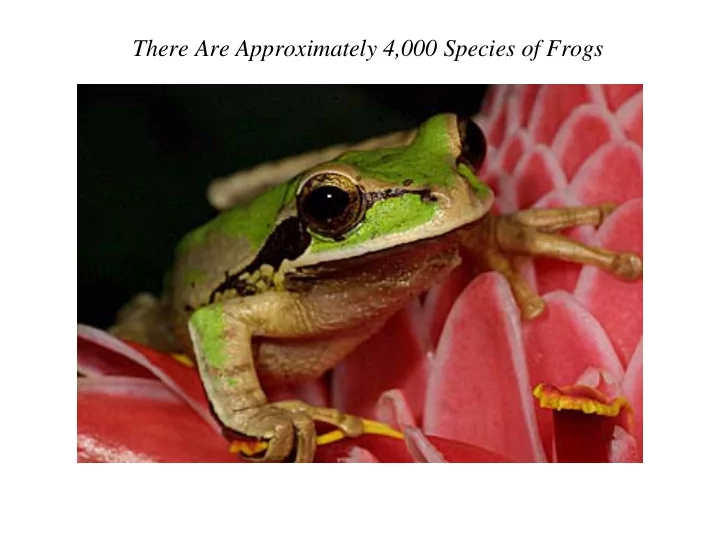
There Are Approximately 4,000 Species of Frogs Here are a few of - - PowerPoint PPT Presentation
There Are Approximately 4,000 Species of Frogs Here are a few of them The Frog Gallery The Frog Gallery Rana latouchi Or even Cream colored Just hangn Poison Dart Frogs Poison Dart Frogs Poison Darts Poison Dart Maker Or Blue
There Are Approximately 4,000 Species of Frogs
Rana latouchi
Or even Cream colored
Just hang’n
Poison Darts
Poison Dart Maker
Or Blue
Chopping Down The Tree Of Life
EJ?CCC áÑxv|xáBçÜ EJ?CCC áÑxv|xáBçÜ DLHC@ÑÜxá DLHC@ÑÜxáxÇà Çà
US Endangered Species: Amphibians
Tarahumara frog (Rana tarahumarae) in Mexico.
Declines in the US are particularly serious in: California The Rocky Mountains The Southwest Puerto Rico. Worldwide, decline "hot spots" also include Australia and Central America.
Extra limbs Malformed or missing limbs Facial deformities Documented in 44 states and involve nearly 60 species. In some local populations, up to 60% of the amphibians exhibit deformities.
Frog Legs
Andrew Blaustein and friends
Andrew Blaustein at work
Frog Eggs
Developing Frogs
Possible causes of declines and malformations
from: Johnson et al, 2002
Hypothesis: Frog declines and deformities are due to UV-B damage and pesticides that weakens their immune system, making them more susceptible to parasitic infections. Sounds like “Frog AIDS”
Blaustein References
Q: Who allows this? A: The EPA: Agricultural runoff is exempt from The Clean Water Act
See: http://www.epa.gov/region5/water/cwa.htm
Herbicide: Atrazine Usage: 2001
Effects of Atrazine* on Frog Development
*endocrine disrupter
Kansas
Minnesota*
* State slogan: Land of 10,000 lakes
*See: http://www.fda.gov/cvm/antimicrobial/022200slides/White/tsld004.htm
Microbe Disease Resistance Enterobacteriaceae bacteremia, pneumonia aminoglycosides wound infections β-lactams chloramphenicol trimethoprim FQs Enterococcus bacteremia aminoglycosides wound infections β-lactams erythromycin glycopeptides Haemophilus influenzae meningitis, otitis media β-lactams pneumonia tetracycline chloramphenicol trimethaprim Mycobacterium tuberculosis tuberculosis aminoglycosides ethambutol isoniazid rifampin Nisseria gonorrhoea gonorrhea β-lactams tetracylcine FQs
Top Ten Drug-resistant Microbes
Microbe Disease Resistance Plasmodium falciparum malaria chloroquine Pseudomonas aerogenosa bacteremia, pneumonia aminoglycosides UTIs β-lactams tetracycline TMX Shigella dysenteriae severe dysentery ampicillin chloramphenicol tetracycline TMX Staphylococcus aureus bacteremia, pneumonia chloramphenicol wound infections macrolides trimethoprim FQs β-lactams tetracycline glycopeptides? Streptococcus pneumoniae meningitis, pneumonia aminoglycosides chloramphenicol macrolides penicillin
“Luck favors only those who are prepared.” Louis Pasteur
(Famous French Microbiologist)
Rene Dubos*
Discoverer of Gramacidin
*also coined the term: “medical ecology”
Side View
Michael Zasloff
The African Clawed Frog Xenopus laevis Xenopus laevis
Life Cycle of Xenopus laevis
Examples of in situ hybridization in Xenopus laevis tad poles
Selected References
In most experiments in which Xenopus laevis was used as an egg donor, a 20% mortality rate was encountered. Michael Zasloff asked why so many survived, given the unsanitary conditions of their “recovery room.” *
*current situation
Michael Zasloff References*
Matsuzaki K, Mitani Y, Akada KY, Murase O, Yoneyama S, Zasloff M, Miyajima K.
Mechanism of synergism between antimicrobial peptides magainin 2 and PGLa.
PMID: 9790678 Tobian JA, Drinkard L, Zasloff M.
tRNA nuclear transport: defining the critical regions of human tRNAimet by point mutagenesis.
PMID: 3852693
* note the shift in research interests
Magainins:
anti-fungal, and anti-protozal activity
3-D Structure Of Prototypical Magainin
Wheel Structure of Magainin 2
Behaves chemically like Gramicidin
Mode Of Action Of Magainin
Mechanism of action of magainin
Each species of frog produces between 8-10 different kinds of magainin. Since there are approximately 4,000 frog species still out there, some of these magainins may prove useful for each of our own antibiotic needs.
Sometimes Its Easy Being Green!
Sometimes its not!
*
* You never know when you might need one!