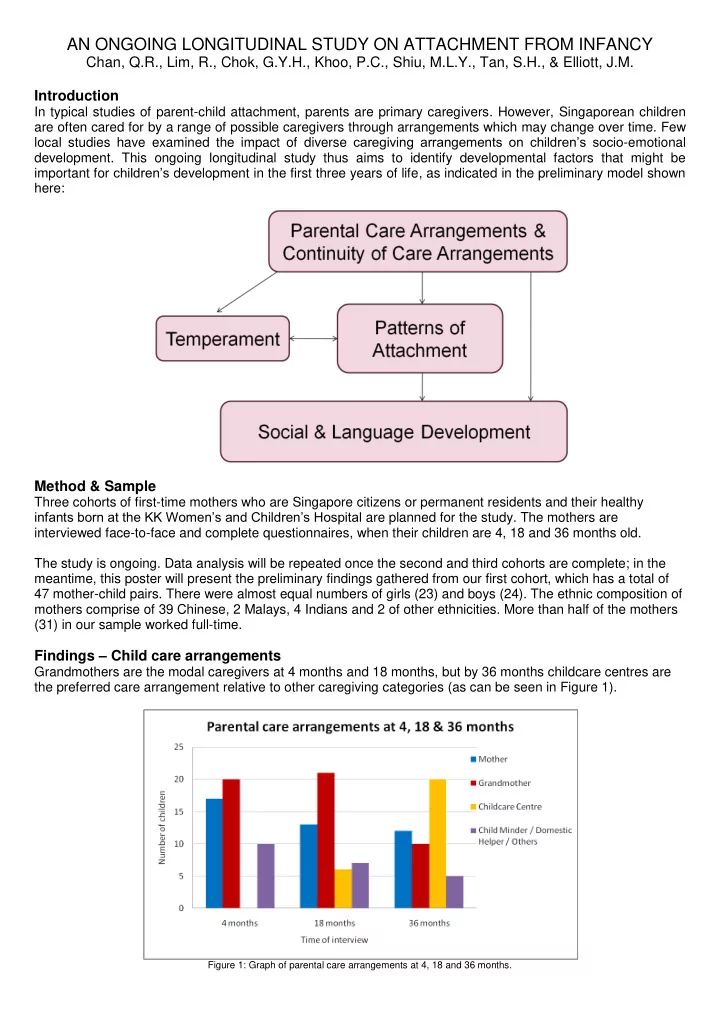
SLIDE 3
> .05), found no significant difference. Similarly, an independent samples t-test revealed that changes in caregiving arrangements did not have an impact on attachment, t(45) = 1.08, p > .05.
Findings – Development
Children’s social-emotional development was assessed using the Ages and Stages Questionnaire-Social Emotional (ASQ-SE) developed by Squires, Bricker and Twombly (2003). An independent samples t-test revealed small but significant differences in development scores between children who attended childcare and children who were cared for by other means, t(45) = 2.30, p < .05, with children who attended childcare scoring better in the ASQ-SE. Choice of main caregiver (one way between groups ANOVA, F(2,44) = 2.61, p > .05) and changes in caregiving arrangement (independent sample t-test, t(45) = -.66, p > .05) were not significant, implying that caregiving arrangements in general did not impact a child’s social-emotional development. Language development was measured at 18 and 36 months using the Singapore Communicative Development Inventories (SCDI), adapted from the MacArthur Communicative Development Inventories (Fenson et al., 1993). A Pearson’s correlation of receptive vocabulary at 18 months and mean length of utterance (MLU) at 36 months revealed a moderate correlation of r = .453, n = 38, p < .05. As the children grew older, their vocabulary size increased from M = 76, SD = 72 at 18 months to M = 430, SD = 167 at 36 months, t(41) = 14.8, p < .05.
Conclusion
This sample is small, and results must be regarded as provisional. Caregiving arrangement had no association with attachment, temperament and developmental outcome measures except for social-emotional development. Changes in caregiving arrangement had an effect on temperament at 36 months. Mothers’ perception of their child’s attachment improved from 18 to 36 months; their perception of their child’s temperament remained stable.
References
Fenson, L., Dale, P. S., Reznick, J. S., Thal, D., Bates, E., Hartung, J. P., Pethick, S. & Reilly, J. S. (1993). The MacArthur Communicative Development Inventories: User’s guide and technical manual. San Diego, CA: Singular Publishing Group. Pedlow, R., Sanson, A., Prior, M., & Oberklaid, F. (1993). Stability of maternally reported temperament from infancy to 8 years. Developmental Psychology, 29, 998-1007. Sanson, A., Prior, M., & Garino, E. (1987). The structure of infant temperament: Factor analysis of the revised infant temperament questionnaire. Infant Behavior and Development, 10, 97-104. Squires, J., Bricker, D., & Twombly, E. (2003). The ASQ:SE User’s Guide for the Ages & Stages Questionnaires: Social-Emotional. East Peoria, IL: Paul H. Brookes Publishing Co. Swewczyk-Sokolowski, M., Bost, K. K., & Wainwright, A. B. (2005). Attachment, Temperament and Preschool Children’s Peer Acceptance. Social Development, 14(3), 379-397. Tan, S. H. (2009). Singapore Communicative Development Inventories. Online at http://www.sci.sdsu.edu/cdi [accessed 21.12.2009] Waters, E., & Deane, K. (1985). Defining and assessing individual differences in attachment relationships: Q- methodology and the organization of behavior in infancy and early childhood. In I. Bretherton & E. Waters (Eds.), Growing points of attachment theory and research. Monographs of the Society for Research in Child Development, 50 Nos 1-2, pp 41-65 (Serial No. 209). For more information, please email info@childrensociety.org.sg.