Outline Dig Sites Nazareth and Bethlehem Recap: Criteria of - - PDF document
Class 6b JESUS INFANCY & CHILDHOOD Outline Dig Sites Nazareth and Bethlehem Recap: Criteria of Historicity Four Infancy Narratives: How Historical Are They? Gospel of Matthew Gospel of Luke Infancy Gospel of James
2
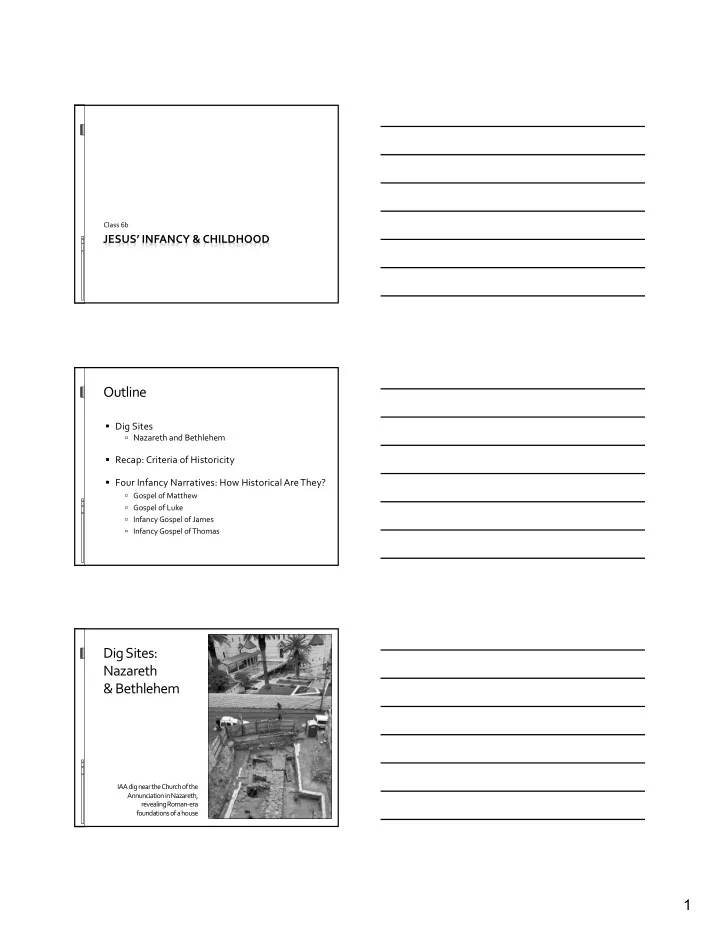
Israeli Archaeologist at work at an excavation in Nazareth
RECAP: CRITERIA OF HISTORICITY
Evaluating Historicity
For Literary Texts
§ IN the text (not an argument from silence) § eyewitness testimony § embarrassing to the author § multiply attested in independent witnesses § coherent with other sayings/actions established as historical § discontinuous with known Jewish or Christian tradition § consistent with Jesus’ execution
Something in the texts is MORE likely to be historical if it is
3 Evaluating Historicity
For Literary Texts
§ NOT actually said anywhere (not in any text) § a later tradition (though it may still be named for an apostle) § NOT embarrassing; it actually bolsters author’s claims
ú
adds laudatory epithets, legends, miraculous events
ú
adds interpretation (ties to Jewish figures, traditions, prophecies)
ú
explains problems in earlier stories
§ only reported in one witness § continuous with later Christian tradition
Something in the texts is LESS likely to be historical if it is
FOUR INFANCY NARRATIVES: HOW HISTORICAL ARE THEY?
Matthew’s Infancy Narrative
A Genealogy that Reveals Jesus’ Significance (Matt 1:1–2:23)
- Genealogy
1:1-17
How is it organized, and what does this symbolize?
4
Matthew’s Infancy Narrative
Five Vignettes in a Highly Structured Narrative (Matt 1:1–2:23)
- Joseph’s dream
1:18-25
- The magoi and the king
2:1-12
- Flight into exile
2:13-15
- Slaughter of infants
2:16-18
- Exodus from Egypt
2:19-23
- Genealogy
1:1-17
Isaiah 7:14 (1:22-23) Micah 5:1 (2:5-6) Hosea 11:1 (2:15) Jeremiah 31:15 (2:17-18) Unknown prophecy (2:23) What events in Jewish history do these episodes recall or echo?
Matthew’s Infancy Narrative
The more highly structured the narrative, and the more it self-consciously mirrors Jewish tradition, the less likely it is historical, the more likely it is an artistic emphasis on the significance of Jesus to the author’s eyes.
Luke’s Infancy Narrative
Highly Structured – in a Very Different Way (1:5–2:52)
Before births Birth Childhood John the Baptist Jesus
5
Luke’s Infancy Narrative
Do any of the episodes match up to the criteria of historicity, or do they demonstrate later theological reflection and embellishment (and if so, of what sort)?
Infancy Gospel of James
Manuscript Evidence
This gospel was very popular and was collated in several liturgical collections. Because the text was not regarded as canonical, it was amended more often, so the versions are quite different from one another. There are over 140 Greek mss (the oldest is Papyrus Bodmer 5 from the 300s), and multiple translations:
v 4 Syriac v 2 Georgian v 1 Latin (+ extracts) v 1 Irish v 3 Armenian v 1 Arabic v 2 fragments in Coptic v 1 Ethiopic paraphrase v 169 Church Slavonic mss
James was one of Jesus’ brothers, hence the tradition that he reported on Jesus’ infancy.
Infancy Gospel of James
§ Date § Genre § Gospel
comparison
§ Content 150–200 CE + later additions, place A narrative like the NT gospels, but confined to stories of parents and Jesus’ birth Presupposes and conflates the canonical infancy stories, adding legendary elements (1 Sam 1:1-2:11; 2 Chr 24:20-22) Mary’s conception, birth, upbringing, betrothal to older Joseph (with sons from a prior marriage), birth of Jesus, virginity in partu and post partum
6
James’ Infancy Narrative
Do any of the episodes match up to the criteria of historicity, or do they demonstrate later theological reflection and embellishment (and if so, of what sort)?
Infancy Gospel of Thomas
Manuscript Evidence
A version of this circulated in Arabic and would later influence the Qur’anic portrait of Jesus’ childhood. Our oldest copies of this gospel date to the fifth century CE:
v 8 Greek (1300s +) v 1 Georgian v 3 Syriac (500s +) v 1 Ethiopic v 2 Latin (400s–500s +) v 15Church Slavonic mss (1000s +)