An Approach to XML-based Description of Intraoperative Surgical - - PowerPoint PPT Presentation

an approach to xml based description of intraoperative
SMART_READER_LITE
LIVE PREVIEW

An Approach to XML-based Description of Intraoperative Surgical - - PowerPoint PPT Presentation

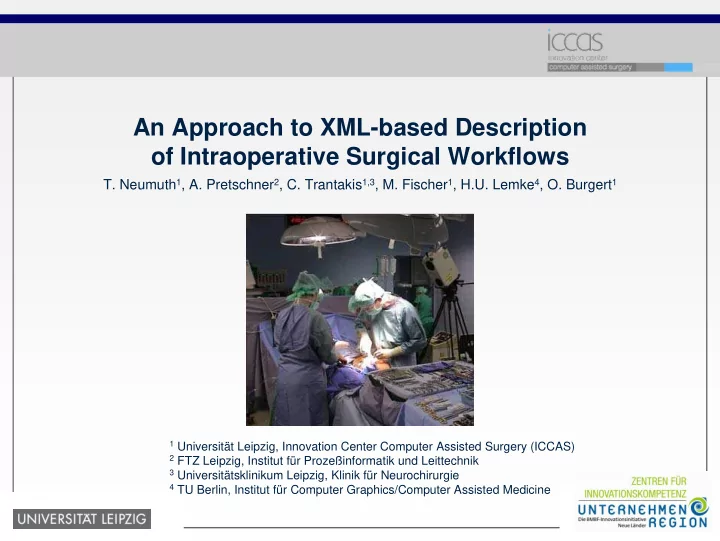
An Approach to XML-based Description of Intraoperative Surgical Workflows T. Neumuth 1 , A. Pretschner 2 , C. Trantakis 1,3 , M. Fischer 1 , H.U. Lemke 4 , O. Burgert 1 1 Universitt Leipzig, Innovation Center Computer Assisted Surgery (ICCAS) 2


slide-1
SLIDE 1

An Approach to XML-based Description

  • f Intraoperative Surgical Workflows
  • T. Neumuth1, A. Pretschner2, C. Trantakis1,3, M. Fischer1, H.U. Lemke4, O. Burgert1

1 Universität Leipzig, Innovation Center Computer Assisted Surgery (ICCAS) 2 FTZ Leipzig, Institut für Prozeßinformatik und Leittechnik 3 Universitätsklinikum Leipzig, Klinik für Neurochirurgie 4 TU Berlin, Institut für Computer Graphics/Computer Assisted Medicine

slide-2
SLIDE 2

Contents

  • Introduction
  • Challenges
  • Concepts
  • Instruments
  • Transformations to SVG
  • Clinical Use
  • Conclusions and the look ahead
  • Standardization
slide-3
SLIDE 3

Vision of ICCAS

  • Computer Assisted Surgery in the past:

– Technology driven – Limitation to special cases – No interoperability – Replacement of the surgeon

  • Vision of ICCAS:

– Research based on scientific process analysis – High medical relevance of all solutions – Integration and interoperability – Assistance of the surgeon

slide-4
SLIDE 4

Surgical Workflows and OR-Workflows

  • W. Sandberg et al: Setting a Research Agenda for Perioperative Systems Design
slide-5
SLIDE 5

Description of Surgical Interventions: Medical Challenges (Examples)

  • How often is instrument of type “cutting” used?
  • At which anatomical structures has it been used?
  • What is the viewing direction of the surgeon?
  • Are there ergonomic limitations?
  • How much time do one gain/spend using technique X?
  • What is the “typical” procedure for intervention Y?
  • How to evaluate the use of mechatronical ressources?
slide-6
SLIDE 6

Recording of Workflows

  • Large amount of information to be recorded:

– Active body parts (both hands, view, … of all participants) – Parallel and overlapping actions – High level of detail (every single work item!)

  • Missing tracking technology
  • Lack of surgical ontology

Workflow Processing

  • Visualization of Workflows
  • Aggregation of single workflows to condensed workflows
  • Analysis of Workflows
  • Identification of Surgical Integration Profiles (SIPs)

Description of Surgical Interventions: Technical Challenges

slide-7
SLIDE 7

Concepts

Workflow Database XSD Editor Core Web Accessible Editor Version Stand Alone Editor Version Transformationen Ontology Database Reporting Visualization

  • ther Use Cases
  • Recording
  • Processing
  • Storing
slide-8
SLIDE 8

Reasons for XML

  • Usage as Meta-Language
  • „Human readability“
  • Complex structures
  • Independence of representation
  • Openess
  • Simplified development of transformations
  • Transferability and knowledge management
slide-9
SLIDE 9

Recording solution

Workflow recording scheme (simplified)

slide-10
SLIDE 10

Workflow-Editor

Screenshot of the workflow-editor

slide-11
SLIDE 11

Representation for clinical users

PraPML

Prozeßablaufplan Markup Language

Insert retractor done

Operation Condition

Y N

Preparation Phase Main

  • perational

Phase Closing Phase

insert retractor musculus done insert drainage in situ remove retractor ex situ suture drainage cutis suture needle in situ connect drainage ex situ done done done done done Y N Y Y Y Y Y N N N N N

slide-12
SLIDE 12

SVG-Representation

  • Generation of graphical positions for task visualisation
  • Presentment of

– Participants with active parts – Causal and temporal relations between tasks – Starttime, Stoptime, duration of a task – Used instruments, executed activities, treated anatomic structures – Mixed representation of temporal and logical structures

  • Inferences:
  • High complexity
  • Aggregation of logical structure
  • Generation of graphical information from time-related

information

slide-13
SLIDE 13

Detailed problems

  • Frame sizes
  • Arrow directions

x x x x x x i=6

2 / _ _ padd y rect 2 / _ _ padd x rect ECMAScript … var height = new Number(amount_lines * sign_height + rect_y_padd + line_space * (amount_lines - 1)) … ECMAScript … function getMaxChars(…) … SVG/ECMAScript … <xsl:element name="svg:g"> … <xsl:attribute name="onload">draw_operation(…)"/>', … SVG …d=“M105 100 L170 80 L210 190“… ECMAScript …function getAngle(170,80,210,190)… SVG …arr_group.setAttribute(…rotate(…)…)…

suture drainage cutis

slide-14
SLIDE 14

00:00:00 00:00:10

Intervention 1

surgeon assistant left right left right A B C D E F

Intervention 2

surgeon assistant left right left right A B C D F

Workflow processing

  • To visualize a single surgical intervention
  • To viualize and to compare surgical interventions of the same

type

  • To compare intervention types of a discipline
  • To compare related intervention types between different

disciplines

  • To identify Surgical Integration Profiles (SIP)
  • To define Clinical-Good-Practice-Workflows (CGP-WF)
slide-15
SLIDE 15

Conclusions and the look ahead

  • Clinical documentation
  • Intervention planning and evaluation
  • Knowledge extraction and formalizing of surgical know-how
  • Instrument for comparison of surgical schools and quality assurance
  • Ergonomic improvement
  • Derivation and evluation of surgical assitance systems
  • Automation of the OR and workflow systems development
slide-16
SLIDE 16

Standardization

  • NEMA Diagnostic Imaging and Therapy Systems Division
  • DICOM Working Group 24

– Surgical DICOM

  • Workflow analysis
  • Workflow support systems

– Initial meeting 06/2004

NEMA National Electrical Manufacturers Association DICOM Digital Imaging and Communications in Medicine

slide-17
SLIDE 17

Acknowledgement

The “Innovation Center Computer Assisted Surgery” is funded by

  • the Federal Ministry of Education and Research (BMBF) and
  • the Saxon Ministry of Science and the Fine Arts (SMWK)

Grant No. “03 ZIK 031” and “03 ZIK 032” Centers of Innovation Competence “Unternehmen Region”

slide-18
SLIDE 18

Thomas Neumuth Research Fellow University of Leipzig Innovation Center Computer Assisted Surgery Working Group „Scientific Methods“ Tel.: +49-341-97-12000 thomas.neumuth@medizin.uni-leipzig.de

Thank you for your attention!