AMath 483/583 Lecture 20 Notes: Outline: Adaptive quadrature, - - PDF document

amath 483 583 lecture 20 notes
SMART_READER_LITE
LIVE PREVIEW

AMath 483/583 Lecture 20 Notes: Outline: Adaptive quadrature, - - PDF document

AMath 483/583 Lecture 20 Notes: Outline: Adaptive quadrature, recursive functions Load balancing with OpenMP nested forking Code: $UWHPSC/codes/adaptive_quadrature R.J. LeVeque, University of Washington AMath 483/583,


slide-1
SLIDE 1

AMath 483/583 — Lecture 20

Outline:

  • Adaptive quadrature, recursive functions
  • Load balancing with OpenMP
  • nested forking

Code:

  • $UWHPSC/codes/adaptive_quadrature

R.J. LeVeque, University of Washington AMath 483/583, Lecture 20

Notes:

R.J. LeVeque, University of Washington AMath 483/583, Lecture 20

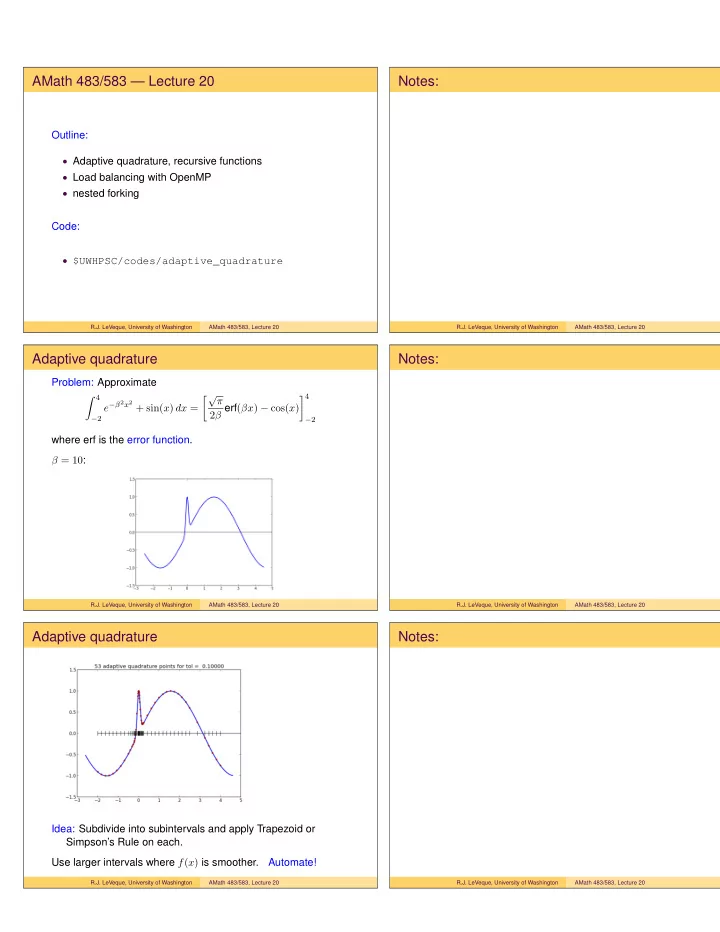
Adaptive quadrature

Problem: Approximate 4

−2

e−β2x2 + sin(x) dx = √π 2β erf(βx) − cos(x) 4

−2

where erf is the error function. β = 10:

R.J. LeVeque, University of Washington AMath 483/583, Lecture 20

Notes:

R.J. LeVeque, University of Washington AMath 483/583, Lecture 20

Adaptive quadrature

Idea: Subdivide into subintervals and apply Trapezoid or Simpson’s Rule on each. Use larger intervals where f(x) is smoother. Automate!

R.J. LeVeque, University of Washington AMath 483/583, Lecture 20

Notes:

R.J. LeVeque, University of Washington AMath 483/583, Lecture 20

slide-2
SLIDE 2

Adaptive quadrature

Ideas:

  • b

a

f(x) dx = (a+b)/2

a

f(x) dx + b

(a+b)/2

f(x) dx.

  • If we split the interval in half and the error on each half is

less than tol/2 then the total error is less than tol.

  • Simpson’s Rule is much more accurate than Trapezoid so

the difference between the two is a good estimate of the error in Trapezoid.

  • If the error estimate on either half is greater than tol/2,

then recursively subdivide that interval in half.

R.J. LeVeque, University of Washington AMath 483/583, Lecture 20

Notes:

R.J. LeVeque, University of Washington AMath 483/583, Lecture 20

Recursive subroutine example

Compute m! recursively, Using m! = m(m − 1)(m − 2) · · · 3 · 2 · 1 = m (m − 1)! $UWHPSC/adaptive_quadtrature/factorial_example.f90

R.J. LeVeque, University of Washington AMath 483/583, Lecture 20

Notes:

R.J. LeVeque, University of Washington AMath 483/583, Lecture 20

Adaptive quadrature

Ideas:

  • b

a

f(x) dx = (a+b)/2

a

f(x) dx + b

(a+b)/2

f(x) dx.

  • If we split the interval in half and the error on each half is

less than tol/2 then the total error is less than tol.

  • Simpson’s Rule is much more accurate than Trapezoid so

the difference between the two is a good estimate of the error in Trapezoid.

  • If the error estimate on either half is greater than tol/2,

then recursively subdivide that interval in half.

R.J. LeVeque, University of Washington AMath 483/583, Lecture 20

Notes:

R.J. LeVeque, University of Washington AMath 483/583, Lecture 20

slide-3
SLIDE 3

Adaptive Quadrature

See codes in $UWHPSC/codes/adaptive_quadrature ../serial: Serial code with recursive subroutine ../openmp1: OpenMP splitting into two pieces ../openmp2: OpenMP with nested forks

R.J. LeVeque, University of Washington AMath 483/583, Lecture 20

Notes:

R.J. LeVeque, University of Washington AMath 483/583, Lecture 20

Adaptive quadrature — recursion

Selected lines from

$UWHPSC/codes/adaptive_quadrature/serial/adapquad_mod.f90

R.J. LeVeque, University of Washington AMath 483/583, Lecture 20

Notes:

R.J. LeVeque, University of Washington AMath 483/583, Lecture 20

Adaptive quadrature — recursion

Using optional subroutine parameters in Fortran 90:

R.J. LeVeque, University of Washington AMath 483/583, Lecture 20

Notes:

R.J. LeVeque, University of Washington AMath 483/583, Lecture 20

slide-4
SLIDE 4

Adaptive quadrature — recursion

Main recursion step:

R.J. LeVeque, University of Washington AMath 483/583, Lecture 20

Notes:

R.J. LeVeque, University of Washington AMath 483/583, Lecture 20

Adaptive quadrature with tol = 0.5

approx = 0.1982448782099E+00 true = 0.4147421694070E+00 error =

  • 0.216E+00

errest = -0.415E-01

R.J. LeVeque, University of Washington AMath 483/583, Lecture 20

Notes:

R.J. LeVeque, University of Washington AMath 483/583, Lecture 20

Adaptive quadrature with tol = 0.1

approx = 0.4074167985367E+00 true = 0.4147421694070E+00 error =

  • 0.733E-02

errest = -0.730E-02 g was evaluated 53 times

R.J. LeVeque, University of Washington AMath 483/583, Lecture 20

Notes:

R.J. LeVeque, University of Washington AMath 483/583, Lecture 20

slide-5
SLIDE 5

Adaptive quadrature with tol = 0.02

approx = 0.4144742980922E+00 true = 0.4147421694070E+00 error =

  • 0.268E-03

errest = 0.119E-01 g was evaluated 115 times

R.J. LeVeque, University of Washington AMath 483/583, Lecture 20

Notes:

R.J. LeVeque, University of Washington AMath 483/583, Lecture 20

Adaptive quadrature — OpenMP

First attempt: split up original interval into 2 pieces in main program...

! $UWHPSC/codes/adaptive_quadrature/openmp1/testquad.f90 xmid = 0.5d0*(a+b) tol2 = tol / 2.d0 !$omp parallel sections !$omp section call adapquad(g,a,xmid,tol2,intest1,errest1) !$omp section call adapquad(g,xmid,b,tol2,intest2,errest2) !$omp end parallel sections int_approx = intest1 + intest2 errest = errest1 + errest2

May exhibit poor load balancing if much more work has to be done in one half than the other.

R.J. LeVeque, University of Washington AMath 483/583, Lecture 20

Notes:

R.J. LeVeque, University of Washington AMath 483/583, Lecture 20

Adaptive quadrature with tol = 0.1

Two threads, with OpenMP applied at top level only. Thread 0 works only on left half, Blue: Thread 0 Thread 1 works only on right half Red: Thread 1

R.J. LeVeque, University of Washington AMath 483/583, Lecture 20

Notes:

R.J. LeVeque, University of Washington AMath 483/583, Lecture 20

slide-6
SLIDE 6

Adaptive quadrature with tol = 0.01

Two threads, with OpenMP applied at top level only. Note that Thread 1 is Blue: Thread 0 done before Thread 0 Red: Thread 1 Poor load balancing if function is much smoother

  • n one half of interval than the other!

R.J. LeVeque, University of Washington AMath 483/583, Lecture 20

Notes:

R.J. LeVeque, University of Washington AMath 483/583, Lecture 20

Adaptive quadrature — OpenMP

Better approach: Allow nested calls to OpenMP .

! $UWHPSC/codes/adaptive_quadrature/openmp2/testquad.f90 ! Allow nested OpenMP threading: !$ call omp_set_nested(.true.) call adapquad(g, a, b, tol, int_approx, errest) !============ ! $UWHPSC/codes/adaptive_quadrature/openmp2/adapquad_mod.f90 if ((errest > tol) .and. (thislevel < maxlevel)) then ! recursively apply this subroutine to each half, with ! tolerance tol/2 for each, and nextlevel = thislevel+1: tol2 = tol / 2.d0 nextlevel = thislevel + 1 !$omp parallel sections !$omp section call adapquad(f,a,xmid,tol2,intest1,errest1,nextlevel,f_a,fmid) !$omp section call adapquad(f,xmid,b,tol2,intest2,errest2,nextlevel,fmid,f_b) !$omp end parallel sections

R.J. LeVeque, University of Washington AMath 483/583, Lecture 20

Notes:

R.J. LeVeque, University of Washington AMath 483/583, Lecture 20

Adaptive quadrature with tol = 0.1

Two threads, with nested OpenMP calls Next available thread takes Blue: Thread 0 each interval to be handled. Red: Thread 1

R.J. LeVeque, University of Washington AMath 483/583, Lecture 20

Notes:

R.J. LeVeque, University of Washington AMath 483/583, Lecture 20

slide-7
SLIDE 7

Adaptive quadrature with tol = 0.1

Running same thing a second time gives different pattern: Next available thread takes Blue: Thread 0 each interval to be handled. Red: Thread 1

R.J. LeVeque, University of Washington AMath 483/583, Lecture 20

Notes:

R.J. LeVeque, University of Washington AMath 483/583, Lecture 20

Adaptive quadrature with tol = 0.01

Two threads, with nested OpenMP calls Next available thread takes Blue: Thread 0 each interval to be handled. Red: Thread 1

R.J. LeVeque, University of Washington AMath 483/583, Lecture 20

Notes:

R.J. LeVeque, University of Washington AMath 483/583, Lecture 20

Software for adaptive quadrature

Much more sophisticated quadrature routines are available... QUADPACK: Fortran 77

http://en.wikipedia.org/wiki/QUADPACK

SciPy: scipy.integrate.quad uses QUADPACK: In [1]: from scipy import integrate as I In [2]: beta = 10. In [3]: f = lambda x: exp(-beta**2 * x**2) + sin(x) In [4]: I.quad(f, -2., 4.) Out[4]: (0.4147421694070216, 8.440197311887498e-09) Returns estimate of integral and of error. Use I.quad? or I? to learn more.

R.J. LeVeque, University of Washington AMath 483/583, Lecture 20

Notes:

R.J. LeVeque, University of Washington AMath 483/583, Lecture 20