Alternative Treatment Centers Draft Regulations - Update March 10, - - PowerPoint PPT Presentation

alternative treatment centers
SMART_READER_LITE
LIVE PREVIEW

Alternative Treatment Centers Draft Regulations - Update March 10, - - PowerPoint PPT Presentation

Alternative Treatment Centers Draft Regulations - Update March 10, 2015 Minimum Statutory Criteria Statute includes two specific locational restrictions (RSA 126-X:8.II): ATCs may not be located in any residential district and may


slide-1
SLIDE 1

Alternative Treatment Centers

Draft Regulations - Update

March 10, 2015
slide-2
SLIDE 2

Minimum Statutory Criteria

  • Statute includes two specific locational

restrictions (RSA 126-X:8.II):

– ATCs may not be located in any residential district and – may not be located within 1,000 feet of any school

  • r drug free zone
slide-3
SLIDE 3

“Residential Districts”

  • City staff interpret “residential districts” to

mean any district in which residential uses are permitted

– Staff is not aware of any contrary interpretation by the Department of Health and Human Services or

  • therwise
slide-4
SLIDE 4

“Drug Free Zones”

  • NH RSA 193-b:1, II defines drug-free school zone as “…an area

inclusive of any property used for school purposes by any school, whether or not owned by such school, within 1,000 feet of any such property[.]”

  • NH Department of Education regulation 316 distinguishes between

and provides definitions for “temporary” and “permanent” drug free zones.

  • How these definitions apply to the ATC statute and where ATCs may

be located has not been fully clarified by the Department of Health and Human Services. There remains a significant amount of uncertainty as to how to interpret and apply the “drug free zone” language.

  • The Therapeutic Cannabis Program Steering Committee met on

March 9, 2015. It is staff’s understanding that the drug free school zones issue was discussed.

slide-5
SLIDE 5

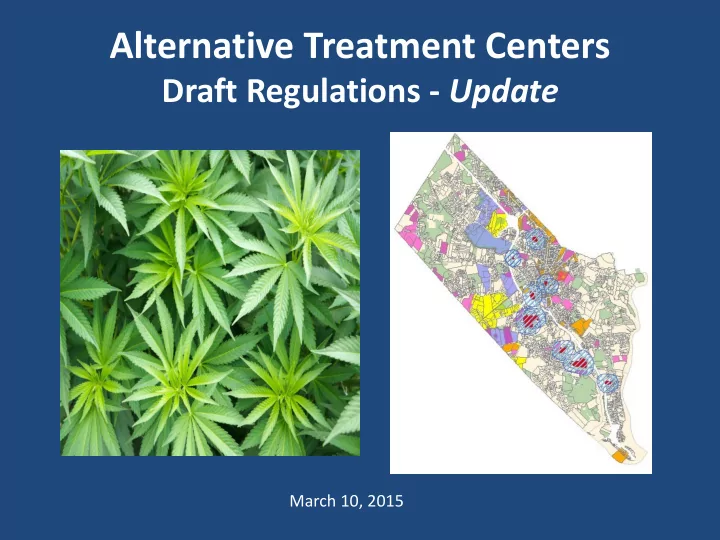
Map Changes

  • School boundaries reduced from 2,000 ft to

1,000 ft

  • McConnell Center property added – meets

definition of “drug free zone”

  • B-4 District properties along Knox Marsh Road

no longer encumbered by what staff had interpreted as the radius of the drug free zone

slide-6
SLIDE 6
slide-7
SLIDE 7

Staff Recommendations

  • Staff recommends allowing ATCs in the B-4

and I-2 Districts

  • Uncertainty in interpretation of statute and

regulations reinforces importance of a proactive zoning approach

  • Placement in B-4 and I-2 will avoid

interpretation issues entirely – no schools or school uses are located in these zones

slide-8
SLIDE 8

Questions?

Department of Planning and Community Development http://www.dover.nh.gov/government/city-operations/planning