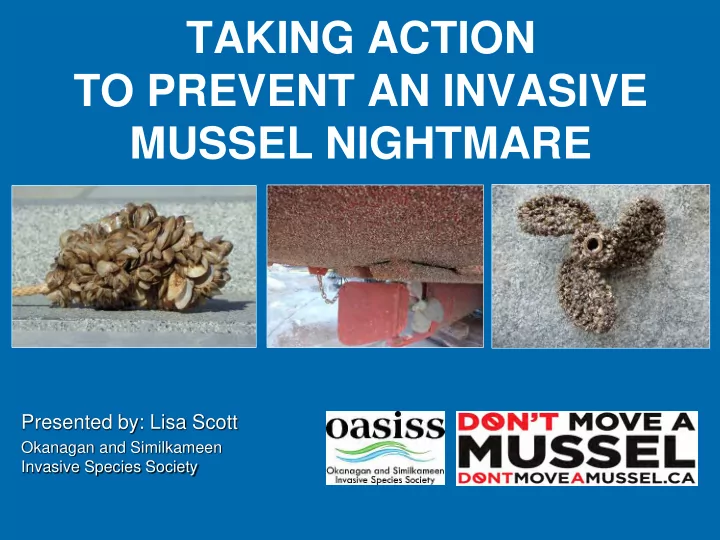
SLIDE 1 TAKING ACTION TO PREVENT AN INVASIVE MUSSEL NIGHTMARE
Presented by: Lisa Scott
Okanagan and Similkameen Invasive Species Society
SLIDE 2 OASISS – who we are
- A non-profit society established in 1996.
- Diverse cross-section of members.
- Broadened mandate to encompass invasive species in
2012.
- Address invasive species and their pathways of
spread through prioritization and multi-stakeholder cooperative coordination
- Responsible for the coordination, implementation and
evaluation of on-the-ground treatment.
- Involved in public information and community
stewardship programs.
SLIDE 3 Okanagan watershed and the Similkameen watershed
SLIDE 4
SLIDE 5 Zebra / quagga mussel biology
- Freshwater mussels
- Ability to attach to solid surfaces
by byssus threads
- Filter feeders
- Free swimming microscopic
larvae
- Adults can live without water for
up to 30 days
Source: BC Government
SLIDE 6 Native mussels vs zebra / quagga mussels
Source: BC Government
SLIDE 7 Why be concerned?
Invasive mussels can….
Clog pipes, water intake systems
and municipal water supply
“The bane of water systems and power plants in the Great Lakes area”
Compete for food with native
species and deplete food sources for fish
Decrease the quality of the
recreational experience and impact tourism
Source: BC Government
SLIDE 8 Source: Therriault et al. 2012 *Based on probability
Could they survive?
SLIDE 9 A substrate sampler before.... A substrate sampler after being set in the south basin of Lake Winnipeg at Gimli for three months. Source: Manitoba Conservation and Water Stewardship
SLIDE 10
How fast have they spread ?
SLIDE 11
How fast have they spread?
SLIDE 12
How fast have they spread?
SLIDE 13
How fast have they spread?
SLIDE 14
How fast have they spread?
SLIDE 15
How fast have they spread?
SLIDE 16
How fast have they spread?
SLIDE 17
How fast have they spread?
SLIDE 18
How fast have they spread?
SLIDE 19
How fast have they spread?
SLIDE 20
How fast have they spread?
SLIDE 21
How fast have they spread?
SLIDE 22
How fast have they spread?
SLIDE 23
How fast have they spread?
SLIDE 24
How fast have they spread?
SLIDE 25
How fast have they spread?
SLIDE 26
How fast have they spread?
SLIDE 27
How fast have they spread?
SLIDE 28
How fast have they spread?
SLIDE 29
How fast have they spread?
SLIDE 30
How fast have they spread?
SLIDE 31
How fast have they spread?
SLIDE 32
How fast have they spread?
SLIDE 33
How fast have they spread?
SLIDE 34
How fast have they spread?
SLIDE 35
How fast have they spread?
SLIDE 36
How fast have they spread?
SLIDE 37
How fast have they spread?
SLIDE 38
SLIDE 39 “If they get over the Continental Divide, then British Columbia, Idaho, Washington and Oregon are all vulnerable. No matter how many inspection stations we have, they’ll just float
- downriver. And it’s not just a tourism matter. We
estimate it will cost the region a half-billion dollars a year for the rest of our lives just to manage impact on hydro, irrigation and fisheries, especially our salmon habitat.”
Matt Morrison, CEO of the Pacific Northwest Economic Region (December 1, 2016)
SLIDE 40 Estimated Economic Impact for the Okanagan Basin
We estimate that the annual total cost of a mussel invasion to exceed 43 million per year in the first few years from lost revenues and added maintenance of aquatic infrastructure, … in addition to irreparable ecological damage.
$ 43,000,000
We could be 43 million richer for every year we keep the mussels out.
SLIDE 41
British Columbia – Summary
Sector Annual costs % total impact Hydropower generation $6,524,532 15.2 Agriculture - Irrigation $14,800,000 34.4 Municipal water supplies $9,251,608 21.5 Recreational boating $12,385,962 28.8 Fisheries, Tourism, Property values ????? Total $42,962,102
SLIDE 42
The current level of Montana’s AIS funding, approximately $6.5 million, is roughly 3 percent of the estimated $234 million annual costs for invasive mussel mitigation and lost revenue.
SLIDE 43 BC Invasive Mussel Defence Program
It is MANDATORY
for ALL watercraft to stop at road side inspection stations.
Watercraft includes
sailboats, motorboats, kayaks, canoes and paddle boards.
Source: https://www2.gov.bc.ca/gov/content/invasive-mussels
SLIDE 44 BC now has 2 dogs trained to detect invasive mussels
SLIDE 45
SLIDE 46
SLIDE 47
SLIDE 48
Monitor the local waters for invasive mussels Raise awareness about invasive mussels and other AIS, and encourage behavior change: CLEAN-DRAIN-DRY
Regional Aquatics Program
SLIDE 49 OASISS worked cooperatively with yacht clubs, marinas, BC Parks and municipalities to monitor the local waters for invasive mussels in 16 locations
Regional Program
Mussel Substrate Monitors
PC: Neil Bousquet
SLIDE 50 Mussel Veliger Monitoring
OASISS collected water samples from 20 different locations and partnered with the Osoyoos Lake Water Quality Society for additional monitoring
PC: Neil Bousquet
SLIDE 51 Source: Aquatic Invasive Species Network http://www.westernais.org/monitoring
Mussel Veliger Monitoring In the Columbia Basin
SLIDE 52 Regional Program
Distribution of
materials to ~400 locations in the Okanagan valley
Interaction with
~7000 people
SLIDE 53
Regional Program
Interactions at
boat launches with ~4000 people
Attendance at 25
community events
16 youth
presentations
9 campground
talks
SLIDE 54
Regional Program
Educational Trailer
SLIDE 55
RESULTS
SLIDE 56
SLIDE 57
SLIDE 58
SLIDE 59
Identified Gaps
Limited $$ Not all recreational
boaters stop at inspection stations
Some boaters not
understanding the issue and what they can do about it => lack of awareness
SLIDE 60 Possible Solutions - Regionally
Increase communication /
those who service/ sell boats
Signage at additional boat launches Workshops and training at boat sales
locations, maintenance shops, dive shops
Enhanced partnerships with marinas,
yacht clubs – events, training, demonstrations, newsletters/websites, packages to members
Increased monitoring
SLIDE 61 For more information contact: Lisa Scott OASISS Executive Director 250-404-0115
www.oasiss.ca
Kal Lake Splash Mob Credit: Brynne Morrice