
Database Management Systems, R. Ramakrishnan and J. Gehrke 1
File Organizations and Indexing
Database Management Systems, R. Ramakrishnan and J. Gehrke 2
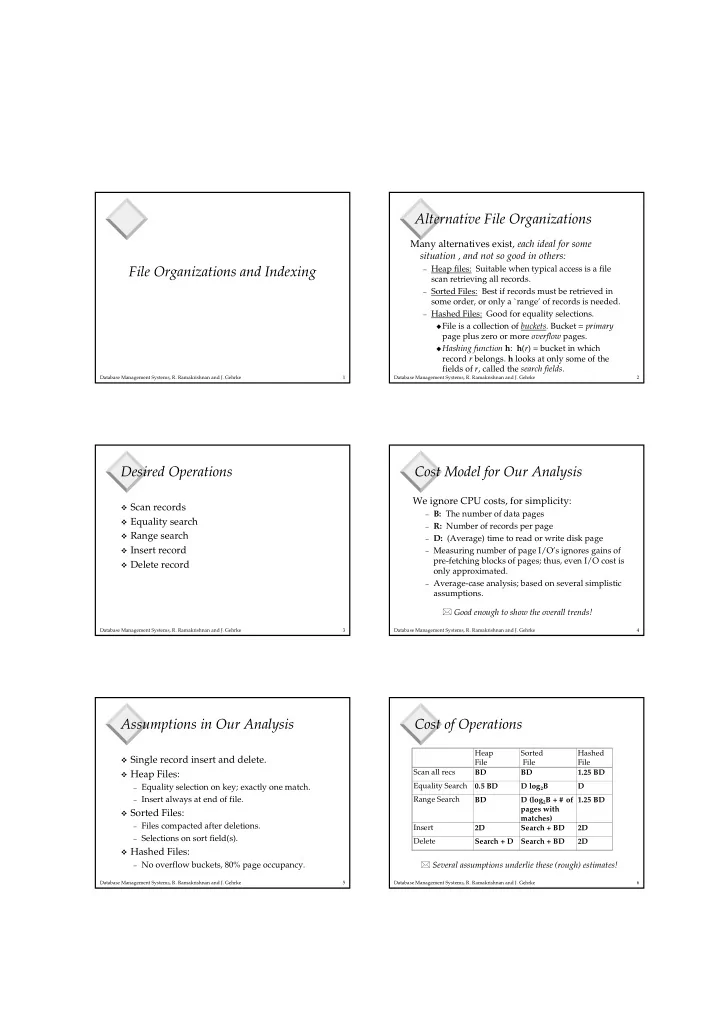
Alternative File Organizations
Many alternatives exist, each ideal for some situation , and not so good in others:
– Heap files: Suitable when typical access is a file
scan retrieving all records.
– Sorted Files: Best if records must be retrieved in
some order, or only a `range’ of records is needed.
– Hashed Files: Good for equality selections.
File is a collection of buckets. Bucket = primary
page plus zero or more overflow pages.
Hashing function h: h(r) = bucket in which
record r belongs. h looks at only some of the fields of r, called the search fields.
Database Management Systems, R. Ramakrishnan and J. Gehrke 3
Desired Operations
Scan records Equality search Range search Insert record Delete record
Database Management Systems, R. Ramakrishnan and J. Gehrke 4
Cost Model for Our Analysis
We ignore CPU costs, for simplicity:
– B: The number of data pages – R: Number of records per page – D: (Average) time to read or write disk page – Measuring number of page I/O’s ignores gains of
pre-fetching blocks of pages; thus, even I/O cost is
- nly approximated.
– Average-case analysis; based on several simplistic
assumptions. Good enough to show the overall trends!
Database Management Systems, R. Ramakrishnan and J. Gehrke 5
Assumptions in Our Analysis
Single record insert and delete. Heap Files:
– Equality selection on key; exactly one match. – Insert always at end of file.
Sorted Files:
– Files compacted after deletions. – Selections on sort field(s).
Hashed Files:
– No overflow buckets, 80% page occupancy.
Database Management Systems, R. Ramakrishnan and J. Gehrke 6