Alte ternate te De Definiti tions (Ru Human inte telligence - - PowerPoint PPT Presentation

alte ternate te de definiti
SMART_READER_LITE
LIVE PREVIEW

Alte ternate te De Definiti tions (Ru Human inte telligence - - PowerPoint PPT Presentation

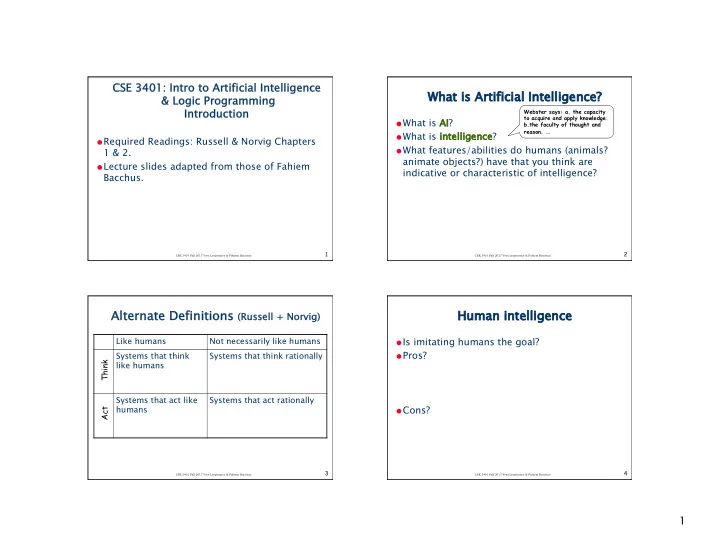
CSE E 3401: Intr tro to to Arti tificial Inte telligence What t is Arti tificial Inte telligence? & Log & Logic P ic Prog rogram rammin ing Intr troducti tion Webster says: a. the capacity to acquire and apply


slide-1
SLIDE 1

1

1

CSE 3401 Fall 2017 Yves Lesperance & Fahiem Bacchus

CSE E 3401: Intr tro to to Arti tificial Inte telligence
 & Log & Logic P ic Prog rogram rammin ing
 Intr troducti tion

  • Required Readings: Russell & Norvig Chapters

1 & 2.

  • Lecture slides adapted from those of Fahiem

Bacchus.

2

CSE 3401 Fall 2017 Yves Lesperance & Fahiem Bacchus

What t is Arti tificial Inte telligence?

  • What is AI

AI?

  • What is inte

telligence?

  • What features/abilities do humans (animals?

animate objects?) have that you think are indicative or characteristic of intelligence?

Webster says: a. the capacity to acquire and apply knowledge. b.the faculty of thought and

  • reason. …

3

CSE 3401 Fall 2017 Yves Lesperance & Fahiem Bacchus

Alte ternate te De Definiti tions (Ru

(Russell + Norv ssell + Norvig ig)

Like humans Not necessarily like humans Systems that think like humans Systems that think rationally Systems that act like humans Systems that act rationally Think Act

4

CSE 3401 Fall 2017 Yves Lesperance & Fahiem Bacchus

Human inte telligence

  • Is imitating humans the goal?
  • Pros?
  • Cons?
slide-2
SLIDE 2

2

5

CSE 3401 Fall 2017 Yves Lesperance & Fahiem Bacchus

Human inte telligence

  • The Turing Test:

■ A human interrogator. Communicates with a hidden

subject that is either a computer system or a

  • human. If the human interrogator cannot reliably

decide whether on not the subject is a computer, the computer is said to have passed the Turing test.

6

CSE 3401 Fall 2017 Yves Lesperance & Fahiem Bacchus

Human inte telligence

  • Turing provided some very persuasive

arguments that a system passing the Turing test is intelligent.

  • But too much emphasis on deception.
  • Moreover, the test does not provide much

traction on the question of how to actually build an intelligent system.

7

CSE 3401 Fall 2017 Yves Lesperance & Fahiem Bacchus

Human inte telligence

  • In general there are various reasons why trying to

mimic humans might not be the best approach to AI.

■ Computers and Humans have a very different architecture

with quite different abilities.

  • Numerical computations
  • Visual and sensory processing
  • Massive and slow parallel vs. fast serial

8

CSE 3401 Fall 2017 Yves Lesperance & Fahiem Bacchus

Human inte telligence

■ But more importantly, we know very little about how the

human brain performs its higher level processes. Hence, this point of view provides very little information from which a scientific understanding of these processes can be built.

■ However, Neuroscience has been very influential in some

areas of AI. For example, in robotic sensing, vision processing, etc.

slide-3
SLIDE 3

3

9

CSE 3401 Fall 2017 Yves Lesperance & Fahiem Bacchus

Rati tionality ty

  • The alternative approach relies on the notion of

rati tionality ty.

  • Typically this is a precise mathematical notion
  • f what it means to do the right thing in any

particular circumstance. Provides

■ A precise mechanism for analyzing and

understanding the properties of this ideal behavior we are trying to achieve.

■ A precise benchmark against which we can measure

the behavior the systems we build.

10

CSE 3401 Fall 2017 Yves Lesperance & Fahiem Bacchus

Rati tionality ty

  • Mathematical characterizations of rationality

have come from diverse areas like logic (laws

  • f thought) and economics (utility theory how

best to act under uncertainty, game theory how self-interested agents interact).

  • There is no universal agreement about which

notion of rationality is best, but since these notions are precise we can study them and give exact characterizations of their properties, good and bad.

  • We’ll focus on acting rationally

■ this has implications for thinking/reasoning

11

CSE 3401 Fall 2017 Yves Lesperance & Fahiem Bacchus

Computa tati tional Inte telligence

  • AI tries to understand and model intelligence

as a computational process.

  • Thus we try to construct systems whose

computation achieves or approximates the desired notion of rationality.

  • Hence AI is part of Computer Science.

■ There are other areas interested in the study of

intelligence, e.g., cognitive science which focuses on human intelligence. Such areas are very related, but their central focus tends to be different.

12

CSE 3401 Fall 2017 Yves Lesperance & Fahiem Bacchus

Agency Agency

  • It is also useful to think of intelligent systems

as being agents ts, either:

■ with their own goals ■ or that act on behalf of someone (a “user”)

  • An agent is an entity that exists in an

environment and that acts on that environment based on its perceptions of the environment

  • An intelligent agent acts to further its own

interests (or those of a user).

  • An autonomous agent can make decisions

without the user’s intervention, possibly based

  • n what it has learned
slide-4
SLIDE 4

4

13

CSE 3401 Fall 2017 Yves Lesperance & Fahiem Bacchus

Agent t Schemati tic (I)

  • This diagram oversimplifies the internal

structure of the agent.

Agent Environment

perceives acts

Types of Agents ts

  • Simple reflex agents

ts: apply simple condition- action rules to decide next action based on current percepts

  • Model-based reflex agents: maintain a model
  • f the world, apply rules to decide next action

based on current world model

  • Goal-based agents

ts: decide next action based

  • n current model of world state and current

go goal(s) s); may do planning; more flexible!

14

CSE 3401 Fall 2017 Yves Lesperance & Fahiem Bacchus

15

CSE 3401 Fall 2017 Yves Lesperance & Fahiem Bacchus

Agent t Schemati tic (II)

  • Supports more flexible interaction with the

environment, ability to modify one’s goals, knowledge that is applied flexibly to different situations.

Agent Environment

perceives acts Knowledge Goals prior knowledge user

Types of Agents ts

  • Uti

tility ty-based agents ts: choose actions to maximize their expected uti tility ty in uncertain worlds

  • Learning agents: explore space of possible

actions, evaluate performance, and modify agent to improve

16

CSE 3401 Fall 2017 Yves Lesperance & Fahiem Bacchus

slide-5
SLIDE 5

5

17

CSE 3401 Fall 2017 Yves Lesperance & Fahiem Bacchus

De Degrees of Inte telligence

  • Building an intelligent system as capable as humans

remains an elusive goal.

  • However, systems have been built which exhibit

various specialized degrees of intelligence.

  • Formalisms and algorithmic ideas have been identified

as being useful in the construction of these “intelligent” systems.

  • Together these formalisms and algorithms form the

foundation of our attempt to understand intelligence as a computational process.

  • In this course we will study some of these formalisms

and see how they can be used to achieve various degrees of intelligence.

18

CSE 3401 Fall 2017 Yves Lesperance & Fahiem Bacchus

AI AI Successes Successes

  • In 1997 IBM’s Deep Blue beat chess world

champion

  • In 1999, NASA Remote Agent used AI planning

to control a spacecraft

  • In 2005 Stanford team won DARPA Grand

Challenge 132mi race in desert

  • In 2011, IBM’s Watson beat the top Jeopardy

winners

  • In 2016, Google DeepMind AlphaGo beat

decade’s top player

  • Many successes in speech recognition, machine

translation, robotics, scheduling, spam fighting

Reasons for Recent t Progress

  • Better hardware
  • AI techniques are improving, especially:

■ Search methods and heuristics ■ Improved representations ■ Machine learning, large corpuses

19

CSE 3401 Fall 2017 Yves Lesperance & Fahiem Bacchus

20

CSE 3401 Fall 2017 Yves Lesperance & Fahiem Bacchus

Sub Subareas s of f AI AI

  • Perception: vision, speech understanding, etc.
  • Robotics
  • Natural language understanding
  • Machine learning
  • Reasoning and decision making (our focus)

■ Knowledge representa

tati tion

■ Reas

Reason

  • nin

ing (logical, probabilistic)

■ De

Decision making (search, planning, decision theory)

slide-6
SLIDE 6

6

Prospects ts for AI

  • Recent progress has been rapid
  • Concerns about the risks of developing AI
  • Are current learning-based AI systems really

intelligent?

■ Winograd Schema Challenge, e.g. The city councilmen refused the demonstrators a permit because they fea feared ed violence. Who feared violence? vs The city councilmen refused the demonstrators a permit because they advocate ted violence. Who advocated violence?

21

CSE 3401 Fall 2017 Yves Lesperance & Fahiem Bacchus

Some Inte teresti ting & En Ente terta taining Vid Video eos

  • James May’s Big Idea Man-Machine episode where

he meets Honda’s Asimo robot programmed so it can learn to recognize objects http:// www.youtube.com/watch?v=QfPkHU_36Cs

  • Google's self-driving car https://

www.youtube.com/watch?v=TsaES--OTzM

  • Google self-driving care Waymo (recent) https://

www.youtube.com/watch?v=uHbMt6WDhQ8

  • Google Deep Mind AlphaGo win http://

www.theguardian.com/technology/video/2016/ mar/09/alphago-computer-beats-go-champion- video

22

CSE 3401 Fall 2017 Yves Lesperance & Fahiem Bacchus