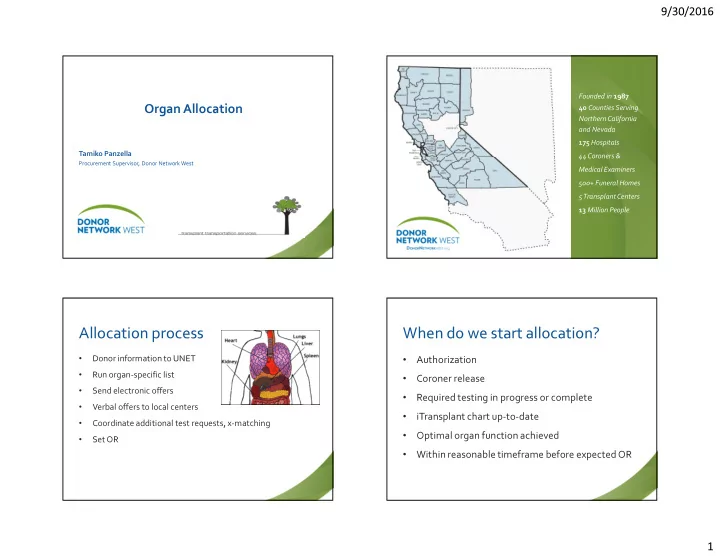
Allocation process When do we start allocation? Donor - - PowerPoint PPT Presentation

allocation process when do we start allocation
SMART_READER_LITE
LIVE PREVIEW

Allocation process When do we start allocation? Donor - - PowerPoint PPT Presentation

9/30/2016 Founded in 1987 40 Counties Serving Organ Allocation Northern California and Nevada 175 Hospitals Tamiko Panzella 44 Coroners & Procurement Supervisor, Donor Network West Medical Examiners 500+ Funeral Homes 5 Transplant


slide-1
SLIDE 1

9/30/2016 1

Heal a life through organ and tissue donation

Organ Allocation

Procurement Supervisor, Donor Network West

Tamiko Panzella Founded in 1987 40 Counties Serving Northern California and Nevada 175 Hospitals 44 Coroners & Medical Examiners 500+ Funeral Homes 5 Transplant Centers 13 Million People

Allocation process

  • Donor information to UNET
  • Run organ-specific list
  • Send electronic offers
  • Verbal offers to local centers
  • Coordinate additional test requests, x-matching
  • Set OR

When do we start allocation?

  • Authorization
  • Coroner release
  • Required testing in progress or complete
  • iTransplant chart up-to-date
  • Optimal organ function achieved
  • Within reasonable timeframe before expected OR
slide-2
SLIDE 2

9/30/2016 2

Recipient Ranking

  • Distance
  • ABO
  • Medical urgency
  • Wait time
  • Longevity matching

Allocation by Organ: Heart

  • List screens by ABO, HLA,

age, size, gender, hxCAD, DCD, HBV, HCV

  • Recipients are ranked by

medical urgency

Sample Heart List Allocation by Organ: Lungs

  • List screens by ABO, HLA,

age, size, smoking hx, DCD, HBV, HCV

  • Recipients ranked by Lung

Allocation Score (LAS)

slide-3
SLIDE 3

9/30/2016 3

Allocation by Organ: Liver

  • List screens by ABO, age,

size, DCD, HBV, HCV, peak lab values (Na, AST, ALT, INR)

  • Recipients are ranked by

medical urgency

Allocation by Organ: Liver

AREA STATUS Local > Regional Adult/Pediatrics Status 1A -> Pediatric Status 1B Local > Regional MELD 40 Local > Regional MELD 39 Local > Regional MELD 38 Local > Regional MELD 37 Local > Regional MELD 36 Local > Regional MELD 35 Local MELD 34-16 Regional MELD 34-16 National Status 1 – MELD 15

Allocation by Organ: Kidneys

  • List screens by ABO, HLA,

KDPI, age, size, DCD, DM, HTN, HBV, HCV, creatinine

  • Recipients ranked by wait

time, HLA matching, longevity matching

  • Highly sensitized recipients

are prioritized

Allocation by Organ: Kidneys

  • KAS (Kidney Allocation System) Started 12/2014
  • Allocation based on KDPI (Kidney Donor Profile Index)
  • Donor age, ethnicity, creatinine, HTN hx, DM hx, height, weight, DCD/BDD,

COD, HCV status

  • Allocation sequences: KDPI 0-20; 21-34; 35-85; >85
slide-4
SLIDE 4

9/30/2016 4

Allocation by Organ: Pancreas

  • List screens by ABO, HLA, age, size, DCD, DM, HTN, HBV,

HCV, labs

  • Pancreas, Combined Kidney-Pancreas, Islet
  • Recipients ranked by wait time

Allocation by Organ: Intestine

  • List screens by ABO, age, HCV, HBV, CMV, DM, GI disease
  • Recipients ranked by medical urgency
  • Combined liver/intestine recipients receive priority on liver

list.

When can we set the OR?

  • Case-by-case basis
  • Organs placed/ backed up as needed
  • Recovery teams identified

– Pancreas team recovers all abdominals – If no pancreas, liver team recovers – If no liver, kidney team recovers – Thoracic teams generally recover their own organs

slide-5
SLIDE 5

9/30/2016 5

Procurement

  • OPO brings supplies and instruments
  • Moment of Silence
  • Warm dissection
  • Cross Clamp
  • Back table

Heart Lungs Liver Kidney Pancreas Small Bowel 4-6 hours 4-8 hours 12 hours 24-48 hours 10-16 hours 10-14 hours

Cold Ischemic Time Limits

Preservation Technology

  • Kidney pumping
  • Heart in a box
  • Lung in a box
  • OrganOx (liver pumping)

Special Considerations

  • PHS Increased Risk
  • DCD
  • HIV +
  • VCA
slide-6
SLIDE 6

9/30/2016 6

12667 Alcosta Blvd., suite 500 San Ramon, CA 94583 tpanzella@dnwest.org

Heal a life through organ and tissue donation

Transplant Travel Logistics

Best Practices for Safe Organ Team Travel

President, Transplant Transportation Services, Inc.

Scott Pritchard

Flight Process Overview

Request from OPO (Activity Report) Request from OPO (Activity Report)

  • Destination
  • OR time
  • Pax Names
  • UNOS
  • DOB
  • Organs (helps us

identify the appropriate airplane) Logistics Planning Logistics Planning

  • Qualified Crew
  • Appropriate plane
  • Third party audit
  • Weather
  • Potential delays (air or ground)
  • After hour services
  • Ground transportation
  • Contingency plan

Post flight Post flight

  • Process review
  • Allocation for

billing

  • Invoice generation

Things that an informed client should know

  • Qualified crew and aircraft
  • Third Party vetting
  • Insurance
  • Pilot duty time limitations
  • Unforeseen delays
  • Weather
slide-7
SLIDE 7

9/30/2016 7

A few Best Practices & Understandings & Common Misunderstandings

  • Turbine engines ARE safer than piston engines
  • Twin engines ARE safer than single engines
  • Two pilots ARE better than one. (Note: Approximately 78% of accidents were

single pilot*)

  • Pilots ARE NOT typically at the airport waiting to fly – allow time for

proper preparation

  • Does your operator utilize third party auditing
  • Forecast volume and forecast weather

Robert Breiling & Associates, Jan. 2014

Common Operator Challenges

Flight departments understanding the timeline (thoracic vs. abdominal) We like to be the “conduit between aviation and transplant medicine” Industry wide there is a massive pilot shortage Effects experience base Enough staff to have the ability to respond timely Cost Luggage/supplies considerations FAA duty time limitations (14 hours total ~12.5 for the client) Passenger specific requests for aircraft types – we want to make everyone happy. The inherent clinical / administrative tug in terms of aircraft used, ground transportation and food as it relates to cost

Questions?

Scott Pritchard, Transplant Transportation Services, Inc. scott@transplanttransportationservices.com 800-915-7190 ext. 3