AJUST TO A LOW EMISSIONS ECONOMY ~Dv1s10N 1 This presentation will - - PowerPoint PPT Presentation

ajust
SMART_READER_LITE
LIVE PREVIEW

AJUST TO A LOW EMISSIONS ECONOMY ~Dv1s10N 1 This presentation will - - PowerPoint PPT Presentation

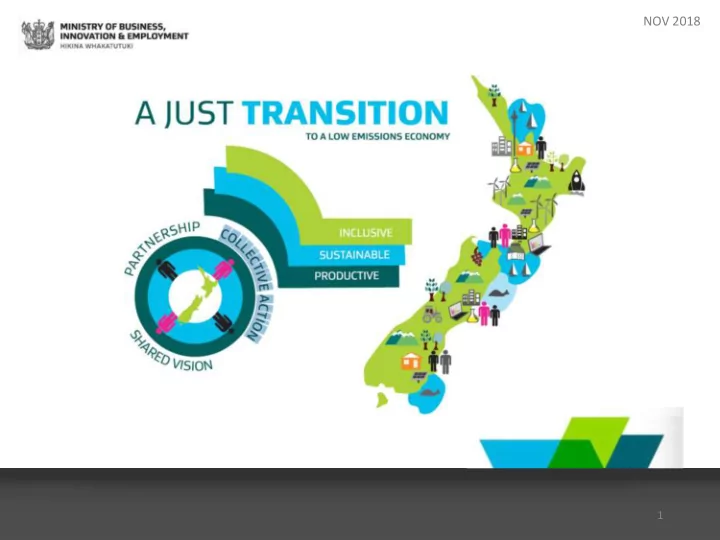
~ ~ NOV 2018 ,-.,.-, MINISTRY OF BUSINESS, INNOVATION & EMPLOYMENT HOUNA WHAKAlUT\JKI AJUST TO A LOW EMISSIONS ECONOMY ~Dv1s10N 1 This presentation will cover What we mean by a Just Transition The role of the Just Transitions Unit


slide-1
SLIDE 1

,-.,.-, MINISTRY OF BUSINESS,

INNOVATION & EMPLOYMENT

HOUNA WHAKAlUT\JKI

AJUST

~

~

~Dv1s10N

TO A LOW EMISSIONS ECONOMY

NOV 2018

1
slide-2
SLIDE 2

This presentation will cover

  • What we mean by a Just Transition
  • The role of the Just Transitions Unit – our focus

and approach

  • The work programme
  • How this fits with Future of Work (and MfE work)

2

slide-3
SLIDE 3

What we mean by a Just Transition

A Just Transition is about:

  • Partnering between government, Māori, business, the workforce,

and communities to:

  • Build an understanding of the potential pathways to

transform our economy (to one that is low emissions);

  • Identify, create and support new opportunities, new jobs,

new skills and new investments that will emerge from the transition; and

  • Better understand how the transition might impact on

different communities, regions or sectors and make choices about how we manage these impacts in a just and inclusive way.

3

slide-4
SLIDE 4

Our focus – On a transition to a low emissions economy

A broad range of factors will impact on New Zealand’s transformation over the next 30 years, including our response to climate change, technological development and the future of work. We are focusing our just transition work on the pathways, partnerships and decisions that support a just transition to a low emissions economy.

4

slide-5
SLIDE 5

,-.,.-, MINISTRY OF BUSINESS,

INNOVATION & EMPLOYMENT

HOUNA WHAKAlUT\JKI

AJUST

~

~

~Dv1s10N

TO A LOW EMISSIONS ECONOMY

NOV 2018

1

slide-6
SLIDE 6

This presentation will cover

  • What we mean by a Just Transition
  • The role of the Just Transitions Unit – our focus

and approach

  • The work programme
  • How this fits with Future of Work (and MfE work)

2

slide-7
SLIDE 7

What we mean by a Just Transition

A Just Transition is about:

  • Partnering between government, Māori, business, the workforce,

and communities to:

  • Build an understanding of the potential pathways to

transform our economy (to one that is low emissions);

  • Identify, create and support new opportunities, new jobs,

new skills and new investments that will emerge from the transition; and

  • Better understand how the transition might impact on

different communities, regions or sectors and make choices about how we manage these impacts in a just and inclusive way.

3

slide-8
SLIDE 8

Our focus – On a transition to a low emissions economy

A broad range of factors will impact on New Zealand’s transformation over the next 30 years, including our response to climate change, technological development and the future of work. We are focusing our just transition work on the pathways, partnerships and decisions that support a just transition to a low emissions economy.

4

slide-9
SLIDE 9

Just Transition Unit Work Programme

Our initial focus will be on three key themes which will help build a Just Transition approach into our climate change work:

  • 1. Partnership
  • Effective partnering with Taranaki to assist with the region’s transition
  • Effective partnering with the food processing sector to assist the sector’s transition
  • 2. Shared vision
  • Planning for a National Just Transition Summit (hosted in Taranaki, second quarter 2019)
  • 3. Policy coherence and alignment
  • Coordinating economic advice into key climate change policy processes
  • Developing an evidence base to better understand the distributional impacts of major

climate change policy decisions on – the regions, sectors and communities most likely to be affected by transition-related decisions

  • Working with other government agencies to ensure a just transition lens is used in the

development of policy and operational work

5

slide-10
SLIDE 10

Just Transition Unit Work Programme

Our initial focus will be on three key themes which will help build a Just Transition approach into our climate change work:

  • 1. Partnership
  • Effective partnering with Taranaki to assist with the region’s transition
  • Effective partnering with the food processing sector to assist the sector’s transition
  • 2. Shared vision
  • Planning for a National Just Transition Summit (hosted in Taranaki, second quarter 2019)
  • 3. Policy coherence and alignment
  • Coordinating economic advice into key climate change policy processes
  • Developing an evidence base to better understand the distributional impacts of major

climate change policy decisions on – the regions, sectors and communities most likely to be affected by transition-related decisions

  • Working with other government agencies to ensure a just transition lens is used in the

development of policy and operational work

5

slide-11
SLIDE 11

Taranaki Just Transition Roadmap

Step 1 (immediate) Step 2 (mid - term) Step 3 (long term) Vision of the future Time

6

slide-12
SLIDE 12

TARANAKI 2050 TRANSITION ROADMAP D vel

NOVl:MBER 2018

men Process

N~CSMldf.va.Uon

~dive

'-1st TransJtionSummit l.aunchdral't roadmap Aalon Pf.)nnlng

7

slide-13
SLIDE 13

Just Transition Unit National Summit

The Just Transition National Summit provides a platform for a national conversation about what a Just Transition to a low emissions future is and what it will look like for New Zealand. It will also allow participants to engage with local and international speakers and experts in the field. It is the opportunity for people to play a key role in building what a successful transition looks like for New Zealand and how we best represent a Just Transitions partnership between government, business, workers and iwi. The National Summit will help guide how we will work together and how we successfully transition New Zealand to a low emission economy with good, high paying jobs.

8

slide-14
SLIDE 14

Future of Work and Just Transitions

TRANSITION HUB

MfE

  • Coordinating and providing climate

change advice and expertise on mitigation and adaptation

  • Building evidence base on potential pathways

to a net zero emissions economy and likely impacts

  • Emissions pricing

International Obligations & Monitoring

Implementation of our Paris commitments MFAT Engagement with the UNFCCC MFAT

JUST TRANSITION UNIT

MBIE

  • Co-creation and engagement with unions,

employers, investors, sectors, regions and key social partners including Māori, Pasifika, NGOs

  • Working with priority groups to develop

strategies for anticipating and responding to the transition – linked into the Economic Strategy

Institutional Arrangements

  • Zero Carbon Bill
  • Emissions Reduction Targets and

Budgets

  • Climate Change Commission
  • ETS Design and Policy
  • Climate Reporting Architecture

International Engagement

Working with key organisation such as the ILO, IEA, OECD, and

  • ther countries, regions and networks to develop evidence base

and guidance on policy concerning a Just Transition MFAT, MBIE,

MfE, Tsy

Future of Work Tripartite Forum

(Minister Robertson)

PRODUCTIVITY SKILLS TECHNOLOGY xxxxxxJUST TRANSITIONS Sector policies in:

  • Transport MoT
  • Agriculture and Forestry MPI
  • Waste MfE
  • Energy markets and efficiency

MBIE, EECA Underpinned by institutional arrangements Developing advice on sector abatement

  • pportunities/ sequencing

Broad Policy Levers

  • Macro and growth policies Tsy, MBIE
  • Innovation and investment MBIE, Tsy
  • Enterprise policy MBIE
  • Science policy MBIE
  • Sector policy MPI, MBIE, MoT, MfE
  • Skills & education policy MoE, MBIE
  • Labour markets MBIE
  • Social welfare policy MSD
  • Energy markets MBIE
  • Urban & built environment MBIE,

(MHUD), MfE

  • Procurement MBIE
  • Provincial Development MBIE

Evaluation and Monitoring External Engagement

CTU Business NZ Regions Māori Pasifika Communities NGOs Local Government Emissions intensive industries Others

Coordination of cross-government policy work to support a just transition

9

slide-15
SLIDE 15

The all-of-government framework for climate change policy and decision-making

Source: MfE

As agreed by Cabinet (March/April 2018)

10