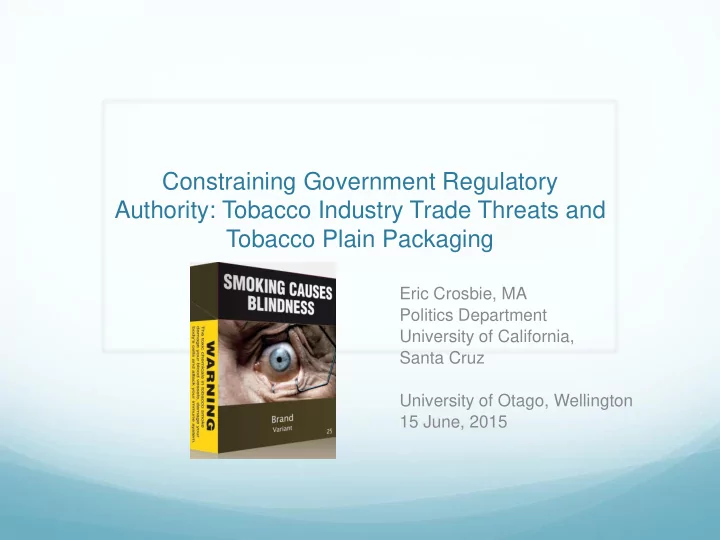
SLIDE 1 Constraining Government Regulatory Authority: Tobacco Industry Trade Threats and Tobacco Plain Packaging
Eric Crosbie, MA Politics Department University of California, Santa Cruz University of Otago, Wellington 15 June, 2015
SLIDE 2
Disclosure Statement
No funding or support from tobacco companies
SLIDE 3
Acknowledgements
University of California Pacific Rim Research Program ASPIRE 2015
SLIDE 4
ASPIRE 2025 Annual Report 2014
SLIDE 5
ASPIRE 2025 Annual Report 2014
SLIDE 6
Collaboration
SLIDE 7
Overview
Background Gaps in the Literature Research Question Case Selection Methods Early Findings
SLIDE 8
Inter-Disciplinary Research
Political Science (International Political Economy) Public Health (Tobacco Control) Case of transnational corporations vis-à-vis the state
(state autonomy and global governance)
SLIDE 9 Global Governance and Global Business Regulation
State Autonomy Under Globalization
Globalization impact Retreat of the state? Role of non-state actors
Global Governance
International trade
TariffsIntellectual property and investment
Global Business Regulation
Private authority and public regulation
Self-regulation
SLIDE 10 Tobacco and Trade
Trade liberalization
Lower tobacco tariffs
Access to new markets
Increased tobacco consumption
Health versus trade debate
WHO versus WTO
Right to health
Intellectual property and
investment arguments
Legal weapon to intimidate governments
SLIDE 11 Preemption & Global Preemption
Preemption
Removing authority from subordinate jurisdictions Preempting strong local laws with weak state laws and
strong state laws with weak national laws
Global Preemption
Shifting authority to international regulatory bodies
Venue Shifting and Forum Shopping
International trade dispute settlement bodies Policy space
SLIDE 12
Preemption
Regulatory Authority
National Level State Level Local Level
SLIDE 13
Preemption
Regulatory Authority
National Level State Level Local Level
SLIDE 14
Preemption
Regulatory Authority
National Level State Level Local Level
SLIDE 15
Preemption
Regulatory Authority
National Level State Level Local Level
SLIDE 16
Preemption
Regulatory Authority
National Level State Level Local Level
SLIDE 17
Preemption
Regulatory Authority
National Level State Level Local Level
SLIDE 18
Preemption
Regulatory Authority
National Level State Level Local Level
SLIDE 19
Global Preemption
Regulatory Authority
International Level National Level State Level Local Level
SLIDE 20
Research Questions
Under what conditions and to what extent are
transnational corporations constraining government regulatory authority?
To what extent are transnational tobacco companies
using trade agreements to constrain governments from implementing public health policies?
What are the political implications of these legal trade
threats and challenges?
SLIDE 21
Cigarette Package Health Warning Labels (HWLs)
Evolution of HWLs: Textual to pictorial warnings Larger, more graphic HWLs are more effective Package: One of the last forms of advertising
SLIDE 22
Cigarette Package Health Warning Labels (HWLs)
Evolution of HWLs: Textual to pictorial warnings Larger, more graphic HWLs are more effective Package: One of the last forms of advertising
SLIDE 23
Case Selection
67 countries require pictorial HWLs (most 50%) 4 countries: New Zealand, Jamaica, Uruguay, and
Australia have attempted to implement 75%
SLIDE 24
Methodology
Mix-Method Approach Comparative Method Archival Research Interviews
SLIDE 25
Comparative Method
Most-different and most-similar systems design
SLIDE 26
Archival Research
University of California, San Francisco (UCSF) Legacy
Library (legacy.library.ucsf.edu)
SLIDE 27 PMI Workshop (October 1985)
tid/tdy88e00
SLIDE 28
Generic/Plain Packaging
NZ Toxic Substances Board proposal (May 1989) Beede, Lawson, & Shepherd study (Dec 1989) Smokefree Environments Act (August 1990)
SLIDE 29 BAT NZ Concerns Over Packaging (January 1993)
tid/udk04a99
SLIDE 30 Plain Pack Group
Members
British American Tobacco (BAT) Rothmans International RJ Reynolds Philip Morris Imperial Tobacco Reemtsma & Gallaher
First meeting
September 1993
Objective
Coordinate internationally on
issues of plain packaging
SLIDE 31 BAT NZ Letter to London Headquarters (May 1993)
tid/wjl23a99
SLIDE 32 Plain Pack Group-Slide Presentation (July 1994)
tid/mjk78a99
SLIDE 33 Australia and Canada Caving Into Trade Threats
Australian Health Minister-July 1995 “Unfortunately [generic packaging] is just not
to buy tobacco companies’ trademarks and that would cost us hundreds of millions of dollars.”
Canadian Health Minister-August 1996 “We would be in violation of trademark and the Charter of Rights and Freedoms because the product is not deemed to be an illegal product.”
SLIDE 34
Trans-Pacific Partnership Agreement (TPP)
SLIDE 35
Trans-Pacific Partnership Agreement (TPP)
Negotiations
Over 20 rounds of negotiations completed Private (wiki leaks leaked documents)
Impact
Tobacco control Access to medicines Food safety standards Alcohol regulation Environment and climate change
SLIDE 36
Interviews
Interview key informants:
Policymakers Government officials (health and trade ministry) Health groups (domestic and international) Tobacco control advocates Legal experts
SLIDE 37
Tobacco Control in NZ
Tobacco indicators
Smoking prevalence 15%, Māori 40% About 5,000 people die per year, 13 people a day
Tobacco control progress
Retail display ban Retailer register Annual above-inflation tobacco taxation increases Smokefree prisons Increased penalties for sales to minors
SLIDE 38 Smokefree 2025
Smokefree 2020 vision Māori Affairs Select
Committee inquiry into tobacco industry (2010)
NZ government 2025
commitment (March 2011)
Smoking prevalence less than 5% (not a ban)
Plain packaging
NZ government announces
plain packs in principle (April 2012)
SLIDE 39 Plain Packaging Goals
Reduces appeal of tobacco
products, especially youth
Reduces any wider social
acceptance of smoking
Discourages people from
taking up smoking
Encourages people to give
up smoking
Supports NZ’s international
commitments to the WHO FCTC
SLIDE 40 Tobacco Plain Packaging Process in NZ
MOH Consultation First Reading Health Select Committee Second Reading Committee
House
Third Reading Governor General’s assent Regulation making Enter into force
SLIDE 41 Tobacco Plain Packaging Process in NZ
MOH consultation process (July-October 2012)
300 submissions from individuals, organizations and
businesses
Health Ministry analyzed submissions and reported
back to Cabinet (November 2012)
Government decided to proceed (February 2013)
MOH Consultation First Reading Health Select Committee Second Reading Committee
House
SLIDE 42
The Plain Truth Campaign
SLIDE 43
BAT Agree-Disagree Media Campaign
SLIDE 44 Industry Arguments Against Plain Packaging
No evidence it would work
Would not reduce youth smoking or consumption
Not working in Australia
Would increase illicit trade Bad precedent for others Retailer concerns Violates international treaties
Breach of WTO and investment treaties
SLIDE 45
The Revolving Door
Christopher Bishop, MP for Hutt South
Former PMI Corporate Affairs Manager
Todd Barclay, MP for Clutha-Southland
Former PMI Corporate Affairs PR
SLIDE 46
Government Response
SLIDE 47 Tobacco Plain Packaging Process in NZ
First Reading (February 2014)
MPs reiterating industry concerns MPs also emphasizing importance of FCTC and public
health
First Reading passes (only 1 vote against)
MOH Consultation First Reading Health Select Committee Second Reading Committee
House
SLIDE 48 Tobacco Plain Packaging Process in NZ
Bill referred to committee (February-March 2014)
15,682 submissions from interest groups/individuals Changed title to “standardised” tobacco packaging
MOH report to Health Committee (June 2014)
61% supported bill, 31% opposed, 8% not clear Opposition mostly from tobacco industry & retail Evidence for plain packs & not to wait
MOH Consultation First Reading Health Select Committee Second Reading Committee
House
SLIDE 49 Tobacco Plain Packaging Process in NZ
MOH Consultation First Reading Health Select Committee Second Reading Committee
House
SLIDE 50
Tobacco Plain Packaging In Comparison
Australia (19 months)
Proposal April 2010, Approval November 2011
Ireland (22 months)
Proposal April 2013, Approval February 2015
United Kingdom (35 months)
Proposal April 2012, Approval March 2015
New Zealand (38+ months)
Proposal April 2012, Approval pending…
SLIDE 51 Tobacco Plain Packaging In Comparison
Australia (2010-2011)
Ireland (2013-2015) New Zealand (2012-???) United Kingdom (2012-2015)
2010 2011 2012 2013 2014 2015
SLIDE 52 Preliminary Results
Regulatory Chill
New Zealand government taking a “wait and see
approach” before proceeding due to the trade lawsuits against the Australian government
2014 Elections
Political campaigning and change in MPs
New Coalition Government
Loss of Māori political leadership at national level
SLIDE 53
Conclusion
SLIDE 54
Ngā Mihi