Social Housing Reform Programme Public Engagement FebruaryMarch - - PowerPoint PPT Presentation

social housing reform programme
SMART_READER_LITE
LIVE PREVIEW

Social Housing Reform Programme Public Engagement FebruaryMarch - - PowerPoint PPT Presentation

Social Housing Reform Programme Public Engagement FebruaryMarch 2015 Rotorua 20 February 2015 What today is about - Public engagement - Well discuss overall objectives, and describe the new social housing system, how you can


slide-1
SLIDE 1

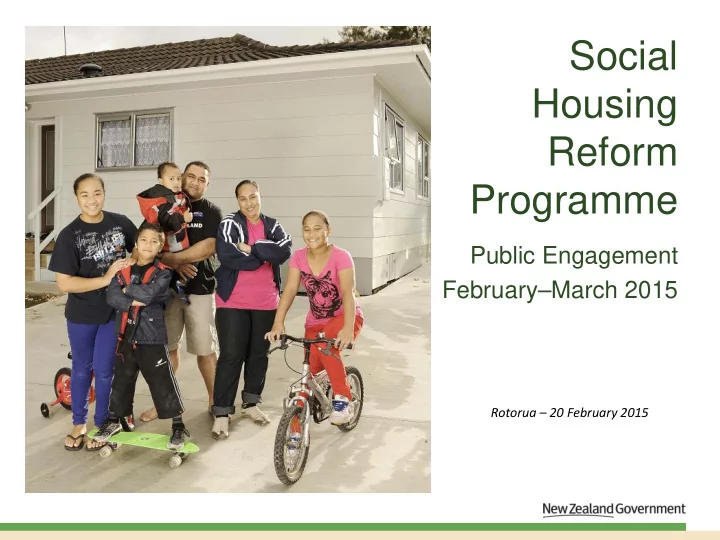
Social Housing Reform Programme

Public Engagement February–March 2015

Rotorua – 20 February 2015
slide-2
SLIDE 2

What today is about

2

  • Public engagement
  • We’ll discuss overall objectives, and describe the new social

housing system, how you can participate, and next steps

  • April-May: Regional consultation on specific

transactions

  • This is where we will be talking to you about your rights and

interests

slide-3
SLIDE 3

Social housing reforms – our objectives

1. Ensure people who need housing support can access it and receive social services that meet their needs. 2. Ensure that social housing is of the right size and configuration, and in the right areas, for those households which need it. 3. Help social housing tenants to independence, as appropriate. 4. Encourage and develop more diverse ownership of social housing, with more innovation and responsiveness to tenants and communities. 5. Help increase the supply of affordable housing, especially in Auckland.

3

slide-4
SLIDE 4

Current situation – tenants

  • Around 62,000 social housing places

funded through income-related rent subsidies ($209/week)

  • 6,000 social housing tenant

placements/year

  • 5,000 on register for social housing
  • Two thirds are in Auckland
  • One quarter are currently in a social

house, but want a transfer

  • Plus 290,000 accommodation

supplements ($78/week)

4

slide-5
SLIDE 5

Current situation – housing

5

  • Housing New Zealand owns 65,000 houses, and leases

another 3,000

  • 3,000 have tenants paying market rent
  • 2,300 are vacant (70% of which are unfit for use)
  • More than 1,000 Community Group Housing properties

(don’t receive IRR)

  • Remainder receive IRR
  • 5,000 houses owned by Community Housing Providers
  • Currently 131 receive IRRS subsidies – and growing
slide-6
SLIDE 6

How social housing providers are paid

Tenants Landlords

Registered community housing providers, Housing NZ

Ministry of Social Development

Tenants typically pay 25% of their income Tenant share is topped up to market rent by Ministry

6

MSD contracts with community housing providers and Housing NZ

slide-7
SLIDE 7

How to register as a community housing provider

7

  • Any social or affordable rental

housing provider may apply for registration

  • An evaluation panel will assess

applicants for eligibility, suitability and risk

  • Registered CHPs are eligible for

income related rent subsidy

  • 38 CHPs already registered
slide-8
SLIDE 8

Current situation – housing

8

  • Around one third of stock of Housing New Zealand is

the wrong type…

slide-9
SLIDE 9

Current situation – housing

9

…or in the wrong place

slide-10
SLIDE 10

How transactions will work

10

Tenants Ministry of Social Development Housing NZ

Registered community housing providers

Treasury

Offers

Investors MBIE Social housing regulator

Business as usual sales

slide-11
SLIDE 11

Opportunities for community providers

11

  • 1,000-2,000 Housing New Zealand houses to be sold
  • ver the next year, with further sales if successful
  • Open to community housing providers and consortia

including community housing providers

  • Competitive tender – we’re looking for best value
  • Opportunities for redevelopment – but must not reduce

social housing supply

  • MSD will increase IRRS purchases to 65,000 by 2018
  • We need 3,000 more houses in right place, right configuration
  • Looking for innovation, niche targeting in housing/wraparound

services for better tenant outcomes.

slide-12
SLIDE 12

Matters for iwi and hapū

12

  • The Government and Housing NZ are working to ensure

your rights and interests are understood and managed appropriately

  • Where rights of first refusal apply, we will discuss this with

you locally

slide-13
SLIDE 13

Transaction types

  • Housing New Zealand business-as-usual sales (500 last

year)

  • Social housing transactions through the Treasury (1,000-

2,000 over the next year)

  • Large one-off transactions e.g. Tamaki, Hobsonville

13

slide-14
SLIDE 14

The approach on social-housing transactions

14

  • Selecting the first transactions
  • Areas where demand is stable, and housing providers are keen

to expand or start up

  • Range of potential transaction sizes – from five to 600 depending
  • n circumstances
  • Timing
  • Selection late March-early April, regional consultation in April-

May

  • Information
  • We’re committed to full information disclosure
slide-15
SLIDE 15

Next steps

15

  • February-March: public engagement on social housing

transactions

  • Late March-early April: selection of specific

transactions

  • April: Information release about MSD’s social housing

purchasing intentions

  • April-May: regional consultation on specific transactions

– this is where we talk to you about your rights and interests

slide-16
SLIDE 16

Next steps

16

  • July: market sounding – testing regional interest
  • September: Expressions of interest
  • Late 2015-mid 2016: request for proposals→preferred

bidders identified

  • November 2015: Cabinet review of progress and next

steps announced

slide-17
SLIDE 17

Our bottom lines – we will ensure…

  • 1. There will be more social housing places in New Zealand - particularly in

Auckland and Christchurch.

  • 2. HNZC will continue to be by far the biggest owner of social housing in

New Zealand and in a year's time it is envisaged that it will provide around 64,000 properties.

  • 3. Properties will be sold only if this results in better services for tenants and

fair and reasonable value for taxpayers.

  • 4. Tenants in properties that are sold will continue to be housed for the

duration of their need.

  • 5. The government will spend more on IRRS and will ensure that HNZC has

enough capital to build new social housing and to redevelop its existing properties.

17

slide-18
SLIDE 18

If you are interested in getting involved…

  • For further information

socialhousing.govt.nz

  • If you have any questions in

the meantime, you can email info@socialhousing.govt.nz

18