Urban development authority LGNZ Chief Executives Forum 3 September - - PDF document

urban development authority
SMART_READER_LITE
LIVE PREVIEW

Urban development authority LGNZ Chief Executives Forum 3 September - - PDF document

3/09/2018 Urban development authority LGNZ Chief Executives Forum 3 September 2018 What is the national UDA and what will it do? The national UDA will be the Governments lead developer. It will deliver: KiwiBuild Existing Crown


slide-1
SLIDE 1

3/09/2018 1

Urban development authority

LGNZ Chief Executives Forum 3 September 2018

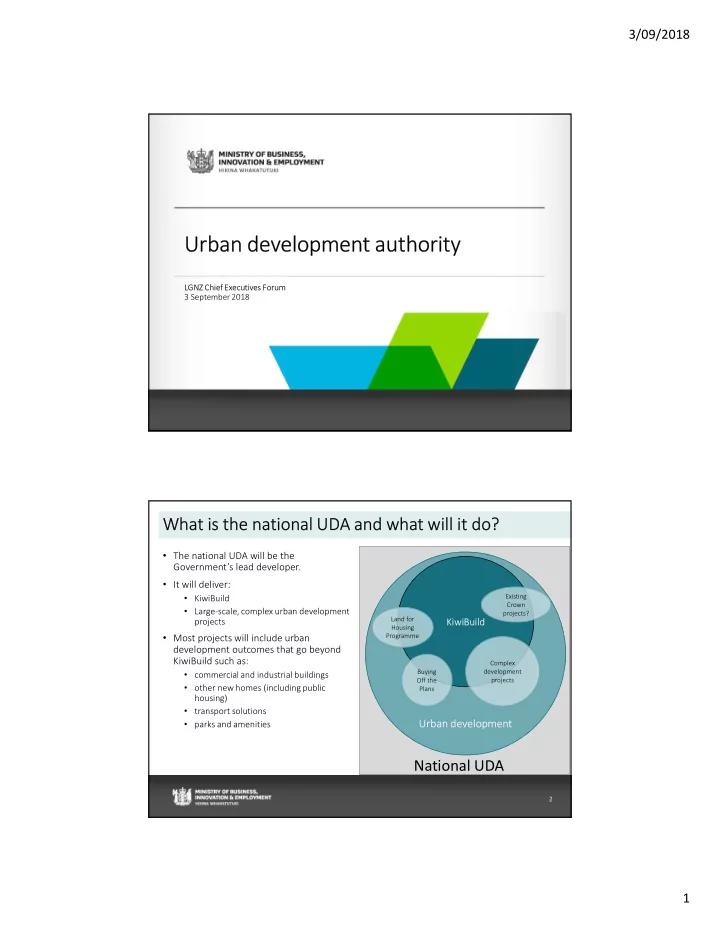
What is the national UDA and what will it do?

  • The national UDA will be the

Government’s lead developer.

  • It will deliver:
  • KiwiBuild
  • Large-scale, complex urban development

projects

  • Most projects will include urban

development outcomes that go beyond KiwiBuild such as:

  • commercial and industrial buildings
  • other new homes (including public

housing)

  • transport solutions
  • parks and amenities

Urban development

KiwiBuild

Land for Housing Programme 2 Buying Off the Plans Existing Crown projects? Complex development projects

National UDA

slide-2
SLIDE 2

3/09/2018 2

3 February 2017 Discussion document released for consultation February – May 2017 Meetings with key stakeholders May 2017 Submissions received May- July 2017 Submissions and feedback analysed December 2017 High level Cabinet paper 2006 - Urban Development Authorities Team DPMC 2006 - Research: Catalysing Positive Urban Change in New Zealand (MfE/SGS) 2007- Sustainable Urban Development Unit DIA 2007 - House Prices Unit DPMC 2007 - Cabinet paper: Urban development authorities and a new sustainable urban development approach 2007 – Report: Final Report of House Price Unit, House Price Increases and Housing in New Zealand (DPMC) 2008 – Cabinet paper: Urban Transformation Mechanisms (MfE) 2008 – Discussion document: Building Sustainable Urban Communities (DIA)

Timeline of the national UDA

August – November 2018 Cabinet decisions on entity structure and development powers March 2019 Introduction

  • f the bill to

the House May 2018 Cabinet decision on UDA framework

Consultation with local government on the UDA proposals

Organisation Date Local Government New Zealand 21 July 2016 Local Government New Zealand 10 August 2016 Panuku 22 February 2017 Hutt City Council 23 February 2017 Metropolitan Mayors meeting 24 February 2017 Wellington City Council 15 March 2017 Waikato Regional Council 16 March 2017 Hamilton City Council 16 March 2017 Auckland Council 22 March 2017 Upper Hutt City Council 27 March 2017 Christchurch City Council 29 March 2017 Porirua City Council 30 March 2017 Dunedin City Council 31 March 2017 Otago Regional Council 31 March 2017 Tauranga City Council 5 April 2017 Greater Wellington Regional Council 7 April 2017 Queenstown Lakes District Council 19 April 2017 Panuku Board 26 April 2017 Hutt City councillors 27 April 2017 Organisation Date Kapiti Coast District Council 28 April 2017 Auckland Transport, Watercare, Auckland Council Healthy Waters, Auckland Council 1 May 2017 Local Government New Zealand 3 May 2017 Upper Hutt City Council, Hutt City Council, Wellington City Council, Kapiti Coast District Council, Porirua City Council 12 May 2017 Organisation Date Queenstown Lakes District Council 24 January 2018 Hamilton City Council 30 January 2018 Tauranga City Council 31 January 2018 Auckland Council 9 February 2018 Local Government New Zealand 13 June 2018 Auckland Council 29 June 2018 Local Government New Zealand executive (Minister Twyford & officials) 6 August 2018 Metropolitan Mayors and CEs Forum 17 August 2018

  • - - Current UDA proposals - - -

4

slide-3
SLIDE 3

3/09/2018 3

List of local government organisations and community groups that submitted on the 2017 UDA discussion document

National organisations: Local Government New Zealand Society of Local Government Managers Auckland Council Auckland Regional Public Health Service Auckland Transport Watercare Tamaki Regeneration Company Ōrākei Local Board Puketāpapa Local Board Waitematā Local Board Devonport-TakapunaLocal Board Hibiscus and Bays Local Board Howick Local Board Māngere-ŌtāhuhuLocal Board Maungakiekie-Tāmaki Local Board Papakura Local Board Franklin Local Board Okura Residents and Ratepayers Association Panmure Community Action Group Long Bay Okura Great Park Society Friends of Regional Parks (Auckland) Inc Wellington City Council Porirua City Council Hutt City Council Upper Hutt City Council Kapiti Coast District Council Greater Wellington Regional Council Masterton District Council Wellington Water Kapiti Housing Task Force Mt Victoria Residents' Association Inc Newtown Residents Association Glenside Progressive Association Taupo District Council Rangitikei District Council Otago Regional Council Queenstown Lakes District Council Aurora Energy Limited Far North District Council Whangarei District Council Christchurch City Council Canterbury District Health Board Canterbury Regional Council (Environment Canterbury) Development Christchurch Limited Regenerate Christchurch Greater Christchurch Urban Development Hamilton City Council Waikato Regional Council Waipa District Council Bay of Plenty Regional Council Hawke’s Bay District Health Board Tauranga City Council

5

Differences between the previous and current UDA proposals

Previous Government’s proposals This Government’s proposals Entity:

  • Multiple UDAs
  • A range of publicly controlled entity

types are available Entity:

  • One national UDA
  • It is still to be decided whether the national

UDA will be built on an existing entity, or become a new agency altogether. Territorial authorities have a veto over UDA projects Minister can override territorial authorities if a project is in the national interest Planning powers:

  • limited right to object on the

proposed development plan

  • limited right to submit on consents

Planning powers:

  • pen right to submit on the proposed

development plan

  • Right to submit on consent applications is set

by notification status Infrastructure powers:

  • Power to change public transport

Infrastructure powers:

  • No powers to change public transport services

*note that this is not the full list of UDA proposals for the new legislation.

6

slide-4
SLIDE 4

3/09/2018 4

  • Remaining Cabinet papers on Māori interests, entity form and financing

powers Q4 2018.

  • Cabinet papers and UDA summary released in Nov 2018
  • Bill introduced to Parliament in Q1 2019.
  • Referred to Select Committee until Q3 2019.
  • Bill passed into law Q4 2019.
  • First UDA projects start Q1 2020.
  • NZ Election Q3/Q4 2020.

What comes next?

KiwiBuild target to June 2019: 1000 homes KiwiBuildtarget to June 2020: 5000 homes KiwiBuildtarget to June 2021 10,000 homes 7

The UDA responds to four key policy problems:

Proposal

Lack of direct central government role

No statutory authority for the Government to participate directly in urban transformation activities at a local level Power for central government to lead and enable significant urban development projects.

Limited coordination

No single public entity responsible for all aspects of urban development.

Single public entity with access to a wide range of development powers, and a mandate for:

  • economic

development

  • local employment
  • affordable housing
  • public transport
  • infrastructure

provision.

Fragmented land

  • wnership in

existing urban areas

Difficulties assembling large, useful parcels of land at strategic sites. Start large-scale redevelopment of publicly owned land. Apply land assembly powers, including the ability to ask the Crown to exercise compulsory acquisition

8

One-size-fits-all development system

An urban development system that isn’t designed to cater for large-scale complex projects. Legislation that better enables complex development projects by having one combined planning and decision-making process for land-use, transport, land acquisition, reserves, design, funding and levy powers.

Problems

slide-5
SLIDE 5

3/09/2018 5

Project-based powers and processes

  • The UDA’s development powers will only apply to large scale, complex urban

development projects

  • a development project is an urban development for a selected project area
  • the project area is the discrete geographic area or areas in which a single

development project is located

  • A project area will not be an entire region or city…
  • …but the area could be big – for example the area between Papakura and

Pukekohe is approximately 3,000 ha.

9

Process to establish a UDA project - overview

  • Part 1: Establishment phase
  • Part 2: Preparing the development plan
  • Part 3: Hearing for submissions
  • Part 4: Implementation

10

slide-6
SLIDE 6

3/09/2018 6

Development plan phase

In collaboration with territorial authority where agreement obtained

j

Establishment phase

  • 1. Project identified
  • 2. Initial assessment
  • 3. Public

consultation

  • 4. Decision to

establish

  • 9. Submissions
  • 6. Public

consultation

  • 10. Development plan approved
  • 8. Plan

published

  • 7. Revise

development plan

Territorial authority agreement sought Commissioners make recommendation to Ministers Commissioners consider plan and submissions Development plan submissions sent to independent commissioners

  • 5. Development plan

prepared Territorial authority agreement sought

The whole process looks like this:

Submissions process

11

Any party (e.g. iwi or territorial authority) can recommend that the UDA consider a particular development project. The UDA prepares an assessment of the development proposal and seeks information. The UDA seeks public feedback on the strategic

  • bjectives and the

proposed project area. The UDA recommends to establish the project to UDA Minister. The UDA produces detailed draft development plan, collaborating with other partners. Draft development plan issued for public consultation. Development plan revised following feedback. Recommended plan published for public review. Submissions to the recommended development plan are lodged (if any). Minister responsible for the UDA reviews and makes final decision on approving the development plan.

What powers does it need?

  • For many development projects, the

national UDA can use standard development and planning powers.

  • For complex development projects, the

UDA needs access to more enabling development powers and processes in specified project areas.

  • These powers mostly already exist, they

are just spread between different parts of central and local government.

  • Cabinet has agreed in principle to enact

the following types of powers for these projects:

  • land assembly and reserves;
  • land use planning and consenting;
  • infrastructure; and
  • funding.

Urban development

KiwiBuild

Land for Housing Programme 13 Buying Off the Plans Existing Crown projects?

Complex development projects

National UDA

Standard powers and processes New powers and processes
slide-7
SLIDE 7

3/09/2018 7

Key powers

  • The UDA can re-purpose Crown owned land;
  • The UDA has the ability to apply to the Minister for

Land Information to compulsorily acquire land or an interest in land;

  • The UDA can set-aside reserves some reserves (in part
  • r whole) for development purposes where needed;
  • The UDA can override existing and proposed Resource

Management plans for the development area;

  • The UDA will issue land-use resource consents; and
  • The UDA can recommend the removal of designations.

UDA infrastructure provisions

slide-8
SLIDE 8

3/09/2018 8 Diagram of UDA infrastructure funding arrangements