Agenda NECA: Introduction NECA: Managing Apprentice Program Pilot - - PDF document

agenda
SMART_READER_LITE
LIVE PREVIEW

Agenda NECA: Introduction NECA: Managing Apprentice Program Pilot - - PDF document

Agenda NECA: Introduction NECA: Managing Apprentice Program Pilot and Accelerated 2013 NECA Roadshow Seminar Apprenticeships NECA WHS: NEW Workplace Health and Safety legislation, and the NECA HSEQ Management System Featuring


slide-1
SLIDE 1

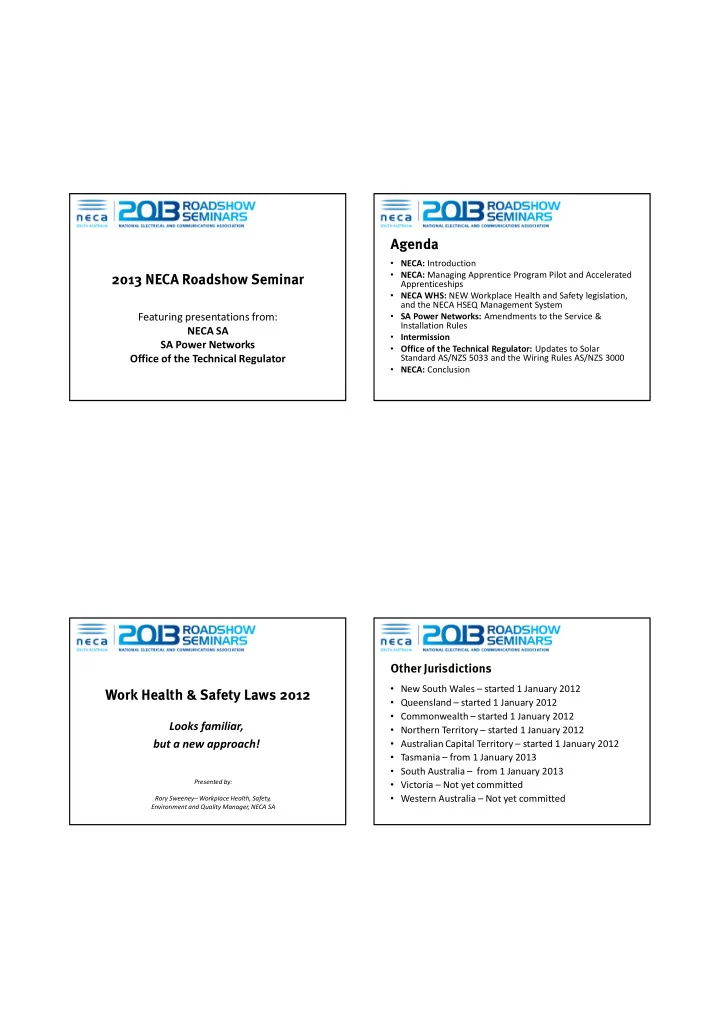
2013 NECA Roadshow Seminar

Featuring presentations from: NECA SA SA Power Networks Office of the Technical Regulator

Agenda

  • NECA: Introduction
  • NECA: Managing Apprentice Program Pilot and Accelerated

Apprenticeships

  • NECA WHS: NEW Workplace Health and Safety legislation,

and the NECA HSEQ Management System

  • SA Power Networks: Amendments to the Service &

Installation Rules

  • Intermission
  • Office of the Technical Regulator: Updates to Solar

Standard AS/NZS 5033 and the Wiring Rules AS/NZS 3000

  • NECA: Conclusion

Work Health & Safety Laws 2012

Looks familiar, but a new approach!

Presented by: Rory Sweeney– Workplace Health, Safety, Environment and Quality Manager, NECA SA

Other Jurisdictions

  • New South Wales – started 1 January 2012
  • Queensland – started 1 January 2012
  • Commonwealth – started 1 January 2012
  • Northern Territory – started 1 January 2012
  • Australian Capital Territory – started 1 January 2012
  • Tasmania – from 1 January 2013
  • South Australia – from 1 January 2013
  • Victoria – Not yet committed
  • Western Australia – Not yet committed
slide-2
SLIDE 2

New Elements

  • PCBU (Person Conducting a Business or Undertaking)
  • Officer duties
  • Removal of responsible officer provisions
  • Clarification for volunteers
  • Heath & Safety Representatives - changes
  • WHS Right of Entry
  • Enforceable Undertakings
  • Increased penalties

Considerations:

  • 1. Is my organisation a PCBU?
  • 2. When do I owe a Duty of Care?
  • 3. What must be reasonably practicably done to

comply with the duty?

  • 4. Who is owed a Duty of Care?
  • 5. Responsibility of Workers
  • 1. Is my Organisation

a PCBU?

BUSINESS ENTITY

Sole Trader Self Employed Employer Partnership Sub- Contractors Labour hire Franchisors Corporation Company

  • 2. When does a PCBU owe a Duty of Care?

Duty of care is owed if in the course of conducting a business/undertaking the PCBU:

  • engages or causes to be engaged (i.e. sub-contract) a

worker to carry out the work; or

  • directs or influences work carried out by a worker; or
  • has the management or control of the workplace in

which work is performed; or

  • designs, manufactures, imports, supplies, installs,

commissions or constructs plant, structures or substances for use as or at a workplace.

slide-3
SLIDE 3
  • 3. What must be reasonably practicably done

to comply with the duty? A PCBU must… Ensure, so far as is reasonably practicable, that the health and safety of other persons is not put at risk from work carried

  • ut as part of the business or

undertaking. A PCBU must…

Ensure so far as reasonably practicable:

  • a safe work environment
  • safe plant, structures, substances and storage;
  • information, training, instruction and supervision;
  • safe systems of work;
  • adequate facilities for welfare of workers;
  • ensure that the health of workers and conditions at the

workplace are monitored for the purposes of preventing work-related injury or illness.

  • 3. What must be reasonably practicably done to

comply with the duty? (cont.)

Reasonably Practicable Test

Factors that may determine whether something is ‘reasonably practicable’ include:

  • the likelihood of the hazard or the risk concerned occurring
  • the degree of harm that might result from the hazard or the risk
  • what the person concerned knows, or ought reasonably to know

about the hazard/risk and ways of eliminating the hazard/risk

  • the availability and suitability of ways to eliminate or minimise the

risk

  • the cost associated with available ways of eliminating or minimising

the risk, including whether the cost is grossly disproportionate to the risk

  • Importantly, the issue of influence and control is also considered in

what is reasonably practicable

  • 4. Who is owed a Duty of Care?

Workers are owed a Duty of Care

A worker is a person who carries out work in any capacity for a PCBU, and includes:

– employee – contractor – subcontractor – Labour hire employee – apprentice or trainee

This is a deliberate broad definition so PCBUs have a broader range of people to consider when assessing WHS matters.

slide-4
SLIDE 4
  • 5. Responsibility of workers (and Volunteers)

A worker or a volunteer at a workplace, must:

  • take reasonable care for own health & safety;
  • ensure that their actions do not adversely affect the

health & safety of others;

  • comply with instructions; and
  • cooperate with OHS policies and procedures.

WHS Officers and Due Diligence

Officers must exercise due diligence to ensure that the PCBU complies with its obligations. Replaces concept of ‘responsible officers’:

  • broader scope as includes any person who makes, or

participates in making, decisions that affect the whole, or substantial part, of the business or undertaking

OFFICERS: Who are they?

OFFICER

Chief Financial Officer Chief Executive Officer Company Secretary Director

Those who participate in making decisions affecting the whole or substantial part

  • f the organisation.

An Officers due diligence is an active obligation

  • Officers of a PCBU must exercise due diligence to

ensure that the PCBU complies with its duty or

  • bligation
  • Due diligence essentially means taking reasonable

steps in:

– being proactive in keeping up to date with WHS issues – being proactive in meeting work health and safety

  • bligations

– The PCBU understanding its operations, hazards and risks – Providing resources and processes to eliminate or control hazards and risks

slide-5
SLIDE 5

Summary of Duties

POSITION ACTIVITY STANDARD PCBU primary duty of care Operation of the business Reasonably Practicable Senior Officers duty of care Organisational decision making and governance Ensure Due Diligence Worker’s duty of care Work Activities (includes management & supervision) Reasonable care Others Suppliers, subcontractors labour hire, visitors etc Reasonable care

Consultation

PCBUs must so far as is reasonably practicable consult with workers who are directly affected by health and safety matters Old: ‘vertical consultation’ – with employees New: Duty holders must consult with other duty holders.

  • referred to as “horizontal consultation”
  • purpose is to identify and address any gaps in

managing OHS risks

Maximum fine: $100k (body corporates)

WHS Entry Permits

  • A union official may enter to:

– inquire into a suspected contravention of the Act – inspect employee records relevant to a contravention, and – consult and advise workers in relation to WHS

  • Prior notice is not required to enter to inquire into a suspected
  • contravention. However, there are procedures for notifying

SafeWork SA in advance of entry.

  • However, after entry to the workplace the permit holder is required

to give the PCBU notice of the entry and details of the suspected contravention as soon as is reasonably practicable.

  • At least 24 hours notice is required to enter to inspect documents
  • r consult with workers.

Compliance and Enforcement Tools

slide-6
SLIDE 6

Enforceable Undertakings

  • An enforceable undertaking is an agreement between

an alleged offender and the regulator to implement specific actions relevant to improving work health and safety where there has been a serious breach of the WHS laws

  • Undertakings provide an alternative to prosecution
  • Provides a non litigious vehicle to enforce compliance

and to alleviate concerns and the impact of legal proceedings on small business, workers and victims families

  • Regulators will continue to prosecute serious breaches

Maximum Penalties

Duty holder Category 1

Reckless

Category 2

Exposure to death or serious injury

Category 3

Non compliance with Legislation

Body corporate or government body $3M $1.5M $500,000 Individual PCBU or Officers $600,000 or 5 years imprisonment $300,000 $100,000 Individual worker or

  • ther persons at the

workplace $300,000 or 5 years imprisonment $150,000 $50,000

The New Regulations

Apply to ALL workplaces including construction sites. Chapter 1: Preliminary Chapter 2: General Risk and Workplace Management Managing risks, General Workplace Management, General Work Environment, Facilities, PPE, First Aid, Emergency Plans Chapter 3: Representation and participation Work Groups, HSRs, Issue Resolution, Cessation of Unsafe Work, Work Health and Safety Entry Permits

The New Regulations (Cont.)

Chapter 4: Hazardous work Noise, Hazardous Manual Tasks, Confined Spaces Falls

  • Management of risk of a fall from one level to

another (no height specified),

  • Promotes work on ground or from a solid

construction, High risk work (licensing and accreditation), Demolition work, (incl notification, approvals & licensing), Electrical work – AS 3012 mandated: - AS 3000 removed from Regs,

slide-7
SLIDE 7

The New Regulations (Cont.)

Chapter 5: Plant and Structures

Including design verification and registration duties

Chapter 6: Construction Work Chapter 7: Hazardous Chemicals Chapter 8: Asbestos (incl Removals & Licensing) Chapter 9: Major Hazard Facilities Chapter 10: Mines Chapter 11: General

  • How to Safely Remove Asbestos
  • How to Manage and Control Asbestos in the

Workplace

  • Abrasive Blasting
  • Confined Spaces
  • Construction Work
  • Work Health and Safety Consultation

Cooperation and Coordination

  • Demolition Work
  • Managing Electrical Risks at the Workplace
  • Excavation Work
  • Managing the risk of Falls at Workplaces
  • Preventing Falls in Housing Construction
  • Managing the Work Environment and

Facilities

  • Preventing and Managing Fatigue in the

Workplace

  • First Aid in the Workplace
  • Labelling of Workplace Hazardous

Chemicals

  • Preparation of Safety Data Sheets for

Hazardous Chemicals

  • Managing Risks of Hazardous Chemicals in

the Workplace

  • Hazardous Manual Tasks
  • Managing Noise and Preventing Hearing

Loss at Work

  • Managing Risks of Plant in the Workplace
  • How to Manage Work Health and Safety

Risks

  • Safe Design of Structures
  • Spray Painting and Powder Coating
  • Welding Processes
  • Preventing and responding to Workplace

Bullying

25 New Codes of Practice General Electrical Safety in Workplaces and Energised Electrical Work

  • Chapter 4 Part 7 Division 4 Sections 152 – 162

discusses Electrical Work on Energised Equipment

  • Working on energised equipment – Section 154

prohibits work on energised equipment

  • Testing, fault finding, troubleshooting
  • Safety observers

Working on Energised Equipment

Section 154 prohibits work on energised equipment – it is prohibited in all cases unless the specific need falls within one of the following areas per S157: a) It is necessary in the interests of health and safety (example lifesaving equipment) b) In order for the work to be carried out properly c) It is necessary for the purposes of testing d) There is no reasonable alternative means of carrying out the work Be clear that whilst S157 permits work on energised electrical equipment you must ensure that you have documented that there is no reasonable alternative means of carrying out that work prior to you working on energised equipment.

slide-8
SLIDE 8

Safety Observer

The safety observer must be competent under S161(4): a) To implement control measures in an emergency b) To rescue the worker who is carrying out the work c) Assessed in the previous 12 months as competent to rescue and resuscitate a person A safety observer is not required under the following circumstance refer S161(5): a) The work consists only of testing, and b) The PCBU has conducted a risk assessment that shows there is no serious risk associated with the proposed work (of testing)

Testing

Testing can mean fault finding and trouble shooting and testing can be conducted without a safety observer. However on all occasions prior to testing a risk assessment must be undertaken. The risk assessment will determine that there is no serious risk associated with the proposed testing by considering such things as;

  • The complexity of the test
  • The likelihood of the electrician coming into contact with live parts
  • Exposed equipment issues
  • Fault levels

If significant risks are identified for that testing work then a safety

  • bserver is to be considered in the control measures.

Practical Steps for PCBU’s

  • Identify who are your Officers
  • Conduct a legal risk analysis and a safety gap analysis
  • Ensure you have a risk management system in place
  • Know your risks - particularly high risks
  • Apply hierarchy of risk controls
  • Consult vertically and horizontally
  • Review current policies and procedures
  • Review safety on your work sites
  • Keep a paper-trail
  • Monitor WHS issues & performance

Practical Steps for Officers

  • All officers must turn their mind to safety issues
  • Regular communication between management

and the Board

  • WHS meetings & document outcomes
  • Provide adequate training
  • Ensure reporting procedures are in

place

  • Allocate appropriate resources to WHS
  • Monitor performance
slide-9
SLIDE 9

In Conclusion… Hefty penalties apply right now so you need to implement and/or improve your WHS practices and paperwork to comply with the new WHS Legislation. The New NECA Health, Safety, Environment and Quality (HSEQ) Management System has been designed to assist you to meet your duty of care and your due diligence obligations under WHS.

The solution to managing your Health Safety, Environment and Quality requirements.

Why do I need a HSEQ Management System?

  • Challenges facing businesses today include;

– Ensuring that you, your employees and your subcontractors work safely – Ensure that you have the minimum documented compliance required by Legislation

What is the HSEQ Management System?

  • Designed specifically for the electrical,

communications, refrigeration and air conditioning industries

  • An integrated manual and online system
  • Assists businesses to meet health, safety, environment

and quality requirements

  • Integrated and user-friendly management system

which can be tailored to your individual needs

  • Enables you to manage the complex obligations

required by our Workplace Health, Safety and Environmental legislation

slide-10
SLIDE 10

Two Independent Certifications

NECA developed the HSEQ Management System in partnership with TQCSI who are JAZ-ANZ Accredited The System meets independent and recognised certification in safety, environment and quality:

  • Certified to the TQCSI QHSE Code 2007
  • Fully meets the requirements of

AS/NZS 4801:2001 – OH&S Management System

What does Certification mean for my Company?

  • Tendering and winning work

– Open new doors in winning work – Demonstrate to perspective clients organised and documented processed and procedures – Enable you to meet pre-qualification requirements for SA Government, local council and private customer work

  • Show compliance to WHS legislation

– Demonstrate to SafeWork SA the Duty of care required of PCBU’s and relevant Due Diligence

HSEQ Management System Components

  • Tailored HSEQ Management Manual
  • System Forms
  • Safe Work Method Statements
  • Emergency Response Plan
  • Site Safety Instructions
  • Work Instructions
  • QHSE Code: 2007 Standard
  • Employee Guide to Safety and Environmental
  • Hazard / Risk Identification Booklet

How does it

  • rganise my

activities?

slide-11
SLIDE 11

Benefits at a glance

  • Individually customised to your business
  • Provide you with a Manual and Online Access
  • Assistance with System implementation
  • 24/7 Access to the System (latest documents) online
  • Ongoing advice, support and assistance

For more information contact:

NECA South Australia Rory Sweeney, Workplace Health, Safety, Environmental and Quality P: (08) 8272 2966 E: rsweeney@necasa.asn.au Or visit www.neca.asn.au

Questions?

~ Thankyou ~

2013 Service & Installation Rules

Presented by:

Martin Wilkes – Network Connections Manager Bob Gore – Data and Documentation Manager Joe Caruso – Major Customer Manager

slide-12
SLIDE 12

Presentation Overview

This presentation will cover the following:

  • Electricity (General) Regulations 2012
  • Changes To The Service And Installation Rules
  • Meter Enclosure Locations
  • Community Title Matters
  • Contact Information
  • Questions

Electricity (General) Regulations 2012

Effective from 1 September 2012 there is now a requirement to publish Technical Installation Rules by 1 March 2013. The significant new requirement is as follows: The operator of a distribution network (SA Power Networks) must prepare and revise these rules with approval from the Technical Regulator. The Technical Installation Rules are known as SA Power Networks Service and Installation Rules.

Changes to the Installation Rules

OTR has agreed that the original Service and Installation Rules may exist as one document with reference to the technical and safety component and the remainder Service and Installation Rules remains as the customers contractual agreement with SA Power Networks.

  • The reference to the Technical and Safety component

has been identified throughout the document by a symbol:

  • This is inline with similar format used in the AS/NZS

3000 wiring rules.

Technical and Safety Clauses

Summary of the sections and parts of the S&IR which are affected. Section 4

  • All of Section 4

Section 5

  • 5.1

Conditions of Supply

  • 5.3

Typical Connection process Section 6

  • 6.1

Supply

  • 6.3

Consumer Terminals

  • 6.4

Identification of Multiple Supplies

  • 6.5

Customer Load requirements

  • 6.8

Additional Sources of Supply

slide-13
SLIDE 13

Technical and Safety Clauses (Cont.)

Section 7

  • 7.4 Service Protection
  • 7.5 Isolating Devices
  • 7.6 Safety When Working On Or Near Distribution Network
  • 7.7 Consumer Mains
  • 7.8 Special Electrical Installations & Supply Arrangements

Section 8

  • 8.3 Metering Obligations
  • 8.4 Metering panels, Surrounds and Enclosures
  • 8.5 Equipment
  • 8.6 Meter panel Labelling
  • 8.7 Protection

Section 9

  • 9.5 Installation Design
  • 9.7 General Design
  • 9.8 Protection
  • 9.9 Insulation Co-ordination
  • 9.10 Short Time Withstand Current
  • 9.11 Earthing
  • 9.14 Testing and Commissioning
  • 9.15 Customer’s HV Installation Operation and Maintenance
  • Section 10
  • Appendix 1 All Of Appendix 1
  • Appendix 5 All Of Appendix 5

Technical and Safety Clauses (Cont.) Meter Enclosure Locations

SA Power Networks expect the following to apply:

  • As close as practicable to the public entrance to the property
  • Outside secured areas

Areas not normally entered by visitors or available for public access. (e.g. not in enclosed backyards)

For single customer residential installations

  • Within the Principal Frontage Area (PFA)

This includes within the 1.5m requirement. – New installations, within 1.5m requirement is mandatory. – Alterations/Additions, within 1.5m requirement to be applied however for existing meter enclosures some flexibility may be considered.

Community Title Matters

Property Titles Confirmation of title should me made prior to starting any works. The developer or members of the Community Title are responsible for establishing a group meter enclosure to supply all members of the community title from a single point of supply. Multi Story Buildings Group Meter Arrangements Apply

  • 18 or less meters to be grouped in a single location
slide-14
SLIDE 14

Contact Information

  • SA Power Networks website

– www.sapowernetworks.com.au

  • Connection Process

– Builders and Contractors Line – 1300 650 014

  • Technical Installation & Service Rules Enquiries

– Advice – Network Connections Manager – 8404 4898 – Service Point

  • Up to 100A Supply – Customer Service Coordinator– 8275 0917
  • Above 100A Supply – Relevant Asset Manager – Refer Section 3
  • Quality of Supply

– Network Manager Quality of Supply – 8404 5242

  • General Enquiries – 13 1261
  • Small Embedded Generator Applications

– SmallEmbeddedGenerators@sapowernetworks.com.au

Any Questions?

~ Thankyou ~

Intermission

~ Thankyou ~

2013 Issues and Updates

Updates to Solar Standard AS/NZS 5033, the Wiring Rules AS/NZS 3000, and electrical fatalities

slide-15
SLIDE 15

Topics

  • New Electricity Regulations
  • Don’t let this be you!
  • Amendment 2 to the ‘Wiring Rules’ AS/NZS 3000
  • Revision of AS/NZS 5033 ‘Installation & safety

requirements for PV arrays’

  • OTR’s photo gallery

New Electricity Regulations Electricity (General) Regulations 2012

  • Effective from 1 Sept 2012
  • Clause numbers are different
  • Some changes do not apply immediately
  • The new Regulations can be downloaded

from www.legislation.sa.gov.au Changes to the Electricity Regulations

Electricity (General) Regulations 2012 Reg 76 SA Power Networks, and other operators of distribution networks, are required to prepare, maintain, revise, make available on an internet site, and copies available for purchase, of their Technical Installation Rules (TIR’s). TIR’s are the safety and technical requirements only,

  • f the operator.

Changes to the Electricity Regulations

Electricity(General)Regulations 2012 Reg 11 Under the Regulations electrical work must be carried out in accordance with particular standards. When the standards are varied or substituted, work under certain conditions can be carried out for a period in accordance with an old standard. These conditions have changed.

slide-16
SLIDE 16

Don’t let this be you!

Working live claims another electrical worker’s life

Don’t let this be you! January 2013 - 4th year apprentice electrician electrocuted. November 2012 - fatality, home

  • wner carrying
  • ut electrical work.

Don’t let this be you!

For all electrical work the risks associated with the electrical work must be assessed.

  • Identify the circuits and apparatus to be worked on

and the appropriate sources of electrical supply.

  • De-energise the circuits and apparatus and isolate

them from all sources of supply.

Don’t let this be you!

  • Ensure the supply remains isolated by securing in the
  • ff position.
  • Test before you touch, prove supply is de-energised

using appropriate test methods and instruments.

  • Verify that instruments are functioning correctly

before and after use.

  • Employ only safe work methods.
slide-17
SLIDE 17

Don’t let this be you!

  • Insulate or segregate any part of

the installation that remains energised, to eliminate or control the risk of inadvertent contact or flashovers.

  • Wear appropriate clothing and

personal protective equipment.

  • Use appropriate tools and equipment.

Don’t let this be you!

  • Workers must have adequate information,

instruction, training and supervision regarding the risk control measures.

  • When leaving unfinished work ensure that it does

not present a hazard to others at the workplace.

  • Persons carrying out electrical work must be suitably

licensed and trained in the work, and in rescue and resuscitation.

Don’t let this be you!

A competent safety observer also trained in the work, & in rescue and resuscitation, must be used when:

  • The electrical work is necessary in the interests of

safety, and the risk of harm would be greater if the circuits and apparatus were de-energised before the work commenced.

  • A risk assessment undertaken before electrical

testing confirms that a safety observer is required.

Amendment 2 to the Wiring Rules

AS/NZS 3000

  • Published on 14 Dec 2012
  • Effective from 14 June 2013
  • Current edition of Regulation Roundup has a

description of main amendments

  • Amendment 2 is available from SAI Global

http://infostore.saiglobal.com

  • OTR will deliver presentations
slide-18
SLIDE 18

Amendment 2 to the Wiring Rules

AS/NZS 3000 Where additional protection by RCDs is required Reworded clause 2.6.3.1 (b). Residential smoke detectors have been included as required to be RCD protected.

Amendment 2 to the Wiring Rules

AS/NZS 3000 Alterations, additions and repairs New exception to clause 2.6.3.4. Exception 3 has been included to allow for the existing exceptions to clause 2.6.3.1 and 2.6.3.2 to be used for this clause.

Amendment 2 to the Wiring Rules

AS/NZS 3000 Recessed luminaires warning sign New clause 4.5.2.3.2 and Figure 4.8. Requirement for warning signs to be installed for downlights in accessible roof spaces.

Amendment 2 to the Wiring Rules

AS/NZS 3000 Switching device (for cooking appliances) Reworded clause 4.7.1. Reference to elements has been removed as the clause includes induction cook tops. Mandatory to label the switch. Ignore Note 3 – it should have been deleted as it refers to marking.

slide-19
SLIDE 19

Amendment 2 to the Wiring Rules

AS/NZS 3000 Gas appliances New clause 4.18. Includes the requirements of AS/NZS 5601 (Gas standard) for electrical isolation of gas/electric appliances.

Amendment 2 to the Wiring Rules

AS/NZS 3000 Gas cylinders New clause 4.18.2. Prohibits electrical equipment (source of ignition) in the hazardous area created by a gas bottle. Figure 4.10 relocated from section 2 shows the exclusion zone for in situ and exchange gas bottles.

Amendment 2 to the Wiring Rules

AS/NZS 3000 Air conditioning and heat pump systems New clause 4.19. New isolation requirements For air conditioners and heat pump systems.

Amendment 2 to the Wiring Rules

AS/NZS 3000 Swimming and spa pools Rewritten clause 5.6.2.6. An accessible equipotential bonding conductor connection point must be installed where pools have conductive structures such as reo mesh.

slide-20
SLIDE 20

Amendment 2 to the Wiring Rules

AS/NZS 3000 Swimming and spa pools Rewritten clause 5.6.2.6. This point enables the connection of bonding conductors to the other conductive fixtures and fittings that may at any time be installed within the pool zone.

Revision of AS/NZS 5033

Installation & safety requirements for PV Arrays

Revision of AS/NZS 5033

Installation & safety requirements for PV Arrays

  • Published on 16 July 2012
  • Effective from 16 January 2013
  • Current edition of Regulation Roundup has a

description of the main changes

  • Further information available from the Clean Energy

Council: www.cleanenergycouncil.org.au

Revision of AS/NZS 5033

Installation & safety requirements for PV Arrays

  • Standard is available from SAI Global
  • Training is available through various Registered

Training Organisations

  • OTR will also deliver presentations to

contractors/workers

  • Over 100,000 solar installations in SA
slide-21
SLIDE 21

Revision of AS/NZS 5033

Installation & safety requirements for PV Arrays

  • Earthing
  • Connections
  • Isolation
  • Cables on roof, HD conduit within buildings
  • Panel orientation
  • Labelling
  • IP rating, sealing of equipment/enclosures

3 methods of earthing connections to PV array frames – clause 4.4.2.2

  • Purpose made fitting installed in accordance with

manufacturers instructions

  • Purpose-made washers with serrations or teeth
  • Tinned cable lugs, fixed by stainless steel bolts,

washers and star washers

Revision of AS/NZS 5033

Installation & safety requirements for PV Arrays

  • Earthing connections shall be arranged so that the

removal of a single module connection shall not affect the continuity to other modules.

  • NO TECH SCREWS

Revision of AS/NZS 5033

Installation & safety requirements for PV Arrays

  • Revision of AS/NZS 5033

Installation & safety requirements for PV Arrays

  • Earthing
slide-22
SLIDE 22

All connections shall be verified for tightness – see clause 4.4.4.1. The ends of stranded conductors shall be secured by suitable means, so as to prevent the spreading or escape of individual strands – see clause 3.7.2.5 of AS/NZS 3000:2007 Wiring Rules.

Revision of AS/NZS 5033

Installation & safety requirements for PV Arrays

Revision of AS/NZS 5033

Installation & safety requirements for PV Arrays

  • Switch-disconnector/s shall be installed adjacent to the

PV array to provide safe disconnection of the array – see clause 4.4.1.4. Switch-disconnector/s shall have mechanisms that have semi-independent or independent manual operation – see clause 4.3.5.2.

Revision of AS/NZS 5033

Installation & safety requirements for PV Arrays

Revision of AS/NZS 5033

Installation & safety requirements for PV Arrays

slide-23
SLIDE 23

Cables shall not lay on roofs or floors without an enclosure or conduit – see clause 4.3.6.3.1. PV array cables within buildings shall be constructed in such a manner as to reduce the risk of short-circuit to a minimum; and be enclosed in heavy-duty insulating conduit to AS/NZS 2053.1. – see clause 4.3.6.3.2.

Revision of AS/NZS 5033

Installation & safety requirements for PV Arrays

Revision of AS/NZS 5033

Installation & safety requirements for PV Arrays

  • Modules that are electrically in the same string shall be

all in the same orientation within ±5° (azimuth and tilt angle) – clause 2.1.5.

Revision of AS/NZS 5033

Installation & safety requirements for PV Arrays

  • A circular green reflector at least 70mm in diameter shall

be placed on or immediately adjacent to the meter box and main switchboard so as to be readily visible to approaching emergency workers – see clause 5.4. Where multiple isolation/disconnection devices are used that are not ganged (refer to clause 4.4.1.3) signage stating WARNING: MULTIPLE D.C. SOURCES TURN OFF ALL D.C. ISOLATORS TO ISOLATE EQUIPMENT shall be placed adjacent to the inverter.

Revision of AS/NZS 5033

Installation & safety requirements for PV Arrays

slide-24
SLIDE 24

Revision of AS/NZS 5033

Installation & safety requirements for PV Arrays Environmental effects & IP rating – clause 4.3.3.1

  • Appropriate IP rating for location
  • Correct mounting & orientation of equipment
  • Cable entries must maintain IP rating
  • Appropriate use of conduits & glands
  • Manufacturer’s instructions

Revision of AS/NZS 5033

Installation & safety requirements for PV Arrays

Revision of AS/NZS 5033

Installation & safety requirements for PV Arrays

  • OTR’s Photo Gallery
slide-25
SLIDE 25
  • Deteriorated CB Covers - A Novel Junction Box!

Which peanut did this? DIN Rail Mounted Breakers:

No switchboard cover!

Drug job wiring:

Loomed cables connected, but unterminated

slide-26
SLIDE 26

Drug job wiring:

Downlight only - please don’t turn on the fan!

Innovative - but unsafe!

A home grown, double adaptor.

How do you turn off the fan when it’s going? OTR Contact Details

Tel: 8226 5518 (8.30am - 4.30pm) Fax: 8226 5529 24/7 Incident reporting: 1800 558 811 Office: L8, ANZ building 11 Waymouth St (Please do not use the office address for mail) Postal: GPO Box 1264 Adelaide SA 5001 Web: www.sa.gov.au/otr Email: dmitre.otrmail@sa.gov.au

slide-27
SLIDE 27

Thanks for your attention!

We will be available at the conclusion of the evening to answer your questions.