Afterschool and summer learning: Opportunities to advance local - - PowerPoint PPT Presentation

afterschool and summer
SMART_READER_LITE
LIVE PREVIEW

Afterschool and summer learning: Opportunities to advance local - - PowerPoint PPT Presentation

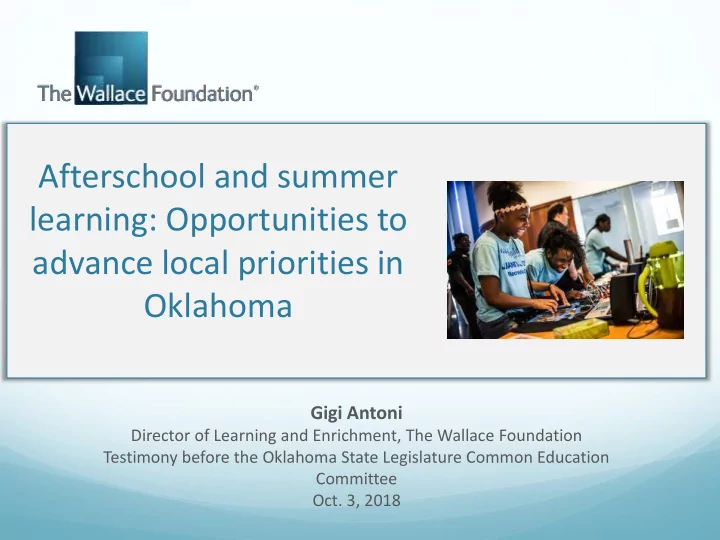
Afterschool and summer learning: Opportunities to advance local priorities in Oklahoma Gigi Antoni Director of Learning and Enrichment, The Wallace Foundation Testimony before the Oklahoma State Legislature Common Education Committee Oct. 3,


slide-1
SLIDE 1

Afterschool and summer learning: Opportunities to advance local priorities in Oklahoma

Gigi Antoni

Director of Learning and Enrichment, The Wallace Foundation Testimony before the Oklahoma State Legislature Common Education Committee

  • Oct. 3, 2018
slide-2
SLIDE 2

Today’s discussion

 About The Wallace Foundation – our approach

and experience

 Why think beyond the traditional school day  Afterschool and summer learning: What we

know about benefits and how to achieve them

 Considerations for state policy and practice

2

slide-3
SLIDE 3

About The Wallace Foundation

 The mission of The Wallace

Foundation is to foster

 improvements in learning and

enrichment for disadvantaged children and

 the vitality of the arts for

everyone.

 We work with grantee partners

to develop -- then broadly share

  • - evidence-based, practical

insights in our focus areas

3

slide-4
SLIDE 4

Wallace’s policy engagement principles

 Full compliance with the law, in letter and

spirit

 We say more only as we know more based

  • n our evidence and experience base

 Support flexible approaches that allow for

adaptation to local context

4

slide-5
SLIDE 5

Wallace’s work in expanded learning

 Since 2003 , we have invested more than $100

million nationally in supporting local progress and developing credible evidence and lessons about:

 How cities can support high-quality afterschool  Full-day summer learning programs  School-run, read-at-home summer programs  Afterschool arts programs

 With independent researchers like RAND, we

have published more than 60 reports distilling key lessons

5

slide-6
SLIDE 6

Our funding in Oklahoma today – $6 million since 2014

 Partnerships for Social and Emotional Learning

Initiative – aligning opportunities for social and emotional learning in school and afterschool

 Tulsa, Boston, Dallas, Denver, Palm Beach County,

Tacoma

 Partners here are Tulsa Public Schools and

community-based organizations led by the Opportunity Project

 Tulsa in Wallace’s Principal Supervisor Initiative

– one of two districts that are more advanced

 We are learning from Oklahoma’s innovations

6

slide-7
SLIDE 7

Today’s discussion

 About The Wallace Foundation – our approach

and experience

 Why think beyond the traditional school day  Afterschool and summer learning: What we

know about benefits and how to achieve them

 Considerations for state policy and practice

7

slide-8
SLIDE 8

Afterschool: A time for development beyond experiences in school

 Need to bolster achievement,

particularly for low-achieving children

 Need opportunities to develop their own

interests and skills, self-management, and enriching interactions with peers and adults

 Need for safety and reducing risky

behavior

8

slide-9
SLIDE 9

Summer: A time of risk for many kids

 Disadvantaged children lose ground

academically during summer

 Fewer structured opportunities for

enrichment

 Less access to healthy foods  Higher rates of obesity  Risk of unsafe behaviors

9

slide-10
SLIDE 10

10 20 30 40 50 Lessons Clubs Sports Participation of children ages 6 - 11 in enrichment activities Annual family income $72,000 and over Annual family income $18,000 and less

Children from low-income families have half the access to enrichment activities

10

Source: U.S. Census Bureau

slide-11
SLIDE 11

3,536 5,650 6,975 8,872 835 1,264 1,173 1,315 2,500 5,000 7,500 10,000 1972 to 1973 1983 to 1984 1994 to 1995 2005 to 2006 Top Quintile Income Bottom Quintile Income

Gap = $2,701 Gap = $7,557

11

Source: Whither Opportunity? Rising Inequality, Schools, and Children’s Life Chances, 2011, Russell Sage Foundation, Greg Duncan and Richard Murnane, ed., p. 11

Growing gap in spending on enrichment

(Family spending on enrichment for children in 2008 dollars)

slide-12
SLIDE 12

Afterschool and summer are

  • pportunities to meet these needs

 Time available in children’s schedules to

provide learning opportunities

 Programs can be adapted to use community

resources

 Multiple local institutions across sectors –

schools, city agencies, nonprofits – can work together

12

slide-13
SLIDE 13

In Oklahoma, parent support is high for afterschool and summer programs

 Afterschool

 77% support public funding  73% say afterschool helps give parents

peace of mind about their kids

 75% say it helps parents keep jobs  Top factors in parents’ selection:

quality; hours; child’s enjoyment; safety; qualified staff

 Summer learning

 84% support public funding  20% say their child in a program  58% would enroll their child

13

Source: America After 3PM, Afterschool Alliance, 2014; America After 3PM Special Report on Summer, Afterschool Alliance, 2010, available at afterschoolalliance.org and www.wallacefoundation.org

slide-14
SLIDE 14

Summing up

 Children from low-income families have an

achievement gap relative to their peers

 They also have fewer opportunities for enriching

experiences – creating an ‘opportunity gap’

 Children benefit from opportunities to address

these – and gain the safety of supervised hours.

 Parents see value both for their children and for

themselves

14

slide-15
SLIDE 15

Today’s discussion

 About The Wallace Foundation – our approach

and experience

 Why think beyond the traditional school day  Afterschool and summer learning: What we

know about benefits and how to achieve them

 Considerations for state policy and practice

15

slide-16
SLIDE 16

Afterschool and summer learning – benefits depend on program design

 “Across studies, we find

evidence that OST programs typically produce the primary

  • utcomes expected by

the content of programming delivered to youth.”

 Communities have

choices to make

16

The Value of Out-of-School Time, RAND, 2017, www.wallacefoundation.org and www.rand.org

slide-17
SLIDE 17

Communities have choices in programs

Program focus Examples of activities Typical staffing Potential primary

  • utcome

Additional

  • utcomes

Specialty

  • Drama
  • Coding
  • Science
  • Staff with

specialized skills

  • New skills
  • New

experiences

  • SEL
  • Attitudes

toward school

  • Behavior in

school

17

The Value of Out-of-School Time, RAND, 2017

slide-18
SLIDE 18

Program focus Examples of activities Typical staffing Potential primary

  • utcome

Additional

  • utcomes

Specialty

  • Drama
  • Coding
  • Science
  • Staff with

specialized skills

  • New skills
  • New

experiences

  • SEL
  • Attitudes

toward school

  • Behavior in

school Multipurpose

  • Homework

help

  • Recreation
  • Enrichment
  • Youth

workers

  • Safety
  • Family

employment

  • New

experiences

  • Attitudes

toward school

  • Behavior in

school

18

Communities have choices in programs

The Value of Out-of-School Time, RAND, 2017

slide-19
SLIDE 19

Program focus Examples of activities Typical staffing Potential primary

  • utcome

Additional

  • utcomes

Specialty

  • Drama
  • Coding
  • Science
  • Staff with

specialized skills

  • New skills
  • New

experiences

  • SEL
  • Attitudes

toward school

  • Behavior in

school Multipurpose

  • Homework

help

  • Recreation
  • Enrichment
  • Youth

workers

  • Safety
  • Family

employment

  • New

experiences

  • Attitudes

toward school

  • Behavior in

school Academic

  • English,

math

  • Enrichment
  • Teachers

(academics)

  • Youth

workers (recreation)

  • Academic

achievement

  • New

experiences

  • Attitudes

toward school

  • Behavior in

school

19

Communities have choices in programs

The Value of Out-of-School Time, RAND, 2017

slide-20
SLIDE 20

Basic building blocks for benefits in both summer learning and afterschool

20 Strong participation by children and youth Well-designed and aligned with community needs

  • Consistent attendance
  • Targeted outcomes
  • Sufficient duration and

frequency Implemented with high quality

  • Qualified staff
  • Age-appropriate

materials and activities

  • Positive, safe climate
slide-21
SLIDE 21

Use of ESSA funds depends on evidence –

and afterschool and summer learning programs qualify

 Federal funds for Title I, II, and IV can be spent

  • n afterschool and summer programs if they

meet evidence requirements

 More than 60 studies in afterschool and 47 in

summer do meet the standards (positive results indicating improved outcomes for students)

 Programs cover pre-K and K, elementary school,

middle and high school… and a variety of different approaches

21

Source: Forthcoming studies by RAND and Research for Action commissioned by The Wallace Foundation.

slide-22
SLIDE 22

Afterschool systems can help increase access and quality

 “This initiative provided a proof of

principle—that organizations across cities could work together toward increasing access, quality, data- based decisionmaking, and

  • sustainability. ”
  • -Hours of Opportunity: Lessons from Six Cities
  • n Building Systems to Improve After-School,

Summer School, and Other Out-of-School-Time Programs 22

Note: This evaluation studied Wallace-funded efforts in six cities. We have heard of regional efforts in rural areas, but have not studied them.

slide-23
SLIDE 23

Afterschool systems: Four key elements

23

  • No one-size-fits-all approach
  • Coordinating organization varies by community

Is Citywide Afterschool Coordination Going Nationwide?, FHI360, 2013, available at www.wallacefoundation.org.

slide-24
SLIDE 24

Today’s discussion

 About The Wallace Foundation – our approach

and experience

 Why think beyond the traditional school day  Afterschool and summer learning: What we

know about benefits and how to achieve them

 Considerations for state policy and practice

24

slide-25
SLIDE 25

Options for state policymakers

 Support programs that match local needs – there

are a broad range of approaches and benefits

 Incentivize and support local providers to

develop well-designed, high-quality programs 

Consider the role of afterschool systems

 Maximize attendance of individual students –

measure attendance, not enrollment

 Measure outcomes that align with program

content 

“Don’t ask the baseball team to score touchdowns”

 Use Title IV and other ESSA funding streams for

afterschool and summer 25

“Policymakers and funders can incentivize intentional, quality programming by providing adequate resources and prioritizing funding for programs that can demonstrate intentionality of design and quality characteristics.”

  • The Value of

Out-of-School Time

slide-26
SLIDE 26

The payoff for children – and communities

 More young people

acquire the broad range

  • f academic, social and

emotional skills to equip them for success

 Reduced risk of obesity,

nutrition, safety problems

 Stronger, more inclusive

communities – benefiting all children

26

slide-27
SLIDE 27

More information @ wallacefoundation.org

27