Aerosols at Mauna Loa Observatory spring, 2011, versus spring, 2001 - - PowerPoint PPT Presentation

aerosols at mauna loa observatory spring 2011 versus
SMART_READER_LITE
LIVE PREVIEW

Aerosols at Mauna Loa Observatory spring, 2011, versus spring, 2001 - - PowerPoint PPT Presentation

Aerosols at Mauna Loa Observatory spring, 2011, versus spring, 2001 Thomas A. Cahill, Jason Snyder, and David Barnes, DELTA Group, University of California, Davis 95616 tacahill@ucdavis.edu Take-home messages: (Ill send this if you access


slide-1
SLIDE 1

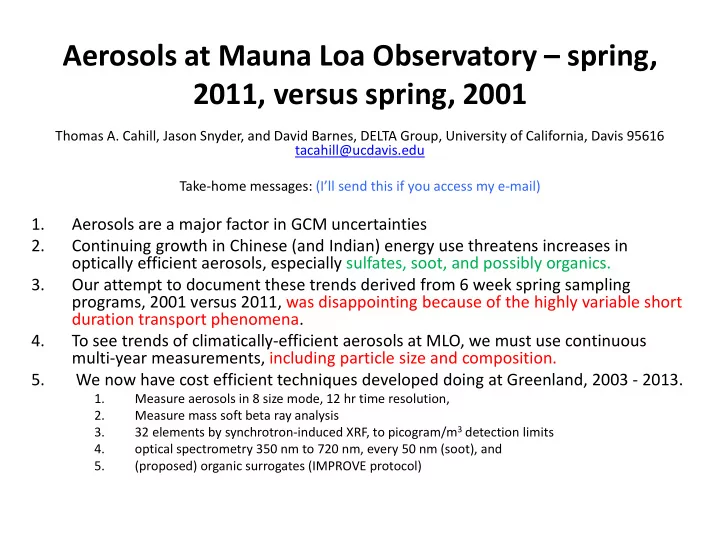
Aerosols at Mauna Loa Observatory – spring, 2011, versus spring, 2001

Thomas A. Cahill, Jason Snyder, and David Barnes, DELTA Group, University of California, Davis 95616 tacahill@ucdavis.edu Take-home messages: (I’ll send this if you access my e-mail)

1. Aerosols are a major factor in GCM uncertainties 2. Continuing growth in Chinese (and Indian) energy use threatens increases in

  • ptically efficient aerosols, especially sulfates, soot, and possibly organics.

3. Our attempt to document these trends derived from 6 week spring sampling programs, 2001 versus 2011, was disappointing because of the highly variable short duration transport phenomena. 4. To see trends of climatically-efficient aerosols at MLO, we must use continuous multi-year measurements, including particle size and composition. 5. We now have cost efficient techniques developed doing at Greenland, 2003 - 2013.

1. Measure aerosols in 8 size mode, 12 hr time resolution, 2. Measure mass soft beta ray analysis 3. 32 elements by synchrotron-induced XRF, to picogram/m3 detection limits 4.

  • ptical spectrometry 350 nm to 720 nm, every 50 nm (soot), and

5. (proposed) organic surrogates (IMPROVE protocol)

slide-2
SLIDE 2

UC Davis and Asian aerosols at MLO

  • 1980 6 weeks northern China
  • Mingxing, Winchester, Cahill, and Lixin, Kexue Tongbao Science Bulletin. Pp. 51-54 (1981).

– First size and compositionally resolved dust near Beijing, 4/19/1980

  • 1983 9 months, MLO, – 3.5 - 1.0, 1.0 – 0.5, 0.5 – 0.0 µm
  • Braaten and Cahill, Atm., Environment 20:1105-1109 (1986).

– Finding: Asian dust in spring, size ~ 1 µm diameter – Elemental ratio of soil same as Beijing, not local Hawaiian soils

  • 1989 – 1999 IMPROVE at MLO, PM2.5 24 hr samples twice a week

– May 6 – May 23, 1996 3 DRUM 10 to 1.15, 1.15 to 0.34, 0.34 to ~ 0.15 µm

  • Perry, Cahill, Schnell and Harris JGR 104 15 18521 – 818533 (1999)
  • Spring enhancement of soils and industrial pollutants (summarized in this talk)
  • Seen across the US - VanCuren and Cahill JGR 107, D24, 1804 (2002)
  • 2001 – March 13 – April 26, the enormous study ACE Asia, aircraft, satellites,

and UC Davis ground level aerosol measurements, all with 3 hr data, 8 with 8 size, modes 10 to 0.09 µm, including MLO, and 10 with 3 size modes.

  • Seinfeld et al Bulletin Amer. Meteor. Society, 85:367-380 (2004)

– Findings: Comparison to Asian sources, – Transport via Taiwan (this talk)

  • 2011 - 6 weeks spring and fall, DELTA Group 8 DRUMs, 8 size modes, 10 to

0.09 µm, 3 hr data

– Findings: Asian trends ??? – Very fine silicon from power plants (this talk);

slide-3
SLIDE 3
slide-4
SLIDE 4
slide-5
SLIDE 5

x 2.5

Currently, 630 power plants Proposed, 363 power plants

slide-6
SLIDE 6
slide-7
SLIDE 7
slide-8
SLIDE 8

Mass and major species

VanCuren, Richard A., and Cahill, Thomas A., Asian Aerosols in North America: Frequency and Concentration of Fine Dust, Journal Geophysical Research 107, No. D24, 4804 (2002)

slide-9
SLIDE 9

Industrial and urban aerosols

slide-10
SLIDE 10

J a n . F e b . M a rc h A p ril M a y J u n e J u ly A u g . S e p t. O c t. N

  • v.

D e c . M

  • n

th 1 9 9 3

  • 1

9 9 6 1 2 3 4 5 6 7 Nanograms/m3

O rg an ic s A m m

  • n

ium s u lfa te

Fin e a ero s

  • ls at M

au n a L

  • a O

b se rv a to ry

Spring enhancement of sulfates and

  • rganics
slide-11
SLIDE 11

+ 9 %

  • 12 %
slide-12
SLIDE 12

April 17, 2010

slide-13
SLIDE 13

Results of 1980 - 1999

  • Soil dust

– Overwhelmingly Asian, not local soil – Overwhelmingly spring transport – Highly variable year to year – Is ~ 1 µm diameter, but extends down to 0.5 µm – Correlated with anthropogenic toxics – Occurs at MLO on both downslope (night) and upslope (day) winds

  • Sulfates and organics

– Spring enhancement but mostly an annual impact

slide-14
SLIDE 14

Aerosol sampling sites – UC Davis in ACE-Asia

Tango, Japan

  • Mt. Bamboo,

Taiwan

slide-15
SLIDE 15

17 18 19 20 21 22 23 24 25 26 27 28 29 30 31 1 2 3 4 5 6 7 8 9 10 11 12 13 14 15 16 17 18 19 20 21 22 23 24 25 26 27 28

March April, 2001 5 10 15 20 Thousands Micrograms/m3

Hefei Beijing

  • Mt. Bamboo
  • Mt. Halla

Tango

Silicon Aerosols during ACE-Asia

DRUM Data for 5.0 > Dp > 2.5 micrometers

(For soil mass, approx. x 4.0)

slide-16
SLIDE 16

Gobi Desert

Takla Makan Desert

slide-17
SLIDE 17

20 21 22 23 24 25 26 27 28 29 30 31 1 2 3 4 5 6 7 8 9 10 11 12 13 14 15 16 17 March April, 2001 500 1000 1500 2000 2500 3000 3500 Nanograms/m3 12 to 5 5 to 2.5 2.5 to 1.15 m

Coarse Aerosols at Tango, Japan during ACE-Asia

Silicon

µ

Gobi #1a,b Transition Clean Japan avg Takla Makan Japan 4/11 Volcano Gobi #2 S G G C J TM G QD

slide-18
SLIDE 18

13 14 15 16 17 18 19 20 21 22 23 24 25 26 27 28 29 30 31 1 2 3 4 5 6 7 8 9 10 11 12 13 14 15 16 17 18 19 20 21 22 March April 10 20 30 40 Nanograms/m3

2.5 to 1.15 1.15 to 0.75 0.75 to 0.56 0.56 to 0.34 0.34 to 0.26 0.26 to 0.09

Mauna Loa Observatory during ACE-Asia, 2001

Al Alum uminum num

slide-19
SLIDE 19

Soil trajectories have Asian sources; Note that they always arrive from elevated trajectories descending to MLO

slide-20
SLIDE 20

1 8 1 9 2 2 1 2 2 2 3 2 4 2 5 2 6 2 7 2 8 2 9 3 3 1 1 2 3 4 5 6 7 8 9 1 1 1 1 2 1 3 1 4 1 5 1 6

March April 1 2 3 4 Micrograms/m3 1 t 1 to 5 . 5 .0 5 . 5 .0 t to

  • 2

. 2 .5 2 . 2 .5 t 5 to

  • 1

. 1 .1 5 1 5 1 . 1 .1 5 t 1 5 to

  • .7

5 7 5 . .7 5 t 7 5 to

  • .5

6 5 6 . .5 6 t 5 6 to

  • .3

4 3 4 . .3 4 t 3 4 to

  • .2

6 2 6 . .2 6 t 2 6 to

  • .0

9 9

A ero s

  • ls

a t M

  • t. B

a m b

  • , T

aiw a n , d u rin g A C E

  • A

s ia

S ilico n

Taiwan is on the transport trajectory

slide-21
SLIDE 21
slide-22
SLIDE 22
slide-23
SLIDE 23
slide-24
SLIDE 24
slide-25
SLIDE 25

Results of ACE-Asia 2001

  • Established spatial variability of soil, sulfur,

and anthropogenic toxics sources in China

  • Measured drop off as aerosols passed over

East Asian islands

  • Tracked a soil event from the Gobi desert to

MLO via Taiwan

slide-26
SLIDE 26
slide-27
SLIDE 27
slide-28
SLIDE 28
slide-29
SLIDE 29
slide-30
SLIDE 30
slide-31
SLIDE 31

PM2.5 Soil Al, Si, K, Amm. Salt metals With

  • xides

Ca, Mn, Fe SO4 NaCl V Cr Ni Cu Zn Se Br Pb ng/m3 ng/m3 ng/m3 ng/m3 ng/m3 ng/m3 ng/m3 ng/m3 ng/m3 ng/m3 ng/m3 2001 299.4 535 11.5 0.05 0.12 0.40 0.58 1.91 0.06 0.23 0.9 2011 325.7 1245 18.0 0.12 0.07 0.41 1.26 1.62 0.44 1.13 5.9 Ratio, 2011/200 1

1.28 2.33 1.56 2.49 0.60 1.04 2.17 0.86 7.28 4.89 6.26

Error ± 0.28

Ratio of aerosols –

6 weeks at Mauna Loa Observatory – Spring 2011 versus spring 2001

  • Notable:

– Soil and sea salt only modestly enhanced – Ammonium sulfate ~ Chinese coal use, up x 2.5 – Cars increased by about a factor of 10, but lead 40% from coal

slide-32
SLIDE 32

1 8 1 9 2 2 1 2 2 2 3 2 4 2 5 2 6 2 7 2 8 2 9 3 3 1 1 2 3 4 5 6 7 8 9 1 1 1 1 2 1 3 1 4 1 5 1 6

March April 2 2 4 4 6 6 8 8 1 1 1 2 1 2 Micrograms/m3 . .3 4 t 3 4 to

  • .2

6 2 6 . .2 6 t 2 6 to

  • .0

9 9

A ero s

  • ls

a t M

  • t. B

a m b

  • , T

aiw a n , d u rin g A C E

  • A

s ia

S ilico n

Very fine silicon – a proven tracer of coal combustion

Very fine and ultra fine silicon – tracer of coal combustion

Dust storm

slide-33
SLIDE 33

The very fine silicon coal tracer at MLO

slide-34
SLIDE 34

24 25 26 27 28 29 30 31 1 2 3 4 5 6 7 8 9 10 11 12 13 14 15 16 17 18 19 20 21 22 23 24 25 26 27 28 29 30 1 2

M arch A pril M ay

2 2 4 4 6 6 8 8 1 1 Nanograms/m3 . .3 4 t 3 4 to

  • .2

6 2 6 . .2 6 t 2 6 to

  • .0

9 9

M auna Loa aerosols, S pring, 2011

S ilico n

Note: SO2 scrubbers, increasingly used in China, remove the silicon, too.

slide-35
SLIDE 35

24 24 25 25 26 26 27 27 28 28 29 29 30 30 31 31 1 2 3 4 5 6 7 8 9 10 10 11 11 12 12 13 13 14 14 15 15 16 16 17 17 18 18 19 19 20 20 21 21 22 22 23 23 24 24 25 25 26 26 27 27 28 28 29 29 30 30 1 2

M arch A pril M ay

200 400 600 800 1000 Nanograms/m3 10 to 5.0 5.0 to 2.5 2.5 to 1.15 1.15 to 0.75 0.75 to 0.56 0.56 to 0.34 0.34 to 0.26 0.26 to 0.09

M auna Loa aerosols, Spring, 2011

Su lfur

slide-36
SLIDE 36
slide-37
SLIDE 37

Spring, 2011

slide-38
SLIDE 38

Comparison to fall; note the scale change.

slide-39
SLIDE 39

Results of 2011 to 2001 comparison

  • Seasonal variability make six week studies

unable to accurately measured annual increases

  • Need an continuous study to see aerosol

trends

  • Very fine silicon (tracer of coal combustion)

~ 15% at MLO versus Taiwan

slide-40
SLIDE 40

Trends in aerosols for global climate studies

  • Urgent need to track aerosols at MLO

– Continuous measurements (12 hr resolution) of size resolved (10 to 0.09 µm) mass, optical scattering and absorption , sulfates, organics, soot, trace metals,….

  • Techniques perfected at Greenland, 2003 to

2013, in much more challenging conditions

– U. California, Davis, with UC Merced, Desert Research Institute, and U. Alaska, Fairbanks – Cost – circa $45,000/year

slide-41
SLIDE 41

1 5 9 13 17 21 25 29 2 6 10 14 18 22 26 30 3 7 11 15 19 23 27 3 7 11 15 19 23 27 31 4 8 12 16 20 24 28

December January February March April May 1 2 3 4 5 6 7 8 9 Nanograms/m3

1.15 t to 0 0.75 75 2.5 t to 1 1.15 15 5.0 t to 2 2.5 Inl nlet to 5 et to 5.0

Soil Aerosols (iron tracer) at the Greenland Summit Site Spring, 2005

Continuous sampling – inlet at surface, but DRUM in tunnel under 3 m of snow

slide-42
SLIDE 42

1 5 9 13 17 21 25 29 2 6 10 14 18 22 26 30 3 7 11 15 19 23 27 3 7 11 15 19 23 27 31 4 8 12 16 20 24 28

December January February March April May 50 100 150 200 250 300 Nanograms/m3

0.26 t to 0 0.09 09 0.34 t to 0 0.26 26 0.56 t to 0 0.34 34 0.75 t to 0 0.56 56 1.15 t to 0 0.75 75 2.5 t to 1 1.15 15 5.0 t to 2 2.5 Inl nlet to 5 et to 5.0

Sulfur Aerosols (coal combustion) at the Greenland Summit Site Spring, 2005

USA China

Soil signature allows deposition calculations while identifying current anthropogenic impacts at Summit

slide-43
SLIDE 43

Optical extinction every 50 nm 350 nm to 720 nm

slide-44
SLIDE 44

Acknowledgements

  • Thanks to

– all the MLO director and staff that supported this work for all those years – Prof. Kevin Perry, Dr. Steve Cliff and Dr. Yongjing Zhou who performed the S-XRF at the Advanced Light Source, Lawrence Berkeley NL (DOE supported) – NOAA READY for HYSPLIT (what would I do without it!) – NSF Polar programs for the Greenland program

slide-45
SLIDE 45

Current: 630 Proposed 363

slide-46
SLIDE 46

For a comparison…..

slide-47
SLIDE 47

Comparison with CO2

J a n . F e b . M a rc h A p ril M a y J u n e J u ly A u g . S e p t. O c t. N

  • v.

D e c . M

  • n

th 1 9 9 3

  • 1

9 9 6 1 2 3 4 5 6 7 Nanograms/m3

O rg an ic s A m m

  • n

ium s u lfa te C O 2 s c a le d , de

  • tren

de d

Fin e a ero s

  • ls at M

au n a L

  • a O

b se rv a to ry

Average m

  • nth, 1993 - 1996; CO

2 Jan - 360.4; C O 2 D ec, 361.8

slide-48
SLIDE 48