Greenhouse Gas Emissions Inventory Presentation VT DEC - - PowerPoint PPT Presentation

greenhouse gas emissions inventory presentation vt dec
SMART_READER_LITE
LIVE PREVIEW

Greenhouse Gas Emissions Inventory Presentation VT DEC - - PowerPoint PPT Presentation

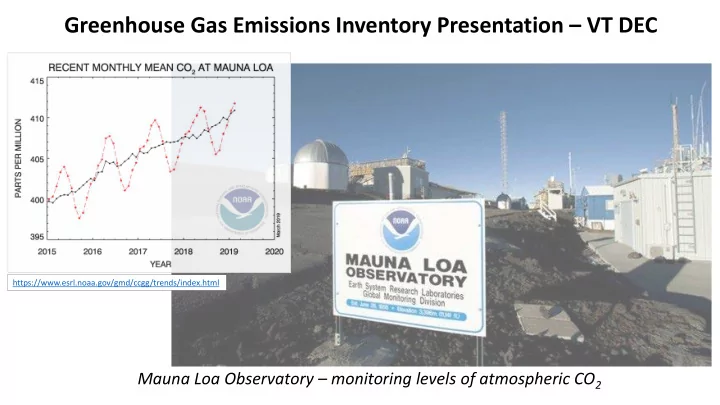
Greenhouse Gas Emissions Inventory Presentation VT DEC https://www.esrl.noaa.gov/gmd/ccgg/trends/index.html Mauna Loa Observatory monitoring levels of atmospheric CO 2 Greenhouse Gas (GHG) Emissions in Vermont Greenhouse Gas Emissions


slide-1
SLIDE 1

Mauna Loa Observatory – monitoring levels of atmospheric CO2

Greenhouse Gas Emissions Inventory Presentation – VT DEC

https://www.esrl.noaa.gov/gmd/ccgg/trends/index.html
slide-2
SLIDE 2

Greenhouse Gas (GHG) Emissions in Vermont

Greenhouse Gas Emissions Inventory

  • Estimates of anthropogenic GHG emissions by sector for VT
  • Attempt to provide a comprehensive and accurate estimate of greenhouse gas emissions totals for

Vermont annually (from 2008 – 2015)

  • Methodologies consistent with
  • Final Vermont Greenhouse Gas Inventory and Reference Case Projections, 1990-2030 (2007)
  • Intergovernmental Panel on Climate Change (IPCC) guidelines
  • Also coordinate with PSD, FPR, VTrans
  • Not direct measurements of GHGs emitted to or in the atmosphere
  • Calculated based on input data (e.g. fuel use) and emission factors for multiple sectors and multiple

end uses within each sector

  • Emissions units in million metric tons CO2 equivalent (MMTCO2e) which adjusts non-CO2 emissions by a global

warming potential to be comparable to CO2

slide-3
SLIDE 3

Greenhouse Gas Emissions Inventory

  • Required by state statute (10 V.S.A. § 582)
  • Initiated under Act 209 (2008) and built upon Governor’s Commission on Climate Change

Process (Governor Douglas)

  • To Facilitate tracking of progress towards Vermont’s greenhouse gas emissions reduction goals
  • 2012: 25% below 1990 baseline (Statute)
  • 2028: 50% below 1990 baseline (Statute)
  • 2030: 40% below 1990 totals (CEP)
  • 2050: 75% below 1990 baseline (Statute)
  • 2050: 80% - 95% below 1990 baseline (CEP)
  • To be a participant in a larger scale (regional, national, worldwide) effort to understand, track,

and combat anthropogenic driven global warming

  • Climate Alliance and New England Governors – Eastern Canadian Premiers (NEG-ECP)

3

slide-4
SLIDE 4

2028 Goal: 4.30 MMTCO2e (50% below 1990 totals) 2030 Goal: 5.16 MMTCO2e NEG-ECP / VT CEP (40% below 1990 totals) 2050 Goal: 2.15 MMTCO2e (75% below 1990 totals) 2012 Goal: 6.45 MMTCO2e (25% below 1990 totals) 2050 Goal (high end): 1.72 MMTCO2e (80% below 1990 levels) -VT CEP 2016 2050 Goal: (low end): 0.43 MMTCO2e (95% below 1990 levels) -VT CEP 2016 0.00 2.00 4.00 6.00 8.00 10.00 12.00

1990 1992 1994 1996 1998 2000 2002 2004 2006 2008 2010 2012 2014 2016 2018 2020 2022 2024 2026 2028 2030 2032 2034 2036 2038 2040 2042 2044 2046 2048 2050 GHG Emissions (MMTCO2e)

Vermont - Future Emissions Goals

– Total Emissions Trends and Goals

  • Emissions goals for 2028, 2030, and 2050 from Statute and CEP
  • New England Governors & Eastern Canadian Premiers (NEG-ECP) goals for 2050 are 75% - 85% below 2001 levels
  • Region-wide (no strict requirement for any one entity)

4

slide-5
SLIDE 5

Inventory Overview

  • Sectors Included in GHG Emissions Totals
  • Transportation
  • Residential/Commercial/Industrial (RCI) – Fuel Use
  • Agriculture
  • Electricity (Consumption)
  • Industrial Processes
  • Waste/Wastewater
  • Fossil Fuel Industry
  • Covers greenhouse gases listed in the Kyoto Protocol
  • Carbon dioxide (CO2), Methane (CH4), Nitrous oxide (N2O), Hydrofluorocarbons (HFCs),

Perfluorocarbons (PFCs), Sulfur hexafluoride (SF6), Nitrogen trifluoride (NF3)

Data Sources for Inventory Development

  • National Emissions Inventory (Triennial NEI)
  • Energy Information Administration (EIA) – State Energy Data System (SEDS)
  • U.S. Department of Agriculture (USDA)
  • Air Point Source Registration Data
  • PSD Utility purchases (kWh)
  • Others…
slide-6
SLIDE 6

Why is the current inventory only through 2015?

  • Many sectors rely on large national data sources
  • Energy Information Administration (EIA) – State Energy Data System (SEDS) – lag time in data availability
  • Large amount of data from multiple sectors required for models/modules
  • Use of EPA tools (default data available varies as well as tool release dates)
  • Data availability for calculations in many sectors is lagging (some by multiple years)
  • Potential inaccuracies in generating estimates based on assumptions/projections
slide-7
SLIDE 7

Vermont 1990 – 2015 Greenhouse Gas Emissions Update

https://dec.vermont.gov/air-quality/climate-change

slide-8
SLIDE 8

Emission Comparison - and the U.S.

  • High per capita vehicle miles traveled (VMT) for Vermont drivers
  • Higher residential and commercial fuel use percentage from winter heating in VT
  • Emissions from electricity consumption sector lower in VT due mostly to large hydro purchases
  • Few large emission point sources in Vermont – somewhat skews transportation percentage

Electricity (consumption based) 10.0% Res/Com Fuel Use 23.9% Industrial Fuel Use 3.9% Transportation 43.3% Fossil Fuel Industry 0.05% Industrial Processes 5.8% Waste 1.7% Agriculture 11.4%

2015 (VT)

Electricity Generation 29.6% Res/Com Fuel Use 10.4% Industrial Fuel Use 13.9% Transportation 28.4% Fossil Fuel Industry 3.1% Industrial Processes 4.4% Waste 2.3% Agriculture 7.8%

2015 (U.S.)

8