
SLIDE 1
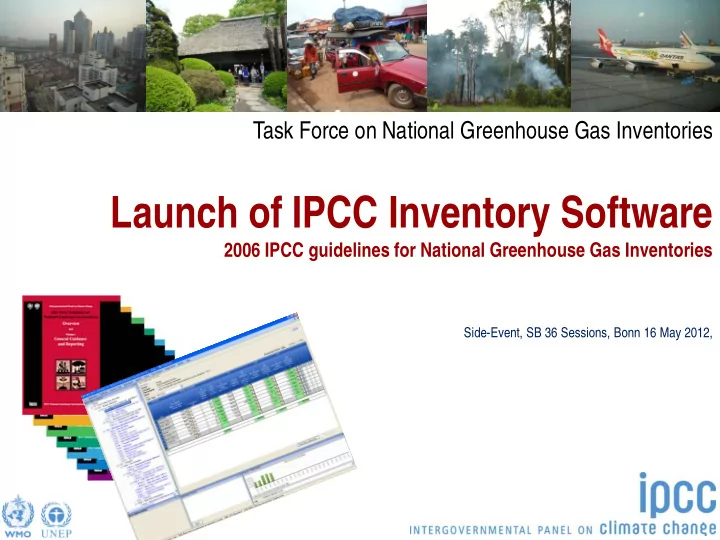
Task Force on National Greenhouse Gas Inventories
Launch of IPCC Inventory Software
2006 IPCC guidelines for National Greenhouse Gas Inventories
Side-Event, SB 36 Sessions, Bonn 16 May 2012,
Launch of IPCC Inventory Software 2006 IPCC guidelines for National - - PowerPoint PPT Presentation
Task Force on National Greenhouse Gas Inventories Launch of IPCC Inventory Software 2006 IPCC guidelines for National Greenhouse Gas Inventories Side-Event, SB 36 Sessions, Bonn 16 May 2012, Aim to introduce the new IPCC Inventory Software
2006 IPCC guidelines for National Greenhouse Gas Inventories
Side-Event, SB 36 Sessions, Bonn 16 May 2012,
– Contain much new and revised data – Have improved data and methods that can and are being used by inventory compilers reporting under the Revised 1996 Guidelines – Include methods for a more complete range of sources/sinks. – Dispense with “potential emissions” approaches replacing them with simple Tier 1 methods. – Update and expand guidance on “Good Practice”: QA/QC, Data Collection, Uncertainties, Methodological Choice etc.
– 1991 OECD (1991) – 1992 IPCC/OECD (1993)
(1996) and 10% & 5% for gross to net CV (GCV to NCV)
in 2004 (2002 Emissions): NCV, Carbon factors
2003: Carbon and CV data including developing countries
(includes developing country data)
0.1 1 10 100 0.1 1 10 100 2006 IPCC Guidelines Revised 1996 Guidelines If value in Revised 1996 Guidelines and 2006 Guidelines are the same point will lie on this line Wider range of emission factors in 2006 Guidelines reflecting improved knowledge of emissions
7
CO2 -Transport and Storage Electrical Equipment Urea-based Catalysts (Road Transport) Military Applications Accelerators Abandoned Underground Mines Medical Applications Propellant for Pressure and Aerosol Products Glass Production Ceramics Non Metallurgical Magnesia Production Complete, consistent treatment of fires Settlements remaining Settlements Caprolactam, Glyoxal & Glyoxylic Acid Some wetlands categories Titanium Dioxide Production Urea Application Petrochemical and Carbon Black Production Indirect N2O Emissions from Manure Harvested Wood Products Lead Production Zinc Production Open Burning of Waste Biological Treatment of Solid Waste Integrated Circuit or Semiconductor TFT Flat Panel Display Photovoltaics Heat Transfer Fluid Fuel Combustion Other Product Manufacture and Use Fugitive Emissions from Fuels Mineral Industry Substitutes for Ozone Depleting Substances Land Use Chemical Industry Metal Industry Waste Electronics Industries Other Indirect N2O Emissions from the Atmospheric Deposition of N (excluding agriculture)
All Sectors Industrial Processes Electronics Industries Magnesium production Halogenated Compounds Production GWP in AR4 CO2, CH4, N2O ✔
✔ ✔
HFC, PFC, SF6
✔ ✔
nitrogen trifluoride (NF3)
✔ ✔ ✔
trifluoromethyl sulphur pentafluoride (SF5CF3)
✔ ✔
halogenated ethers (e.g. C4F9OC2H5, CHF2OCF2OC2F4OCHF2, CHF2OCF2OCHF2)
✔ ✔ ✔
CF3I, CH2Br2, CHCl3
✔
CH2Cl2, CH3Cl
✔ ✔
C3F7C(O)C2F5
✔ ✔
C4F6, C5F8, c-C4F8O
✔ ✔ Many non-annex I parties just report these Currently, Annex I parties must report these “New” gases
these sub- categories
– This avoids any “potential” emission estimates as these are misleading and may over- or under-estimate emissions – A spreadsheet is provided that at a minimum requires ONLY the waste arising in the current year (with historic population data). – As more information is added the estimates become increasingly
changes in waste composition can be included if available. – Incidentally this spreadsheet can be used for projections
– Improved fuel factors based on wide range of data – CCS included explicitly – Role of “reference approach” as QA tool clarified – Urea Based catalysts
– Combines Industrial Processes and Solvent Use – No removals from short term CO2 storage in products unless emissions accounted for (e.g. Urea)
– Combines Agriculture and LULUCF – Improved consistency and coverage of fires (n.b. mapping back)
– New FOD model for landfill sites
New and updated emission factors and other parameters Revised and updated methods
annual emissions
GPG and methodological guidance integrated
15
16
Initial setting
MDB file XML file MDB file XML file
17
Hierarchical list
Worksheet-based calculations follow 2006 Guidelines Data Entry Time Series Display Category selected: Energy
18
Defaults Available: can be over-writen with country specific data Notation Keys Available Time Series Data Entry Uncertainties
Treatment of Solid Waste
Disposal
Open Burning of Waste
Treatment and Discharge
generation data (Tier1)
Solid Waste Disposal Select appropriate region and climate zone Select appropriate region and climate zone IPCC default values will be adjusted (e.g. methane generation rate constant)
NO YES
Are historical data
disposal available?
Waste category and type (e.g. industrial waste) After entering parameters and activity data Amount of CH4 generated
Annual CH4 emissions