Advancing Equity Analysis in Scenario Planning Social Vulnerability - - PowerPoint PPT Presentation

advancing equity analysis in scenario planning
SMART_READER_LITE
LIVE PREVIEW

Advancing Equity Analysis in Scenario Planning Social Vulnerability - - PowerPoint PPT Presentation

Advancing Equity Analysis in Scenario Planning Social Vulnerability and Neighborhood Effects Analysis Tools Robert Goodspeed, AICP, University of Michigan Chicago Open Heat Vulnerability Mapper Bev Wilson and Arnab Chakraborty, University of


slide-1
SLIDE 1

1

Advancing Equity Analysis in Scenario Planning

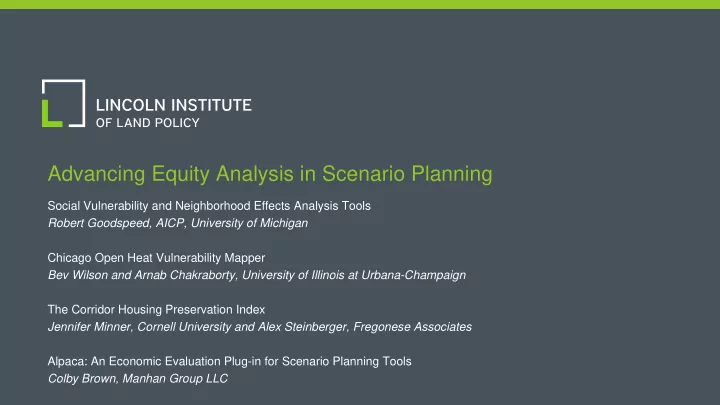
Social Vulnerability and Neighborhood Effects Analysis Tools Robert Goodspeed, AICP, University of Michigan Chicago Open Heat Vulnerability Mapper Bev Wilson and Arnab Chakraborty, University of Illinois at Urbana-Champaign The Corridor Housing Preservation Index Jennifer Minner, Cornell University and Alex Steinberger, Fregonese Associates Alpaca: An Economic Evaluation Plug-in for Scenario Planning Tools Colby Brown, Manhan Group LLC

slide-2
SLIDE 2

From Social Vulnerability and Neighborhood Effects to Planning Knowledge: Tools for Considering Social Equity in Scenario Planning

Robert Goodspeed, AICP Assistant Professor of Urban Planning Presented May 8, 2017 at APA National Planning Conference “Advancing Equity Analysis in Scenario Planning”

slide-3
SLIDE 3

Overview

  • Project Overview

– Social Vulnerability Tool – Social Equity Tool

  • Uncertainty in Scenario Planning Tools
slide-4
SLIDE 4

PROJECT OVERVIEW

slide-5
SLIDE 5

Equity Analysis Framework

slide-6
SLIDE 6

What tools did we create?

  • A social vulnerability tool to map out the community before planning has

begun

– The “base map” is typically focused on existing buildings & infrastructure – not social issues

  • A neighborhood effects tool to allow ET+ users to conduct additional

analysis of their land use scenarios

– Existing analysis focuses on issues such as fiscal impact and travel behavior

slide-7
SLIDE 7

Tool Development Process

slide-8
SLIDE 8

Social Vulnerability Index

  • Demographics

– Percentage of non-white residents – Percentage of population under age 18 and over age 65

  • Social and economic

– Unemployment rate for civilian population in labor force 16 years and over – Percentage of households with no vehicles available

  • Wealth and Inequality

– Percentage with income in the past 12 months below poverty level

  • Healthcare and Food Access
  • Percentage of people without health insurance coverage

– Percentage of population with disability – Food desert status (Yes = 1, No = 0) (more than 1 mile away from the nearest supermarket)

  • Education and Language

– Percentage of population with less than regular high school diploma – Percentage of limited English speaking household

  • Housing

– Percentage of Vacant housing units – Percentage of households who pay more than 30 % of their income rent – Percentage of renter-occupied housing units

  • Large body of descriptive and theoretical work on social vulnerability,

a few validated indices (Lee 2014, Mendes 2009, Cutter et al 2000)

  • Created a new index, only 1 correlation greater than .3 at the

individual level!

slide-9
SLIDE 9

Social Vulnerability Index User Guide

Literature review Comparison with CDC’s Social Vulnerability Index, and Cutter/Army Corps SoVI Correlation analysis using Public Use Microdata Sample

slide-10
SLIDE 10

Neighborhood Effects Tool

  • A growing body of “neighborhood effects”

research has documented the role of neighborhoods in various well-being outcomes. Our tool identifies built environment factors in the tool linked to different outcomes. Indicators

  • Child BMI (Grafova 2008)

– Proportion of cul-de-sacs

  • Adult BMI (Rundel et al 2007)

– Land use mix – Population density

  • Collective Efficacy (Cohen, Inahami, Finch 2008)

– Proportion of open space

  • Upward mobility, adult BMI, heart disease,

diabetes (Ewing, Meakins and Hamidi 2014)

– Population density – Employment density – Land use mix – Building size mix – Intersection density

slide-11
SLIDE 11

Neighborhood Effects User Guide

Detailed summary of rigorous neighborhood effects studies Handout summarizing research findings

  • n built environment impact on mental

health, physical health, economic mobility and social capital. Step-by-step instructions

slide-12
SLIDE 12

Tool Package Contents

  • Social Vulnerability Tool

– User Guide (42 pp) – Example Data Files – R Script (folder)

  • Social Equity Scenario Tool

– User Guide (23 pp) – Tool Spreadsheet (.xlsx) – Sample ET+ Scenario Data

slide-13
SLIDE 13

UNCERTAINTY IN SCENARIO PLANNING TOOLS

slide-14
SLIDE 14

Why care about uncertainty?

In a laboratory experiment a tool which showed uncertainty as a range of values (Dong and Hayes 2012):

  • Helped users understand when uncertainty made a choice unclear;
  • Helped users make good decisions even with ambiguity;
  • Encouraged users to seek clarifying information;
  • Was preferred by users!

Only concerns the simplest form of distributional or statistical uncertainty.

slide-15
SLIDE 15

What are we uncertain about in planning?

Options Consequences Utility/Value Source: Abbot (2005)

slide-16
SLIDE 16

Sources of Uncertainty and Representation Options

Source of Uncertainty Type How to address? Social Vulnerability Tool Index Uncertainty (ACS errors) Distributional Compute margin of error – impossible! Temporal Uncertainty (relevance of past information) Singular Draw attention to years, rates of change Construct Uncertainty (validity of construct) Singular Report empirical validation Neighborhood Effects Tool Factor Uncertainty (Causal- consequences) Distributional Report traditional measures (P values) Strength Uncertainty (Causal-utility) Singular Describe study design; details Temporal Uncertainty (relevance of old studies) Singular Display study years Geographic Uncertainty (relevance of external studies) Singular Provide context comparison

slide-17
SLIDE 17

Conclusions

  • The adoption of planning tools which utilize external knowledge, introduces

new source of causal uncertainty in planning decisions;

  • Most sources of uncertainty are singular and not distributional in nature,

meaning statistical principles do not apply;

  • We need improved knowledge about which representations can foster

consideration of these sources of uncertainty in collaborative planning contexts

slide-18
SLIDE 18

Discussion

  • For works cited and further background, see accompanying memo, Goodspeed,

Zainulbhai, and Wang, “Development of tools for considering social equity in scenario planning,” 18 November 2015.

  • Funding provided by Lincoln Institute of Land Policy, Grant #URG082015

Contact Robert Goodspeed - rgoodspe@umich.edu, @rgoodspeed Project RAs: Sabiha Zainulbhai, Bonnie Wang Download the tools: www-personal.umich.edu/~rgoodspe/

slide-19
SLIDE 19

Works Cited

Abbott, J. 2005. "Understanding and managing the unknown - The nature of uncertainty in planning." Journal of Planning Education and Research 24 (3):237-251. doi: 10.1177/0739456x04267710. Cohen, Deborah A, Sanae Inagami, and Brian Finch. 2008. "The built environment and collective efficacy." Health & place 14 (2):198-208. Cutter, Susan L., Jerry T. Mitchell, and Michael S. Scott. 2000. "Revealing the Vulnerability of People and Places: A Case Study of Georgetown County, South Carolina." Annals of the Association of American Geographers 90 (4):713-737. doi: 10.1111/0004-5608.00219. de Oliveira Mendes, Jose Manuel. 2009. "Social vulnerability indexes as planning tools: beyond the preparedness paradigm." Journal of Risk Research 12 (1):43-58. Dong, Xiao, and Caroline C Hayes. 2012. "Uncertainty visualizations helping decision makers become more aware of uncertainty and its implications." Journal of Cognitive Engineering and Decision Making 6 (1):30-56. Ewing, Reid, and Shima Hamidi. 2014. Measuring Urban Sprawl and Validating Sprawl Measures. Metropolitan Research Center, University of Utah. Ewing, Reid, Shima Hamidi, James B. Grace, and Yehua Dennis Wei. 2016. "Does urban sprawl hold down upward mobility?" Landscape and Urban Planning 148:80-88. doi: http://dx.doi.org/10.1016/j.landurbplan.2015.11.012. Goodspeed, Robert. 2013. "Planning Support Systems for Spatial Planning Through Social Learning." Doctor of Philosophy in Urban and Regional Planning, Urban Studies and Planning, Massachusetts Institute of Technology. Goodspeed, Robert. 2015. "Sketching and learning: A planning support system field study." Environment and Planning B: Planning and Design. doi: 10.1177/0265813515614665. Grafova, Irina B, Vicki A Freedman, Rizie Kumar, and Jeannette Rogowski. 2008. "Neighborhoods and obesity in later life." American Journal

  • f Public Health 98 (11):2065-2071.

Kahneman, Daniel, and Amos Tversky. 1982. "Variants of uncertainty." Cognition 11 (2):143-157. Lee, Yung-Jaan. 2014. "Social vulnerability indicators as a sustainable planning tool." Environmental Impact Assessment Review 44:31-42. Rundle, Andrew, Ana V Diez Roux, Lance M Freeman, Douglas Miller, Kathryn M Neckerman, and Christopher C Weiss. 2007. "The urban built environment and obesity in New York City: a multilevel analysis." American Journal of Health Promotion 21 (4s):326-334.
slide-20
SLIDE 20

Chicago Heat Vulnerability Mapper

Bev Wilson and Arnab Chakraborty

University of Illinois at Urbana-Champaign

slide-21
SLIDE 21

Heat waves are becoming more common and more deadly, especially in urban areas

21

Source: NASA, https://www.nasa.gov/feature/goddard/2016/climate-trends- continue-to-break-records

slide-22
SLIDE 22

Extreme heat events are a serious problem in Chicago

  • Chicago is getting hotter…
  • Annual average observed

temperatures at Chicago Midway

  • Solid line is 10 year running

mean

slide-23
SLIDE 23

Common heat planning approaches

Source: Stone, B., Vargo, J., & Habeeb, D. (2012). Managing climate change in cities: Will climate action plans work? Landscape and Urban Planning, 107, 263-271.

Source: Chicago Climate Action Plan White rooftop at Crane Technical High School

slide-24
SLIDE 24

Multi-dimensional approach to heat planning

  • Heat exposure varies within an urban area
  • Existing models are too coarse and sensors are few and far between
  • Local sensing and downscaled climate models can help
  • Sensitivity to heat varies by community/household/individual
  • Access to air conditioning, ability to evacuate, etc. may mediate the impact of

heat

  • Patterns of sensitivity and exposure to heat may change over time
  • Dynamically visualizing, linking, and projecting heat sensitivity and

exposure to create scenarios can be useful for planners

slide-25
SLIDE 25

Source: Wilhelmi, O. V., & Hayden, M. H. (2010). Connecting people and place: A new framework for reducing urban vulnerability to extreme heat. Environmental Research Letters, 5(1), 14-21.

Heat vulnerability framework

slide-26
SLIDE 26

Key drivers (sensitivity + adaptive capacity)

Proportion of persons aged 25+ without H.S. diploma Mean household income Female-headed households Proportion of occupied housing units with no car Poverty rate Proportion elderly population Proportion of persons under age of 18 Proportion of population living in group quarters Proportion of population in nursing homes or homes for the aged and dependent Proportion renter households Proportion substandard housing units Proportion of occupied housing units comprised by mobile homes Proportion population identifying as Black or African-American only Proportion population identifying as Asian, Native Hawaiian, or Pacific Islander only Proportion of population identifying as some

  • ther race only

Proportion population identifying as Hispanic

slide-27
SLIDE 27
  • Heat Vulnerability Index
  • Captures sensitivity to hazards

across social groups that are attributable in part to the social, economic, political, and institutional factors (Tate et al., 2010).

  • Mediates the risk or impact of

disasters (Cutter et al. 2003)

  • Developed using a national dataset

and factor analysis technique

Sensitivity + adaptive capacity

slide-28
SLIDE 28

Measuring exposure: spatial resolution

Landsat 8

slide-29
SLIDE 29

Measuring exposure: temporal resolution

Moderate Resolution Imaging Spectroradiometer (MODIS)

slide-30
SLIDE 30

Other data sources

slide-31
SLIDE 31
  • Open source, web application

– Built in R using leaflet et and shiny packages – Where does vulnerability (higher sensitivity + lower adaptive capacity) intersect with exposure to extreme heat? – Support longitudinal visualization and analysis

  • Historical patterns
  • Future conditions using downscaled climate model projections and scenario analysis

Tool development

slide-32
SLIDE 32
slide-33
SLIDE 33
slide-34
SLIDE 34
slide-35
SLIDE 35
slide-36
SLIDE 36
slide-37
SLIDE 37
slide-38
SLIDE 38
slide-39
SLIDE 39
slide-40
SLIDE 40
slide-41
SLIDE 41

Conclusions and takeaways

  • Urban planners and climate action plans need to pay more attention to

extreme heat events (Oke, 2006)

  • Land use and the built environment (Stone Jr. & Rodgers, 2001; Coseo & Larsen,

2014)

  • Patterns of social vulnerability (Klinenberg, 2015; Reid et al., 2009; Johnson et al.,

2012)

  • Data-driven mitigation planning
  • We need more tailored and flexible responses
  • Where are cooling facilities and capacity given shifting patterns of vulnerability?
  • Green infrastructure alongside construction materials alongside social factors
slide-42
SLIDE 42

Accessing the tool

Visit http://chicagoheatvulnerability.org The documentation and supporting materials are embedded

slide-43
SLIDE 43

The Corridor Housing Preservation Index: A new tool for equitable corridor planning

Image credits: Metrorail, Paul Kimo McGregor on flickr, (cc) Apartment Bike, HerLanieShip on Flickr, (cc)

slide-44
SLIDE 44

Redevelopment & Affordable Housing Displacement

  • Rising property values along

transit corridors

  • Aging rental housing likely to be

redeveloped or sold

  • Rents in these properties are

likely to rise or units converted to

  • wner occupancy
  • Aging but unsubsidized rental

housing is typically a city’s largest source of affordable housing Now de demolish shed ed a apa partmen ent bu building (Stoner eridge e Apa partmen ents) s)

Stone neridge A Apa partment nts Will S ll Soon B n Be Gone, Image by Tim Patterson on Flickr (cc)

slide-45
SLIDE 45

Corridor Housing Preservation Tool

A planner’s index for gauging the value and vu vulnerability of affordable housing in transit-served corridors.

slide-46
SLIDE 46

Three Fundamental Questions

How many affordable rental units are vulnerable to redevelopment? How much transit access to jobs does a corridor provide to low income residents? How intense is the development pressure?

slide-47
SLIDE 47

Funded by the Lincoln Institute

  • f Land Policy

and U.S. HUD

Developme ment of a new metric Te Testing in other cities: Austin, Texas Denver, Colorado Portland, Oregon Put t into p practi ctice ce in San Antonio, Texas Curri ricul ulum development to share the method

slide-48
SLIDE 48

Envision Tomorrow an open-access suite of scenario planning tools

slide-49
SLIDE 49

Excel-Based Model

Individual tabs walk users through the process of gathering required data.

slide-50
SLIDE 50

National CHPT Dataset

Much of the required data can be extracted from the national CHPT

  • Dataset. Available at online at

www.EnvisionTomorrow.org

slide-51
SLIDE 51

The Tool in Practice

SA Corridors is a collaborative effort between the City of San Antonio and VIA Metropolitan Transit. It is a study that is taking a deeper look at transit supportive land use policies along San Antonio’s major transit corridors.

slide-52
SLIDE 52

Young, Diverse Families

San Antonio will continue to be a majority minority region. These households will seek home-

  • wnership and may be willing to

move in order to achieve it.

Young, Diverse Families in San Antonio

Source, ESRI Tapestry 2014, Fregonese Associates

slide-53
SLIDE 53

Affordable Housing Vulnerability

2 4 6 8 10 0% 20% 40% 60% 80% 100%

Young Diverse Families Affordable Housing Vulnerability

Source: Envision Tomorrow Corridor Housing Preservation Tool

slide-54
SLIDE 54

Transit Access to Low Wage Jobs

2 4 6 8 10 0% 20% 40% 60% 80% 100%

Young Diverse Families Transit Access to Low Wage Jobs

Source: Envision Tomorrow Corridor Housing Preservation Tool

slide-55
SLIDE 55

Development Pressure

2 4 6 8 10 0% 20% 40% 60% 80% 100%

Young Diverse Families Development Pressure

Source: Envision Tomorrow Corridor Housing Preservation Tool

slide-56
SLIDE 56

9.3 1.8 5.4 6.4 4.6 4.0 0.4 4.9 9.6 10.0 9.9 7.6 3.5 8.0 6.0 1.5 10.0 6.9 3.2 4.4 7.1 6.2 4.4 6.7 6.1 9.9 8.0 2.8 8.5 8.4 3.4 6.0 10.0 6.5 5.9 4.5 0.0 5.0 10.0 15.0 20.0 25.0 30.0

Index Results Summary

Development Pressure Affordable Housing Vulnerability Transit Access to Low Wage Employment

Source: Envision Tomorrow Corridor Housing Preservation Tool

slide-57
SLIDE 57

Freely Available Tool and Training Package

Online Training Packet:

  • Step-by-step instructions
  • Geodatabase with national data
  • Questionnaires - pre and post training
slide-58
SLIDE 58

Our Challenge

Ease of Use Replicability Verisimilitude Construct validity Precision As accurate as possible AND easy enough to become regularly used measurement tool Create tool that is nationally replicable that planners will use and students able to learn from conceptually and perform technically

slide-59
SLIDE 59

Teaching Tool

Cornell University courses where tool introduced:

  • Seminar in Regional Science, Planning, &

Policy Analysis (graduate)

  • CRP 2000: Promises & Pitfalls of

Contemporary Planning (undergraduate)

  • CRP 3210: Introduction to Quantitative

Methods for the Analysis of Public Policy (undergraduate) Courses where lab instructions tested:

  • Concepts and Methods of Land Use

Planning (graduate)

  • Equity Preservation and Planning Workshop

(gradudate student testing)

Topics

  • Equity
  • Affordable

Housing

  • Transit oriented

development

  • Gentrification
  • Value of

preserving building stock

  • Integrated

Housing, Land Use and Transportation Planning

Methods, Tools

  • Scenario Planning
  • Candidate

Redevelopment App (in Envision Tomorrow)

  • Land to

Improvement Ratio

Data

  • Smart Location

Database

  • National Housing

Preservation Database

  • American

Community Survey

  • Local Tax

Assessor’s data

slide-60
SLIDE 60

Concepts and Methods of Land Use

Lab assignment that replicated analysis for Portland, Oregon

Map by Hannah Banhmiller and figure by Dylan Tuttle.

slide-61
SLIDE 61

Equi quity Preservation a

  • n and

d Planni ning ng Workshop hop

Testing value of tool in Buffalo, a legacy city

Photo credit: Jennifer Minner; Map and Figures by Tom Pera.

slide-62
SLIDE 62

Thank nk y you! u!

envisiontomorrow.org/corridor-housing-preservation-tool

slide-63
SLIDE 63

ADVANCING EQUITY ANALYSIS IN SCENARIO PLANNING Colby Brown, AICP

Alpaca: An Economic Evaluation Plug-in for Scenario Planning Tools

APA National Planning Conference 2017

slide-64
SLIDE 64

The Promise of Sustainable Urban Development

  • Cities are retrofitting their transportation

networks for a smarter, greener future…

– Fixed-guideway transit (rail, BRT) – Bicycle and pedestrian trails / rights of way – Shared mobility (bike-sharing, ride-sharing)

  • The economic value added by these features

can be captured to augment funding streams

– Jobs / economic development – Property value & tax base uplift

slide-65
SLIDE 65

Gentrification & Other Challenges

  • Planning agencies are being

made increasingly aware of the potential consequences of redevelopment & TOD

  • Gentrification of neighborhoods

and displacement of residents moving to top of agenda

  • Cities need better models to

predict, prevent and mitigate adverse impacts of plans

slide-66
SLIDE 66

How Bid-Rent Analysis Helps

  • Robust way to quantify

value uplift from transport projects

  • Also predicts

characteristics of

  • ccupants

– Example: industry mix – Demographics are more relevant to equity issues

slide-67
SLIDE 67

67

Bid-Rent Demo: LLAMA Web App

  • Different market segments have different willingness to pay for

specific real estate property & location characteristics

  • Competitive bidding affects “auction” winner & price
slide-68
SLIDE 68

68

“Alpaca” vs. LLAMA

slide-69
SLIDE 69

“Alpaca” Project Goals

  • Integrate bid-rent calculations into scenario planning process

(tools & data) across three distinct, independent case studies:

– MAPC / CommunityViz – FresnoCOG / Envision Tomorrow + – SCAG / Urban Footprint

  • Investigate effects of new economic measures enabled by

these tools on planning process

slide-70
SLIDE 70

70

“Alpaca” Project Team and Tasks

  • Dr. Michael Clay

BYU Pedro Donoso LABTUS Colby Brown, AICP Manhan Group

฀ Literature

review

฀ Interviews with ฀ practitioners ฀ Recommended ฀ measures ฀ Core software ฀ development ฀ Mathematical ฀ methodology ฀ Unit testing ฀ Overall direction ฀ Integration into ฀ scenario

planning

฀ tools / programs ฀ Case studies (3)

slide-71
SLIDE 71

Alpaca Web Service for Mu-Land

  • New open-source

Linux program for bid-rent evaluation

  • Web services API
  • Scenario planning

tools (such as CViz, UF & ET+) can call this API & get info

µ API

SP Tool Add-on Script(s)

slide-72
SLIDE 72

Integration with CommunityViz / ArcGIS in Boston

slide-73
SLIDE 73

SCAG Cube Land Pilot Study

  • 531 Land Use Zones (LUZ)
  • Calibrated using available data
  • Average res. rent (darker blue=higher)
slide-74
SLIDE 74

“Mu-land” SCAG Case Study

  • 196,858 Scenario Planning Zones (SPZ)
  • Bid-rent evaluation of UF “Base Canvas”
  • Average res. rent (darker blue=higher)
slide-75
SLIDE 75

Fresno Housing Affordability Case Study

slide-76
SLIDE 76

Recent Updates & Progress

  • Housing affordability measures

– Simple HAI metric incorporated into COMPASS (Greater Boise MPO) Performance Measures Framework – Supported by a new bid-rent land use model

  • Gentrification & inequality

– SCAG study compared actual vs. modeled trends from 2008-2012 – Recommendation: increase market segmentation detail (esp. race)

  • Method for expanding resolution pioneered in Boston
slide-77
SLIDE 77

Colby M. Brown, AICP Colby@ManhanGroup.com Voice: (413) 282-8629

Non-original image credits (in order): 1. By vxla from Chicago, US (HPIM7031) [CC BY 2.0 (http://creativecommons.org/licenses/by/2.0)], via Wikimedia Commons 2. http://www.dailyherald.com/article/20130713/news/707139934/ 3. http://www.economist.com/news/united-states/21644164-gentrification-good-poor-bring-hipsters 4. By SyntaxError55 at the English language Wikipedia, CC BY-SA 3.0, https://commons.wikimedia.org/w/index.php?curid=6281937

slide-78
SLIDE 78

78

113 BRATTLE STREET CAMBRIDGE MA 02138 LINCOLNINST.EDU @LANDPOLICY