Advances in Heart Disease: Endovascular Repair of Aortic Diseases - - PDF document

advances in heart disease endovascular repair of aortic
SMART_READER_LITE
LIVE PREVIEW

Advances in Heart Disease: Endovascular Repair of Aortic Diseases - - PDF document

Disclosures Scientific Advisor Radial Medical Advances in Heart Disease: Endovascular Repair of Aortic Diseases Shant Vartanian, MD Assistant Professor of Surgery Division of Vascular and Endovascular Surgery Interim Chief of Surgery


slide-1
SLIDE 1

[ADD PRESENTATION TITLE: INSERT TAB > HEADER & FOOTER > NOTES AND HANDOUTS] 12/2/17 1

Advances in Heart Disease: Endovascular Repair of Aortic Diseases

Dec 2, 2017

Shant Vartanian, MD Assistant Professor of Surgery Division of Vascular and Endovascular Surgery Interim Chief of Surgery Zuckerberg San Francisco General Hospital

Disclosures

Scientific Advisor – Radial Medical

12/2/17 Advances in Heart Disease 2

Endovascular Repair of Aortic Disease

§ Abdominal Aortic Aneurysms

  • Natural History
  • Risk Factors
  • Open vs Endovascular Repair
  • Branch technologies

§ Thoracic Aortic Aneurysms § Aortic Dissection

  • Endovascular interventions for acute dissections
  • Indications for subacute interventions

Outline

12/2/17 Advances in Heart Disease 3

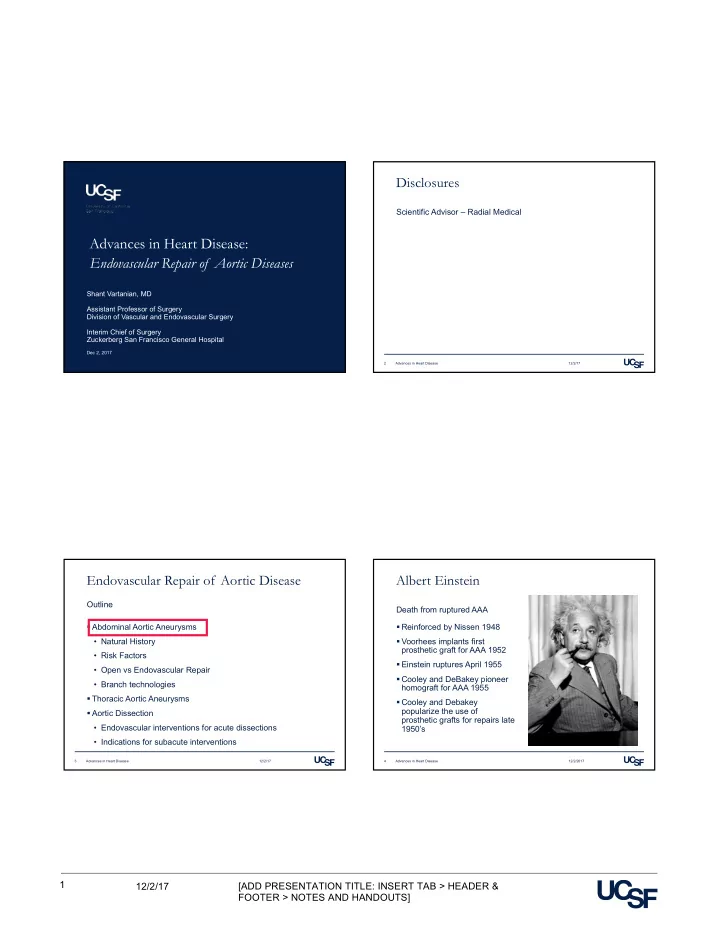
Albert Einstein

§ Reinforced by Nissen 1948 § Voorhees implants first prosthetic graft for AAA 1952 § Einstein ruptures April 1955 § Cooley and DeBakey pioneer homograft for AAA 1955 § Cooley and Debakey popularize the use of prosthetic grafts for repairs late 1950’s Death from ruptured AAA

12/2/2017 Advances in Heart Disease 4

slide-2
SLIDE 2

[ADD PRESENTATION TITLE: INSERT TAB > HEADER & FOOTER > NOTES AND HANDOUTS] 12/2/17 2

Introduction

§ Abdominal Aorta 3 cm § Common Iliac 2 cm § Fusiform vs Saccular § Degenerative vs Inflammatory § Infectious (mycotic) § Traumatic § Post Dissection § Multifocal Focal dilation of > 50% larger than nominal arterial diameter

12/2/17 Advances in Heart Disease 5

Natural History

Laplace’s Law: Wall tension is directly proportional to radius

12/2/17 Advances in Heart Disease 6 Joon Bum Kim et al. Circulation. 2015;132:1620-1629

Natural History

§ Aneurysm shape § Female gender § Smokers § HTN § COPD § Family history § Expansion rate § Biomarkers? § Genetic profile? Rupture Risk

12/2/17 Advances in Heart Disease 7

Smoking and AAA Risk

12/2/17 Advances in Heart Disease 8 Kent et al. JVS vol 52(3) 2010

slide-3
SLIDE 3

[ADD PRESENTATION TITLE: INSERT TAB > HEADER & FOOTER > NOTES AND HANDOUTS] 12/2/17 3

Aneurysm Progression

Influence of smoking

12/2/17 Advances in Heart Disease 9 Br J Surg. 2012;99(5):655-65.

Protection from AAA

Optimal medical management

12/2/17 Advances in Heart Disease 10 Kent et al. JVS vol 52(3) 2010

Protection from AAA

Diabetes is Protective

12/2/17 Advances in Heart Disease 11 Br J Surg. 2012;99(5):655-65.

Natural History

12/2/17 Advances in Heart Disease 12

Expansion rate: Normal is 3 mm / year

slide-4
SLIDE 4

[ADD PRESENTATION TITLE: INSERT TAB > HEADER & FOOTER > NOTES AND HANDOUTS] 12/2/17 4

Screening and Surveillance

§ Screening

  • 4 randomized trials with total 137,233 patients
  • Screening reduces aneurysm related mortality
  • Est 216 men need to be screened to save one death
  • US Preventative Services Task Force (USPSTF) recommends
  • ne time screening for men age 65-75 who have ever smoked

§ Surveillance

12/2/17 Advances in Heart Disease 13

AAA Size Surveillance Interval 3.0 – 3.9 cm 3 years 4.0 – 4.9 cm 12 months 5.0 – 5.4 cm 6 months

Open Repair in the Modern Era

Estimated complication rate in society practice guidelines

12/2/17 Advances in Heart Disease 14

6-8 week recovery

Endovascular Repair

Disruptive innovation

12/2/17 Advances in Heart Disease 15

EndoVascular AAA Repair (EVAR)

§ Anatomic suitability

  • Aneurysm neck

‒ Length, diameter, angulation ‒ Atheroma, thrombus

  • Iliac seal zones
  • Access vessels
  • Critical branch vessels

‒ Accessory renal arteries

Security of the repair relies solely upon the radial force generated by the graft at the landing zones

12/2/17 Bakersfield Cardiovascular Symposium 16

slide-5
SLIDE 5

[ADD PRESENTATION TITLE: INSERT TAB > HEADER & FOOTER > NOTES AND HANDOUTS] 12/2/17 5

FDA Approved Devices

12/2/17 Advances in Heart Disease 17

Anatomic Criteria for Devices on Market

Seal in Normal Aorta: Staying within the IFU

12/2/17 Advances in Heart Disease 18

Complications of Endovascular Repair

Early and Late complications

12/2/17 Advances in Heart Disease 19

Compliance with surveillance necessary for durable outcomes

Long Term Complications

12/2/17 Advances in Heart Disease 20

Endoleaks

5% Balloon Raise the seal zone Endoanchor 20% Rx only if sac growth Embolization <5% Present at implantation Seals sponteaneously <5% Bridge the gap

slide-6
SLIDE 6

[ADD PRESENTATION TITLE: INSERT TAB > HEADER & FOOTER > NOTES AND HANDOUTS] 12/2/17 6

EVAR vs Open Surgery

§ Aortic cross clamping vs continuous perfusion § Laparotomy vs femoral cut-down

  • Totally percutaneous EVAR

§ General anesthesia vs regional/local/sedation § Access complications § Endoleaks § Durability vs continued surveillance Advantages of EVAR

12/2/17 Advances in Heart Disease 21

EVAR vs Open Surgery

§ EVAR1 Trial

  • UK trial 1252 patients to open vs EVAR

§ OVER Trial

  • VA trial with 881 patients randomized to open vs EVAR

§ ACE Trial

  • French trial randomizing 316 patients to open vs EVAR

§ DREAM Trial

  • Dutch trial randomizing 351 patients

Level I Evidence

12/2/17 Advances in Heart Disease 22

EVAR vs Open Surgery

Short Term Mortality (30 days)

12/2/17 Advances in Heart Disease 23

Long Term Mortality (>4 years)

EVAR vs Open Surgery

§ 30d mortality is lower (1.6% vs 4.8%)

  • Survival advantage greater with higher risk patients

§ Lower perioperative morbidity (cardiac, pulmonary, stroke) § Less blood loss § Faster recovery § Shorter hospital stay (10d vs 4d) Summary of randomized trials: Advantages of EVAR

12/2/17 Advances in Heart Disease 24

slide-7
SLIDE 7

[ADD PRESENTATION TITLE: INSERT TAB > HEADER & FOOTER > NOTES AND HANDOUTS] 12/2/17 7

EVAR vs Open Surgery

§ Long term results for survivors is equivalent

  • Initial reduction in all-cause mortality is eliminated within 2 years

§ Higher re-intervention rate § < 50% of patients compliant with recommended surveillance § Higher late aortic complication rate w/ EVAR § Greater cost??? Summary of randomized trials: Advantages of Open

12/2/17 Advances in Heart Disease 25

Increasing AAA repair rates

12/2/17 Advances in Heart Disease 26

Paradigm shift due to endovascular options

Ann Surg. 2012 Oct; 256(4): 651–658.

Currently, >80% of AAA repairs are endovascular

Operative Mortality

12/2/17 Advances in Heart Disease 27

All Medicare beneficiaries

Ann Surg. 2012 Oct; 256(4): 651–658.

Decreasing Mortality from AAA

12/2/17 Advances in Heart Disease 28

Correlation to increase in elective repair

Ann Surg. 2012 Oct; 256(4): 651–658.

slide-8
SLIDE 8

[ADD PRESENTATION TITLE: INSERT TAB > HEADER & FOOTER > NOTES AND HANDOUTS] 12/2/17 8

Decreasing Mortality AAA

12/2/17 Advances in Heart Disease 29

Correlated to increase in elective repair or decreased smoking?

  • Circulation. 2011: 124(10):1097-9

Tips for Successful EVAR Outcomes

Seal in Normal Aorta: Staying within the IFU

12/2/17 Advances in Heart Disease 30

30% of patients treated in the US do not meet IFU for aortic neck criteria

Tips for Successful EVAR Outcomes

Seal in Normal Aorta: Staying within the IFU

12/2/17 Advances in Heart Disease 31

  • Circulation. 2011 Jun

21;123(24):2848-55.

Raising the Seal Zone

12/2/17 Advances in Heart Disease 32

slide-9
SLIDE 9

[ADD PRESENTATION TITLE: INSERT TAB > HEADER & FOOTER > NOTES AND HANDOUTS] 12/2/17 9

Raising the Seal Zone

12/2/17 Advances in Heart Disease 33

Lowering the Seal Zone: Iliac Branch Devices

12/2/17 Advances in Heart Disease 34

Summary

§ Highest risk populations are men, smokers and advanced age

  • Screen all men over age 65 with smoking history

§ Risk stratification for rupture can be refined

  • Treat when risks of rupture exceed risks of repair

§ Durability of EVAR is maximized when staying within IFU § Failed EVAR happens when off IFU and > 3 years after initial treatment § Don’t be afraid to raise the seal zone to healthy aorta

  • Fenestrated devices FDA approved
  • Branched devices close behind

12/2/17 Advances in Heart Disease 35

Endovascular Repair of Aortic Disease

§ Abdominal Aortic Aneurysms

  • Natural History
  • Risk Factors
  • Open vs Endovascular Repair
  • Branch technologies

§ Thoracic Aortic Aneurysms § Aortic Dissection

  • Endovascular interventions for acute dissections
  • Indications for subacute interventions

Outline

12/2/17 Advances in Heart Disease 36

slide-10
SLIDE 10

[ADD PRESENTATION TITLE: INSERT TAB > HEADER & FOOTER > NOTES AND HANDOUTS] 12/2/17 10

Thoracic Aortic Aneurysms

Thoracic Aortic Size and Rupture Risk

12/2/17 Advances in Heart Disease 37

Thoracic Aortic Aneurysms

Thoracic Aortic Size and Adverse Events

12/2/17 Advances in Heart Disease 38

Thoracic Aortic Aneurysms

§ Descending Thoracic Aortic Aneurysms (TAA)

  • Ave. sized adults 6-7 cm
  • High surgical risk >7 cm
  • Genetically mediated conditions 5-6 cm

‒ Marfans, Loeys-Dietz, Ehlers-Danlos, Turner or familial TAAD

  • Rapid expansion
  • Symptoms

Indications for Repair

12/2/17 Advances in Heart Disease 39

Thoracic Endovascular Aneurysm Repair (TEVAR)

12/2/17 Advances in Heart Disease 40

Available Endografts

slide-11
SLIDE 11

[ADD PRESENTATION TITLE: INSERT TAB > HEADER & FOOTER > NOTES AND HANDOUTS] 12/2/17 11

Thoracic Aortic

12/2/17 Advances in Heart Disease 41

Branch Vessels

TEVAR

§ Spinal Cord Ischemia

  • Most studies report rates between 3 – 11%
  • Similar or better than open surgery

§ Risk Factors

  • Extent of coverage
  • Hypotension (rupture)

§ Spinal cord protection

  • Lumbar drain
  • Staged procedures
  • Preserve collateral circulation

Complications

12/2/17 Advances in Heart Disease 42

TEVAR

§ Stroke rate 4-8% § Long term mortality biased by indication

  • Trauma > Dissection > TAA

§ Endoleak rate 5-15% § Graft migration ~3% § Secondary intervention rate 10-25% (pooled analysis 585 patients)

  • Dissection 20%
  • Aneurysm 8%
  • Penetrating ulcer 1%

Clinical Outcomes

12/2/17 Advances in Heart Disease 43

Future Directions: Arch Branch Devices

12/2/17 Advances in Heart Disease 44

slide-12
SLIDE 12

[ADD PRESENTATION TITLE: INSERT TAB > HEADER & FOOTER > NOTES AND HANDOUTS] 12/2/17 12

Endovascular Repair of Aortic Disease

§ Abdominal Aortic Aneurysms

  • Natural History
  • Risk Factors
  • Open vs Endovascular Repair
  • Branch technologies

§ Thoracic Aortic Aneurysms § Aortic Dissection

  • Endovascular interventions for acute dissections
  • Indications for subacute interventions

Outline

12/2/17 Advances in Heart Disease 45

Aortic Dissection

§ Spontaneous tear in aortic intima allowing blood to be driven between the aortic intima and media § Transverse tears § Cleavage of the medial layer § Fenestrations beyond entry tear

12/2/17 Advances in Heart Disease 46

Pathophysiology

§Malperfusion

  • End organ ischemia from aortic branch compromise
  • Present in > 1/3 of acute dissections
  • Can involve multiple vascular beds simultaneously

12/2/17 Advances in Heart Disease 47

Malperfusion

12/2/17 Advances in Heart Disease 48

slide-13
SLIDE 13

[ADD PRESENTATION TITLE: INSERT TAB > HEADER & FOOTER > NOTES AND HANDOUTS] 12/2/17 13

Epidemiology

  • Incidence 4/100,000 person-years

Most common acute catastrophic event involving the aorta § Risk Factors

  • Male gender
  • HTN
  • Atheroslcerosis
  • Drug abuse
  • Structural wall abnormalities

‒ Bicuspid Aortic Valve

‒ Cystic medial necrosis ‒ Connective tissue disorders

  • Pregnancy

12/2/17 Advances in Heart Disease 49

Presentation

§ Classic presentation is 60-70 year old male with HTN and tearing back pain

  • Abrupt onset
  • Migratory
  • Abdominal pain in 40%

§ More likely to present between 6AM – Noon § More likely to occur in winter vs summer § HTN § Neurologic findings

12/2/17 Advances in Heart Disease 50

Classification

§Temporal

  • Acute < 2 weeks
  • Subacute 2 – 6 weeks
  • Chronic > 6 weeks

12/2/17 Advances in Heart Disease 51

Presentation

12/2/17 Advances in Heart Disease 52

slide-14
SLIDE 14

[ADD PRESENTATION TITLE: INSERT TAB > HEADER & FOOTER > NOTES AND HANDOUTS] 12/2/17 14

Natural History

§ Early complications

  • Death
  • Rupture
  • Malperfusion
  • Pain

§ Late complications

  • Aneurysmal degeneration
  • Rupture

§ Few people survived past 3 months § Mortality of 30% at 6 hours, 50% at 24 hours and 70% at 7 days

12/2/17 Advances in Heart Disease 53

Medical Therapy

§ Concept of anti-impulse therapy proposed by Wheat et al in 1965

  • 100% 1 year survival in 6 patients

§ Daily reported 5 year series of 35 dissections

  • Proposed classification scheme of ascending (type A) and

descending (type B) to guide treatment

  • Surgery reserved for type A and medical therapy for type B

12/2/17 Advances in Heart Disease 54

Medical Therapy

§ Optimal medical therapy

  • Goal SBP < 120
  • HR < 60
  • b-blocker are first line agent as they decrease aortic wall shear

stress

  • Calcium channel blocker
  • Observation and surveillance

§ 90% of patients w/ type B dissections can be managed with medical therapy alone

12/2/17 Advances in Heart Disease 55

§ 464 patients enrolled from 1996 - 1998

  • 279 Type A patients
  • 175 Type B patients (including 24 IMH)

§ Presentation

  • HTN 77%
  • Abdominal pain 43%
  • Neurologic findings 4%

12/2/17 Advances in Heart Disease 56

slide-15
SLIDE 15

[ADD PRESENTATION TITLE: INSERT TAB > HEADER & FOOTER > NOTES AND HANDOUTS] 12/2/17 15

Type B Mortality

Surgical Therapy Medical Therapy

JAMA 2000 vol. 283 (7) pp 897-903

12/2/17 Advances in Heart Disease 57

Overall in-hospital mortality was 27%

Majority of mortality occurred within 7 days of presentation

Open Surgical Repair

§ Resection of the primary entry tear § Direct bypass grafting of the involved branch vessels § Creation of a fenestration in the abdominal aorta

12/2/17 Advances in Heart Disease 58

Open Surgical Fenestration

12/2/17 Advances in Heart Disease 59

TEVAR for Acute Type B Dissection

§ Aortic Endograft (TEVAR)

  • Sealing entry tear relieves dynamic obstruction
  • Static obstruction needs additional treatment
  • Promotes false lumen thrombosis with subsequent remodeling

(healing)

  • Decreased late risk of rupture
  • Risk unstable landing zones with possible retrograde

dissection

  • Potentially greater risk of spinal ischemia as more intercostal

will be covered

12/2/17 Advances in Heart Disease 60

slide-16
SLIDE 16

[ADD PRESENTATION TITLE: INSERT TAB > HEADER & FOOTER > NOTES AND HANDOUTS] 12/2/17 16

Endovascular Fenestration

§ Fenestration

  • Treating branch vessel

compromise, not the aorta

  • Less risk of SCI
  • No long term aortic remodeling
  • Does not treat risk of aortic

rupture

12/2/17 Advances in Heart Disease 61

TEVAR for Acute Type B Dissection

§ Single institution retrospective series (1998 – 2008)

  • 23 patients with malperfusion

§ Correction of malperfusion in 91% § 30 day mortality of 9% § Strokes in 4/23 (17%) § Dialysis in 3/23 patients § Mean follow up of 17 +/- 15 months in 19 patients

12/2/17 Advances in Heart Disease 62

TEVAR for Acute Type B Dissection

§ Prospective registry data (VIRTUE Registry)

  • Industry sponsored
  • Mixed acute and chronic

§ 49 patients with acute dissection

  • 6 in hospital deaths

‒ Stroke, spinal ischemia, Mesenteric ischemia, Retrograde type A, aortoesophageal fistula

12/2/17 Advances in Heart Disease 63 Eur J Vasc Endovasc Surg. 2014 Oct;48(4):363-71

TEVAR for Acute Type B Dissection

§ Prospective multicenter clinical trial (STABLE)

  • Industry sponsored study for pre market approval

§ 55 patients with acute type B dissection § 30 day Mortality 6% (3/55)

  • 1 death due to aortic rupture, 2 strokes

§ Overall Mortality 13%

  • 3 additional deaths due to aortic rupture

12/2/17 Advances in Heart Disease 64 J Vasc Surg. 2014 Jun; 59(6):1544-54.

slide-17
SLIDE 17

[ADD PRESENTATION TITLE: INSERT TAB > HEADER & FOOTER > NOTES AND HANDOUTS] 12/2/17 17

TEVAR for Acute Type B Dissection

12/2/17 Advances in Heart Disease 65 Booher AM, Isselbacher EM, Nienaber CA, et al. Am J Med 2013; 126: 730.e19–24

Natural History of Type B Dissection

§ Long term results are not ideal

  • Mortality of 25% at 3 years

‒ May be as high as 50% over 5 years

  • Up to 25% will have late aortic related complications
  • Large fraction of mortality may be related to comorbid conditions

§ A vulnerable aorta

Circulation (2006) vol. 114 (21) pp. 2226-31

12/2/17 Advances in Heart Disease 66

Medical Therapy

§ Long term results are not ideal

  • Mortality may be as high as 50% over 5 years
  • Large fraction of mortality may be related to comorbid conditions
  • Up to 25% will have late aortic related complications

§ Complications of acute aortic dissection

  • Rupture
  • Rapid enlargement
  • Malperfusion
  • Persistent pain

12/2/17 Advances in Heart Disease 67

Risk Factors for Late Aortic Events

§ Thrombosed false lumen protects against aneurysm and rupture § Presenting aortic diameter > 4 cm § False lumen diameter > 22 mm § Primary entry tear > 10 mm § Intimal flap morphology

Tsai et al. N Engl J Med (2007) vol. 357 (4) pp. 349-59 J Am Coll Cardiol 2007 vol. 50 (8) pp. 799-804 Eur J Cardiothorac Surg 2004 vol. 26 (2) pp. 359-66

12/2/17 Advances in Heart Disease 68

slide-18
SLIDE 18

[ADD PRESENTATION TITLE: INSERT TAB > HEADER & FOOTER > NOTES AND HANDOUTS] 12/2/17 18

Adjunctive Treatment to Prevent Late Events

§ Continued pressurization of thin, weak false lumen wall

  • Aneurysmal degeneration and potentially rupture

§ Hypothesis

  • TEVAR as adjunctive treatment early in the course of uncomplicated

aortic dissection can promote remodeling and subsequent healing of the aorta

  • Can it change the long term mortality related to chronic aortic

dissections?

12/2/17 Advances in Heart Disease 69

INSTEAD Trial: Study Design

§ 140 patients with subacute Type B dissection § Randomized 1:1 § Endpoints

  • All cause mortality
  • Aortic related mortality
  • Aortic remodeling
  • Progressive aortic pathology

‒ Composite end point

§ Crossover § Any open or endovascular intervention § Expansion

Circulation (2009) vol. 120 (25) pp. 2519-28

12/2/17 Advances in Heart Disease 70

INSTEAD Trial: Long Term Results

Circulation: Cardiovascular Interventions. 2013;6:407-416

12/2/17 Advances in Heart Disease 71

Future Directions:

12/2/17 Advances in Heart Disease 72

slide-19
SLIDE 19

[ADD PRESENTATION TITLE: INSERT TAB > HEADER & FOOTER > NOTES AND HANDOUTS] 12/2/17 19

Type B Dissections

§ Most common catastrophic aortic condition § For patients with complicated type B dissection, endovascular therapy is preferred, but still carries significant morbidity and mortality § Patients with uncomplicated type B dissection have a high rate of aortic related mortality over next 5 years

  • Anti-impule therapy for life

§ Adjunctive endovascular treatment is uncomplicated type B to prevent late events is controvertial § Endovascular treatment for type A dissections is on the horizon Summary

12/2/17 Advances in Heart Disease 73