Advances and key issues in marine climate change adaptation Neil - - PDF document

advances and key issues in marine climate change
SMART_READER_LITE
LIVE PREVIEW

Advances and key issues in marine climate change adaptation Neil - - PDF document

Advances and key issues in marine climate change adaptation Neil Holbrook NCCARF Conference 2011 Cairns Convention Centre, 6 April 2011 Image: Nick Graham SPM-AR4 Image: Nick Graham Coral reefs [Anthony and


slide-1
SLIDE 1

Advances and key issues in marine climate change adaptation

Neil Holbrook

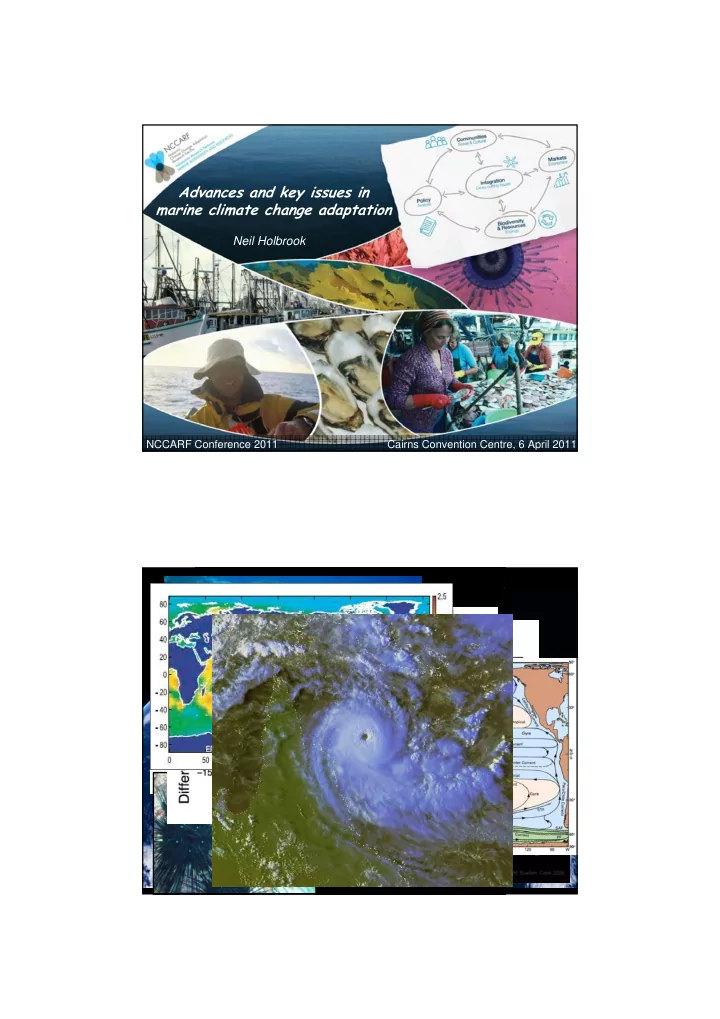
NCCARF Conference 2011 Cairns Convention Centre, 6 April 2011 Image: Nick Graham SPM-AR4 Image: Nick Graham
slide-2
SLIDE 2

Coral reefs

[Anthony and Marshall 2009]

bb

slide-3
SLIDE 3

FRDC Regional Programs DAFF Action Plan NCCARF NARP

2. Commercial and recreational fishing

2.1

Which fishery stocks, in which locations, are most likely to change as a result of climate change? What will those changes be (e.g. in distribution, productivity) and when are they likely to appear under alternative climate change scenarios? 2.2 What options or opportunities are there for commercial fishers in identified impacted fisheries to adapt to climate change effects through changing target species, capture methods and management regime, industry diversification, relocation or divestment?

NARP Priority Questions

slide-4
SLIDE 4

3. Conservation management

3.1 Which ecosystems and species of conservation priority most require adaptation management and supporting research, based on their status, value, vulnerability to climate change and the feasibility

  • f adaptive responses?

3.2 How should conservation managers and planners adapt their practices to ameliorate climate change risks and enhance adaptation options? What intervention strategies will increase system resilience and improve the time within which biological systems can adjust to a future climate?

NARP Priority Questions

Marine Conservation

Adaptive management of temperate reefs to minimise effects of climate change Adapting to the effects of climate change on Australia’s deep marine reserves Changing currents in marine biodiversity governance and management responding to climate change Human adaptation options to increase resilience of conservation-dependent seabirds and marine mammals impacted by climate change Pre-adapting a Tasmanian coastal ecosystem to ongoing climate change through reintroduction of a locally extinct species

FRDC/DCCEE projects

slide-5
SLIDE 5

FRDC/DCCEE projects Fisheries and Aquaculture

Vulnerability of an iconic Australian finfish (Barramundi) and related industries to altered climate across tropical Australia Ensuring that the Australian oyster industry adapts to a changing climate: a natural resource and industry spatial information portal for knowledge action and informed adaptation frameworks Management implications of climate change effects on fisheries in Western Australia Management implications of climate change impacts on fisheries resources of tropical Australia Preparing fisheries for climate change: developing best practice for management and adaptation using three key fisheries in South Eastern Australia [not yet contracted]

FRDC/DCCEE projects Recreation and Tourism

Identification of climate-driven species shifts and adaptation options for recreational fishers: learning general lessons from a data rich case Beach and surf tourism and recreation in Australia: vulnerability and adaptation

Community knowledge & strategies

A climate change adaptation blueprint for coastal regional communities

slide-6
SLIDE 6

Marine Adaptation Report Card 2009 http://www.oceanclimatechange.org.au/content/index.php

www.oceanclimatechange.org.au

slide-7
SLIDE 7

Fisheries Research

Species and biology focused Reliant on fishery independent and dependent data.

Physical data What drives the system? How do we adjust? Economic and Social Research

Biophysical system Human system

Governance & Management www.nccarf.edu.au/marine/

slide-8
SLIDE 8

Integrated activity: Marine NARP Theme case study syntheses

Tourism and recreational uses

Building resilience: Tourism, climate change and the Great Barrier Reef, Australia [Communities led]

Commercial & recreational fishing

The building blocks of economic resilience to climate change: the case

  • f the Tasmanian rock lobster fishery

[Markets led]

Aquaculture

Climate change adaptation in the Australian edible oyster industry: a social-ecological systems approach [Policy led]

Conservation management

Ecological, socio-economic and management implications of range- shifting species in marine systems [Biodiversity & Resources led]

Oyster Report released in August 2010

slide-9
SLIDE 9

Marine stakeholder priorities Marine stakeholder top priorities

Communication and education Flexible or adaptive management

Aquaculture Conservation Tourism Commercial fishing Recreational fishing WA TAS QLD NT SA VIC NSW Industry Government NGO

slide-10
SLIDE 10

Summary

Key issues

Climate change is expected to affect marine species – range (extension) – recruitment – breeding – phenology

  • Communication / Education / Collaboration
  • Climate change uncertainties challenge management

approaches to be – flexible – adaptive

Advances

– Network thinking – Increased connect with stakeholder needs – Marine Report Card Please visit www.nccarf.edu.au/marine/ or email arnmbr@arnmbr.org

Thank you!

Neil Holbrook neil.holbrook@utas.edu.au 03-6226-2027