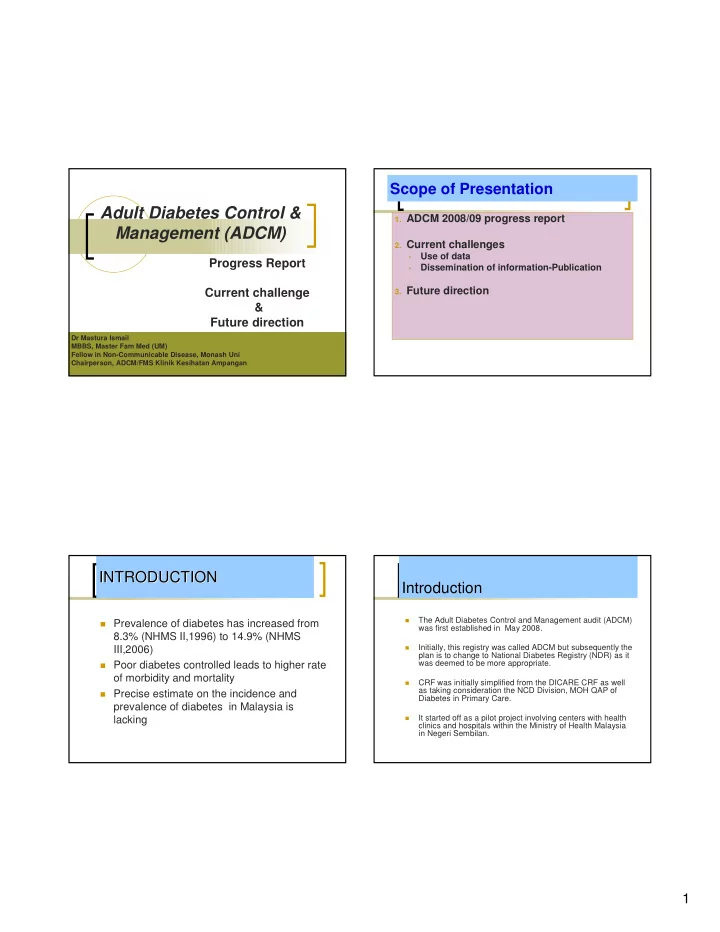
Adult Diabetes Control & 1. ADCM 2008/09 progress report - - PDF document

adult diabetes control
SMART_READER_LITE
LIVE PREVIEW

Adult Diabetes Control & 1. ADCM 2008/09 progress report - - PDF document

Scope of Presentation Adult Diabetes Control & 1. ADCM 2008/09 progress report Management (ADCM) 2. Current challenges Use of data Progress Report Dissemination of information-Publication 3. Future direction Current challenge


slide-1
SLIDE 1

1

Adult Diabetes Control & Management (ADCM)

Progress Report Current challenge & Future direction

Dr Mastura Ismail MBBS, Master Fam Med (UM) Fellow in Non-Communicable Disease, Monash Uni Chairperson, ADCM/FMS Klinik Kesihatan Ampangan

Scope of Presentation

  • 1. ADCM 2008/09 progress report
  • 2. Current challenges
  • Use of data
  • Dissemination of information-Publication
  • 3. Future direction

INTRODUCTION INTRODUCTION

Prevalence of diabetes has increased from

8.3% (NHMS II,1996) to 14.9% (NHMS III,2006)

Poor diabetes controlled leads to higher rate

  • f morbidity and mortality

Precise estimate on the incidence and

prevalence of diabetes in Malaysia is lacking

Introduction

  • The Adult Diabetes Control and Management audit (ADCM)

was first established in May 2008.

  • Initially, this registry was called ADCM but subsequently the

plan is to change to National Diabetes Registry (NDR) as it was deemed to be more appropriate.

  • CRF was initially simplified from the DICARE CRF as well

as taking consideration the NCD Division, MOH QAP of Diabetes in Primary Care.

  • It started off as a pilot project involving centers with health

clinics and hospitals within the Ministry of Health Malaysia in Negeri Sembilan.

slide-2
SLIDE 2

2

Initial Steering Committee

  • Dr. Mastura Ismail, Ampangan Health Clinic
  • Dr. Wan Shaariah mohd Yusuf, Clinical Research Centre, Hospital

Seremban

  • Dr. Zanariah Hussein, Medical Department, Hospital Putrajaya
  • Dr. Hjh. Fatanah Ismail, Disease Control Division, MOH, Putrajaya
  • Dr. Feisul Idzwan Musthapa, Disease Control Division, MOH, Putrajaya
  • Dr. Inderjeet Kaur Gill, Medical Development Department, Putrajaya
  • Dr. G.R. Letchumanan a/k Ramanathan, Medical Department,

Hospital Taiping

  • Dr. Sri Wahyu Taher, Simpang Kuala Health Clinic

Objectives of ADCM

1.

Determine the demographic of the diabetic patients attending the MOH health clinics/hospital

2.

Determine the diabetic health educational and preventive program among patients attending their regular follow-up in MOH health clinics/hospitals

3.

Determine the diabetic complications workload in health clinics/hospitals KKM

Objectives.. cont

4.

Determine the demographic of the diabetic patients attending the MOH health clinics/hospital because of diabetes complications

5.

Determine the diabetic treatment outcome in patients attending the MOH health clinics/hospital

6.

To facilitate service improvements by providing robust nationally comparable data for diabetic care.

7.

Stimulate and facilitate diabetic research activities using this database.

Vision

An Accessible Diabetes Health Information System

slide-3
SLIDE 3

3

ADCM Registry-www.acrm.org.my/adcm

Launch 1.5.2008

Organization chart

Governance /Advisory Board

(MOH, public, university

Steering Committee

Advisor; Dr. Lim Teck Onn Chairperson: Mastura Ismail Members: Wan Shaariah, Zanariah, jamaiyah, Fatanah, Feisul, sri Wahyu, Letchumanan

Source Data Producers

Heads of Department (Site Co-Investigator) Doctor in charge Site Coordinator

Users –e.g. MOH, Universities Registry Coordinating Centre

Public health ophthalmologist / epidemiologist Clinical Registry manager (Miss Tee ) Research Assistant (Akma, Nurafiqah) IT personnel Statistician

Sub committee/expert panels

  • Registry PI/Co-PI
  • Independent data monitoring
  • Outcome evaluation
  • Data access & Publication
  • Medical writing

Activities in 2008 3 Steering committee meetings , 1 publication 1 SDP management meeting-present annual reports,

Materials and Methods

  • Age 18 and above years old
  • Type 1 and Type 2 Diabetes seen in any of the participating

sites.

  • Old and newly diagnosed cases
  • Open for health clinics and hospital
  • Center need to register with ADCM
  • Centre Participation Self Reply Form
  • Authorization Form
  • Information Security Policy/User Agreement
  • Upon receiving these documents, the centre shall be

registered and each of the users of the ADCM shall be notified via their e-mail address.

Method- web based registry

Centres Registry

  • virtual

Users /Public

  • internet

internet

Online web application

  • 1. Data collection &

entry

  • at participating site

2 Data analysis

  • real time
  • automated
  • 3. Online report to users

and data providers

slide-4
SLIDE 4

4

Uses of Registry data

Conventional

  • Epidemiology
  • Public health service planning
  • Outcome assessment
  • Standard of care
  • Quality Assurance
  • Research

Expansion

  • Trending and tracking
  • Benchmarking
  • Quality assurance
  • eKPI
  • Performance monitoring
  • eCUSUM

Data Information Wisdom

Presentation at meetings

Apply in clinical practice

  • r effect change in

Healthcare Policy

Progress report

Cases Reported by SDP (As of 25 March 2009)

Cases Reported by SDP

slide-5
SLIDE 5

5

Cases Reported by SDP Cases Reported by SDP

Cases Reported by SDP Cases Reported by SDP

slide-6
SLIDE 6

6 Current Challenges / Ways to overcome

  • Participation – MOH only, not

national data

  • Data ascertainment – not 100%
  • Data Quality
  • missing values
  • wrong values
  • as it is web based with real

time report, data cleaning at RCC is difficult

  • Use of data on NDR web – not yet

widely used and present or published

  • Change of staff lead to problem in

data collection.

  • Funding – special registry grant –

stop by 2011

  • Invite private centre as SDP
  • Data collection -Need to incorporate into

routine work flow and need to maintain alertness of staff

  • Data quality
  • At system – must fill, accuracy

check, range check ,pop up message

  • At SDP sites :
  • Training /awareness-doctor
  • Eyeball CRF before data entry -

site coordinator

  • HOD- encourage use of data at
  • CME/CNE
  • Dept audit
  • Publication/ presentation at

scientific meetings

  • Seek other means – e-KPI/e-CUSUM

Reasons to publish

1.

Unethical to conduct study and do not report (accountable to study subjects (patients) and sponsors ( public $)

2.

Sharing of information to wider medical practitioners

3.

Want to progress scientific thoughts and improve health

  • utcomes ( saving life)

4.

Give credibility to research team

5.

Sense of achievement and pride

6.

Add credibility to your reputation

7.

Improve chance of promotion

8.

More likely to obtain research grants

Publication !

Activities…..

1.

SC meeting: 20th February 2008 and 5th June 2008

2.

Protocol development: The final version was released on 30Oct 2008 (Protocol Number: NMRR ID: 08-12-1167)

3.

MREC submission: The ADCM obtained its approval from MREC on Dec 2008

4.

CRF development: Latest version is version 1.2 which was released on 1st Apr 2008

5.

Web application for ADCM was released in May 2008

6.

User training : 3hb Julai 2008 (Hospital Seremban), 25th July 2008 (PKD Gombak), 19th August 2008 (KK Teluk Datok), 13th November 2008 (JKNNS K.Terengganu)

Publications and Presentations

  • 1. One paper (special registry issue,

MJM,volume 63 Supplement September 2008)

  • 2. One Poster presentations at CREATE

meeting 20-23 Oct 2008

slide-7
SLIDE 7

7

Future Direction

  • Recruiting more SDPs: Participation of all diabetes care providers
  • Promotional activities, more training and website design
  • Establish medical writing committee- publish more papers
  • Cohort (systematic random sampling) – too many pts
  • Expansion of NDR
  • Link Tele Diab. retinopathy screening data
  • Link with National Nephropathy Screening data
  • Pulling data from TPC
  • Link To Hypertension Registry
  • On-line registration
  • NDR widen its scope
  • e-KPI
  • Sponsorship/Funding

Critical Success factors

Commitment Endurance Team work Appreciation

“Research is sacred.” “It is a sin if we do not use applicable research findings in improving health care practice.”

  • Quote:Dr.Mariam Ismail

Discussion

1.

ADCM provides sound evidence for Public Health Actions – Service & training

2.

Users can then put effort to meet the unmet needs

3.

Use of ADCM data for Healthcare Provider

  • Plan for diabetes services
  • Outcome of treatment
  • Economic burden of treatment
  • Research databases
  • e-KPI
  • 4. Use of ADCM data by policy makers to ensure good health is
  • Accessible
  • Affordable
  • Provided with equity

Registry provides information essential for public health

advocacy

e-registry- Make it easy Research into action - improve public diabetes care Future direction –NDR to widen scope

– evaluating quality, cost effectiveness and accessorily

  • f health care

Conclusion

slide-8
SLIDE 8

8

Acknowledgement

We wish to thank

  • CRC network director:Dr.Lim TO
  • ADCM advisor:
  • ADCM Steering committee members
  • Principal investigators of registries
  • HODs as site co-investigators
  • SDP Doctors in charge
  • SDP Site coordinators
  • All the staff of Hospital and health clinics, MOH
  • Registry Coordinating Unit :Miss Tee, Akma
  • Manager CRC H. Tuanku Jaafar :