HI in a Mul*-wavelength Disserta*on of Galaxies Jing - - PowerPoint PPT Presentation

hi in a mul wavelength disserta on of galaxies
SMART_READER_LITE
LIVE PREVIEW

HI in a Mul*-wavelength Disserta*on of Galaxies Jing - - PowerPoint PPT Presentation

HI in a Mul*-wavelength Disserta*on of Galaxies Jing Wang (Australia Telescope Na*onal Facility) (j.wang@csiro.au) Beijing, Jan 2016 (Background


slide-1
SLIDE 1

HI ¡in ¡a ¡Mul*-­‑wavelength ¡ Disserta*on ¡of ¡Galaxies ¡

¡ Jing ¡Wang ¡ ¡ (Australia ¡Telescope ¡Na*onal ¡Facility) ¡ (j.wang@csiro.au) ¡ Beijing, ¡Jan ¡2016 ¡

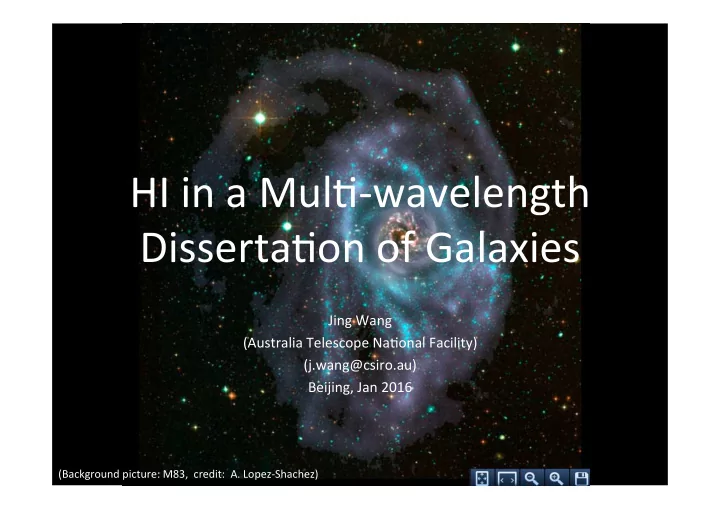
(Background ¡picture: ¡M83, ¡ ¡credit: ¡ ¡A. ¡Lopez-­‑Shachez) ¡

¡

slide-2
SLIDE 2

AN ¡HI ¡AND ¡MULTI-­‑WAVELENGTH ¡ VIEW ¡OF ¡GALAXIES ¡

The ¡introduc*on ¡

slide-3
SLIDE 3

The ¡many ¡faces ¡of ¡Whirlpool ¡galaxy ¡ (M51) ¡ ¡

¡(Credit: ¡A. ¡Lopez-­‑Shachez, ¡S. ¡Vogel) ¡

slide-4
SLIDE 4

The ¡many ¡faces ¡of ¡Centurus ¡A ¡ (NGC5128) ¡ ¡

¡(Credit: ¡A. ¡Lopez-­‑Shachez) ¡

slide-5
SLIDE 5

气体吸积, 盘的再生 成 ¡

The ¡universe ¡today ¡

slide-6
SLIDE 6

The ¡colour-­‑magnitude ¡diagram ¡

Dominated ¡by ¡old ¡ stars ¡ Dominated ¡by ¡ young ¡stars ¡ Credit: ¡wiki ¡

slide-7
SLIDE 7

(Credit: ¡ ¡ Stweard ¡Observatory ¡Radio ¡ Astronomy ¡Laboratory) ¡

The ¡life ¡cycle ¡of ¡ gas ¡in ¡a ¡galaxy ¡

slide-8
SLIDE 8

Source ¡of ¡cold ¡gas ¡

Source ¡of ¡gas: ¡

  • The ¡IGM ¡(“cold” ¡and ¡hot ¡mode) ¡
  • Gas ¡rich ¡satellite ¡galaxies ¡

More ¡than ¡half ¡of ¡the ¡mass ¡of ¡baryons ¡are ¡not ¡in ¡stars ¡ If ¡no ¡feedbacks, ¡these ¡baryons ¡would ¡cool ¡and ¡be ¡accreted ¡

(Picture ¡credit: ¡ ¡T. ¡Oosterloo) ¡

slide-9
SLIDE 9

The ¡cold ¡and ¡hot ¡mode ¡accre*on ¡ predicted ¡by ¡theore*cal ¡simula*ons ¡

slide-10
SLIDE 10

Star ¡forma*on ¡traced ¡by ¡HI ¡

H2 ¡dominated ¡regions: ¡the ¡ rela*on ¡between ¡HI ¡and ¡SFR ¡ is ¡disrupted ¡ HI ¡dominated ¡regions: ¡HI ¡ seems ¡to ¡be ¡a ¡key ¡ parameter ¡in ¡se_ng ¡the ¡SFR ¡ (credit: ¡Bigiel+08, ¡10) ¡

slide-11
SLIDE 11

The ¡XUV ¡disk ¡in ¡M83 ¡traced ¡by ¡HI ¡

(credit: ¡ ¡A. ¡Lopez-­‑Shachez) ¡

¡ Red: ¡op*cal ¡ ¡ Blue: ¡Far-­‑ ultraviolet ¡ ¡ Grey: ¡HI ¡

slide-12
SLIDE 12

Star ¡forming ¡regions ¡traced ¡by ¡HI ¡in ¡a ¡ dwarf ¡galaxy ¡(ESO245-­‑G005) ¡

(Credit: ¡LVHIS) ¡

slide-13
SLIDE 13

The ¡star ¡forma*on ¡quenching ¡ mechanism ¡traced ¡by ¡HI ¡in ¡Phoenix ¡

(Credit: ¡LVHIS) ¡

HI ¡contours ¡on ¡ top ¡of ¡the ¡op*cal ¡ image ¡

slide-14
SLIDE 14

The ¡op*cal ¡and ¡HI ¡view ¡of ¡a ¡galaxy ¡

NGC ¡6946 ¡ ¡ ¡(Credit: ¡T. ¡Oosterloo) ¡ Op*cal ¡ ¡ ¡ ¡ ¡ ¡HI ¡

slide-15
SLIDE 15

Tidal ¡stripping ¡traced ¡by ¡HI ¡in ¡M ¡81 ¡ Group ¡

¡ ¡ ¡ ¡(credit: ¡NROA) ¡

slide-16
SLIDE 16

Ram ¡pressure ¡stripping ¡traced ¡by ¡HI ¡in ¡ the ¡Virgo ¡Cluster ¡

(Credit: ¡A. ¡Chung) ¡

slide-17
SLIDE 17

Coming ¡HI ¡surveys ¡defined ¡at ¡new/ upgraded ¡HI ¡facili*es ¡

  • WALLABY ¡(ASKAP): ¡2/3 ¡sky ¡HI ¡survey ¡
  • WNSHS ¡(WSRT, ¡Aper*f): ¡1/3 ¡sky ¡HI ¡survey ¡
  • FLASH ¡(ASKAP): ¡HI ¡absorp*on ¡survey ¡
  • DINGO(ASKAP): ¡deep ¡HI ¡for ¡the ¡GAMA ¡field ¡
  • LADUMA ¡(MeerKAT): ¡deep ¡HI ¡for ¡the ¡ECDF-­‑S ¡field ¡
  • MONGHOOSE ¡ ¡(MeerKAT): ¡deep ¡HI ¡centered ¡on ¡

selected ¡galaxies ¡

  • Etc… ¡
slide-18
SLIDE 18

All ¡sky ¡HI ¡mapping ¡

ASKAP ¡(WALLABY) ¡+ ¡ Aper*f ¡(WNSHS) ¡ ¡

¡

Half ¡sky ¡HI ¡ mapping ¡with ¡ FAST ¡? ¡

(Spa*al ¡resolu*on~ ¡10-­‑30 ¡arcsec, ¡Tsys~ ¡50 ¡K) ¡ (dec ¡-­‑30~80 ¡deg ¡sky, ¡spa*al ¡ resolu*on~ ¡3 ¡arcmin, ¡Tsys~ ¡20 ¡K) ¡ ¡ ¡ ASKAP ¡(Aper*fi) ¡shortest ¡ baselines: ¡20 ¡(36) ¡m ¡-­‑> ¡ Largest ¡structure ¡ detectable: ¡44 ¡(24.5)’, ¡ ¡

  • r ¡12.7 ¡(7.1)*(Dis/Mpc) ¡

[kpc] ¡

slide-19
SLIDE 19

Group ¡IC ¡1459 ¡at ¡Dis=29 ¡Mpc ¡

10% ¡of ¡detected ¡HI ¡mass ¡is ¡outside ¡galaxies ¡in ¡the ¡extended ¡group ¡environment, ¡ Serra ¡et ¡al. ¡(2015) ¡

slide-20
SLIDE 20

Outline ¡

  • How ¡do ¡galaxies ¡obtain ¡the ¡HI ¡gas? ¡
  • How ¡is ¡HI ¡distributed ¡in ¡galaxies? ¡
  • How ¡do ¡galaxies ¡form ¡stars ¡in ¡HI-­‑dominated ¡

regions? ¡

  • How ¡is ¡star ¡forma*on ¡quenched ¡in ¡galaxies? ¡
  • How ¡do ¡galaxies ¡(trans-­‑)form ¡their ¡structure ¡

with ¡the ¡cold ¡gas? ¡

slide-21
SLIDE 21

Outline ¡

  • How ¡do ¡galaxies ¡obtain ¡the ¡HI ¡gas? ¡
  • How ¡is ¡HI ¡distributed ¡in ¡galaxies? ¡
  • How ¡do ¡galaxies ¡form ¡stars ¡in ¡HI-­‑dominated ¡

regions? ¡

  • How ¡is ¡star ¡forma*on ¡quenched ¡in ¡galaxies? ¡
  • How ¡do ¡galaxies ¡(trans-­‑)form ¡their ¡structure ¡

with ¡the ¡cold ¡gas? ¡

slide-22
SLIDE 22

FOOT ¡PRINTS ¡OF ¡GAS ¡ACCRETION ¡

The ¡Bluedisk ¡project-­‑-­‑the ¡distribu*on, ¡morphology, ¡kinema*cs ¡and ¡environment ¡of ¡HI ¡ and ¡ ¡the ¡accompanied ¡molecular ¡gas, ¡gas ¡phase ¡metallicity ¡and ¡star ¡forma*on ¡ distribu*on ¡in ¡massive ¡HI-­‑rich ¡and ¡normal ¡disk ¡galaxies ¡ ¡at ¡low ¡redshiv ¡ (Wang+13,14,15, ¡E.Wang+15, ¡der ¡Heijen+15, ¡Carton+15, ¡Roychowdhury+15, ¡Cormier ¡ in ¡prep, ¡Jozsa ¡in ¡prep) ¡

slide-23
SLIDE 23

The ¡Bluedisk ¡project ¡

PI: ¡ ¡Guinevere ¡Kauffmann ¡(MPA) ¡

  • 20 ¡massive ¡ ¡HI-­‑excess ¡galaxies ¡with ¡log ¡M*/M_sun~10-­‑11, ¡at ¡z~0.023-­‑0.03, ¡with ¡no ¡

major ¡merge ¡companions ¡within ¡100 ¡kpc. ¡

  • A ¡control ¡sample ¡of ¡another ¡20 ¡HI-­‑normal ¡galaxies. ¡

¡ ¡ Wang+13,14 ¡ (Ca*nella+13 ¡HI ¡plane) ¡ (Schiminovich+07 ¡SF ¡ sequence) ¡ (Ca*nella+13 ¡ ¡M*-­‑ ¡MHI/ M* ¡rela*on) ¡

slide-24
SLIDE 24

The ¡Bluedisk ¡synthesis ¡HI ¡data ¡

Westerbork ¡observa*on ¡ Resolu*on: ¡25 ¡arcsec ¡(10 ¡kpc) ¡ Depth: ¡ ¡ ¡ ¡ ¡ ¡point ¡sources~10^8 ¡M_sun ¡ ¡ ¡ ¡ ¡surface ¡density ¡~0.5*1020 ¡cm-­‑2 ¡ Field-­‑of-­‑view: ¡1 ¡deg ¡(~2 ¡Mpc) ¡ ¡ ¡ ¡ ¡ hzp://www.mpa-­‑ garching.mpg.de/GASS/ Bluedisk/index.php ¡

slide-25
SLIDE 25

HI ¡in ¡HI-­‑excess ¡galaxies ¡show ¡normal ¡ morphology ¡

HI-­‑excess ¡ Control ¡

No ¡difference ¡

Wang+13 ¡ 3D ¡asymmetry ¡ 2D ¡asymmetry ¡

slide-26
SLIDE 26

Minor ¡merger ¡rate ¡is ¡too ¡low ¡to ¡ support ¡SFR ¡

Wang+ ¡15 ¡ Among ¡a ¡sample ¡of ¡20 ¡HI-­‑ excess ¡galaxies, ¡only ¡8 ¡of ¡ them ¡have ¡satellites ¡with ¡ M_HI>10^8 ¡M_sun, ¡within ¡a ¡ searching ¡cylinder ¡of ¡500 ¡kpc ¡ and ¡500 ¡km/s ¡

slide-27
SLIDE 27

HI ¡excess ¡in ¡centrals ¡and ¡ ¡satellites ¡

  • E. ¡Wang+15 ¡

HI-­‑rich ¡central ¡ Control ¡central ¡ Satellites ¡around ¡HI-­‑rich ¡ central ¡ Satellites ¡around ¡control ¡ central ¡ Enci ¡Wang ¡(SHAO) ¡ “The ¡centrals ¡and ¡ satellites ¡might ¡be ¡ fueled ¡by ¡a ¡common ¡ underlying ¡reservoir ¡

  • f ¡cold ¡gas” ¡,”possibly ¡

the ¡cold-­‑mode ¡ accre*on ¡predicted ¡ by ¡simula*ons” ¡ ¡

  • ­‑-­‑Kauffmann ¡et ¡al. ¡

(2010) ¡

slide-28
SLIDE 28

HI ¡mass ¡of ¡undetected ¡systems ¡in ¡the ¡ 1 ¡Mpc ¡environment ¡

Wang+ ¡15 ¡ Small ¡M* ¡ Large ¡M* ¡

slide-29
SLIDE 29

Accre*on ¡of ¡cold ¡gas ¡in ¡massive ¡disk ¡ galaxies ¡at ¡low ¡redshiv ¡

  • is ¡in ¡a ¡smooth ¡and ¡gentle ¡way ¡
  • is ¡not ¡contributed ¡much ¡by ¡merger ¡events ¡

(major ¡or ¡minor) ¡

  • is ¡connected ¡with ¡the ¡HI ¡present ¡in ¡the ¡large-­‑

scale ¡environment, ¡possibly ¡the ¡cold-­‑mode ¡ accre*on ¡predicted ¡by ¡CDM ¡simula*ons ¡ AKSAP ¡may ¡allow ¡us ¡to ¡analyze ¡the ¡structure ¡of ¡ the ¡HI ¡large ¡scale ¡environment, ¡while ¡FAST ¡may ¡ reveal ¡the ¡iceberg ¡below ¡the ¡detected ¡*ps ¡

slide-30
SLIDE 30

Outline ¡

  • How ¡do ¡galaxies ¡obtain ¡the ¡HI ¡gas? ¡
  • How ¡is ¡HI ¡distributed ¡in ¡galaxies? ¡
  • How ¡do ¡galaxies ¡form ¡stars ¡in ¡HI-­‑dominated ¡

regions? ¡

  • How ¡is ¡star ¡forma*on ¡quenched ¡in ¡galaxies? ¡
  • How ¡do ¡galaxies ¡(trans-­‑)form ¡their ¡structure ¡

with ¡the ¡cold ¡gas? ¡

slide-31
SLIDE 31

THE ¡DISTRIBUTION ¡OF ¡HI ¡IN ¡ GALAXIES ¡

New ¡lessons ¡from ¡revisi*ng ¡the ¡HI ¡size-­‑mass ¡rela*on ¡of ¡Broeils+97 ¡ ¡ (Wang+ ¡submized) ¡

The ¡Broeils ¡rela*on ¡ ¡ DHI: ¡major ¡axis ¡of ¡1 ¡Msun ¡ pc-­‑2 ¡isophot ¡ ¡

slide-32
SLIDE 32

The ¡spiral ¡ galaxies ¡ Galaxies ¡in ¡ clusters ¡ The ¡early-­‑ type ¡galaxies ¡ The ¡dwarf ¡galaxies ¡ Scazer~0.06 ¡dex ¡

slide-33
SLIDE 33

Challenges ¡to ¡theore*cal ¡models ¡

slide-34
SLIDE 34

Clues ¡from ¡the ¡radial ¡distribu*on ¡of ¡HI ¡

slide-35
SLIDE 35

Indica*on ¡of ¡scaling ¡rela*on ¡between ¡ the ¡masses ¡of ¡HI ¡and ¡dark ¡mazer ¡

(This ¡work) ¡ ¡ (from ¡op*cal ¡size-­‑stellar ¡mass ¡rela*on, ¡ Kauffmann ¡et ¡al. ¡2003) ¡

  • The ¡low ¡efficiency ¡of ¡locking ¡baryon ¡mass ¡in ¡stars ¡in ¡small ¡halos ¡is ¡because ¡

the ¡efficiency ¡of ¡conver*ng ¡cold ¡gas ¡to ¡stars ¡is ¡low, ¡not ¡because ¡the ¡halos ¡are ¡ devoid ¡of ¡cold ¡gas. ¡(The ¡missing ¡baryon ¡problem?) ¡ ¡ ¡

  • Combining ¡the ¡two ¡scalings: ¡

¡ ¡ ¡ ¡ ¡ ¡ ¡ ¡ ¡Consistent ¡with ¡the ¡stellar ¡mass ¡limited ¡HI ¡survey ¡ ¡for ¡massive ¡galaxies ¡ (GASS ¡, ¡Ca*nella+10). ¡ So, ¡

slide-36
SLIDE 36

The ¡new ¡lessons: ¡

  • Galaxies ¡of ¡different ¡types ¡lie ¡on ¡the ¡same ¡DHI-­‑MHI ¡

rela*on; ¡the ¡scazer ¡of ¡the ¡rela*on ¡does ¡not ¡ depend ¡on ¡the ¡mass, ¡HI ¡richness ¡or ¡HI-­‑to-­‑op*cal ¡ size ¡ra*o ¡of ¡the ¡galaxies ¡ More ¡clues ¡may ¡come ¡from ¡kinema*c ¡analysis ¡of ¡HI ¡ from ¡future ¡high ¡resolu*on ¡images ¡(MeerKat, ¡EVLA, ¡ SKA..) ¡

  • The ¡slope ¡of ¡the ¡rela*on ¡predicts ¡a ¡scaling ¡

rela*on ¡between ¡HI ¡mass ¡and ¡stellar ¡mass. ¡ This ¡is ¡going ¡to ¡be ¡tested ¡by ¡future ¡op*cally ¡defined ¡ HI ¡mass ¡surveys ¡(FAST ¡telescope?) ¡ ¡ ¡

slide-37
SLIDE 37

Outline ¡

  • How ¡do ¡galaxies ¡obtain ¡the ¡cold ¡gas? ¡
  • How ¡is ¡HI ¡distributed ¡in ¡galaxies? ¡
  • How ¡do ¡galaxies ¡form ¡stars ¡in ¡HI-­‑dominated ¡

regions? ¡

  • How ¡is ¡star ¡forma*on ¡quenched ¡in ¡galaxies? ¡
  • How ¡do ¡galaxies ¡(trans-­‑)form ¡their ¡structure ¡

with ¡the ¡cold ¡gas? ¡

slide-38
SLIDE 38

STAR ¡FORMATION ¡IN ¡HI-­‑ DOMINATED ¡REGIONS ¡

A ¡case ¡study ¡of ¡the ¡dwarf ¡galaxy ¡ESO215-­‑G?009 ¡ ¡ (Koribalski ¡& ¡Wang ¡in ¡prep) ¡

slide-39
SLIDE 39

HI ¡disk ¡of ¡ESO215-­‑G?009 ¡ ¡ ¡ ¡

slide-40
SLIDE 40

R05(HI)/rs(B)=12.8 ¡ R05(HI)/R25(B)=8.73 ¡ ¡ M(HI)/M*~6.76 ¡ M*/SFR ¡~5.8 ¡X109 ¡yr ¡ MHI/SFR~4.0X1010 ¡yr ¡

slide-41
SLIDE 41
slide-42
SLIDE 42

V+I ¡

slide-43
SLIDE 43

V+I ¡

slide-44
SLIDE 44
slide-45
SLIDE 45

Lack ¡of ¡corresponding ¡HI ¡peaks ¡

slide-46
SLIDE 46

NGC602 ¡

¡ 58X58 ¡pc ¡ ¡ (Carlson ¡et ¡al. ¡2007) ¡ ¡

5-­‑10 ¡Myr ¡ <5 ¡Myr ¡ <5 ¡Myr ¡

slide-47
SLIDE 47

Z1 ¡ Z3 ¡ Z2 ¡

slide-48
SLIDE 48

Age ¡grids: ¡ 4,8,12,16,20,32,60, 100,200,500 ¡Myr ¡ ¡ ¡ GALEV ¡(Kotulla ¡et ¡ al.2009): ¡ Con*nuum +emission ¡line ¡ ¡ Starburst99(Leithe rer ¡et ¡al. ¡1999): ¡ Con*nuum ¡of ¡stars ¡ and ¡ionized ¡gas ¡ ¡ CB07 ¡(Charlot ¡& ¡ Bruzual ¡2007): ¡ Con*nuum ¡of ¡stars ¡ GALEV ¡ Starburst99 ¡ CB07 ¡ ¡

slide-49
SLIDE 49

4-­‑6 ¡star ¡forming ¡HII ¡regions: ¡

  • ¡1-­‑3 ¡of ¡them ¡are ¡outlying ¡HII ¡regions ¡(dis ¡>2R25). ¡Werk ¡et ¡al.(2010): ¡the ¡overal ¡

frequency ¡of ¡outlying ¡HII ¡regions ¡in ¡gas-­‑rich ¡galaxies ¡is ¡8%-­‑11% ¡

  • The ¡SFR ¡contained ¡in ¡these ¡regions ¡are ¡~30% ¡of ¡the ¡total ¡SFR. ¡

2R25 ¡ 2R25 ¡

slide-50
SLIDE 50
  • The ¡HI-­‑SF ¡efficiency: ¡the ¡K-­‑S ¡star ¡forma*on ¡law ¡
  • The ¡Ostriker ¡et ¡al.2010 ¡star ¡forma*on ¡model: ¡

Gas ¡ surfarce ¡ density ¡ Stellar ¡ volume ¡ density ¡ Dark ¡mazer ¡ volume ¡ density ¡ Metallicity ¡of ¡ dust ¡(gas) ¡

Azempt ¡to ¡understand ¡the ¡local ¡SF ¡in ¡star ¡ forming ¡regions ¡with: ¡

slide-51
SLIDE 51

1.2 ¡kpc ¡grids ¡ SFR>0.0003 ¡ M¤/yr ¡ The ¡HII ¡ regions ¡ Roychowdhury+14,15y ¡ Roychowdhury+14,15y ¡

SFR ¡in ¡the ¡star ¡forming ¡regions ¡

slide-52
SLIDE 52

Cause ¡for ¡the ¡low ¡HI-­‑SF ¡efficiency ¡at ¡a ¡ fixed ¡ΣHI ¡in ¡the ¡star ¡forming ¡regions ¡

How ¡to ¡understand ¡the ¡~-­‑0.5 ¡dex ¡offset ¡from ¡revised ¡KS ¡laws ¡ The ¡O10 ¡ model: ¡ ¡ ¡ ¡ ¡ Dwarf: ¡ Spiral: ¡

slide-53
SLIDE 53

SF ¡in ¡ESO215-­‑G?009: ¡ ¡

The ¡SF ¡is ¡efficient: ¡

  • The ¡occurrence ¡of ¡outlying ¡HII ¡regions ¡is ¡frequent ¡
  • The ¡SFR ¡in ¡star ¡forming ¡regions ¡are ¡consistent ¡with ¡its ¡stellar ¡mass ¡

surface ¡density. ¡ ¡ The ¡SF ¡is ¡ineffcient: ¡

  • The ¡SFR/HI ¡in ¡star ¡forming ¡regions ¡are ¡low ¡because ¡of ¡low ¡stellar ¡

mass ¡surface ¡density: ¡low ¡SF ¡in ¡the ¡past. ¡(lack ¡of ¡trigger ¡in ¡the ¡ past?) ¡ ¡ ¡ ¡ ¡ ¡ ¡ ¡“no ¡neighbors ¡iden*fied ¡out ¡to ¡1 ¡Mpc” ¡, ¡Warren ¡et ¡al. ¡(2004) ¡

  • The ¡lack ¡of ¡star ¡forming ¡regions ¡in ¡the ¡southern ¡half ¡of ¡the ¡HI ¡disk. ¡

(SF ¡happens ¡in ¡a ¡stochas*c ¡way? ¡) ¡ ¡ ¡ ¡ ¡ ¡ ¡

slide-54
SLIDE 54

Outline ¡

  • How ¡do ¡galaxies ¡obtain ¡the ¡cold ¡gas? ¡
  • How ¡is ¡HI ¡distributed ¡in ¡galaxies? ¡
  • How ¡do ¡galaxies ¡form ¡stars ¡in ¡HI-­‑dominated ¡

regions? ¡

  • How ¡is ¡star ¡forma*on ¡quenched ¡in ¡galaxies? ¡
  • How ¡do ¡galaxies ¡(trans-­‑)form ¡their ¡structure ¡

with ¡the ¡cold ¡gas? ¡

slide-55
SLIDE 55

QUENCHING ¡OF ¡STAR ¡FORMATION ¡ IN ¡GALAXIES ¡

How ¡is ¡star ¡forma*on ¡quenched ¡in ¡low ¡mass ¡galaxies? ¡ (Wang ¡& ¡Pan ¡in ¡prep) ¡

slide-56
SLIDE 56

The ¡star ¡forma*on ¡gradient ¡of ¡galaxies ¡

(<1.5 ¡arcsec) ¡

Blue-­‑cored: ¡outside-­‑in ¡ Red-­‑cored: ¡inside-­‑out ¡

The ¡green ¡valley ¡ The ¡green ¡valley ¡ (A ¡modified ¡analysis ¡of ¡Pan+14) ¡

slide-57
SLIDE 57

Galaxy ¡assembly ¡mode ¡depending ¡on ¡ stellar ¡mass ¡

Blue-­‑cored: ¡outside-­‑in ¡ ¡(low ¡mass ¡galaxies) ¡ ¡ Red-­‑cored: ¡inside-­‑out ¡ ¡(high ¡mass ¡galaxies) ¡

(A ¡modified ¡analysis ¡of ¡Pan+14) ¡

slide-58
SLIDE 58

Cross-­‑match ¡with ¡the ¡ALFALFA.40 ¡HI ¡ sample ¡

To ¡increase ¡sta*s*cs: ¡ ¡ ¡ ¡ ¡ ¡ ¡ ¡ ¡4+32= ¡18+18 ¡ 18: ¡less ¡red-­‑cored ¡ 18: ¡more ¡red-­‑cored ¡

Blue-­‑cored: ¡outside-­‑in ¡ Red-­‑cored: ¡inside-­‑out ¡

N=4, ¡32 ¡

slide-59
SLIDE 59

The ¡difference ¡in ¡HI ¡mass ¡

Less ¡red-­‑cored ¡ galaxies ¡have ¡ more ¡HI ¡than ¡ More ¡red-­‑cored ¡

  • nes. ¡
slide-60
SLIDE 60

Quenching ¡in ¡low-­‑mass ¡GV ¡galaxies ¡ (summary ¡and ¡caveats) ¡

  • The ¡blue-­‑cored ¡ones ¡are ¡slight ¡less ¡likely ¡to ¡be ¡

detected ¡in ¡shallow ¡HI ¡surveys ¡than ¡the ¡red-­‑cored ¡

  • nes, ¡however ¡when ¡detected ¡the ¡less ¡red-­‑cored ¡

galaxies ¡are ¡more ¡HI-­‑rich ¡than ¡the ¡more ¡red-­‑cored ¡

  • nes: ¡a ¡non-­‑con*nuity ¡in ¡HI ¡content ¡between ¡inside-­‑
  • ut ¡and ¡outside-­‑in? ¡

Sta*s*c ¡limits: ¡with ¡a ¡one-­‑year ¡shallow ¡survey, ¡FAST ¡is ¡ going ¡to ¡expand ¡the ¡size ¡of ¡the ¡ALFALFA.40 ¡sample ¡used ¡ in ¡this ¡study ¡by ¡more ¡than ¡70 ¡*mes ¡

  • Limited ¡by ¡data ¡available ¡in ¡other ¡bands, ¡dust ¡

azenua*on ¡and ¡molecular ¡gas ¡not ¡considered ¡yet. ¡

slide-61
SLIDE 61

Outline ¡

  • How ¡do ¡galaxies ¡obtain ¡the ¡cold ¡gas? ¡
  • How ¡is ¡HI ¡distributed ¡in ¡galaxies? ¡
  • How ¡do ¡galaxies ¡form ¡stars ¡in ¡HI-­‑dominated ¡

regions? ¡

  • How ¡is ¡star ¡forma*on ¡quenched ¡in ¡galaxies? ¡
  • How ¡do ¡galaxies ¡(trans-­‑)form ¡their ¡structure ¡

with ¡the ¡cold ¡gas? ¡

slide-62
SLIDE 62

THE ¡STRUCTURE ¡OF ¡GALAXIES ¡

The ¡the ¡bulge, ¡the ¡bar ¡and ¡the ¡outer ¡disk ¡(Wang+11, ¡12) ¡

slide-63
SLIDE 63

Bars ¡in ¡galaxies ¡

slide-64
SLIDE 64

What ¡kind ¡of ¡bars ¡enhance ¡central ¡ star ¡forma*on ¡

Strong ¡bars: ¡the ¡bars ¡with ¡b/a<0.5 ¡ ¡ Only ¡strong ¡bars ¡enhance ¡central ¡SF ¡

Barred ¡ control ¡

Wang+11 ¡ Weak ¡bars ¡ ¡ ¡ ¡ ¡ ¡ ¡ ¡ ¡ ¡ ¡ ¡Strong ¡ ¡bars ¡

slide-65
SLIDE 65

How ¡important ¡are ¡strong ¡bars ¡in ¡ enhancing ¡central ¡SF? ¡

  • The ¡galaxies ¡

which ¡have ¡ highest ¡C(SF) ¡ also ¡have ¡ highest ¡bar ¡ frac*on ¡ ¡ ¡ ¡ ¡~60% ¡

  • Bar ¡frac*on ¡

show ¡double ¡ peaks ¡along ¡ C(SF) ¡ ¡

Wang+11 ¡

  • Bar ¡is ¡one ¡of ¡

the ¡most ¡ important ¡ mechanisms ¡in ¡ inducing ¡ central ¡SB ¡

  • Bar ¡may ¡be ¡

related ¡to ¡the ¡ central ¡SF ¡

  • quenching. ¡

¡μ* ¡ ¡f(bar) ¡ C(SF) ¡

slide-66
SLIDE 66

Bar ¡length ¡depending ¡on ¡color ¡

Wang ¡+12 ¡ Cold ¡gas ¡may ¡suppress ¡bars. ¡

slide-67
SLIDE 67

Morphology ¡of ¡the ¡inside-­‑out ¡ galaxies ¡

¡ UV ¡bright ¡“ring” ¡(which ¡is ¡not ¡so ¡clear ¡in ¡the ¡op*cal) ¡

  • p*cal ¡ ¡ ¡ ¡ ¡ ¡ ¡ ¡ ¡ ¡ ¡UV ¡

Wang+11 ¡ The ¡galaxies ¡with ¡the ¡most ¡nega*ve ¡colour ¡gradients: ¡

slide-68
SLIDE 68

The ¡rela*on ¡between ¡MHI/M* ¡and ¡ color ¡gradients ¡

Wang+11 ¡

slide-69
SLIDE 69

Rela*on ¡between ¡HI ¡Gas ¡and ¡Growth ¡

  • f ¡Inner ¡and ¡Outer ¡Regions ¡

inner ¡

  • uter ¡

Mostly ¡ determined ¡ by ¡M* ¡ Inner ¡regions ¡ reflect ¡down- sizing ¡ Mostly ¡ determined ¡ by ¡HI ¡frac*on ¡ Outer ¡regions ¡ reflect ¡influence ¡

  • f ¡gas ¡accre*on ¡

Different ¡ color=diffe-­‑ rent ¡M* ¡bin ¡

Wang+11 ¡

slide-70
SLIDE 70

The ¡outer ¡disk ¡structure ¡in ¡the ¡op*cal ¡

wang+ ¡in ¡prep ¡ Pure ¡exponen*al ¡ ¡ ¡ ¡ ¡ ¡ ¡ ¡ ¡ ¡ ¡ ¡ ¡ ¡ ¡ ¡ ¡ ¡ ¡ ¡ ¡ ¡ ¡ ¡ ¡ ¡down-­‑bending ¡ ¡ ¡ ¡ ¡ ¡ ¡ ¡ ¡ ¡ ¡ ¡ ¡ ¡ ¡ ¡ ¡ ¡ ¡ ¡ ¡ ¡up-­‑bending ¡ ¡ ¡ ¡ ¡ ¡ ¡ ¡ ¡ ¡ ¡ ¡ ¡ ¡ ¡ ¡ ¡ ¡ ¡ ¡ ¡ ¡ ¡ ¡ ¡

slide-71
SLIDE 71

HI ¡may ¡build ¡up-­‑bending ¡disks ¡ ¡

wang+ ¡in ¡prep ¡ ALFALFA ¡ ¡192 ¡ ¡ ¡ ¡ ¡ ¡ ¡ ¡ ¡ ¡ ¡ ¡ ¡7.7% ¡ ¡ ¡ ¡ ¡ ¡ ¡ ¡ ¡ ¡ ¡ ¡ ¡ ¡43.1% ¡ ¡ ¡ ¡ ¡ ¡ ¡ ¡49.1% ¡ ¡ ¡ ¡ ¡ ¡ ¡ ¡ ¡ ¡ ¡ ¡ ¡ ¡ ¡ ¡ ¡ ¡ ¡9.2% ¡ ¡ ¡ ¡ ¡ ¡ ¡ ¡ ¡ ¡ ¡73.7% ¡ ¡ ¡ ¡ ¡ ¡ ¡ ¡ ¡ ¡ ¡ ¡17.1% ¡

slide-72
SLIDE 72

The ¡cold ¡gas ¡has ¡an ¡important ¡ influence ¡on ¡

  • the ¡built ¡of ¡central ¡mass ¡concentra*on ¡due ¡to ¡the ¡

inflow ¡driven ¡by ¡bars ¡

  • the ¡amplitude ¡of ¡bars ¡ ¡

(In ¡these ¡bar ¡related ¡studies, ¡we ¡used ¡star ¡forma*on ¡to ¡ indicate ¡the ¡status ¡of ¡gas ¡(atomic ¡and ¡molecular). ¡ Op*cally ¡defined ¡HI ¡surveys ¡needed. ¡FAST?) ¡

  • the ¡inside-­‑out ¡growing ¡stellar ¡disks ¡

(The ¡only ¡study ¡in ¡this ¡sec*on ¡based ¡on ¡a ¡stellar ¡mass ¡ limited ¡HI ¡sample.) ¡

  • the ¡bending ¡of ¡outer ¡disks ¡

(A ¡large ¡and ¡op*cally ¡defined ¡HI ¡sample ¡needed. ¡FAST?) ¡

slide-73
SLIDE 73

Summary ¡

  • Galaxies ¡at ¡low ¡redshiv ¡accrete ¡their ¡gas ¡in ¡a ¡gentle ¡way, ¡possibly ¡from ¡a ¡reservoir ¡

present ¡in ¡the ¡Mpc-­‑scale ¡environment. ¡ ¡

  • HI ¡is ¡distributed ¡in ¡galaxies ¡in ¡a ¡remarkably ¡uniform ¡way, ¡which ¡raises ¡challenges ¡

for ¡exis*ng ¡models ¡of ¡galaxy ¡forma*on. ¡

  • ¡Star ¡forma*on ¡rate ¡in ¡HI ¡dominated ¡regions ¡is ¡possibly ¡regulated ¡by ¡stellar ¡mass ¡

surface ¡density. ¡ ¡

  • The ¡evolu*on ¡of ¡GV ¡low ¡M* ¡galaxies ¡are ¡complicated ¡as ¡revealed ¡by ¡the ¡HI ¡content ¡

with ¡current ¡data. ¡ ¡

  • The ¡excess ¡HI ¡gas ¡mass ¡in ¡massive ¡galaxies ¡is ¡connected ¡with ¡the ¡inside-­‑out ¡

growing ¡op*cal ¡disks, ¡and ¡the ¡up-­‑bending ¡outer ¡structures ¡of ¡the ¡op*cal ¡disks. ¡The ¡ distribu*on ¡of ¡gas ¡and ¡the ¡op*cal ¡bar ¡structure ¡affect ¡each ¡other, ¡and ¡affect ¡the ¡ built ¡of ¡central ¡stellar ¡mass ¡concentra*on. ¡ ¡ A ¡lot ¡of ¡the ¡limita*ons ¡in ¡the ¡studies ¡can ¡be ¡overcome ¡with ¡the ¡new ¡radio ¡facili*es ¡ including ¡the ¡FAST ¡telescope. ¡ ¡

HI ¡science ¡is ¡ ¡in ¡ ¡front ¡of ¡a ¡golden ¡age. ¡