Addressing the health needs of urban slum dwellers in the context - - PowerPoint PPT Presentation

addressing the health needs of urban slum dwellers in the
SMART_READER_LITE
LIVE PREVIEW

Addressing the health needs of urban slum dwellers in the context - - PowerPoint PPT Presentation

Addressing the health needs of urban slum dwellers in the context of COVID-19 Urban Health Community of Practice Webinar May 13, 2020 The information provided in this webinar is not official U.S. Government information and does not represent


slide-1
SLIDE 1

5/13/20

The information provided in this webinar is not official U.S. Government information and does not represent the views or positions of the U.S. Agency for International Development or the U.S. Government.

1

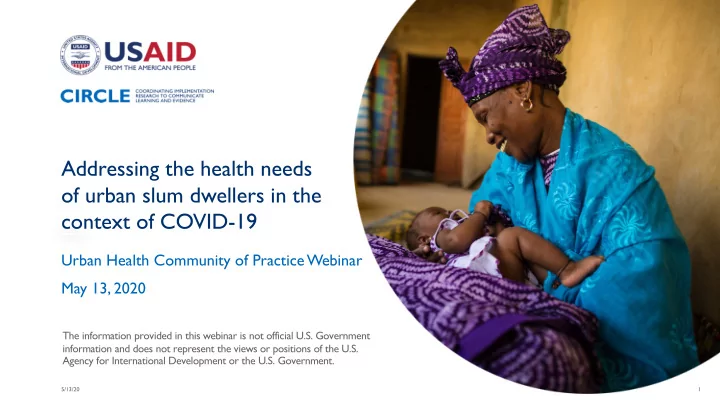
Addressing the health needs

  • f urban slum dwellers in the

context of COVID-19

Urban Health Community of Practice Webinar May 13, 2020

slide-2
SLIDE 2
slide-3
SLIDE 3

Slum Health: Arresting COVID-19 and Improving Well- Being in Urban Informal Settlements

Jason Corburn, David Vlahov, Blessing Mberu, Lee Riley et al.

slide-4
SLIDE 4

Kenya Top Takeaways for Covid-19

slide-5
SLIDE 5

Demographics of Infection for SUNDAY MAY 10, 2020

slide-6
SLIDE 6

v What are the challenges for residents of informal settlements

Ø Responses are inconsistent with both their livelihood and living space contexts

Ø Informal workers, daily wage earners, so stay at home lockdown, quarantine at home, work from home, Ø social distancing in high density neighbourhoods, overcrowded and multi-purpose rooms Ø Are all inconsistent if not impractical in their situations.

Ø Already living in some form of perpetual emergencies

Ø With lack of basic infrastructure, Ø Limited or total lack of access to social services and Ø Near absence of the public sector. Ø Now exacerbated by Covid-19 pandemic and Ø Disruptions in the livelihood and service delivery value chain. Ø The responses that are being enforced (in a draconian top-down way) did not seem to take cognizance of these challenges in informal settlements contexts

Ø The Slum residents operate in what is called in Kenya the Kidogo economy,

Ø Small packet economy of a bag or two of tea bags, small sugar packs, small tomato paste, small quantity of food, small liters of water and oil and Kerosene. Ø So they need access to the market on a daily basis Ø A little shock will rock their world into food insecurity and associated hazards, Ø So Covid 19 lockdown is a nightmare.

slide-7
SLIDE 7

WHAT CAN BE DONE TO HELP? This can be divided into short term and long term measures

  • In the short run, addressing immediate needs and disruptions associated with Covid-19
  • In the long run, addressing the structural issues of inequity in society, universal health

coverage, leave no one behind, promoting human dignity and all the SDG 2030 agenda.

Our paper listed these recommendations: 1. institute informal settlements/slum emergency planning committees in every settlement; 2. apply an immediate moratorium on evictions; 3. provide an immediate guarantee of payments to the poor; 4. immediately train and deploy community health workers; 5. immediately meet Sphere Humanitarian standards for water, sanitation, and hygiene; 6. provide immediate food assistance; 7. develop and implement a solid waste collection strategy; 8. implement immediately a plan for mobility and health care. 9. lessons learned from earlier pandemics such as HIV and epidemics such as Ebola, can be applied here

slide-8
SLIDE 8

THANK YOU

@APHRC @APHRC

www.aphrc.org

slide-9
SLIDE 9

ADDRESSING THE HEALTH NEEDS OF URBAN SLUM DWELLERS IN THE CONTEXT OF COVID-19

PRESENTER TALKING POINTS

  • Dr. Sathy Rajasekharan, Kuboresha Afya Mitaani

Main talking points: Jacaranda partners with government hospitals to deliver maternal and newborn health solutions across 5

  • counties. Since the outbreak of COVID-19, we have been tracking the impact on MNH service demand

and supply challenges. This data, sourced from client and provider program data, has been compiled to reveal initial trends in the first weeks after the first official COVID-19 case in Kenya (March - April 2020). Data is sourced from Kenyan Counties: Makueni, Muranga, Bungoma, Kiambu and Nairobi. Data from urban areas has been highlighted below: Perspectives of pregnant women and new mothers regarding MNH care-seeking during the COVID-19 outbreak

  • 61% of clients seeking prenatal care said that their plan to go for visits was affected by the

COVID pandemic

  • 62% of women with newborns/infants said that COVID has affected their decision to go for

PNC or CWC visits.

  • Women were planning to change when and where they decided to seek care
  • Relocation from city to village
  • Changed to private facility
  • Changed because of increased transport costs
  • Turned away from health facilities for specific clinical services

Reports of provider challenges in delivering MNH services after the outbreak in Kenya

  • Providers reporting that the curfew has impacted their ability to reach the facility, indirectly

resulting in longer shifts

  • Increased expense of commuting to facilities, lack of transport options for those living

far from their reporting facility, and restrictions on movements between cities

  • Providers reporting concerns regarding being adequately equipped to handle clients during the

COVID-19 outbreak

  • Concerns over a lack of personal protective equipment (PPE)
  • Providers reporting concerns regarding community awareness of COVID-19, which is impacting

service provision

  • Changes in client volumes (increases and decreases); stigma against HCWs

Changes and associated challenges in MNH service delivery at health facilities after the

  • utbreak
slide-10
SLIDE 10

Based on reports from clients, providers and after verification with county health officials, we noted a change in service in 31 facilities. Based on our estimations, 26-28% of the catchment population served by partner facilities under observation experienced disruption. Disruption includes: all ANC clinics stopped, high risk clinics stopped, 6-week clinic appointment halted and mothers asked to not attend routine weighing. The MOH released updated RMNH guidelines on April 13, which indicated that essential services should continue as per standard of care. We will redo the analysis to see if the situation on service disruption has changed. In progress: Tools to support essential service delivery Jacaranda is supporting its County partners in the following way:

  • Challenge tracker for County Health Managers: Map indicating detected challenges across health
  • facilities. This tool allows managers to view ‘hotspots’ for service disruption
  • “Teletriage” prenatal appointments: Women who have missed their ANC visits have an SMS

survey and are supported via phone by a nurse, who refers them for additional care

  • Dr. Yvonne Mugerwa, Kampala MaNe Project

COVID-19 In Urban settings: Observations from communities and health facilities in Kampala COVID situation: Uganda currently has 126 confirmed COVID cases and 0 deaths Are pregnant women delaying initiation or hesitant to attend antenatal care?

  • USAIDs MCHN project has reported 23% reduction in ANC 1 attendance between February

and March 2020 in Kampala

  • KCCA data showing up to 30% reduction in facility deliveries and even greater reductions in

both ANC1 and continuing (ANC4) attendance between mid March and mid April

  • Women are delaying initiation of movement to facility probably because of anticipated challenges

in travel/ transportation and perhaps also fear of getting COVID-19 infection.

  • Up to 60% of c- sections done in 2 of the major hospitals in Kampala in the first few weeks of

the lock down were supposed to be elective operations which ideally should have been planned for and scheduled during ANC visits.

  • Initially (in the first few weeks of lock down) the ANC clinics were not open – hospitals closed
  • ut-patient units that would potentially have crowds. However, women who showed up for

care were given care in other units e.g labour wards. Later on clinics were opened and ANC is being provided.

  • On the other hand, however, in some parts of metropolitan Kampala, women have turned parts
  • f the facilities (especially the mission facilities) into waiting shelters. They move there early and

camp in the hospital (e.g in kisubi mission hospital) until deliver. The problem/ challenge now is access to food.

slide-11
SLIDE 11

Are they presenting later than usual for obstetric and newborn emergencies? Women are presenting later that usual for obstetric emergencies – for 2 reasons 1) Trying to get help closer to home but in the ‘wrong’ facility 2) presenting late at the facility due to delays in decision making and in transportation. Examples: Up to 75% of the cases of ruptured uterus handled by the regional and national referral hospital in the first week of April were due to late representation to the facility, mainly caused by delays in transportation after recognition of a complication. How are they traveling to health facilities and what challenges are they facing due to COVID-19?

  • Some are travelling by ambulance, others by private means, others have to walk
  • Initially the process required for transportation was arduous and presented many challenges.

Pregnant mothers had to first seek approval from a district political leader’s office (known as the RDC) for authorization to utilize private means.

  • Now the President has said that if a woman is pregnant, she should be allowed to move. she

should move with her papers.

  • The challenges are that 1) communities do not seem to know that this has changed 2) they do

not know all the lines to call for ambulance services 3) they do not trust or are afraid to take up the offer – for fear of being asked to pay. They do not believe that the transportation is free of charge to the user.

  • In some of the Privately-owned facilities (especially those under UCMB) women have been

asked to call the facility where they were attending ANC and ask to be picked up by the facility

  • ambulance. The ambulance is supposed to pick the mother, take her to the facility for care then

take her back home. The challenge is that a significant proportion of the mothers are not able to pay for care at the facilities. Do health workers have the personal protective equipment they need? Most health workers now have the PPE that is needed. This is mainly masks, gloves, aprons. However, this was initially not the case. In the first few days of the lock down there were significant delays in getting PPE (with workers having to buy or facilities making internal arrangements to protect their workers). Unpreparedness for lockdown, requisitioning challenges and stockouts at the central store were among the reasons for the delay. However, this was quickly resolved. What challenges are health workers facing?

  • As mentioned above, initially there were challenges with PPE
  • Some facing very heavy workload, especially in public facilities
  • Social distancing is not possible in some public facilities because of high volume of patients.
  • Problems with transportation before the KCCA deployed vehicles. Hence being stopped several

times by security agencies. But also, real challenges for those who normally use public transport. Plus, delays in handover due to waiting for colleague to be picked

  • Having to work within curfew times lines
  • Delays in rolling out of training – so some are not confident to take care of patients. They are

afraid.

slide-12
SLIDE 12
  • Mental stress
  • For the health care managers one of the challenges has been that data for decision

making is not readily available. MaNe has addressed this challenge by availing almost real-time (24hourly) data to key players/ decision makers for mNH care in Kampala on a WhatsApp platform to inform daily decision making.

  • The data and platform has helped in making timely decisions on referrals (decisions and

destinations); facilitating interfacility/ interteam consultations; addressing critical bottlenecks hindering provision of emergency obstetric care e.g absence of anaesthetists and other key theatre staff & absence of drugs; holding critical office bearers accountable; auditing of clinical care given in some cases and increased accountability for maternal and deaths. It has also helped avoid the bureaucratic red tape that would have

  • therwise been necessary for this kind of communication between and across cadres

and health facilities of different levels. It has certainly strengthened teamwork across the city.

  • Dr. Raz Stevenson, USAID

I would like to thank USAID/CIRCLE project for setting up the Care-seeking and Referral Community of Practice and this timely webinar, “Addressing the health needs of urban slum dwellers in the context of COVID-19”. The current setting in Tanzania is in many ways similar to that described in Kenya and Uganda but it is less discussed. Officially we have had 509 cases, 21 deaths and no reporting in over 4 days. We have no formal lock down but hear of large numbers of cases and overwhelmed health facilities in the urban cities. Many of us know of deaths of co-workers, friends and even family members. Therefore, my presentation will highlight three important themes for programming in urban slum settings in the context of the COVID19 pandemic. These are:

  • adaptive management,
  • implementation research and
  • community led programming

USAID’s development work has increasingly taken on the adaptive management approach, AND, given all the uncertainties resulting from COVID19 in the countries we support, …an approach based on a continuous learning and adaptation mode is extremely relevant: USAID defines adaptive management as “an intentional approach to making decisions and adjustments in response to new information and changes in context.” It is not about changing goals during implementation, but rather changing the path being used to achieve the goals in response to contextual changes. “The uncertain and ever-changing context in which we work, and the need to be responsive to the

  • utbreak and…, has underscored the need to mainstream adaptive management … into our …

activities”. https://pdf.usaid.gov/pdf_docs/PBAAJ032.pdf

slide-13
SLIDE 13

For some time, the Office of MCH/N’s Research and Policy Division at USAID has championed the use

  • f Implementation Research to improve MCH and nutrition outcomes.

Implementation research is an important tool in the adaptive management approach. The head of the Division, Neal Brandes, co-authored a Lancet paper published in 2018, in which implementation research is described as the “new imperative” in global health programming. https://www.thelancet.com/pdfs/journals/lancet/PIIS0140-6736(18)32205-0.pdf Implementation research is a critical tool that should be used as part of mainstream adaptive management because it embodies the key practices of real-time inclusive planning and data driven

  • solutions. Implementation research is:
  • multidisciplinary in nature,
  • it uses a range of empirical and systematic methods to document, analyze, and address key

health problems,

  • it focuses on testing innovative health interventions and
  • modifying them with real time information to ensure that they are contextually suited to the

needs in the setting in which they are being deployed

  • and it engages the key actors in the process

In Tanzania, the USAID/CIRCLE project, has shown that Implementation research with embedded evaluators can be used in real time to evaluate and improve the feasibility, adoption, and acceptance of interventions such as integrated RMNCH, HIV, TB and malaria services. A key attribute of Implementation research is fostering ownership and collaboration among those engaged – these include policy makers, implementers, communities, and researchers who work together throughout the research and implementation processes in an iterative way to build trusting partnerships and collectively give shape to knowledge, interventions and results. The recent paper (https://medicine.yale.edu/news-article/23734/) shared with us by Dr. Blessing, reminds us

  • describes the vulnerabilities of dwellers in informal periurban settlements
  • and highlights the opportunities to respond in a way that can go beyond disaster response and

promote long term inclusive planning and implementation.

  • that “Most top-down strategies to arrest an infectious disease ignore the often-robust social

groups and the knowledge that already exist in many slums.”

  • and encourages engaging the affected community in co-creating their own solutions and using

community structures to ensure a successful and sustained response We know that the corona pandemic will not be a one-time peak of cases that will go away, rather, until there is a vaccine or treatment, we anticipate multiple waves of infection which can wear down any community from externally mandated strategies that have an unusual impact on their lives. Looking back at previous outbreaks and the past few months of this pandemic, we have learned that a

  • ne-size-fits-all approach can have devastating effects in a highly vulnerable and marginalized community,

living in extremes of economic and structural deprivation. Looking forward we know that we have examples of successful programs in unplanned urban settlements that have been designed and managed by indigenous community-based groups. I believe we now have an imperative to empower these groups to use an adaptive management approach that benefits from known implementation research methods.

slide-14
SLIDE 14

These groups must acquire the capacity to use real time data collection and engage with multidisciplinary decision-making teams to co-create solutions to address the evolving situation on their home turf. I am going to list some of the iterative action steps needed in the adaptive management / implementation research approach. They include:

  • 1. Engage key stakeholders to jointly identify problems and track results,
  • 2. Triangulation and use of the best available real-time data sources (such as with embedded

evaluators), contextual information, and perspectives from those who are intimately involved for timely decision-making (community members, community organizations, community leaders, health providers, CHWs assigned to these communities, local government authorities responsible for these settings, and so on)

  • 3. Use regular health and social data reviews for a ‘pause and reflect’ opportunity
  • 4. Documenting “pivots” (and the reasons behind them) to ensure transparency and support

iterative learning In short, we must use

  • adaptive management
  • implementation research and
  • community led programming

for all program implementation and management in urban slum settings. These are critical tools that can save lives in vulnerable communities in urban, unplanned settlements. They can create ways to address local myths and misconceptions (see IFRC Risk Communication and Community Engagement Efforts in Africa COVID19 Community feedback report IFRC (8 April 2020)),

  • vercome the fears and stigma of COVID19, advance uptake of risk reduction strategies, and modify

provision food assistance, and provide essential services that are supportive of providers and ensure uptake of services by those who live in unplanned settlements (see Community-based health care, including

  • utreach and campaigns, in the context of the COVID-19 pandemic Interim guidance, UNICEF, May 2020).

Thank you for your engagement.

slide-15
SLIDE 15

COVID-19, Cities & Informal Settlements

  • Prof. Jason Corburn

UC Berkeley Jcorburn@Berkeley.edu

1.

Disease reveals persistence of structural inequities & failure of global health: not focused enough on urban health equity.

2.

All informal settlements not the same; both risks & assets; no one-size-fits-all approach.

3.

Context matters, so policy & practices must involve local expertise & knowledge.

4.

COVID-19: new urgency to deliver infrastructure & services, but danger that ignores community experts & not integrated strategy for well-being.

jcorburn@berkeley.edu, www.jasoncorburn.com

slide-16
SLIDE 16

jcorburn@berkeley.edu, www.jasoncorburn.com

slide-17
SLIDE 17
  • 1. Create Pandemic Community Action Teams of residents, CBOs & NGOs
  • 2. Immediate moratorium on evictions & secure new land w/3Km of settlements

for emergency staging & new long-term housing.

  • 3. Immediate guarantee of 3+ months pay/subsistence wage to all urban poor
  • 4. Immediately end debt interest and principal payments for all countries with

sizeable informal settlement, pavement dwellers, etc. populations.

  • 5. Hire new urban Community Health Workers, especially youth – ‘credible

messengers’ to educate, contact trace, referral for care, etc.

Urgent Recommendations

jcorburn@berkeley.edu, www.jasoncorburn.com

slide-18
SLIDE 18

Urgent Recommendations

  • 6. Immediately meet Sphere Humanitarian standards for water, sanitation, &

energy

  • 7. Immediate food assistance of family meals, some that avoid indoor cooking
  • 8. Immediate municipal Solid Waste collection strategy
  • 9. Immediate mobility plan, esp. emergency services, elderly & persons with

disabilities 10.Mobile clinics with all medical equipment needed to treat everyday ailments & COVID-19.

jcorburn@berkeley.edu, www.jasoncorburn.com

slide-19
SLIDE 19

Next Steps

1. Work with resident groups to treat neighborhoods not just individuals = infrastructure, food, income, etc. 2. Those most impacted, involved in shaping decisions. Transparency. 3. Don’t expect science to ride in on white horse & save poor - - medicine & science has exploited more than supported poor. 4. Crisis response transfer into long- term investments & policy change. 5. Global health: acknowledge & confront legacies of colonialism & imperialist science & medicine.

jcorburn@berkeley.edu, www.jasoncorburn.com

slide-20
SLIDE 20

ADDRESSING THE HEALTH NEEDS OF URBAN SLUM DWELLERS IN THE CONTEXT OF COVID-19

PRESENTER BIOS

Professor Blessing Uchenna Mberu is Head of Urbanization & Wellbeing at African Population and Health Research Center and Honorary Professor of Demography and Population Studies, University of

  • Witwatersrand. He earned MA and PhD from Brown University in 2004 and 2008 respectively. He also

holds a B. Sc. and an M.Sc. degree in Sociology from Imo State University and University of Ibadan, Nigeria, in 1987 and 1990 respectively. His work covered migration, urbanization, and urban health in

  • SSA. He is in the International Advisory Board of Sierra Leone Urban Research Centre and Executive

Board of the International Society for Urban Health.

  • Dr. Yvonne Kidza Mugerwa is a Ugandan Obstetrician and Gynecologist with 18 years’ experience in

Reproductive Health programming, training, research and service provision, in rural and urban settings in Eastern and Central Africa. She is the Project Director of Kampala Slums Maternal and Newborn health project, a USAID supported implementation research project whose goal is to generate evidence on effective and feasible interventions to improve MNH for the urban poor in Kampala. Project focus areas are on Improving access to quality and affordable MNH services to the urban poor, illness recognition and care seeking; building an effective MNH referral system. Sathy Rajasekharan is the Executive Director (Africa) at Jacaranda Health, and oversees the

  • rganization's mission of delivering low-cost, sustainable solutions through public hospitals to improve

maternal and newborn health outcomes. Prior to joining Jacaranda Health, Sathy was a Senior Program Manager for Health Systems Strengthening at the Clinton Health Access Initiative (CHAI), Eswatini. He has held previous positions in the commercialization and translational research space, as Associate Director of the McGill University Centre for Biomedical Innovation and the Associate Director of Experimental Therapeutics at the Montreal Neurological Institute. Sathy has a Ph.D. in Neuroscience. Ráz Stevenson, physician and public health specialist, joined USAID/ Global Health Bureau, Office of MCHN in the Division of Research and Policy Division last year as Senior Implementation Research

  • Adviser. For the previous fifteen years she served variously as the Senior Maternal and Child Health

Advisor, Quality of Care and Service Delivery Advisor, and Global Health Security Advisor at USAID/Tanzania. In this capacity she collaborated extensively with national and subnational

  • governments. Dr. Stevenson has systematically worked to improve outcomes for mothers and children

by employing implementation research methods to strengthen the effectiveness of integrated RMNCH services at facilities and communities, to strengthen networks of care in delivering services, and to promote respectful maternity care. In her new position, she will contribute to implementation research efforts undertaken by the Health Research Program (HRP), which applies an implementation research approach as a means of accelerating the research-to-use process for new or adapted health interventions within countries, while promoting collaborative learning globally. Jason Corburn is a Professor in the School of Public Health and Department of City and Regional Planning at the University of California, Berkeley. He is the Director of the Institute of Urban and Regional Development and the Center for Global Healthy Cites at UC Berkeley (healthycities.berkeley.edu). Prof. Corburn’s research is focused on urban health equity, the role of citizen science in improving the lives of city residents and measuring the health impacts of participatory upgrading of urban informal settlements. His current work is focused on redesigning education for urban
slide-21
SLIDE 21

2

health and evaluating urban health equity interventions in Sri Lanka, Kenya, South Africa, Egypt, India, Brazil and Colombia. Professor Corburn is the author of a number of award winning books including: Street Science: Community Knowledge and Environmental Health Justice (MIT Press, 2005); Toward the Healthy City (MIT Press, 2009); Healthy City Planning (Routledge, 2013) and Slum Health (UC Press, 2016). He is a member of the Scientific Committee of the International Science Council’s Urban Health & Well-Being program and the International Society for Urban Health. See: www.jasoncorburn.com.