2/10/2020 Era of Unprecedented World Wide Care of Immigrant - - PDF document

2 10 2020
SMART_READER_LITE
LIVE PREVIEW

2/10/2020 Era of Unprecedented World Wide Care of Immigrant - - PDF document

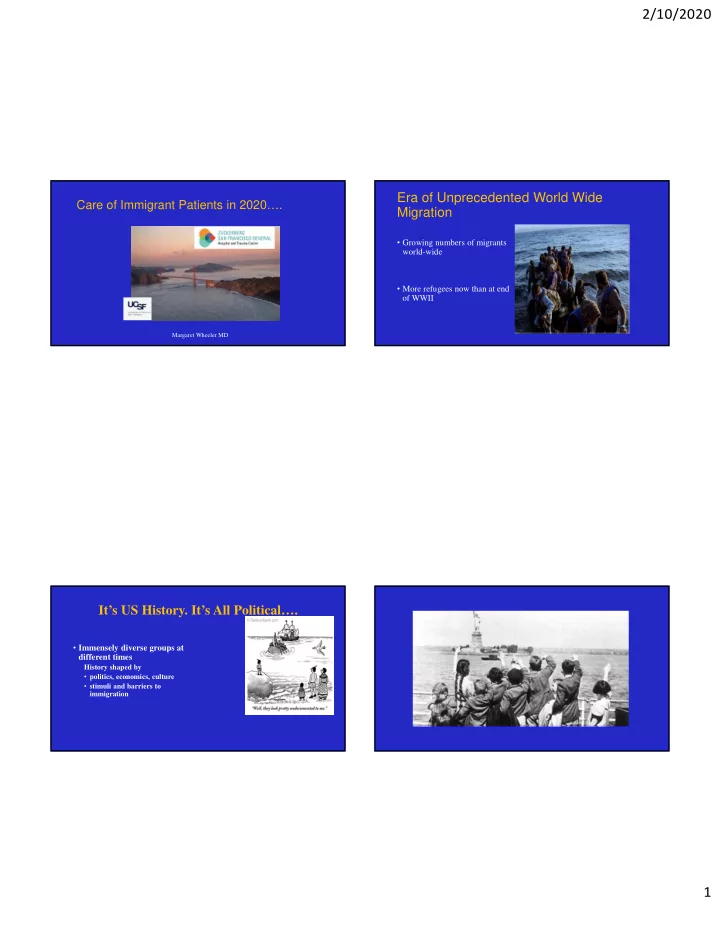
2/10/2020 Era of Unprecedented World Wide Care of Immigrant Patients in 2020. Migration Growing numbers of migrants world-wide More refugees now than at end of WWII Margaret Wheeler MD Its US History. Its All Political.


slide-1
SLIDE 1

2/10/2020 1

Care of Immigrant Patients in 2020….

Margaret Wheeler MD

Era of Unprecedented World Wide Migration

  • Growing numbers of migrants

world-wide

  • More refugees now than at end
  • f WWII

It’s US History. It’s All Political….

  • Immensely diverse groups at

different times

History shaped by

  • politics, economics, culture
  • stimuli and barriers to

immigration

slide-2
SLIDE 2

2/10/2020 2

US Immigration

Immigration Since 1860

  • 13.3% (42.4 m) US

population foreign born (FB) today

  • ½ citizens
  • ¼ here legally
  • ¼ without

documentation

  • Pew, 2016
  • 27% CA are FB
  • 26% US pop FB or

children of FB

Undocumented Immigrants

  • Numbers declining (reverse

migration_

  • Largest number today NOT from

border crossings but visa overstay

  • Integrated into our communities
  • Many in mixed status families
  • 2/3 here over a decade
  • Own homes; work; pay billions in

taxes

slide-3
SLIDE 3

2/10/2020 3

An Approach to Immigrant Patients: Three Considerations

  • Health risks of native country
  • Health risks of travel– both

initial and recurrent

  • Health risks of adopted

country

You can’t take good care of your patient if you don’t know where they are from….

Risks of Native Country

  • Epidemiology of diseases
  • Risk of exposure to infectious diseases, environmental exposures,

geography of genetic disorders

  • https://www.cdc.gov/immigrantrefugeehealth/guidelines/refugee-guidelines.html
  • Epidemiology of stressors/resilience
  • Politics/economics/natural disasters/cultural practices
  • Keeping up current events as important as med updates
  • Health care access and practices
  • Vaccinations, preventative care, chronic disease care,

medication use

Have a global differential…

  • Eosinophilia
  • think parasitic infections strongyloidiasis, filariasis, or schistosomiasis.
  • Palpitations
  • Stressors, PTSD, RHD,
  • Renal failure
  • Exposures, lead, DM, untreated HTN, congenital disorders, medications, Balkan/Mesoamerican

nephropathy

  • Hematuria, infertility, or chronic pelvic pain
  • Schistosomiasis; TB; undiagnosed congenital issues
  • Splenomegaly
  • Hepatitis, TB, HIV, malaria syndrome; schistosomiasis; leishmaniasis;
  • Lymphadenopathy
  • TB,HIV, filariasis
  • Heart failure
  • Chagas disease, rheumatic heart disease
  • Seizures
  • neurocysticercosis.

World news as important as medical journals

slide-4
SLIDE 4

2/10/2020 4

An Approach to Immigrant Health

  • Health risks of native country
  • Health Risks of Travel–Initial and Recurrent
  • Health risks of adopted country

Risks of Initial Travel

  • When—age, health, who left behind
  • Why left?
  • Travel itself—refugee camp, border crossing, debt, jet lag?
  • Recurrent travel vs permanent break with home

High Risk Travel Medicine

  • ½ of US residents traveling abroad are FB visiting home
  • Higher risk of getting sick while traveling
  • Riskier behavior
  • Visit when pregnant, sick or with children
  • Stay for longer, eat like hosts.
  • More often sex, rural areas, contact sick relatives
  • Travel for health care or use health care– dentistry, specialty care, return

with medications from home

  • But less often vaccinated/prophylaxed
  • Recs for FB travelers same all travelers

An Approach to Immigrant

  • Health risks of native country
  • Health risks of travel–initial and recurrent
  • Health risks of adopted country
slide-5
SLIDE 5

2/10/2020 5

Risks of US Life

  • Epidemiology of Disease
  • More chronic illness, lifestyle changes
  • Environmental risks: Occupational Risk
  • Epidemiology of Stressors/Resilence
  • Minority Status
  • Legal status
  • Language marginalization
  • Discrimination/Fear
  • Absent family
  • Health Care Access and Practices

Community Strengths

  • Safer neighborhoods
  • Cultural practices
  • Social capital of family

Legal Issues: Undocumented and Access to Care

  • Highly variable by state, county, city policies
  • Can range from excellent to none
  • Undocumented children covered in many states
  • Undocumented adults covered in NYC, SF, LA, others
  • Some undocumented adults have private insurance via employers

Policies Matter

  • Undocumented with good access do well:
  • No difference btwn undocumented/documented/citizens Mexican- Americans in

diabetes outcomes

Iten/Fernandez 2014

  • Undocumented present with more advanced HIV do equally well once in care
  • Poon, 2012
  • Expanding coverage to undocumented children results in high

enrollments and better outcomes

  • Howell, 2010
slide-6
SLIDE 6

2/10/2020 6

Policies Matter: ESRD and Undocumented

  • Near universal coverage for ESRD with exception
  • f undocumented
  • Two strategies depending on state
  • Emergent dialysis (only when emergent conditions exist)
  • more costly; 5x-15x the mortality
  • Chronic dialysis
  • Rodriguez, 2015; Cervantes, 2017/2108;Fernandez 2017

Fear as Barrier

  • 1/8 undocumented

immigrants fear deportation when accessing care

  • Maldonado, 2013
  • Patients forgo care for fear of

ICE

  • Hacker, 2012
  • Patients forgo care when

immigration policies become more stringent

  • Rhodes, 2015
  • Citizens in mixed status

families forgo care too

Since Trump Election

  • Fewer immigrants obtaining services
  • More openly hostile comments in waiting rooms toward

immigrants from other patients

  • More immigrant parents making DPOA plans for children
  • Actions: more home visits; health care worker outreach; ride

shares etc

  • Fleming, 2018

Asking About Legal Status

  • Immigrant rights organizations advise against
  • Pts may fear
  • Denial of care or lower standard of care
  • Immigration service involvement
  • Risking future legal/citizen standing
  • Discrimination
  • Documenting in chart: Do Not
  • If need, to know or remember “can you travel?”
slide-7
SLIDE 7

2/10/2020 7

If Patient Reveals Undocumented Status

Reassure

  • Confidentiality, especially from ICE
  • Current federal policies keep ICE out of

hospitals/clinics

  • Will not lead to differential care or

abandonment/repatriation

  • Consider legal referrals

https://www.immigrationlawhelp.org

Refer Your Undocumented Patients for Legal Advice

  • Naturalization
  • Asylum
  • Specialty visas (Temporary Protection, U visa, T visa,

VAWA)

  • Deportation issues
  • Advice for DACA
  • Anticipatory guidance

How do I screen my patient?

  • Take an immigration history
  • Screen for domestic violence and community violence
  • Screen for victims of trafficking
  • Do you live and work in the same place?
  • Do you have access to your own documents?
  • Have you been denied access to care/food/clothes?
  • Have you been threatened with will call police, deportation,

physical violence?

  • Are you getting paid regularly?

If You Are Asked for a Letter

  • Contact the lawyer for scope/focus
  • Refer to legal assistance ( No letter without lawyer.)
  • Asylum: consider referral for forensic specialist
  • Civil Surgeon PE/vaccinations
slide-8
SLIDE 8

2/10/2020 8

Anticipatory Guidance- Legal

  • Rights of Habeus Corpus
  • Remain silent
  • Insist on warrant/don’t open

the door

  • Right to legal counsel
  • Carry a lawyer’s #
  • Don’t sign anything
  • Have an emergency plan,

especially with children

  • Backup childcare
  • Designate POA
  • Contact consulate

https://www.ilrc.org/know-your-rights-and-what- immigrant-families-should-do-now

Red Cards

https://www.ilrc.org/red-cards

Clinic Policies

  • Staff training
  • asking demographics
  • documentation of legal status
  • Pro-active “signal safety” ---

posters, cards

  • Partnership with community

groups

  • Referral information for

immigration services

  • ICE plan?

Advocating for Undocumented Patients

  • Know basic immigration policies and processes
  • Refer for legal assistance and rights education
  • Establish clinic policies to support undocumented
  • Strengthen partnerships with community groups
slide-9
SLIDE 9

2/10/2020 9

Immigrant Health: Think Globally, Act Locally

Legal Referrals SF

www.projectlegallink.org

More resources

  • Public Health Actions for Immigrant Rights

(https://docs.google.com/document/d/1MXecn5b_IZPZ5r6LA3U4Ggz2gSMqxMONGBlCngsX

HEU)

  • National Immigrant Law Center (https://www.nilc.org)
  • The Fair Immigration Reform Movement (FIRM; http://fairimmigration.org/)
  • United We Dream (http://unitedwedream.org/)
  • We Belong Together (https://www.domesticworkers.org/we-belong-

together)

  • National Council of La Raza (NCLR; http://www.nclr.org/)
  • Check for potential partners on local college campuses, which may

have groups already formed around immigration.

  • Human Impact Partners (immigrationguide@humanimpact.org)
  • Immigrant Legal Resource Center (https://www.ilrc.org)
  • ACLU (aclu.org)

More Resources

  • Minnesota Department of Public Health: A Call to Action, Immigrant Health

http://www.health.state.mn.us/divs/idepc/refugee/topics/immhealthrpt.pdf

  • Examining asylum seekers: A clinician’s guide to physical and psychological evaluations of torture

and ill treatment; 2012 Dec [cited 2015 Sept 1]. 191 . Available from: http://physiciansforhumanrights.org/library/reports/examining-asylum-seekers-manual-2012.html

  • United Nations. The Manual on Effective Investigation and Documentation of Torture and Other

Cruel, Inhuman, or Degrading Treatment or Punishment: Istanbul Protocol. Geneva, Switzerland: United Nations, November 1999. http://www.ohchr.org/Documents/Publications/training8Rev1en.pdf