
CS490W: Web I nformation Search & Management CS-490W Web Information Search & Management
Basic Concepts of Information Retrieval
Luo Si Department of Computer Science Purdue University
Basic Concepts of I R: Outline
Basic Concepts of Information Retrieval:
Task definition of Ad-hoc IR
Terminologies and concepts Overview of retrieval models
Text representation
Indexing Text preprocessing
Evaluation
Evaluation methodology Evaluation metrics
Ad-hoc I R: Terminologies
Terminologies:
Query
Representative data of user’s information need: text (default) and
- ther media
Document
Data candidate to satisfy user’s information need: text (default) and
- ther media
Database|Collection|Corpus
A set of documents
Corpora
A set of databases Valuable corpora from TREC (Text Retrieval Evaluation Conference)
Ad-hoc I R: I ntroduction
Ad-hoc Information Retrieval:
Search a collection of documents to find relevant documents that
satisfy different information needs (i.e. queries)
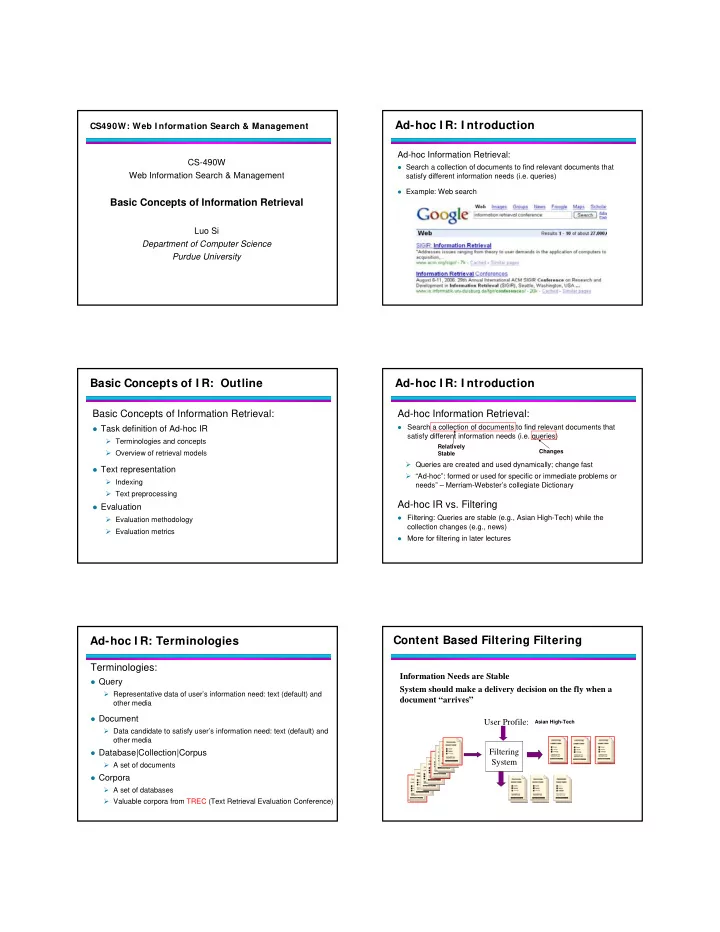
Example: Web search
Ad-hoc I R: I ntroduction
Ad-hoc Information Retrieval:
Search a collection of documents to find relevant documents that
satisfy different information needs (i.e. queries)
Relatively Stable Changes
Queries are created and used dynamically; change fast “Ad-hoc”: formed or used for specific or immediate problems or needs” – Merriam-Webster’s collegiate Dictionary
Ad-hoc IR vs. Filtering
Filtering: Queries are stable (e.g., Asian High-Tech) while the
collection changes (e.g., news)
More for filtering in later lectures
Filtering System User Profile: Information Needs are Stable System should make a delivery decision on the fly when a document “arrives”
Content Based Filtering Filtering
Asian High-Tech