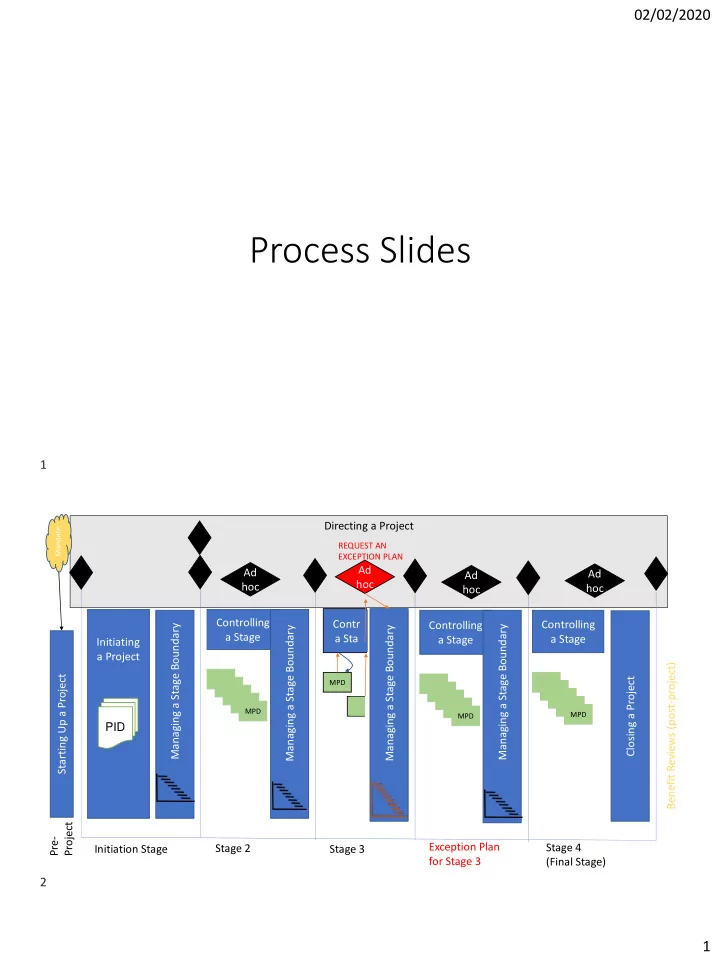
Process Slides 1 Directing a Project Mandate REQUEST AN - - PDF document

process slides
SMART_READER_LITE
LIVE PREVIEW

Process Slides 1 Directing a Project Mandate REQUEST AN - - PDF document

02/02/2020 Process Slides 1 Directing a Project Mandate REQUEST AN EXCEPTION PLAN Ad Ad Ad Ad hoc hoc hoc hoc Controlling Contr Controlling Controlling Managing a Stage Boundary Managing a Stage Boundary Managing a Stage


slide-1
SLIDE 1

02/02/2020 1

Process Slides

Directing a Project Starting Up a Project Initiating a Project Managing a Stage Boundary Controlling a Stage

MPD

Managing a Stage Boundary Controlling a Stage

MPD

Closing a Project

MPD

Managing a Stage Boundary Contr a Sta Controlling a Stage

MPD

Managing a Stage Boundary PID Initiation Stage Stage 3 Stage 2 Exception Plan for Stage 3 Stage 4 (Final Stage) Pre- Project

Mandate

Ad hoc Ad hoc Ad hoc Ad hoc

REQUEST AN EXCEPTION PLAN

Benefit Reviews (post-project)

1 2

slide-2
SLIDE 2

02/02/2020 2

Chapter 14: Starting up a project

14.4 Activities (Page 168)

  • Appoint an Executive and Project Manager
  • Capture Previous Lessons
  • Design and Appoint a Project Management Team Structure
  • Prepare Outline Business Case
  • Select the Project Approach and Assemble the Project Brief
  • Plan the Initiation Stage

Appoint Executive and Project Manager Project Manager Executive Role Description Role Description

DAILY LOG Project Mandate Starting Up a Project Process

3 4

slide-3
SLIDE 3

02/02/2020 3

Capture Previous Lessons

LESSONS LOG

Prepare Outline Business Case

WHY

Senior User(s) Acceptance Criteria - measurable

WHAT

Executive

Project Manager

Reasons Business Option (If know more, add it) Executive CQEs (Vague, aspirational statements)

Project Product Description

5 6

slide-4
SLIDE 4

02/02/2020 4

Select the Project Approach Senior Supplier(s)

HOW

Project Brief

Project Manager

AND Assemble the Project Brief (AKA Delivery Approach) Project Brief (Appendix A - Page 317 and 318)

  • Project Definition (from the Mandate): Background, objectives,
  • utcomes, scope, constraints, tolerances, users, interfaces – as known

to-date.

  • Outline Business Case: Reason and Business Option
  • Project Product Description: CQEs and Acceptance Criteria (Briefly

discussed)

  • Project Approach: AKA Delivery Approach
  • Project Management Team Structure
  • Role Descriptions
  • References

7 8

slide-5
SLIDE 5

02/02/2020 5

Plan the Initiation Stage Plan

Time, Money, Resources Initiation Stage Plan Project Mandate Starting Up a Project

Authorise Initiation

Authorise initiation

Pre-Project Initiating a Project

Initiation Stage

Ma a Bo

9 10

slide-6
SLIDE 6

02/02/2020 6

Appoint Executive and Project Manager Project Manager Executive Role Description Role Description

DAILY LOG Capture Previous Lessons LESSONS LOG Design and Appoint Project Management Team Structure Role Descriptions

WHO

Prepare Outline Business Case

WHY

Executive

Senior User(s)

CQEs Acceptance Criteria Project Product Description

WHAT

Executive

Project Manager

Reasons Business Option (If know more, add it) Select the Project Approach

Senior Supplier(s)

HOW

Project Brief

Project Manager

AND Assemble the Project Brief

Plan the Initiation Stage Plan Time, Money, Resources Initiation Stage Plan

Project Mandate

Starting Up a Project Process

Chapter 15: Directing a project

15.4 Activities (page 181)

  • Authorise initiation
  • Authorise a project
  • Authorise a next stage or exception plan
  • Give ad hoc advice
  • Authorise project closure

11 12

slide-7
SLIDE 7

02/02/2020 7

Authorise Initiation

Initiating a Project

Authorise initiation Initiation Stage

Ma Bo Project Mandate Starting Up a Project Pre-Project Initiating a Project

PID

Authorise a project

Initiation Stage Authorise a project

13 14

slide-8
SLIDE 8

02/02/2020 8

Managing a Stage Boundary

Initiation Stage

Authorise a project Authorise next stage

  • r

exception plan

Controlling a Stage

Delivery Stage

Initiating a Project

PID

At the end of Initiation Stage, two decisions need to be made: Authorise a project and Authorise next stage plan

Managing a Stage Boundary

Authorise a stage or exception plan AUTHORISE A STAGE PLAN Delivery Stage

Authorise a STAGE plan

Controlling a Stage M

Delivery Stage

Controlling a Stage

15 16

slide-9
SLIDE 9

02/02/2020 9

Authorise a stage or exception plan AUTHORISE AN EXCEPTION PLAN

Ad hoc

REQUEST AN EXCEPTION PLAN

Managing a Stage Boundary

Delivery Stage

Authorise an

EXCEPTION

plan

Controlling a Stage M

Delivery Stage using Exception Plan

Give ad hoc direction

Give ad hoc direction

17 18

slide-10
SLIDE 10

02/02/2020 10

Closure Notification

Authorise project closure

Authorise project closure

Closing a Project

Final Stage Controlling a Stage Controlling a Stage

Chapter 16: Initiating a project

16.4 Activities (Page 197-198)

  • Agree tailoring requirements
  • Prepare risk management approach
  • Prepare change control approach
  • Prepare quality management approach
  • Prepare communication management approach
  • Create the project plan
  • Set up project controls
  • Prepare benefits management approach
  • Assemble the PID

19 20

slide-11
SLIDE 11

02/02/2020 11

Agree tailoring requirements Project Manager

Agree Tailoring Requirements

Project Assurance Team Managers

Ask Project Assurance for advice

  • n how formally to informally

the project should be managed and documented. Ask Team Managers for input, as they will be doing the specialist work and will have even more insights on how to tailor the project

Prepare risk management approach

Risk Management Approach

HOW WILL THIS PROJECT TEAM ON THIS PROJECT MANAGE RISKS? For example:

  • Risk Management procedure (PRINCE2 or

something else?)

  • Frequency of Risk Management activities
  • Who is responsible for helping with Risk

Management activities (roles and responsibilities)

  • Risk Budget?
  • Consistent scales for Probability and

Impact Risk Register

Risk – Status – Probility/Impact – prox – response –

  • wner/actionee

1xxx- open – high/low – this stage – avoid—Sarah/Bob 2xxx- open – med/med ---next stage – reduce- Raj/Bob 3xxx- open – high/med ---this stage – transfer – Bob/Sarah

21 22

slide-12
SLIDE 12

02/02/2020 12

Prepare change control approach

Change Control Approach

HOW WILL THIS PROJECT TEAM ON THIS PROJECT CONTROL CHANGE AND ISSUES? For example:

  • Change Control procedure (PRINCE2 or

something else?)

  • Frequency of Change Control activities
  • Who is responsible for helping with

Change Control activities (roles and responsibilities)

  • WHO IS CHANGE AUTHORITY AND HOW

MUCH CHANGE BUDGET IS AVAILABLE FOR THIS PROJECT? Issue Register

Issue– Impact – Options – Decision – Status 1xxx- Medium – fix 50%– Change Auth YES– Closed 2xxx- High – fix 75%---Proj Board YES – Open 3xxx- Low – do nothing---Project Mgr YES – Closed

IF USED: CIRs Item – Version – Status – related items FOR MANAGEMENT PRODUCTS

Prepare quality management approach

Quality Management Approach

HOW WILL THIS PROJECT TEAM ON THIS PROJECT MANAGE QUALITY? For example:

  • STANDARDS
  • Industry Standards
  • Company Standards
  • Frequency of Quality Management

activities

  • Who is responsible for helping with

Quality Management activities (roles and responsibilities) Quality Register

Product – Test – Target Date – Actual Date– Result

BLANK FOR NOW

23 24

slide-13
SLIDE 13

02/02/2020 13

Prepare Communication management approach

Communication Management Approach

HOW WILL THIS PROJECT TEAM ON THIS PROJECT MANAGE COMMUNICATIONS? For example:

  • STAKEHOLDER IDENTIFICATION
  • STAKEHOLDER ANALYSIS
  • Communication needs of each Stakeholder
  • Frequency of Communication Management

activities

  • Who is responsible for helping with

Communication Management activities (roles and responsibilities)

Create the project plan Product Descriptions (Major products) IF USED: C.I.R.s (Specialist Products) Project Product Description Project Plan

25 26

slide-14
SLIDE 14

02/02/2020 14

Set up controls

Stage Boundaries Tolerances Set up tools Document Tailoring requirements Update Project Management Team Structure and Role Descriptions Role Descriptions

Prepare Benefits Management Approach

FULL BUSINESS CASE Executive Summary Reasons Business Option Benefits

  • B1 – measurable improvement resulting from an outcome
  • B2 – measurable improvement resulting from an outcome
  • B3 – measurable improvement resulting from an outcome

Dis-benefits Timescales Costs Investment Appraisal Major risks

Benefits Management Approach B1 --- DATE(s) --- step by step instructions on how to manage and how to measure B2 --- DATE(s) --- step by step instructions on how to manage and how to measure B3--- DATE(s) --- step by step instructions on how to manage and how to measure

27 28

slide-15
SLIDE 15

02/02/2020 15

Assemble the PID

Assemble the PID

PID (Appendix A – page 319 and 320)

  • Project Definition (from the Brief)
  • Project Approach (from the Brief)
  • Business Case (full)
  • Project Management Team Structure
  • Role descriptions
  • Quality Management Approach
  • Change Control Approach
  • Risk Management Approach
  • Communication Management Approach
  • Project Plan
  • Project Controls (includes frequency of Highlight Reports)
  • Tailoring

29 30

slide-16
SLIDE 16

02/02/2020 16

Agree Tailoring Requirements Risk Management Approach Risk Register Change Control Approach Issue Register

IF USED: C.I.R.s

Quality Management Approach Quality Register Communication Management Approach Project Plan Stage Boundaries Tolerances Set up tools Document Tailoring requirements Update Project Management Team Structure and Role Descriptions

Role Descriptions

Set up controls

Full Business Case Benefits Management Approach

Assemble the PID

Initiating a Project

Project Product Description Product Descriptions IF USED: CIRs

Initiating a Project

PID

Authorise a project

Initiation Stage Authorise a project

31 32

slide-17
SLIDE 17

02/02/2020 17

Initiating a Project

PID

Managing a Stage Boundary

Initiation Stage

Authorise a project Authorise next stage

  • r

exception plan

Controlling a Stage

Delivery Stage At the end of Initiation Stage, two decisions need to be made: Authorise a project and Authorise next stage plan

Chapter 17: Controlling a stage

17.4 Activities (Page 218)

  • Work packages
  • Authorise a WP
  • Review WP status
  • Receive completed WPs
  • Monitor & Report
  • Review Stage status
  • Report highlights
  • Issues & Risks
  • Capture and examine issues & risks
  • Take corrective action
  • Escalate issues & risks

Chapter 18: Managing product delivery

18.4 Activities (Page 237)

  • Accept a WP
  • Execute a WP
  • Deliver a WP

WP = Work Package

33 34

slide-18
SLIDE 18

02/02/2020 18

Work Packages

Authorise a Work Package Receive Completed Work Packages Review Work Package Status Managing Product Delivery Deliver a Work Package Execute a Work Package Accept a Work Package Issues & Risks Monitor & Report Controlling a stage – WORK PACKAGES (page 218) Managing Product Delivery Deliver a Work Package Execute a Work Package Accept a Work Package

  • -Create PRODUCT as described in the

PRODUCT DESCRIPTION (no more, no less)

  • -REVIEWERS test PRODUCT as soon as

it is complete – compare PRODUCT to PRODUCT DESCRIPTION

  • -Send Checkpoint Reports at agreed

frequency (in the Work Package) When all work is completed, return the products and any appropriate documentation back to the project (as per instructions agreed in the Work Package) Agree to do the work and all the terms and conditions Create Team Plan (Optional)

Managing Product Delivery – WORK PACKAGES (page 237)

35 36

slide-19
SLIDE 19

02/02/2020 19

Work Packages

Monitor & Report

Issues & Risks Review Management Stage Status Report Highlights Highlight Reports

Frequency defined in Communication Mgmt. Approach and the Controls section of PID

MONITOR DAILY: Am I inside Stage Tolerances? Controlling a stage – MONITOR & REPORT (page 218) Work Packages Monitor & Report

Issues & Risks

Capture and Examine Issues & Risks Take Corrective Action Escalate Issues & Risks Controlling a stage – ISSUES AND RISKS (page 218)

37 38

slide-20
SLIDE 20

02/02/2020 20

Authorise Stage or Exception Plan Controlling a Stage Work Packages Authorise a Work Package Receive Completed Work Packages Review Work Package Status Issues & Risks Capture and Examine Issues & Risks Take Corrective Action Escalate Issues & Risks Monitor & Report Review Management Stage Status Report Highlights Am I inside Stage Tolerances? Highlight Reports

Frequency defined in Communication Mgmt. Approach and the Controls section of PID

Managing Product Delivery Deliver a Work Package Execute a Work Package Accept a Work Package

Chapter 19: Managing a stage boundary

19.4 Activities (Page 248)

  • Plan the next stage
  • Update the project plan
  • Update the business case
  • Report stage end
  • Produce an exception plan

39 40

slide-21
SLIDE 21

02/02/2020 21

Initiating a Project Controlling a Stage Managing a Stage Boundary OR Managing a stage boundary – STAGE PLAN Plan the next stage Product Descriptions IF USED: CIRs Update Quality Register Update Risk Register Stage Plan Review & update PID

41 42

slide-22
SLIDE 22

02/02/2020 22

Capture actuals to- date Provide new estimates for the future Update Risk Register Project Plan Update the project plan Update Business Case Update Benefits Management Approach Update the business case

43 44

slide-23
SLIDE 23

02/02/2020 23

End Stage Report IF USED: Product Status Account PRODUCT: STATUS:

Product a Approved Product b Approved Product c Approved

Report stage end

Controlling a Stage Managing a Stage Boundary

Authorise a stage or exception plan AUTHORISE A STAGE PLAN Delivery Stage

Authorise a STAGE plan

Controlling a Stage M

Delivery Stage

45 46

slide-24
SLIDE 24

02/02/2020 24

Managing a Stage Boundary Ad hoc REQUEST AN EXCEPTION PLAN Managing a stage boundary – EXCEPTION PLAN Review & update PID Update Issue Register Update Quality Register Update Risk Register Product Descriptions IF USED: CIRs Exception Plan Produce an exception plan

47 48

slide-25
SLIDE 25

02/02/2020 25

Capture actuals to- date Provide new estimates for the future Update Risk Register Project Plan Update the project plan Update Business Case Update Benefits Management Approach Update the business case

49 50

slide-26
SLIDE 26

02/02/2020 26

End Stage Report IF USED: Product Status Account PRODUCT: STATUS:

Product a Approved Product b In development Product c Not started

Report stage end Optional Optional Authorise a stage or exception plan AUTHORISE AN EXCEPTION PLAN

Ad hoc

REQUEST AN EXCEPTION PLAN

Managing a Stage Boundary

Delivery Stage

Authorise an

EXCEPTION

plan

Controlling a Stage M

Delivery Stage using Exception Plan

51 52

slide-27
SLIDE 27

02/02/2020 27

Initiating a Project Controlling a Stage

Managing a Stage Boundary

OR Ad hoc REQUEST AN EXCEPTION PLAN Product Descriptions IF USED: CIRs Update Quality Register Update Risk Register Stage Plan Review & update PID Update Issue Register Update Quality Register Update Risk Register Product Descriptions IF USED: CIRs Exception Plan Update Business Case Update Benefits Management Approach End Stage Report IF USED: Product Status Account Optional with Exception Plan Update Risk Register Project Plan Review & update PID

Chapter 20: Closing a project

20.4 Activities (Page 262)

  • Prepare planned closure
  • Prepare premature closure
  • Hand over products
  • Evaluate the project
  • Recommend project closure

53 54

slide-28
SLIDE 28

02/02/2020 28

Controlling a Stage (FINAL STAGE) Closing a Project Closing a project – PLANNED CLOSURE Prepare planned closure All products are Approved Products – Sign off / Acceptance Check Project Product Description IF USED: Product Status Account Update Project Plan with actuals

55 56

slide-29
SLIDE 29

02/02/2020 29

Specialist products IF USED: CIRs Follow on action recommendations (including any open issues and risks) Users Or Product Owner Benefits Management Approach Senior User(s) Hand over products Evaluate the project End Project Report Lessons Report

57 58

slide-30
SLIDE 30

02/02/2020 30

Recommend project closure DRAFT Closure notification Archive Management Products Controlling a Stage Controlling a Stage Closure Notification Authorise project closure

Final Stage

Authorise project closure

Closing a Project

Prepare planned close

59 60

slide-31
SLIDE 31

02/02/2020 31

Ad hoc Closing a Project Closing a project – PREMATURE CLOSURE OR

Authorise a stage or exception plan

“No Go!”

Approved Products – Sign off / Acceptance Prepare premature closure Check Project Product Description IF USED: Product Status Account Update Project Plan with actuals Products “in development” – Make major decisions (usually involving Corporate Management) Update Issue Register Unfinished

61 62

slide-32
SLIDE 32

02/02/2020 32 FEWER Specialist products IF USED: FEWER CIRs MORE Follow on action recommendations (including any open issues and risks)

Users Or Product Owner

SMALLER Benefits Management Approach

Senior User(s) Hand over products Evaluate the project End Project Report MORE Lessons Report

63 64

slide-33
SLIDE 33

02/02/2020 33

Recommend project closure DRAFT Closure notification Archive Management Products

Closing a Project

Prepare premature close

Closure Notification Authorise project closure

Authorise project closure

Authorise stage or exception plan

Ad hoc

OR

“No Go”

65 66

slide-34
SLIDE 34

02/02/2020 34

Ad hoc

Controlling a Stage (FINAL STAGE)

Closing a Project

Authorise Stage or Exception Plan “No Go!”

OR

Prepare planned closure All products are Approved Products –Sign off / Acceptance Check Project Product Description IF USED: Product Status Account Update Project Plan with actuals Approved Products – Sign off / Acceptance Prepare premature closure Check Project Product Description IF USED: Product Status Account Update Project Plan with actuals Products “in development” – Make major decisions (usually involving Corporate Management) Update Issue Register Specialist products

IF USED: CIRs Follow on action recommendations Users or Product Owner

Benefits Management Approach

Senior User(s)

End Project Report Lessons Report DRAFT Closure notification Archive Management Products

Directing a Project Starting Up a Project Initiating a Project Managing a Stage Boundary Controlling a Stage

MPD

Managing a Stage Boundary Controlling a Stage

MPD

Closing a Project

MPD

Managing a Stage Boundary Contr a Sta Controlling a Stage

MPD

Managing a Stage Boundary PID Initiation Stage Stage 3 Stage 2 Exception Plan for Stage 3 Stage 4 (Final Stage) Pre- Project

Mandate

Ad hoc Ad hoc Ad hoc Ad hoc

REQUEST AN EXCEPTION PLAN

Benefit Reviews (post-project)

67 68