
SLIDE 1
1
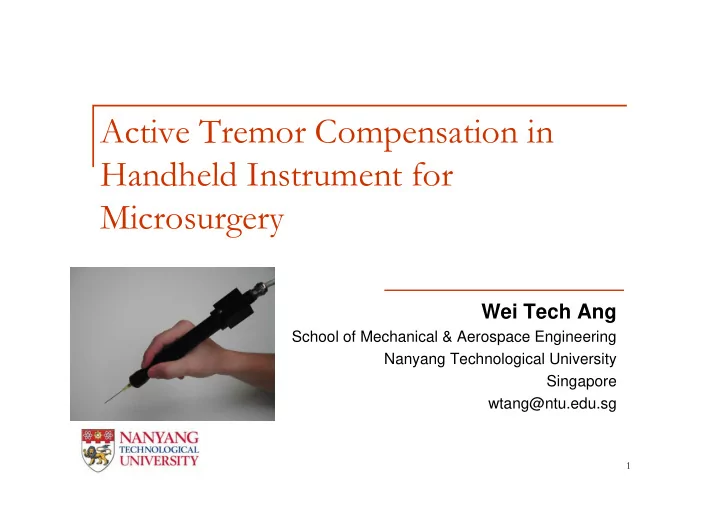
Active Tremor Compensation in Handheld Instrument for Microsurgery
Wei Tech Ang
School of Mechanical & Aerospace Engineering Nanyang Technological University Singapore wtang@ntu.edu.sg
Active Tremor Compensation in Handheld Instrument for Microsurgery - - PowerPoint PPT Presentation
Active Tremor Compensation in Handheld Instrument for Microsurgery Wei Tech Ang School of Mechanical & Aerospace Engineering Nanyang Technological University Singapore wtang@ntu.edu.sg 1 Contributors Cameron N. Riviere Wei Tech
1
School of Mechanical & Aerospace Engineering Nanyang Technological University Singapore wtang@ntu.edu.sg
2
Cameron N. Riviere
Associate Research Professor
David Y. Choi
Ph.D. Student
Si Yi Khoo
Research Engineer Medical Robotics Technology Center The Robotics Institute Carnegie Mellon University Pittsburgh, PA, USA
Wei Tech Ang
Assistant Professor
Mounir Krichane
Exchange Student (EPFL) Robotics Research Centre &
Nanyang Technological University Singapore
3
Visuomotor Control System
Noisy, Tremulous Motion Motion Sensing
Visual Feedback Micron
Vitreoretinal Microsurgery Estimation of erroneous motion Tip manipulation for active error compensation Task Definition Problem Analysis Engineering Solutions Technical Details
4
Removal of
5
Injection of anticoagulant using intraocular
6
Tremor: under microscope
7
8
Complicate microsurgical procedures and makes certain
Impact on microsurgeons
2 of 10 surgeons become microsurgeons
Factors affecting tremor
Fatigue – strenuous exercise etc. Caffeine/alcohol consumption Lack of practice – long vacation etc. Age – experience vs hand stability
Microsurgeons’ consensus:
10 µm positioning accuracy
9
Physiological Tremor
Roughly sinusoidal motion,
8-12 Hz
≤ 50 µm rms in each
principal axis
Non-tremulous Errors
Myoclonic jerk, drift etc. Aperiodic, may be in the
same frequency band as voluntary motion
Larger amplitude: > 100
µm
10
Visuomotor Control System
Noisy, Tremulous Motion Motion Sensing
Visual Feedback Micron
Vitreoretinal Microsurgery Estimation of erroneous motion Manipulation of tip for active error compensation
11
Telerobotic systems:
Master-Slave
Erroneous motion
12
‘Steady-hand’ robot:
Surgeon and compliant
robot hold tool simultaneously
Force feedback ‘Third hand’ operation
Erroneous motion damped
13
Active Handheld
Same concept
14
Telerobotics ‘Steady Hand’ robot Active Handheld
Cheap Unobtrusive Safer Limited workspace No motion scaling No ‘third hand’
15
Length: 180 mm long Diameter: Ø20(16) mm Weight <100 g 9 DOF inertial and
3 DOF piezoelectric driven
180 mm (w/ o needle) Ø20 mm Ø16 mm Manipulator System Sensing System Disposable surgical needle
16
Motion of instrument Magnetometer- aided all- accelerometer IMU ADC Sensor fusion Estimation of erroneous motion Erroneous tip displacement
WDtremor(3×1)
Inverse kinematics
Joint variables λ1, λ2, λ3
DAC Power Amplifier Piezoelectric
parallel manipulator
V1, V 2, V 3
Motion of instrument tip
WDvoluntary (3×1)
Host PC Inverse feedforward controller
BA(6×1), BM(3×1)
Forward kinematics
WDB(3×1), WΘB(3×1) WDtip(3×1)
Sensing Filtering Manipulation
17
Visuomotor Control System
Noisy, Tremulous Motion Motion Sensing
Visual Feedback Micron
Vitreoretinal Microsurgery Estimation of erroneous motion Manipulation of tip for active error compensation
18
Magnetometer-aided all-
3 dual-axis miniature
Three-axis magnetometer
Housed in 2 locations
Back Sensor Suite Sensing direction Front Sensor Suite ZB XB YB Dual-axis accelerometer Dual-axis accelerometers Tri-axial Magnetometer Manipulator System
19
Internally referenced sensors because:
Less obtrusive
Resolution:
All accelerometers because:
Low cost, miniature gyros too noisy
Navigation/tactical grade gyros - too expensive and bulky
20
Body acceleration sensed by
Differential Sensing
Accelerati induced Rotation −
Bi Bi CG i
Xw P23 P13 P12 P3 P2 P1 Yw Zw {W} {B} {2} {3} {1} Y2 Z2
⎥ ⎥ ⎥ ⎦ ⎤ ⎢ ⎢ ⎢ ⎣ ⎡
⎥ ⎥ ⎥ ⎦ ⎤ ⎢ ⎢ ⎢ ⎣ ⎡
⎥ ⎥ ⎥ ⎦ ⎤ ⎢ ⎢ ⎢ ⎣ ⎡
= × Ω + × Ω × Ω = − =
z y x ij i j ij
a A a A a A j i P A A A
12 12 23 23 13 13
, , 3 2, 1, , , ] [ ] ][ [
Acceleration Tangential Acceleration Measurement
21
3 unknowns:
Solve system of nonlinear
Numerical instability
Assume Ω2 ≈ 0, solve for
P23 P13 P12 P3 P2 P1 Yw Zw {W} {B} {2} {3} {1} Y2 Z2
22
BA – Wg
× × ×
3 1 1 3 3 3 T
2 3 2 2 2 1 2 1 3 2 2 3 1 1 3 2 2 3 2 2 2 1 2 3 2 1 2 3 1 3 2 1 2 3 2 2 2 1 2
W
tip B B B W t T t E W tip W tip W
−
23
Sensing resolution dependent
Angular Sensing
Sensing equation:
Covariance:
Pij σAx
2
σAy
2
σAy
2
σAx
2
σωx
2 or σωy 2
Back sensor suite Front sensor suite
24
All-accelerometer IMU
Maximized Pij, with physical constraint of a slender handheld
Conventional IMU (3A-3G)
Tokin CG-L43D rate gyros x 3
96.9% / 32x 4.42 × 10-2 1.41 ωz 99.3% / 130x 1.08 × 10-2 1.41 ωx & ωy
Noise reduction / resolution improvement
6A
Error std. dev. (deg/s)
3G-3A
Error std. dev. (deg/s)
25
Small angular velocity
50 100 150 200 250 300 350 400 450 500
2 4 6 8 50 100 150 200 250 300 350 400 450 500
2 4 6 8 50 100 150 200 250 300 350 400 450 500
2 4 6 8
ωz (deg/s) ωx, ωy (deg/s) ωG (deg/s)
Time (ms) Time (ms)
Tokin Gyroscope All-accelerometer IMU
26
Translational Sensing
2 accelerometers in each sensing direction: Sensing resolution improves by a factor of 2½
Better orientation estimation → more complete
2 2 2 Ai A Aj Ai A
27
Visuomotor Control System
Noisy, Tremulous Motion Motion Sensing
Visual Feedback Micron
Vitreoretinal Microsurgery Estimation of erroneous motion Manipulation of tip for active error compensation
28
Integration drift
Erroneous DC Offset
Error accumulates and
Poor sensing accuracy ∫ ∫
0.2 0.4 0.6 0.8 1
0.5 1 Acceleration (mm/s2) 0.2 0.4 0.6 0.8 1 0.02 0.04 0.06 Velocity (mm/s) 0.2 0.4 0.6 0.8 1 0.01 0.02 0.03 Time (s) Displacement (mm)
Mean = 0.05 mm/s2
29
Measurement model allows error analysis and
Measurement Model = Physical (Deterministic)
30
Calibration
Record accelerometer outputs at
Linear model
Acceleration,
Scale factor,
Bias
β = 0° +90° 180° 90° α = 180°
0°
0°
β α y x
g
31
0.5 1 1.5 2 2.5 3 3.5 Acceleration (g) Accelerometer Output (V)
A B + + − − CW: A+ → B- CCW: B+ → A-
g
0.5 1 1.5 2 2.5 3 3.5 Acceleration (g) Accelerometer Output (V)
α±150 α±90
g
α = 90°, β = -180° to 180° α±30 α = 30° & 150°, β = -180° to 180°
32
Bias, Bx(Vy, Vz) = Bx+gx(Vy)+hx(Vz) Scale Factor,
2 + rx1Vz + rx0 Model
0.5 1 1.06 1.07 1.08 1.09 1.1 1.11 z-Acceleration (g) Scale Factor (V/g) 1.5 2 2.5 3 3.5 4
0.01 0.02 0.03 0.04 y-Accelerometer Output, Vy (V) Residue Rxy (V)
0.5 1
5 10 15 x 10
z-Acceleration (g) Residue Rxz (V)
gx(Vy) = px2Vy
2 + px1Vy + px0
hx(Vz) = qx2Vz
2 + qx1Vz + qx0
SFx(Vz) = rx2Vz
2 + rx1Vz + rx0
In plane cross
xis effect Out of plane cross
xis effect Scale Factor
33
Motion generator
10 Hz, 50 µm p-p sinusoid
Displacement Sensor
Infrared interferometer
Sub-micrometer accuracy
Rotary Stages Accelerometer Displacement Sensor Motion Generator Motion
34
0.2 0.4 0.6 0.8 1
100 200 Time (s) Acceleration (mm/s2)
0.2 0.4 0.6 0.8 1
50 100 150 200 Time (s) Acceleration (mm/s2)
Error Reduction (%) <1 <5 31* Proposed Physical Model 6 272 300 Linear Model Scale Factor (mm/s2) Bias (mm/s2) Rmse (mm/s2) Linear Model Proposed Physical Model * ADXL-203 rated rms noise = 22.1 mm/ s2 Interferometer Accelerometer
35
Random noise analysis
Dominant accelerometer
Velocity random walk
acceleration
Acceleration random walk
Trend / Bias Instability
10
10 10
2
10
4
10 10
1
10
2
Velocity random walk Acceleration random walk τ (s) σ(τ)(m/s/s) Trend / Bias Instability
36
Time varying zero bias
Heating up of internal
Steady state: 2-12 hours
Solutions:
Modeling Wait for steady state Ovenization
power resistor
2 4 6 8 10 12 2.64 2.645 2.65 B ias (V ) 2 4 6 8 10 12 1.075 1.08 1.085 1.09 1.095 Time (hr) S cale Factor (V/g)
Steady State
37
Motion Bias +
_
Scale Factor Local Gravity Misalign- ment Correction Location & Orientation Error Magnetic North Augmented State Kalman Filtering Acc. Trend Acceleration Random Walk 1/ s Velocity Random Walk + +
Acc. Mag.
White Noise 1/ s White Noise + + Physical Model + Norma- lization Misalign- ment Correction Bias Orientation Error Q-based Kalman Filtering Kinematics Tool tip displacement
_
Numerical Transform- ation Error
38 2 4 6 8 10
50 100
[ ] [ ] [ ] [ ] [ ] [ ] [ ] [ ] [ ] [ ]
[ ] [ ] [ ]
[ ] [ 2 ] [ 1 1 1 1 2 1 1 ] 1 [ 1 1 1 1 1
2 2 1 2
k w k k k k c T kT c T c k x k b k b k a k a k u A T T T T k x k b k b k a k a k u
arw vrw a u a u
⎥ ⎥ ⎥ ⎥ ⎥ ⎥ ⎦ ⎤ ⎢ ⎢ ⎢ ⎢ ⎢ ⎢ ⎣ ⎡ + ⎥ ⎥ ⎥ ⎥ ⎥ ⎥ ⎦ ⎤ ⎢ ⎢ ⎢ ⎢ ⎢ ⎢ ⎣ ⎡ + + + ⎥ ⎥ ⎥ ⎥ ⎥ ⎥ ⎦ ⎤ ⎢ ⎢ ⎢ ⎢ ⎢ ⎢ ⎣ ⎡ ⎥ ⎥ ⎥ ⎥ ⎥ ⎥ ⎥ ⎦ ⎤ ⎢ ⎢ ⎢ ⎢ ⎢ ⎢ ⎢ ⎣ ⎡ = + ⎥ ⎥ ⎥ ⎥ ⎥ ⎥ ⎦ ⎤ ⎢ ⎢ ⎢ ⎢ ⎢ ⎢ ⎣ ⎡ + + + + + β ξ ξ
Velocity Random Walk Acceleration Random Walk
Quadratic Model
⎪ ⎩ ⎪ ⎨ ⎧ x ˆ ⎩ ⎨ ⎧ b ˆ
State Transition Matrix Velocity (mm/s2) Time (s)
KF ASKF
39
Source 1: Differential sensing kinematics
ΩA[k] from differential acceleration State transition matrix: Dynamic state equation: qA[k + 1] = F[k]qA[k] + γ[k] Orientation defined by quaternion
+ : high resolution
) 4 4 ( ) 4 4 (
] [ ~ 2 ] [ sin ] [ 1 2 ] [ cos ] [
× ×
+ = k Θ k k Ω I k k F θ θ
T k T k k
T A A A A
⎥ ⎦ ⎤ ⎢ ⎣ ⎡ Ω − Ω × Ω = Θ Ω = θ
× × ×
] [ 2 1 ] [ ~ ; ] [ ] [
3 1 1 3 3 3
40
Source 2: TRIAD
Gravity vector & Magnetic North vector are non-
TRIAD algorithm:
+ : non-drifting
zw yw xw Nw gw
41
Source 1: ΩA
High resolution, drifting
Source 2: NB + gB
Noisy, non-drifting
Quaternion-based KF: Q-KF
Reduced noise, non-drifting
200 400 600 800 1000 1200 0.05 0.1 0.15 0.2 0.25 0.3 0.35 0.4 200 400 600 800 1000 1200 0.05 0.1 0.15 0.2 0.25 0.3 0.35 0.4
ΩA
200 400 600 800 1000 1200 0.05 0.1 0.15 0.2 0.25 0.3 0.35 0.4
Time(ms) Time(ms) Normalized Gravity Normalized Gravity Normalized Gravity
NB + gB Q-KF
42
43
No non-drifting reference
Poor translational sensing accuracy
Not important if tremor is separable from drift and intended
500 1000 1500 2000
10 20 500 1000 1500 2000
10 20 30 40
500 1000 1500 2000
10 20 30 40
Tremor Filtering
Sensed motion Intended+ Drift Tremor
44
Visuomotor Control System
Noisy, Tremulous Motion Motion Sensing
Visual Feedback MICRON
Vitreoretinal Microsurgery Estimation of erroneous motion Manipulation of tip for active error compensation
45
Physiological tremor has a distinct frequency
Voluntary motion: ≤ 1 Hz; Electrical noise: >> 12 Hz
Classical frequency selective bandpass / band-stop
Phase lag ≡ Group (time) delay Filtered signal is a time delayed version of the actual
Unacceptable condition for real-time error canceling
46
Separation of tremor from the intended
Prediction/projection capability Adaptive
Non-linear phase response of IIR filter, i.e. phase
Two proposed algorithms
Weighted-frequency Fourier Linear Combiner
Adaptive Phase Compensating Band-pass Filter
47
Truncated Fourier series to adaptively estimate amplitude
48
Extends FLC to also adaptively estimate the frequency
Band-pass filter to select the band of interest
Assumption: rate of change of the dominant input signal
frequency is slow
Zero-phase notch
Signal input
ω0
Tremor Bandpass Filter
49
50
1 DOF motion
Stability problem
Double adaptive
51
0.1 0.2 0.3 0.4 0.5 0.6 0.7 0.8 0.9 1
0.2 0.4 0.6 0.8 1
Low-pass filters create phase lag High-pass filters create phase lead
0.1 0.2 0.3 0.4 0.5 0.6 0.7 0.8 0.9 1
0.2 0.4 0.6 0.8 1
Time
Input Output
Low-pass Filter High-pass Filter
Time
52
The idea:
To design a cascaded low-pass and high-pass filters
WFLC to estimate
Motivation
Most sensors come
53
Design LP-HP filter pairs
Filter design frequency
Filter type: Elliptical 2nd
Roots of transfer function
LP HP Roots of Filter Transfer Functions × - Poles ο - Zeros
7 Hz 7 Hz 3 Hz 3 Hz 5.67 Hz 5.67 Hz
54
55
Motion generator
Camcorder recording a
25 frames per second
Image post processing
Motion generator
56
Rmse:
Error reduction:
Original Compensated
57
Visuomotor Control System
Noisy, Tremulous Motion Motion Sensing
Visual Feedback MICRON
Vitreoretinal Microsurgery Estimation of erroneous motion Manipulation of tip for active error compensation
58
+ :
High bandwidth Fast response High output force
– :
Hysteresis
~15% of max. displacement
20 40 60 80 100 2 4 6 8 10 12 14
Voltage (V) Displacement (µm)
59
20 40 60 80 100 10 20 30 40 50 60 70 80 90
0.2 0.4 0.6 0.8 1
20 40 60 80 100
Time (s) Displacement (µm) Measured Desired Displacement (µm) Voltage (V)
60
hysteretic behavior of a piezoelectric actuator
2 4 6 8 10 12 14 20 40 60 80 100 20 40 60 80 100 2 4 6 8 10 12 14 2 4 6 8 10 12 14 2 4 6 8 10 12 14
Feedforward controller Piezoelectric
Desired Displacement (µm) Actuator Response (µm) Voltage (V)
Displacement (µm)
Displacement (µm)
Voltage (V)
Voltage (V)
Actuator Response (µm)
Displacement (µm)
Displacement (µm)
Desired Displacement (µm)
61
Rate independent backlash operator:
Linearly weighted superposition of backlash operators:
r1
y x wh1 ri y x Whi = Σwhi
0 t
r T h
62
) ]( [ ) ( ), ( , , ) ( max ) ]( [ t y S w t z d t y d d t y t y S
d T s d
= ⎩ ⎨ ⎧ = > − =
PI model Real Hysteresis
di z y d0 d1
=
=
i j sj si
w W
z y d >0 ws d =0
63
r T h d T s
x(t) z(t)
time time Backlash operators Saturation operators
64
Hysteresis Model Inverse Model
65
, , , 1
, ,
d T s r T h
1 −
time time
) ( ˆ t z ) (t x
Inverse saturation
Inverse Backlash
66
Basic assumption of
Hysteresis is rate
independent
Our observation:
Hysteresis is rate
dependent
Tremor frequency is time
8-12 Hz
25 Hz 15 Hz 5 Hz
67
Assume saturation is rate
Sum of the backlash
200 400 600 800 1000 1200
0.2 0.4 0.6 0.8 1
Whi
Actuation rate (µm/s)
i hi hi
68
Rate dependent model: Also a PI type → Inverse exists Rate dependent inverse model
r T h d T s
, , )) ( ( , 1
,
d T s t x r T h
−
69
Measured Desired
0.05 0.1 0.15 0.2
2 4 6 8 10 12 14
Displacement (µm)
Error
Rate
Time (s)
0.05 0.1 0.15 0.2
2 4 6 8 10 12 14 Error
Rate
Time (s) Displacement (µm)
0.05 0.1 0.15 0.2
2 4 6 8 10 12 14
Time (s) Displacement (µm) Without Model
stationary sinusoids
70
0.05 0.1 0.15 0.2
2 4 6 8 10 12 14
Tracking multiple frequency
0.05 0.1 0.15 0.2
2 4 6 8 10 12 14
Time (s)
Displacement (µm)
Error Error
Measured Desired Without model. Rate
0.05 0.1 0.15 0.2
2 4 6 8 10 12 14
Displacement (µm)
Time (s)
Error
Displacement (µm) Rate
ependent.
71
(%) amplitude p
rmse (%) amplitude p
error max
rms noise of interferometer = 0.01 µm
72
Tracking recordings of real tremor using 1 piezoelectric stack
Rmse = 0.64% of max ampl.; Max error = 2.4% of max ampl.
0.2 0.4 0.6 0.8 2
2 4 6 8 10 12 14 Desired Obtained Error 0.2 0.4 0.6 0.8 1
2 4 6 8 10 12 14 Desired Obtained Error
Without Model Rate-Dependent Controller
Time (s) Time (s) Displacement (µm) Displacement (µm)
73
Visuomotor Control System
Noisy, Tremulous Motion Motion Sensing
Visual Feedback MICRON
Vitreoretinal Microsurgery Estimation of erroneous motion Manipulation of tip for active error compensation
74
75
3 DOF piezoelectric-driven parallel manipulator
1 actuator per axis, max effective stroke = 12.5 µm Motion amplification = 9.4x, total stroke > 100 µm
Tool tip approximated as a point, hence only 3 DOF
Parallel manipulator design because
Rigidity, compactness, and design simplicity
Located at the front end to balance the weight of the
76
IEEE EMBS 2005
David Choi et al.
Monolith design using
∅22 x 58 mm
77
Inverse kinematics
Modeled as Lee &
Closed-form
No internal
78
Xmax, Ymax = 650 µm Zmax = 100 µm Tremor Space = ∅ 50 µm
Tremor Space Manipulator Workspace
79
Tracking planar circle
Mean tracking rmse ~
80
Visuomotor Control System
Noisy, Tremulous Motion Motion Sensing
Visual Feedback Micron
Vitreoretinal Microsurgery Estimation of erroneous motion Manipulation of tip for active error compensation
81
91 µm p-p
8.8 9 9.2 9.4 9.6 9.8 10
10 20 30 40 Tip Displacement in Z time (seconds) Displacement (microns)
5 10 15 20 25 5000 10000 15000 Frequency Response without Compensation Magnitude 5 10 15 20 25 5000 10000 15000 Frequency Response with Compensation Frequency (Hz) Magnitude
82
83
Total range: 52% reduction RMS amplitude: 47% reduction
1 2 3
30 60
time (s) displacement (µm) compensated uncompensated
84
Surgery and Diagnostics
Beating heart, breathing, etc. Pathological tremor due to Parkinson’s diseases,
Military optical tracking devices
Handheld, vehicle & ship mounted
Consumer camera/camcorder
85
86