Achievements to Date-focus groups Question Set A: Health issues 1. - - PowerPoint PPT Presentation

achievements to date focus groups
SMART_READER_LITE
LIVE PREVIEW

Achievements to Date-focus groups Question Set A: Health issues 1. - - PowerPoint PPT Presentation

Achievements to Date-focus groups Question Set A: Health issues 1. What are the top 3 major health issues affecting people who are aging with HIV? Question Set B: Resiliencies 1. What are some of the resiliencies that allow people to age


slide-1
SLIDE 1

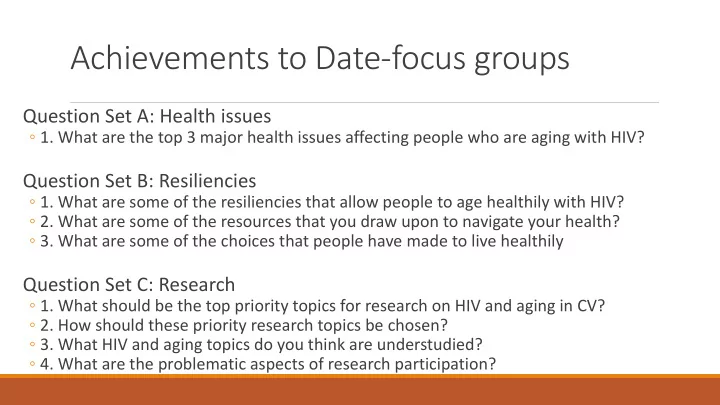
Achievements to Date-focus groups

Question Set A: Health issues

  • 1. What are the top 3 major health issues affecting people who are aging with HIV?

Question Set B: Resiliencies

  • 1. What are some of the resiliencies that allow people to age healthily with HIV?
  • 2. What are some of the resources that you draw upon to navigate your health?
  • 3. What are some of the choices that people have made to live healthily

Question Set C: Research

  • 1. What should be the top priority topics for research on HIV and aging in CV?
  • 2. How should these priority research topics be chosen?
  • 3. What HIV and aging topics do you think are understudied?
  • 4. What are the problematic aspects of research participation?
slide-2
SLIDE 2

Focus groups-Top hits by all stakeholders

Question Set Topics Health issues • Cognitive function, dementia, memory loss

  • Depression and isolation
  • Financial strain

Resiliencies

  • Exercise/gym
  • Socializing/having friends
  • Support groups (online and in person)
  • CBO services (DAP, The Center)

Research Priorities

  • HIV and co-morbidities
  • HIV and neurological function (memory loss,neuropathy)
slide-3
SLIDE 3

Stakeholder quotes-health issues

Cognitive function: It might just be fear of loss of cognitive memory, too. I mean, people are very, very touchy of—well, my partner is very touchy if like, I bring up that he doesn’t remember something

  • caregiver-7 (76 year old White male)

I think that my caregiver’s standpoint, I would like to see research on, like, the memory and medication compliance. Or even people who are starting to have more medical issues, what their medical complaints feelings are. Like, you’ve gotten to be 75 or 80, your memory issues are there—how compliant are you with you medication or--? Are you just choosing to maybe skip days ‘cause you think it will help you with your med— you know. Taking your own, uh—you’re Googling yourself thinking, “Oh if I take my medication half of the time”—which I run into a lot. Not where—with my clients where they’re like, “Oh, I’ll just cut back and I’ll feel better then.” Which, without speaking with your provider, is probably not a great idea

  • caregiver-9 (39 year old White male)
slide-4
SLIDE 4

Stakeholder quotes-health issues

Competent care:

There’s a lot of, ill feeling—if you will—folks, often put off or avoid health care altogether because, they don’t feel comfortable in the presence of doctors or nurses and support people. Um, you hear about things like misgendering, just outright rudeness, asking inappropriate

  • questions. And if people don’t feel comfortable they won’t go back or they’ll get to a point where

their situation is really desperate before they seek health care

  • CBO-6 (69 year old Black transgender person)

I think maybe stigma. I mean we live in Palm Springs and there’s a large gay population, sometimes I have clients who come from Riverside and farther out and it’s like a whole different world for them. They’re not accepted and they’re very very cautious about letting anybody know their status because of the stigma and I wonder about, you know, how that would be for somebody who lives in other states, you know, middle America, you know, that’s gotta be really difficult, especially if they’re older and are a long-term survivor if you’re going to an assisted living home, even going to medical facilities, I don’t know if they have access to all of that, and how are they treated, you know?

  • CBO-1 (38 year old Hispanic female)
slide-5
SLIDE 5

Stakeholder quotes-health issues

Depression:

So I go over to his condo and he’s on the bedroom floor, and he hadn’t eaten in 3 or 4 days, he couldn’t even get off the floor. Uh, we ended up having to call an ambulance and then transport him to the hospital. And then, he was a retired nurse and, he didn’t want to finish his test and I finally took him home. And then, uh, for two weeks I got him, the uh, like Pediacare, uh, for his electrolytes and Ensure so he could eat. But this really, this kind of issue bothers me because, at the pos life series—that it would be nice to have a support group here that looks in on people that are isolated. And he’s doing better now, I still check on him every once in a while—he has two sons—they don’t care about him—and he just got depressed and stopped eating

  • Patient1-4 (61 year old White male)

And my good friend died two years ago, and he didn’t take them because he was depressed. He died of AIDS. Um, he was diagnosed when he was 18 and there was no mental—easy, available mental health in his state—he was in San Diego, not up here. And, he couldn’t comply with the medications, or even doctor follow-ups, he was so depressed. And I know I’ve had a few dips of depression, and I have been compliant with my meds, but it’s difficult

  • Patient1-7 (72 year old White male)
slide-6
SLIDE 6

Stakeholder quotes-resiliencies

Education, HIV and health

Well a lot of our subjects are very well read when it comes down to HIV, so they actually do know that they tend to age like 10 years faster than a person that’s HIV-negative. So going to his point, a lot of them are also wondering, ‘At what point should I do a bone density test?’ since we know that osteoporosis is one of the problems that, um, HIV-positive men face a lot A lot of them are very proud. They want to cooperate when they know about clinical research— they’re calling us, they want to be part of it, what can they do. So they’re very, very proud

  • Provider/academic-2 (39 year old Hispanic male)
slide-7
SLIDE 7

Stakeholder quotes-resiliencies

Good medical care

What engenders in the community is that—are the places that you go to not feel that stigmatization or some feeling or, you know, something is wrong with you. It’s this welcoming feeling that makes you want to do things or makes you feel more comfortable in those places. And that’s a good thing. And, um, a lot of places that I’ve been to—you know—some places were really bad, some places were really good. Here in Palm Springs area, I’ve found that it’s been really good. I’m feel very glad that I, um, was fortunate to be in LKA and gone to Borrego to their Stonewall Clinic. And all of it was good. So I felt very comfortable being there. But it would have been something else if—I went to another doctor, which I’m not gonna say, and she was not great at all. I felt, like, stigmatized, I felt really bad about myself. I felt dirty, and they made me feel that way. So, there was a big difference in how they treated people and that made a difference in how I felt about myself

  • caregiver-5 (57 year old Hispanic male)
slide-8
SLIDE 8

Stakeholder quotes-resiliencies

Support Groups

So there’s like different people who are isolated and separated and lonely and don’t feel community support, and then there are people who are not like that having another experience who benefit from the Desert AIDS Project, the LGBT center, having many peers who have survived with or without HIV, so those social networks are absolutely resiliencies. They rely on each other understand each other, they find support with each other, they’ve had common experiences that they’ve gotten to share. Um, we have a lot of spiritual organizations here in The Valley that people find support. There’s support groups that people get connected in. Those are all forms of resiliencies that exist in the community

  • CBO-8 (58 year old White male)

Well just thinking to piggyback more on that support like LKA and so forth is the ability to talk with other long-term survivors and sort of, um, trade tips—what works, what doesn’t work. Um, that test isn’t as scary as the doctor says, “take this for side effects”—that sort of in-house sharing, that um, that happens at events like LKA and so forth

  • caregiver-12 (55 year old White male)
slide-9
SLIDE 9

Stakeholder quotes-resiliencies

Having Pets

I just recently got a cat and it has really put me on a schedule. And a positive, more positive

  • feeling. I’m not as depressed as I was. She makes me laugh
  • Patient2-10 (54 year old White male)
  • Animals. I have a little dog. And I, you know, I never thought I’d like a dog that much but it’s

amazing how it does give you some sort of support. You know it also puts you on a routine which I think is important because of memory issues and you know—so it’s a good thing

  • Patient2-1 (69 year old Hispanic male)
slide-10
SLIDE 10

Stakeholder quotes-resiliencies

Exercise

  • Yes. So it’s good cardio—good cardio workout but it’s—you socialize. And you go to places like

that and usually people are very friendly, especially at a dance—the people are happy and— because there’s music. Mmm, I go to the gym every day. And I do a lot of stretching and weights and pretty much everything. And uh, I still play a little basketball, I do some hiking, and I travel a little bit

  • Patient2-2 (69 year old Hispanic male)

I have so many, I really do. I do hiking, like I said. Like I hike these mountains right here, well there’s a lot of hiking trials. I ride my bicycle. Um, like I said, I sing karaoke and I dance. Uh, I do every kind of dance you can think of. When I go to the senior center, a lot of people just sit there and listen to the music. They have a dance floor; I try to get everybody on the dance floor. And they do. I drag people up there and they have so much fun. I’m kind of like the instigator, I guess

  • Patient2-2 (69 year old Hispanic male)
slide-11
SLIDE 11

Stakeholder quotes-research priorities

Side effects of medication

I’d have to go with the long-term side effects of meds. Um, I think it’s important not for me, but those that are coming up behind me. That we—we were basically guinea pigs for this lovely disease all of our lives, and I hope that something can be, bound from what we went through. Also, I think a lot of medical professionals who don’t have to take the medications we do, don’t know what it’s like to take medications. You know, they can say, ‘well how does this feel?’ but if you’re not there, then you really don’t know

  • Patient1-5 (76 year old American Indian male)

Very important, and not just you know, uh, just because I’ve been on drugs for so long and a lot

  • f us have been on these drugs for, you know, a long time, and we are surviving, uh, but in the

end when, you know, what’s the price we’re gonna pay for, you know, living this long and taking these drugs and the effects they’re gonna have on parts of our bodies. I’m taking part in the San Diego neuro, uh, study of, um, for HIV [unintelligible]. They’re studying the types of HIV on, you know, it’s chronic and, uh, but, uh, just on the body in general and, uh, what’s happening

  • Patient1-8 (69 year old Native American male)
slide-12
SLIDE 12

Stakeholder quotes-research priorities

Socio-environmental I think looking at, um, within the clinical setting, um, asking questions around, uh, income and housing and social support. Um, these—and opening up those conversations with their primary care providers, um, is important. And I think, um, you now, I know there’s, you know, some nascent research out there looking at this kind of stuff, but not with this population specifically—I mean, maybe there is, but I haven’t seen it. And I think some, you know, looking around that. Um, yeah, you know, a lot like [5], I go back to a lot of the, um, social determinants of health. So, but we know that having those conversations with a provider, um, you know, not necessarily, uh, you know, um, for this population, but you know, provider prescribing, um, you know, uh, diabetes medication when the patient doesn’t have any place to put the diabetes medication. You know, kinds of problems. I think, you know, opening up some of those conversations or doing research, um, within, you know, the benefits of those sorts of conversations

  • Provider/academic-4 (48 year old White male)
slide-13
SLIDE 13

Stakeholder quotes-research priorities

HIV and mental health

Well many of the ones that we talked about but I’m most—what I’m most concerned about is when people don’t have individual—they can’t tap into their individual resiliencies—they don’t understand it and so perhaps therapy to help identify people’s resiliencies and bring it to their awareness but when people are already isolated, alone, depressed, anxious, don’t even know what these inner strengths are their experiences, and it has a very big impact on their wellbeing. So what those resiliency factors are that are most meaningful in this aging population with the stressors that they have whether they’re financial, medical, health, you know, social, but are those resiliency factors and how do we help, uh, engage more people?

  • CBO-8 (58 year old White male)
slide-14
SLIDE 14

Stakeholder quotes-research priorities

HIV and Inflamation

Yeah, I keep hearing about how inflammation, uh, affects, uh, the health of your, uh, arteries and veins in terms of building up a plaque and so forth, and how constant inflammation affects arthritis and diseases of the joints. Um, but we don’t hear a lot about, ‘what is it doing to people with HIV to have this twenty years or thirty years of constant inflammation?’ And you go to ask your doctor about it and he doesn’t have anything to pull on either. He can’t say, “Oh, well this is doing this to you,” or “This is doing that,” “This is why you’re feeling this way.” (12)I just—um, going back to the cardiology. I’m going through similar issues. I’m 54 years old, I’ve have friends who—I have one friend who is a former partner, 55, who has had 6 stents, who has been positive a lot shorter time than I have. Uh, and the inflammation came in with my cardiologist, he said, “This has very little to do with diet. It mostly has to do with the length of time that the virus has been in your body and the inflammation that your body has under, pressuring the veins that is causing high blood pressure.” So, so little is known and we’re on the forefront. And I think a major focus has to be memory and cardiology, it’s just, um, along with the inflammation. It’s kind of the overlying—(10)[regarding inflammation] And I recently read a study by an HIV-specialist who was talking about that very issue, about joints and joint pain and all these things, and the title of the article was ‘No, you’re not crazy.’ And when I brought it up with my doctor, she had never heard of it

  • caregiver-3 (63 year old Multi-racial male)
slide-15
SLIDE 15

Food for thought-barriers to research

Location—where they’re doing it—location. I don’t have a car anymore; I have to take a bus now

  • Patient2-9 (59 year old White male)

There is one thing I just thought of too. Sometimes when you’re in a study then you can’t—means you can’t be in the future in any other studies. On the other hand, some of them do permit you to be in other studies. I mean, that was consideration for me, to be in—I didn’t want to be in a study that would prevent me from participating in another study and/or going back to my old medicines if it would be necessary. I really am troubled by the fact that if you are wanting to be in a clinical trial, they usually have a cutoff of 75 age requirement. And I’m

  • 77. However I was taken into one recently—a clinical trial—about a year ago

and it’s been very successful and it’s really kind of changed my life, physically. So, that’s a big concern

  • Patient2-1 (69 year old Hispanic male)